UNIT 8.1 - Government policies to achieve efficient resource allocation and correct market failure
 Call Kai
 Learn
Learn Practice Test
 Spaced Repetition
 Match
Match Flashcards
 Knowt Play
1/101

There's no tags or description
Looks like no tags are added yet.
Name | Mastery | Learn | Test | Matching | Spaced | Call with Kai |
|---|
No analytics yet
Send a link to your students to track their progress
102 Terms
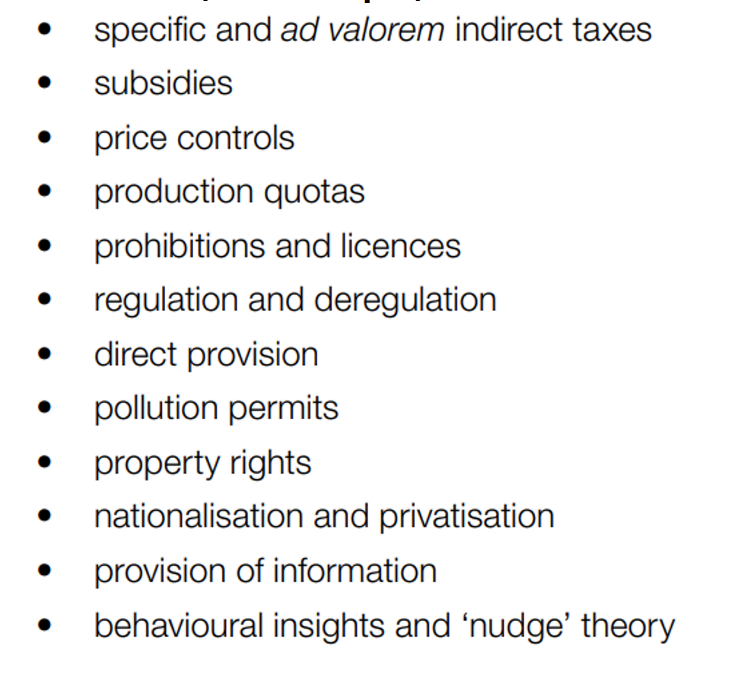
What are the 12 government intervention measures used to correct market failure due to externalities (from the spec)
What are negative production externalities
Negative production externalities occur when a firm’s production creates external costs for third parties that are not included in market prices, leading to market failure and overproduction.
What are examples of negative production externalities (3)
Examples include firms illegally dumping toxic waste and releasing harmful fumes, farmers over‑using pesticides that contaminate water supplies and damage health, and urban traffic congestion, where vehicle emissions increase air pollution and harm the health of people living and working in cities.
What are the 4 ways to correct negative consumption externalities
Specific & ad valorem indirect taxes 2. Regulations 3. Property rights 4. Pollution permits
How can indirect taxes be used to correct negative production externalities
The government can impose an indirect tax on firms or individuals responsible for the externality. - Ideally, this tax equals the marginal external cost (MEC) and is known as a Pigouvian tax. - It internalises the externality by making producers pay the full social cost of production.
What is a Pigouvian tax and what is its purpose
A Pigouvian tax is an indirect tax set equal to the marginal external cost of production. Its purpose is to internalise the externality, so firms take account of the costs imposed on third parties, reducing overproduction and correcting market failure.
How does an ad valorem pollution (green) tax affect costs and supply + diagram
An ad valorem tax is charged as a percentage of price. When imposed on output, it increases production costs as output rises. As a result, the MSC curve shifts upwards so that MSC = MPC + tax, leading to a higher market price and lower output.
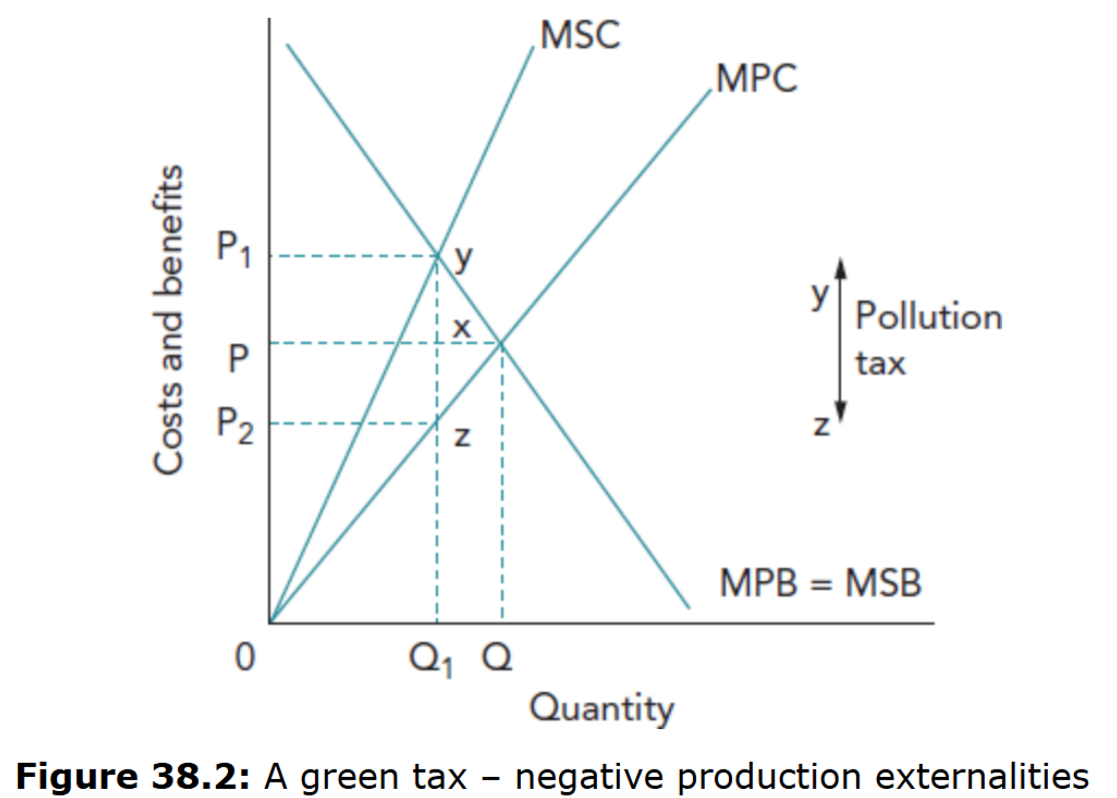
How is the burden of a green tax shared between consumers and producers + diagram
Although the tax is imposed on firms, the burden is shared. • Consumers pay a higher price (from P to P₁). • Producers receive a lower price (from P to P₂). The total tax revenue is the area P₂P₁yz, with consumers bearing PP₁yx and producers bearing P₂Pxz.
Why is estimating the correct size of a Pigouvian tax difficult
It is hard to place an accurate monetary value on external costs (e.g. clean air). If the tax is set below the MEC, market failure is only partially corrected; if set above the MEC, the outcome is inefficient. This estimation problem can lead to government failure.
How does price elasticity of demand affect the effectiveness of a green tax
If demand is price inelastic (e.g. diesel fuel), consumers will continue buying and bear most of the tax, so pollution may not fall much. If demand is price elastic, consumption is more likely to switch to less polluting alternatives, making the tax more effective.
What international competitiveness issues can arise from green taxes
High green taxes can raise production costs, making exports less competitive compared to goods produced in countries without such taxes. This may reduce exports and shift production abroad.
What are regulations
A wide range of legal and other restrictions that come from government or regulatory bodies.
How can regulations be used to correct negative production externalities + what may it include
Governments can introduce regulations to limit harmful activities that cause negative production externalities. - This may include setting legal standards on pollution levels and requiring firms to comply through inspection and enforcement.
How do regulations work in practice to reduce pollution
Governments may restrict the amount of polluted waste that firms can legally dump. Regulatory bodies inspect firms to ensure compliance, impose large fines if rules are broken, and in extreme cases may force firms to close if environmental damage continues.
What is deregulation and what is its purpose
Deregulation involves removing regulations that act as barriers to entry for new firms. Its purpose is to increase competition, improve efficiency, lower prices, and force inefficient or highly polluting firms out of the market.
How can deregulation indirectly reduce pollution
By encouraging competition, deregulation allows more efficient firms to enter the market. These firms often have lower costs and cleaner production methods, while inefficient and more polluting firms may be unable to compete and exit the industry.
What are property rights
Where owners have the right to decide how their assets may be used
How can property rights be used to correct negative production externalities
Clearly defined and enforceable property rights allow affected parties to negotiate (via bargaining) to internalise external costs, leading to a market-based solution. If property rights cannot be assigned (e.g. air or oceans), government intervention is needed instead.
Why does the absence of property rights lead to negative production externalities
Without property rights, firms can impose external costs on others without compensation. - By assigning or extending property rights, owners can prevent damage to their property or charge firms that impose costs, reducing market failure.
What happens if the polluting firm holds the property rights
Those affected by pollution may pay the firm to reduce output or emissions. In principle, the payment would equal the firm’s loss of profit. - However, bargaining may occur, often encouraged by the threat of future regulation by the government, until a mutually acceptable solution is reached.
What happens if those affected by pollution hold the property rights
Those affected can sue the polluting firm or demand compensation. In principle, compensation would equal the marginal external cost. - However, individuals may struggle against powerful firms; success is more likely if groups with shared property rights act together.
What are the limitations of using property rights to correct externalities
Property rights are difficult to establish for common resources like air and oceans. Bargaining power may be unequal, and legal action can be costly and complex, limiting the effectiveness of this approach.
What are pollution permits (tradable permits)
A form of licence given by governments that allows a firm to pollute up to a given level. - Permits can be bought and sold, making them a market‑based solution to negative production externalities. - Firms must hold enough permits to cover their emissions.
Why are pollution permits described as a ‘cap and trade’ system
Governments set a cap on total pollution by limiting the number of permits issued. Firms then trade permits in a market. Firms that reduce emissions can sell spare permits, while firms that pollute more must buy extra permits.
How do pollution permits create incentives to reduce pollution
Firms that cut emissions can sell unused permits, earning revenue. As permits become scarcer or more expensive, firms are encouraged to invest in cleaner technologies rather than buy permits.
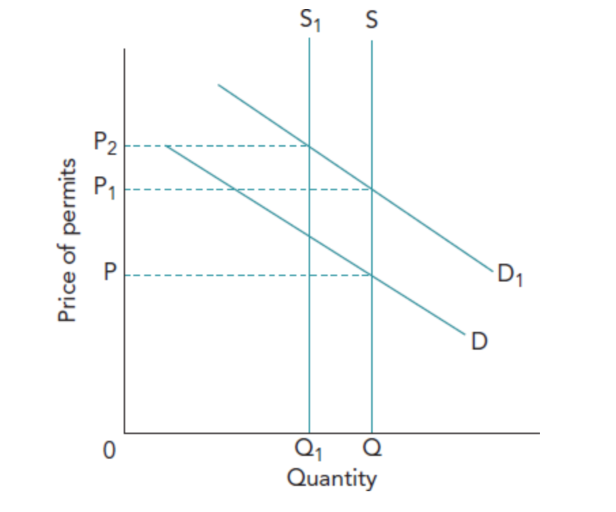
What happens when demand for permits increases (diagram)
If pollution rises, demand for permits increases, raising the permit price from P to P₁. Higher permit prices give firms an incentive to reduce emissions.
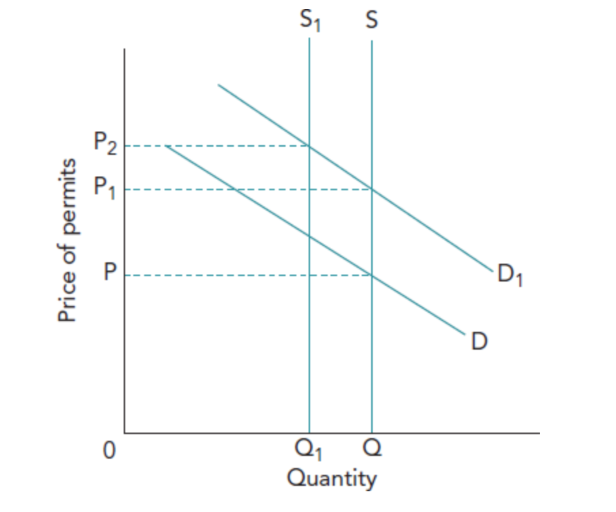
How does reducing the supply of permits affect the market (diagram)
Cutting supply shifts the permit supply curve left. Permit prices rise (e.g., to P₂), increasing financial pressure on firms to invest in cleaner technologies reducing total emissions.
What is a real‑world example of a pollution permit scheme
China’s Emissions Trading Scheme (ETS) is the world’s largest cap‑and‑trade system. It covers about 25% of China’s GDP and limits carbon emissions by setting regional caps and allowing firms to trade emission credits.
What is a common problem with pollution‑permit systems + how can this problem be solved
Oversupply of permits can lead to low prices, reducing the incentive for firms to cut emissions (as seen in the EU ETS during recessions). - The government can reduce the number of permits issued, increasing their price and strengthening incentives to reduce pollution and adopt cleaner technologies.
What is one disadvantage of pollution permits
It is difficult to set the correct pollution limit and monitor emissions.
What is a prohibition
A prohibition is a complete ban on the production or consumption of a good or service.
What is a licence
A licence is official permission required to produce or sell a good or service.
What is one disadvantage of prohibitions and licences
They may create black markets and involve high enforcement costs.
What are negative consumption externalities
They are spillover costs caused by the consumption of demerit goods, where consumption harms third parties who are not involved.
Why does a negative consumption externality occur
Because MSB is lower than MPB — consumers ignore the external cost their consumption imposes on others.
What are 3 examples of a negative consumption externality
Passive smoking - non‑smokers suffer health risks from inhaling smoke produced by smokers. 2. Aircraft noise - People living near airports experience disrupted lifestyles and stress from aircraft noise, even if they never fly. 3. Road congestion - As individuals use road space, less space is available for others, causing slower traffic, longer journey times, and higher fuel costs.
What are the 6 ways to correct negative consumption externalities
Specific indirect taxes
Price controls
Provision of information
Production quotas
Regulations
Prohibitions
What is the purpose of a specific indirect tax for negative consumption externalities
It is imposed on consumers of demerit goods to reduce consumption that harms third parties.
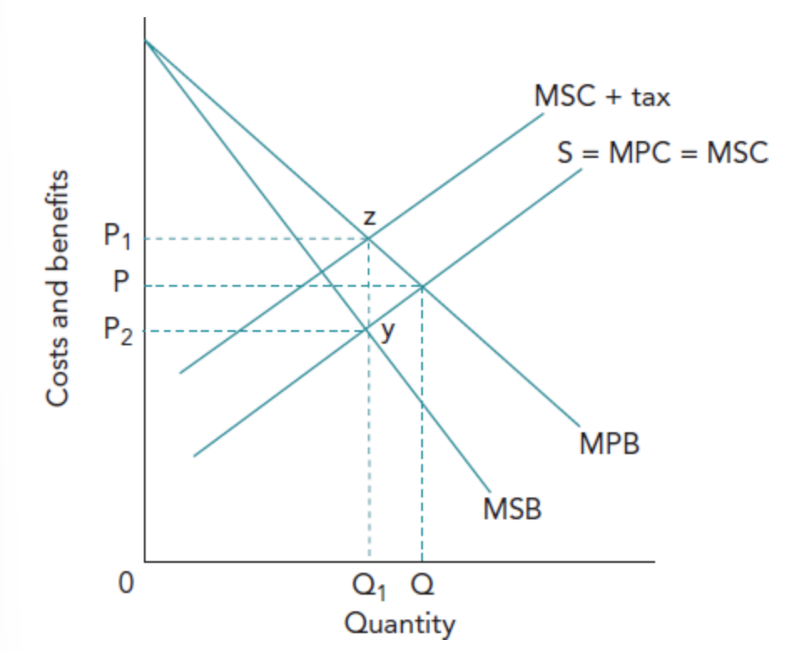
On a diagram show how a specific indirect tax correct the market failure (effects of an indirect tax - negative consumption externalities) - 3 bullet points
Market equilibrium is at P and Q, where MPB = MPC. The socially optimal quantity is Q₁, where MSB intersects MSC. - A tax equal to the external cost (yz in the diagram) is added to the cost of consumption. This shifts the supply curve left, raising the price to P₁ and reducing quantity to Q₁. - Consumption falls to the socially efficient level, and resources are allocated more efficiently.
What is the purpose of imposing a minimum price on demerit goods
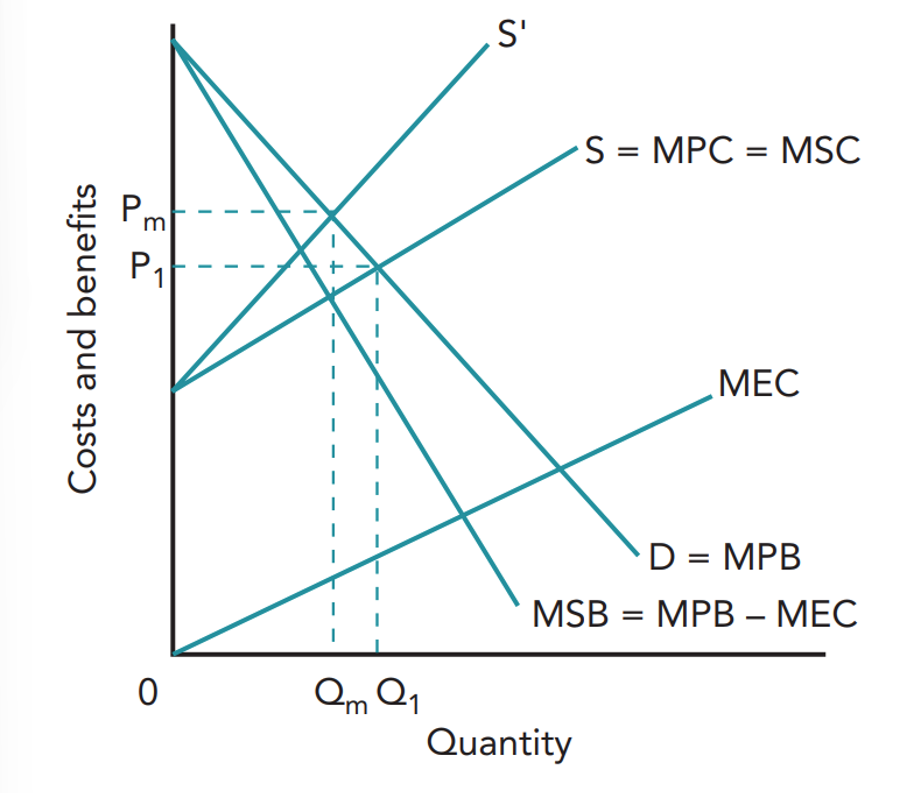
A minimum price raises the price of goods that create negative consumption externalities (e.g., energy drinks, tobacco), reducing consumption to where MPB = MSC.
Show the effects on the market when a minimum price is imposed on a product with negative consumption externalities. ( diagram + 3 bullet points)
- A minimum price set above equilibrium raises the price from P₁ to Pₘ, reducing quantity demanded from Q₁ to the socially efficient Qₘ.
- This helps correct overconsumption because consumers now face a higher price that reflects the external costs.
- However, it creates excess supply since firms are willing to supply more at the higher price.
What determines the effectiveness of a minimum price
Its success depends on the price elasticity of demand. Since demand for demerit goods is usually price inelastic, consumption may not fall significantly.
What is provision of information
Provision of information involves giving consumers accurate information to improve decision-making. - Governments directly provide information to correct market failure
What is the role of provision of information in reducing consumption of demerit goods
Information (e.g., warnings, photographs, nutritional labels, carbon footprint details) helps consumers make better decisions and reduces consumption by highlighting external costs.
What is one limitation of provision of information (1 A* evaluation sentence)
Consumers may ignore or misunderstand the information. Provision of information can be ineffective because consumers may ignore, misunderstand, or undervalue the warnings—especially when habits are addictive or behavioural biases are strong—meaning consumption may not fall despite higher awareness, leading to potential government failure.
How do regulations help reduce demerit‑good consumption
Regulations can set minimum age limits or restrict consumption in specific settings, reducing harmful demand.
What are production quotas
A production quota is a physical legal limit on the amount of a good that firms are allowed to produce. - Lower quotas raise prices and reduce consumption.
What is a problem associated with production quotas
Quotas can lead to informal (black) market dealing, as some consumers try to obtain the good illegally.
What is one disadvantage of production quotas (1 A* evaluation sentence)
Production quotas are often ineffective because they are costly to monitor and enforce, creating opportunities for black‑market production while also restricting entry and reducing competition, which can lead to higher prices and long‑run inefficiencies — a clear case of potential government failure.
What are positive production externalities
They occur when producers create spillover benefits for third parties, meaning the social benefit of production is greater than the private benefit to the firm.
What is one example of a positive production externality
Vaccines - Vaccines protect individuals who receive them and also reduce disease spread (herd immunity), benefiting the wider community.
What are the two ways to increase positive production externalities
Subsidies to increase supply/improve allocative efficiency 2. Provision of information to increase demand for products with positive production externalities
What is a subsidy
A subsidy is a payment by the government to producers or consumers to encourage production or consumption.
Why are subsidies used
Subsidies are used to encourage goods with positive externalities that are underconsumed in the free market.
How do subsidies correct market failure
They reduce costs of production, shift the supply curve rightwards and increase output towards the socially optimal level.
How can subsidies correct positive production externalities
A subsidy to producers from the government reduces their costs, shifting supply right and increasing output toward the socially efficient level.
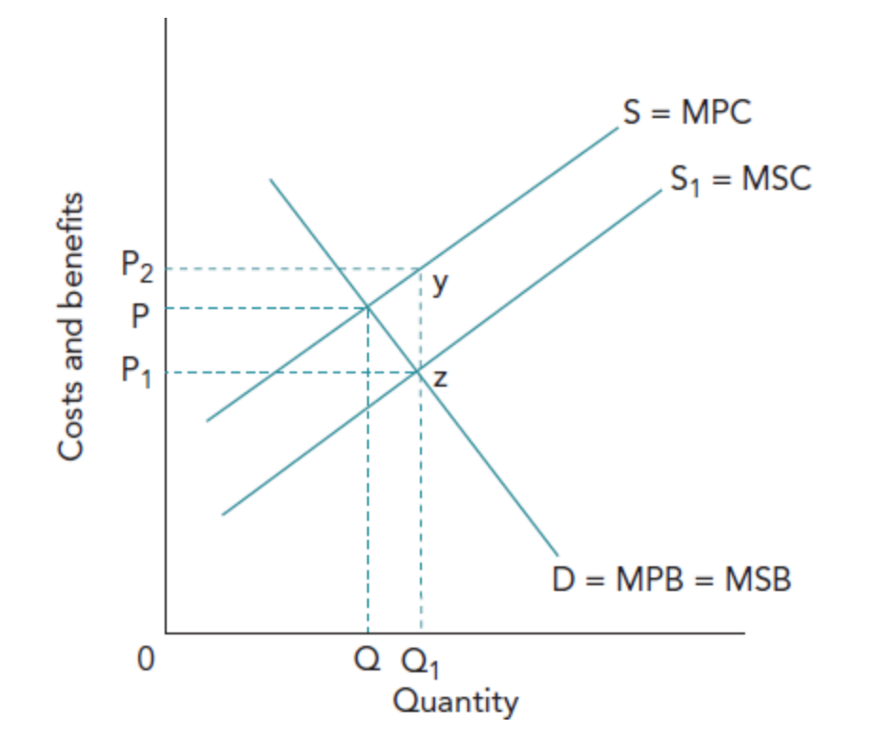
Show on a diagram the impact of a subsidy (positive production externalities) + explanation
The graph shows that when the government gives a subsidy equal to the external benefit, the supply curve shifts from S (MPC) to S₁ (MSC), reducing the price from P to P₁ and increasing output from Q to the socially efficient Q₁. The subsidy (area P₁P₂yz) encourages firms to produce more of a good that creates positive externalities, correcting underproduction and achieving allocative efficiency.
What does the subsidy do to price and quantity
It lowers the market price from P to P₁ and increases production from Q to Q₁, correcting under‑production.
How large should the subsidy be
It should be equal to the external benefit (shown as y–z on the diagram), aligning MSC with MPC.
How can subsidies increase demand for products with positive production externalities
If the good is sold on the market, lowering its price through a subsidy increases consumer demand.
How can provision of information support positive production externalities
Governments provide firms with data (e.g., costs, prices, export opportunities) that improve business decisions, raising demand for beneficial products.
How can information campaigns help consumers
Campaigns can educate the public on socially beneficial behaviours, such as recycling or disease prevention, increasing socially desirable consumption.
What is one advantage of subsidies (A* evaluation sentence)
Subsidies can be highly effective because they lower prices and boost consumption of socially beneficial goods, helping correct underproduction and improving long‑run welfare if well‑targeted.
What is one disadvantage of subsidies (A* evaluation sentence)
A major drawback is that subsidies impose a significant fiscal cost and may encourage overconsumption or misuse of government funds, creating the risk of government failure if poorly designed.
What is a positive consumption externality
It occurs when consuming a good creates additional benefits for third parties who are not directly involved.
What are 2 examples of a positive consumption externality
The provision of secondary education - Education benefits the individual and also creates a more productive workforce, boosting long‑term economic growth. 2. Subsidised rail travel - Government rail subsidies lower fares, benefiting travellers and reducing road congestion—creating wider social gains.
What are the two ways to increase positive consumption externalities
Direct provision 2. Subsidies
What is direct provision
Direct provision occurs when the government provides goods or services itself.
Why is direct provision used
It ensures access to essential services and corrects market failure from public goods and equity concerns.
How do subsidies correct positive consumption externalities
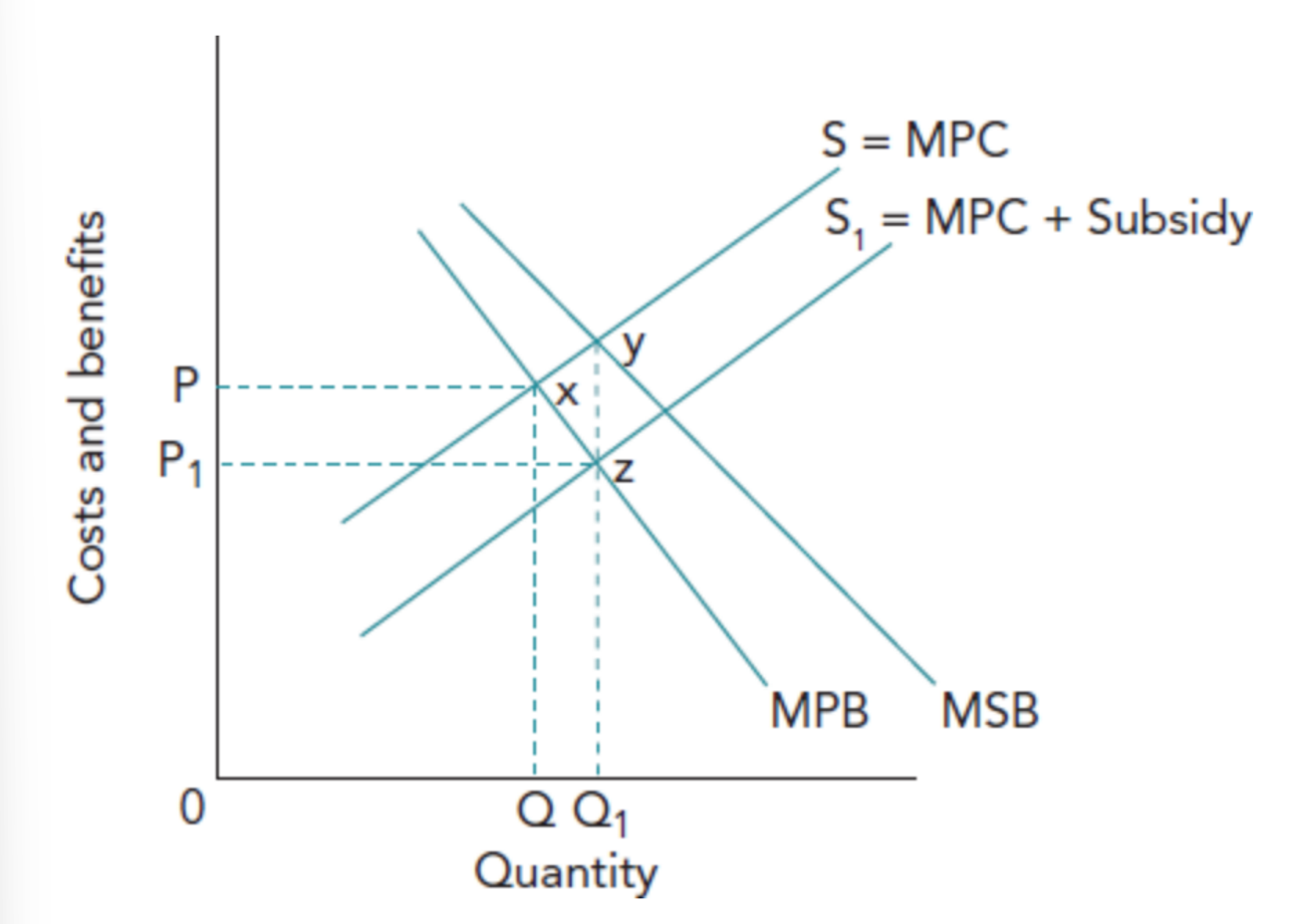
A subsidy shifts supply from S to S₁, lowering price from P to P₁ and increasing consumption from Q to the socially efficient Q₁.
Using a diagram explain the effects of a subsidy - positive consumption externalities
• The diagram shows that without intervention, the market produces quantity Q at price P, where MPB = MPC, but this is below the socially optimal Q₁ because MSB > MPB.
• A government subsidy shifts the supply curve from S (MPC) to S₁ (MPC + subsidy) by the vertical distance yz, reducing the price to P₁ and increasing consumption to Q₁.
• This lowers the marginal cost of supplying the good, encourages higher consumption of a product that generates positive spillover benefits, and moves the market toward allocative efficiency.
Why is a subsidy beneficial for consumers
It reduces the cost of buying goods that generate positive externalities, encouraging higher socially desirable consumption.
Other than direct provision and subsidies, how else can governments increase consumption of goods with positive externalities (3)
Governments can use legislation (e.g., compulsory education), provide information campaigns to promote beneficial behaviours, and offer grants or financial support—such as university grants or health‑promotion advice—to increase consumption of goods that create positive spillover benefits.
What is nudge theory
Influencing choice by 'nudging' individuals towards making more effective decisions - The idea that presenting choices in a clearer or more helpful way influences people to make better decisions without removing their freedom to choose.
How does nudge theory help correct market failure
It guides individuals toward socially beneficial behaviour (e.g., consuming merit goods, reducing negative externalities) without the need for strict regulation or bans.
Why is nudge theory considered less intrusive than regulation
It preserves individual choice because it changes how options are presented rather than forcing a specific outcome.
What are 2 examples of a nudges by government
Inoculation - Governments can send simple, personalised letters explaining the benefits and availability of vaccinations to encourage uptake, especially among older people. 2. Traffic congestion - Media campaigns promoting cycling, walking, or public transport can nudge motorists to switch to less polluting transport options.
Does nudge theory work
Nudge theory works, but only to a limited extent; it is most effective when used alongside other policies that directly address market failure.
What is direct provision of goods and services
It is when the government produces and supplies goods or services itself, often free or at subsidised prices, to correct market failure.
Why is direct provision necessary for public goods
Public goods are non‑excludable and non‑rival, so the market will not provide them; government provision is the only feasible solution.
Why do governments directly provide merit goods like healthcare and education (3)
Imperfect information - People may not realise the long‑term benefits of education or healthcare, leading to underconsumption unless the government provides or subsidises them. 2. Positive externalities - Merit goods generate spillover benefits (e.g., treating infectious diseases helps the whole community), so the socially optimal level is higher than what the market would provide. 3. Wider economic benefits - A healthier, better‑educated population increases human capital, boosting productivity and long‑run economic growth.
What is nationalisation
Nationalisation is when the government takes ownership of an industry or firm and transfers it to state ownership to correct market failure when the industry is not operating in the public interest.
Why might nationalisation be used for natural monopolies
In natural monopolies, having multiple firms leads to inefficiency and duplication of infrastructure, so public ownership can improve efficiency and reduce waste.
What positive externalities justify nationalising rail networks, for example
Railways create wider social benefits such as reduced road congestion, better access to employment, and improved mobility for people in rural areas.
What is a challenge faced by nationalised industries
Many nationalised industries are loss‑making and require government subsidies to maintain service levels.
What is one disadvantage of nationalisation
It may reduce efficiency due to lack of profit incentives.
What is privatisation
Privatisation is the transfer of ownership from the public sector to the private sector - usually to increase efficiency and competition.
Why do some economists support privatisation
They argue that private firms have stronger incentives to be efficient, accountable, and responsive to consumers, leading to lower costs and better allocation of resources.
What is a potential downside of privatisation
Privatisation can replace a public monopoly with a private monopoly, giving firms market power to raise prices and restrict output.
What is a perceived benefit of privatisation
It can reduce the financial burden on the government by removing the need to subsidise state‑owned industries.
Why is the impact of nationalisation and privatisation considered mixed
Both strategies can correct market failure in some cases, but global experience shows no consistent trend favouring one approach over the other.
What is government failure
Government failure occurs when government intervention leads to a more inefficient allocation of resources than the free market, leading to a net loss in economic welfare
What are the three main causes of government failure
Imperfect information 2. Unintended consequences 3. Policy conflict
How can imperfect information lead to market failure (one long sentence)
Imperfect information can lead to government failure because policymakers rarely know the true marginal external cost or the actual demand for merit or public goods, so interventions like taxes or free provision are set at the wrong level, causing misallocation and deadweight loss instead of correcting the original failure.
What is one main cause of government failure linked to imperfect information
Governments may not know the true cost or value of externalities, leading to incorrect policy decisions and misallocation of resources.
Why is setting the correct tax difficult for governments
They often lack accurate data on the external cost (e.g., pollution), so the tax may be set too high or too low, causing further inefficiency.
How can road pricing illustrate imperfect information
Governments do not know the optimal price to reduce congestion, so incorrect charges may worsen resource allocation.
How does imperfect information affect provision of merit goods
Governments must estimate demand for goods like free healthcare; wrong estimates lead to over‑ or under‑provision and wasted resources. - inefficient allocation of resources
How can unintended consequences lead to market failure (one long sentence)
Unintended consequences arise when policies distort incentives, so behaviour changes in ways policymakers did not anticipate, undermining efficiency and potentially worsening the initial problem.
How can taxes/benefits cause unintended consequences
High income taxes may reduce incentives to work, while generous welfare benefits may reduce incentives for unemployed workers to seek jobs.