Male Breeding Soundness Exam (Bull + Stallion)

0.0(0)
Studied by 0 people
call kaiCall Kai
learnLearn
examPractice Test
spaced repetitionSpaced Repetition
heart puzzleMatch
flashcardsFlashcards
GameKnowt Play
Card Sorting

1/71

encourage image

There's no tags or description

Looks like no tags are added yet.

Last updated 11:42 PM on 6/4/26
Name
Mastery
Learn
Test
Matching
Spaced
Call with Kai

No analytics yet

Send a link to your students to track their progress

72 Terms

1
New cards
What is the purpose of a bull breeding soundness exam (BSE)?
To evaluate a bull’s potential fertility and determine whether he is physically and reproductively capable of successfully breeding cows during a breeding season.
2
New cards
What are the major components of a bull BSE?
  • Physical examination

  • Reproductive tract examination

  • Scrotal circumference measurement

  • Semen collection/evaluation

  • Classification as satisfactory, unsatisfactory, or deferred

3
New cards
Why is bull fertility especially important in beef cattle production?
Beef cattle reproduction relies heavily on natural service breeding, so a subfertile bull can dramatically reduce herd pregnancy rates and profitability.
4
New cards
What factors influence bull fertility?
  • Sperm output, morphology, and motility

  • Reproductive tract normality

  • Physical soundness

  • Mating ability

  • Libido

  • Age

  • Body condition

  • Social interactions with other bulls

5
New cards
What are the three possible classifications in a bull BSE?
  • Satisfactory potential breeder

  • Unsatisfactory potential breeder

  • Deferred for bulls needing reevaluation

6
New cards
What does “classification deferred” mean in a bull BSE?
The bull may improve over time or requires retesting because findings are inconclusive, immature, or potentially reversible.
7
New cards
What are the major limitations of the bull BSE?
It reflects fertility only at the time of examination, works best at identifying infertile bulls, and does not routinely evaluate libido, mating ability, or venereal disease status.
8
New cards
What is evaluated during the general physical exam of a bull?
  • Body condition

  • Feet and legs

  • Eyes

  • Structural soundness

  • Lameness

  • Disease

  • Overall health that could impair breeding performance.

9
New cards
Why are feet and leg soundness critical in breeding bulls?
Bulls must walk long distances, locate cows in estrus, mount successfully, and physically withstand breeding activity.
10
New cards
What foot and leg abnormalities may impair breeding ability?
  • Sickle hocks

  • Post legs

  • Arthritis

  • Lameness

  • Cracked hooves

  • Foot rot

  • Corns

  • Long hooves

  • Old injuries causing pain or reduced mobility.

11
New cards
Why are eye problems important in breeding bulls?
Vision problems reduce the bull’s ability to locate cows, compete socially, and successfully breed females.
12
New cards
Why is body condition evaluated during a bull BSE?
Bulls that are overly thin or overweight often have reduced stamina, libido, and fertility performance.
13
New cards
What reproductive structures are evaluated externally during a bull BSE?
  • Scrotum

  • Testes

  • Epididymides

  • Penis

  • Prepuce

  • Associated reproductive structures

14
New cards
What reproductive structures are evaluated internally by rectal palpation?
  • Accessory sex glands

  • Seminal vesicles

  • Prostate

  • Vas deferens

  • Internal penis

  • Inguinal rings

15
New cards
Why is rectal palpation important in the bull BSE?
It allows evaluation of internal reproductive structures for enlargement, inflammation, defects, or infection that cannot be assessed externally.
16
New cards
What are common reproductive abnormalities identified during a bull BSE?
  • Seminal vesiculitis

  • Penile deviation

  • Persistent frenulum

  • Cryptorchidism

  • Epididymitis

  • Testicular hypoplasia

  • Scrotal hernia

  • Abnormal testes

17
New cards
What is seminal vesiculitis?
Inflammation or infection of the seminal vesicles that can reduce semen quality and fertility.
18
New cards
What is cryptorchidism?
Failure of one or both testes to descend into the scrotum, resulting in abnormal thermoregulation and infertility.
19
New cards
What is a persistent penile frenulum?
Failure of the penile frenulum to separate normally, restricting extension of the penis during breeding.
20
New cards
What is scrotal circumference (SC)?
Measurement of the widest portion of the scrotum used as an indirect estimate of sperm-producing capacity.
21
New cards
Why is scrotal circumference one of the most important parts of the bull BSE?
It strongly correlates with sperm production and is one of the best predictors of bull fertility.
22
New cards
How is scrotal circumference measured correctly?
The testes are pushed firmly into the bottom of the scrotum and a scrotal tape is tightened around the widest portion of the scrotum.
23
New cards
Why must the testes be held tightly in the bottom of the scrotum during SC measurement?
To ensure accurate, repeatable measurements and avoid falsely low values.
24
New cards
What are the minimum satisfactory scrotal circumference standards by age?
  • <15 mo = 30 cm

  • 15–18 mo = 31 cm

  • 18–21 mo = 32 cm

  • 21–24 mo = 33 cm

  • >24 mo = 34 cm.

25
New cards
What semen collection method is most commonly used during a bull BSE?
Electroejaculation using a rectal probe that stimulates pelvic nerves and induces ejaculation.
26
New cards
Why is electroejaculation commonly used instead of an artificial vagina in bulls?
It is safer and more practical for unhandled or range bulls that cannot be easily trained for AV collection.
27
New cards
What semen characteristics are evaluated during a bull BSE?
Semen volume, color, motility, and sperm morphology.
28
New cards
What semen appearance is considered normal in bulls?
Milky semen free of contamination such as blood, urine, pus, dirt, or debris.
29
New cards
What is sperm motility?
The ability of sperm to move progressively forward toward the oocyte.
30
New cards
What is the minimum acceptable sperm motility for a satisfactory bull?
At least 30% progressive individual motility or “fair” gross motility according to Society for Theriogenology standards.
31
New cards
How is gross sperm motility evaluated?
By observing the swirling or wave motion of concentrated semen under low magnification.
32
New cards
What gross motility patterns correspond to different motility scores?
  • Very good = rapid swirling

  • Good = slower swirling

  • Fair = generalized oscillation

  • Poor = sporadic movement

33
New cards
What is sperm morphology?
Microscopic evaluation of the percentage of structurally normal versus abnormal sperm.
34
New cards
What is the minimum acceptable sperm morphology for a satisfactory bull?
At least 70% morphologically normal sperm.
35
New cards
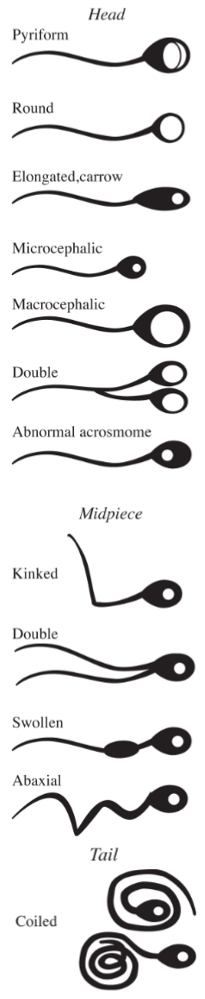
What are primary sperm abnormalities?
Usually severe defects of the sperm head or major structural abnormalities originating during spermatogenesis.
36
New cards
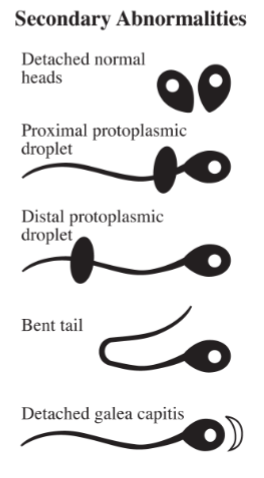
What are secondary sperm abnormalities?
Usually less severe tail or droplet abnormalities developing after sperm formation or during epididymal transit.
37
New cards
What are examples of primary sperm abnormalities?

Head:

  • Pyriform

  • Round

  • Elongated

  • Microcephalic or macrocephalic

  • Double

  • Abnormal acrosmomes

Midpiece

  • Kinked

  • Double

  • Swollen

  • Abaxial

Tail

  • Coiled

<p>Head:</p><ul><li><p>Pyriform</p></li><li><p>Round</p></li><li><p>Elongated</p></li></ul><ul><li><p>Microcephalic or macrocephalic</p></li><li><p>Double</p></li><li><p>Abnormal acrosmomes</p></li></ul><p>Midpiece</p><ul><li><p>Kinked</p></li><li><p>Double</p></li><li><p>Swollen</p></li><li><p>Abaxial</p></li></ul><p>Tail</p><ul><li><p>Coiled</p></li></ul><p></p>
38
New cards
What are examples of secondary sperm abnormalities?
  • Detached normal heads

  • Proximal protoplasmic droplet

  • Distal protoplasmic droplet

  • Bent tail

  • Detached galea capitis

<ul><li><p>Detached normal heads</p></li><li><p>Proximal protoplasmic droplet</p></li><li><p>Distal protoplasmic droplet</p></li><li><p>Bent tail</p></li><li><p>Detached galea capitis</p></li></ul><p></p>
39
New cards
What is the relationship between abnormal sperm morphology and fertility?
Increased sperm abnormalities are associated with lower conception rates and poorer fertility.
40
New cards
What additional fertility factors are NOT routinely evaluated in a standard bull BSE?

Libido, mating ability, and venereal diseases (STIs) such as trichomoniasis and vibriosis.

41
New cards
What is libido in breeding bulls?
Sex drive and willingness to seek out and breed cows in estrus.
42
New cards
Why is libido important even if a bull passes the BSE?
A physically normal bull may still fail to impregnate cows if he lacks sexual interest or mating activity.
43
New cards
What is mating ability?
The bull’s physical ability to mount, achieve intromission, and complete successful copulation.
44
New cards
Why should bulls still be observed during breeding season after passing a BSE?
Lameness, penile injuries, illness, or reproductive problems may develop later and reduce fertility.
45
New cards
What is the overall purpose of the bull BSE as a herd management tool?
Improve reproductive efficiency, increase pregnancy rates, identify subfertile bulls, and improve profitability.
46
New cards
What are the major components of a stallion breeding soundness exam (BSE)?
  • Physical examination

  • Reproductive history

  • Reproductive tract examination

  • Semen evaluation

  • Cultures

  • Assessment of sexual behavior.

47
New cards
Why is a stallion BSE commonly performed?
  • Pre-purchase evaluation

  • Fertility assessment

  • Insurance requirements

  • Breeding management decisions

  • Investigation of infertility problems

48
New cards
Why is reproductive history especially important in stallions?
It provides critical information about fertility trends, breeding performance, pregnancy rates, semen quality changes, and prior reproductive issues.
49
New cards
What information is important in a stallion reproductive history?
  • Age

  • Number of mares bred

  • Breeding method

  • Pregnancy/foaling rates

  • Prior BSE results

  • Illness

  • Medications

  • Semen quality changes

  • Fertility problems.

50
New cards
What is evaluated during the general physical exam of a stallion?
  • Body condition

  • Conformation

  • Soundness

  • Neurologic status

  • Orthopedic pain

  • Hereditary defects affecting breeding ability.

51
New cards
Why are soundness and orthopedic health important in breeding stallions?
Pain or lameness may impair mounting behavior, ejaculation, libido, and willingness to breed.
52
New cards
What reproductive structures are evaluated externally in the stallion?
Penis, sheath, testes, epididymides, and scrotum.
53
New cards
What penile abnormalities are evaluated in stallions?
  • Lesions

  • Trauma

  • Swelling

  • Strictures

  • Inability to achieve erection

  • Inability to retract the penis after ejaculation

54
New cards
What testicular abnormalities may indicate reproductive problems in stallions?

Small, soft, uneven, flat, or ribbed testes suggest reduced sperm production or pathology.

55
New cards
How can stallion testes be measured?
Using calipers or ultrasonography to determine testicular dimensions and volume.
56
New cards
How is daily sperm output (DSO) estimated in stallions?
By calculating total testicular volume and evaluating semen collected over repeated ejaculations.
57
New cards
Why are repeated semen collections performed during a stallion BSE?
To estimate daily sperm output, sperm reserves, and detect incomplete ejaculation or sperm accumulation.
58
New cards
What collection schedule is commonly used during a stallion BSE?
Two ejaculates collected one hour apart after several days of sexual rest.
59
New cards
What does it suggest if the second ejaculate does NOT contain approximately half the sperm of the first ejaculate?
Incomplete ejaculation, low sperm reserves, sperm accumulation, or abnormal reproductive function.
60
New cards
What is evaluated regarding stallion sexual behavior?
  • Libido

  • Erection quality

  • Mounting behavior

  • Ejaculation efficiency

  • Willingness to breed

61
New cards
How should a normal stallion behave during collection?
He should rapidly obtain an erection and ejaculate within one or two mounts.
62
New cards
What factors can impair normal sexual behavior in stallions?
Pain, improper phantom setup, AV problems, orthopedic disease, reproductive pathology, or behavioral issues.
63
New cards
What are the major semen parameters evaluated in stallions?
Volume, concentration, total sperm number, motility, and morphology.
64
New cards
Why is total sperm number more important than concentration alone in stallions?
Volume and concentration vary independently, while total sperm better reflects sperm-producing capacity.
65
New cards
How is total sperm number calculated in stallions?
Sperm concentration multiplied by ejaculate volume.
66
New cards
What is total motility versus progressive motility in stallions?
  • Total motility = percentage of sperm moving

  • Progressive motility = percentage moving forward in a straight line

67
New cards
Why is semen diluted before motility evaluation in stallions?
Raw semen may be too concentrated to accurately assess sperm movement and progressive motility.
68
New cards
How is sperm morphology evaluated in stallions?
Stained sperm are examined microscopically and normal versus abnormal sperm percentages are calculated.
69
New cards
What is bacteriology used for in a stallion BSE?
Detection of reproductive pathogens that may be transmitted to mares and reduce fertility.
70
New cards
What sites may be cultured during stallion bacteriology testing?
Semen, urethra, urethral fossa, and prepuce.
71
New cards
What reproductive pathogens are commonly cultured from stallions?
  • Pseudomonas aeruginosa

  • Klebsiella pneumoniae

  • Streptococcus zooepidemicus

  • E. coli.

72
New cards
What is the overall goal of the stallion BSE?
Identify reproductive abnormalities, estimate breeding potential, and determine how many mares the stallion can successfully breed.