Exam 3
 Call Kai
 Learn
Learn Practice Test
 Spaced Repetition
 Match
Match Flashcards
 Knowt Play
1/85

There's no tags or description
Looks like no tags are added yet.
Name | Mastery | Learn | Test | Matching | Spaced | Call with Kai |
|---|
No analytics yet
Send a link to your students to track their progress
86 Terms
Breast exam
How often?
Which locations should be examined?
Once a month
inner to outer, nipple to lymph nodes
How often should a female get a pap smear?
Every 3 years
What position is patient placed in when seeing a gynecologist?
lithotomy position
Should men do breast exams?
Yes, men should perform regular breast exams
Testicular exam
How often?
When?
Once a month
after a shower because the scrotum is relaxed
How long should you count the apical pulse? why?
Count for 60 seconds to ensure accuracy in measuring heart rate.
Describe serous drainage
Clear/pale, yellow, thin, orderless.
Describe sanguineous drainage
Bright red drainage that darkens over time.
Describe Serosanguineous drainage
light pink, thin, small amounts. Serum + blood
Describe purulent drainage
thick, yellow, green, or brown drainage, often associated with infection.
When conducting a focus assessment, what do you assess?
Level of consciousness
Heart, lung, abdomend (cardiopulmonary)
Dorsal pedis pulse (perfusion)
Surgical sites— check for abnormalities and any changes in vital signs.
What organs are in the RUQ of the abdomen?
liver
gallbladder
right kidney
pancrease
ascending colon
transverse colon
What organs are in the LUQ of the abdomen?
stomach
spleen
left kidney
pancreas
descending colon
What organs are in the RLQ of the abdomen?
appendix
cecum
right ovary (female)
right fallopian tube (female)
right ureter
right kidney
What organ are in the LLQ of the abdomen?
left ovary (female)
left fallopian tube (female)
left ureter
sigmoid colon
descending colon
Explain the Health Insurance Portability and Accountability Act?
Protests the privacy of individuals’ health information and gives patients greater control over their medical records, ensuring that sensitive information is shared only with authorized parties.
Define Good Samaritan Law
Statutory law
A legal practice that protects individuals who provide assistance to those who are injured or in danger from legal liability, as long as their actions are reasonable and intended to help.
Omnibus Budget Reconciliation Act (OBRA)
A federal law enacted to improve the efficiency and effectiveness of health care in America, particularly focusing on the management of payments and services within Medicaid and Medicare programs. Nursing home safety (
Emergency medical treatment and labor act
A federal law that requires hospitals to provide emergency medical treatment to patients regardless of their ability to pay, ensuring that all individuals receive the necessary care in urgent situations.
Consolidation omnibus budget reconciliation act (COBRA)
is a federal law that allows individuals to continue their health insurance coverage after leaving their job, ensuring access to healthcare benefits for a limited time.
Intentional Torts
are wrongful acts committed on purpose that result in harm or damage to another person, such as assault, battery, or defamation.
Assualt
Verbal threats of bodily contact with another person
Define battery
Battery is the unlawful physical act of inflicting harm or offensive contact on another person without their consent, typically following an assault.
False Imprisonment
is the unlawful restraint of a person against their will, restricting their freedom of movement without legal justification.
American with disabilities act (ADA)
A civil rights law that prohibits discrimination against individuals with disabilities in various areas, including employment, public accommodations, and transportation.
Mental health parity & Addiction Equity Act (MHPAEA)
A law that requires health insurance plans to provide equal coverage for mental health and substance use disorder treatment as they do for physical health care, ensuring fair access to care.
Define libel
Libel is a published false statement that is damaging to a person's reputation. It involves defamation through written or printed words, as opposed to spoken statements (slander).
Define slander
Slander is a spoken false statement that harms a person's reputation, involving verbal defamation as opposed to written statements (libel).
Unintentional Torts
Unintentional torts refer to legal wrongs that occur due to negligence or failure to act with reasonable care, resulting in harm or injury to another person. Unlike intentional torts, these actions are not deliberate.
Define malpractice
Used to describe negligence by professionals such as doctors or lawyers, leading to harm or injury to a client or patient due to failure to meet standard care expectations.
Define negligence
Failure to exercise the care that a reasonably prudent person would exercise in like circumstances, leading to unintentional harm or injury to another person.
Patient’s self determination act
A federal law that promotes a patient's right to make decisions about their medical care, including the right to refuse treatment.
Define misdemeanor
A less serious crime than a felony, typically punishable by fines or a limited term in jail. (less than year)
Define felony
greater than one year in prison
Statutory law
Written/passed by federal, state, or local legislatures
Regulatory law
rules by admin agencies enforcing statutory laws (OSHA, state board of nursing and other regulatory bodies). They ensure compliance with laws and regulations.
Negligence
Failing to act as a reasonably prudent person would
Define Malpractice
Negligence by a professional
Define forgery
Falsifying signatures or medical records
Define medical theft
Diverting meds intended for patients
Define sexual misconduct conduct
Any sexual behavior/contact towards a patient
Define living will
Legally recognized documented dictating medical/end of life preferences. Patients must be A&O x 4.
Define healthcare proxy
specifically makes health care decisions only
Define AMA or Against medical Advice
Patient chooses to stop treatment/leave even though physicians recommend against it.
Define Durable power of attorney
done by lawyers, controls finances and all medical decisions when a patient can’t communicate
Define informed consent
patient voluntarily agrees after provider fully explains risk and benefits. Legal and documented.
Define beneficence
doing good
define nonmaleficence
do no harm
define justice
treat everyone fairly
define autonomy
respect patient’a right to decide
Define fidelity
keep promises
Define Veracity
truth telling
Define accountability
accept responsibility
Define advocacy
protect patient’s rights
Deine Deontology
Focuses on moral duties and rules — do what is best for you patient at all times
Define utilitarianism
An ethical theory that advocates for actions that maximize overall happiness and minimize suffering for the greatest number of people. “greatest good for the greatest number" principle.
Define moral distress
occurs when your ethical beliefs are challenged— you question yourself or others
Male external anatomy
What is frenulum?
behind the tip of the penis that helps anchor the foreskin.
Male external anatomy
Scrotum
is the pouch of skin that contains and protects the testicles, regulating their temperature for optimal sperm production.
Define a focus assessment
Your focus on why your patient is there
What are you checking when conducting a focus assessment?
level of consciousness (neuro status)
Central/Vital organs (Cardio pulmonary and abdomen)
Doral pedis pulse (perfusion)
Focused assessment based on their admission
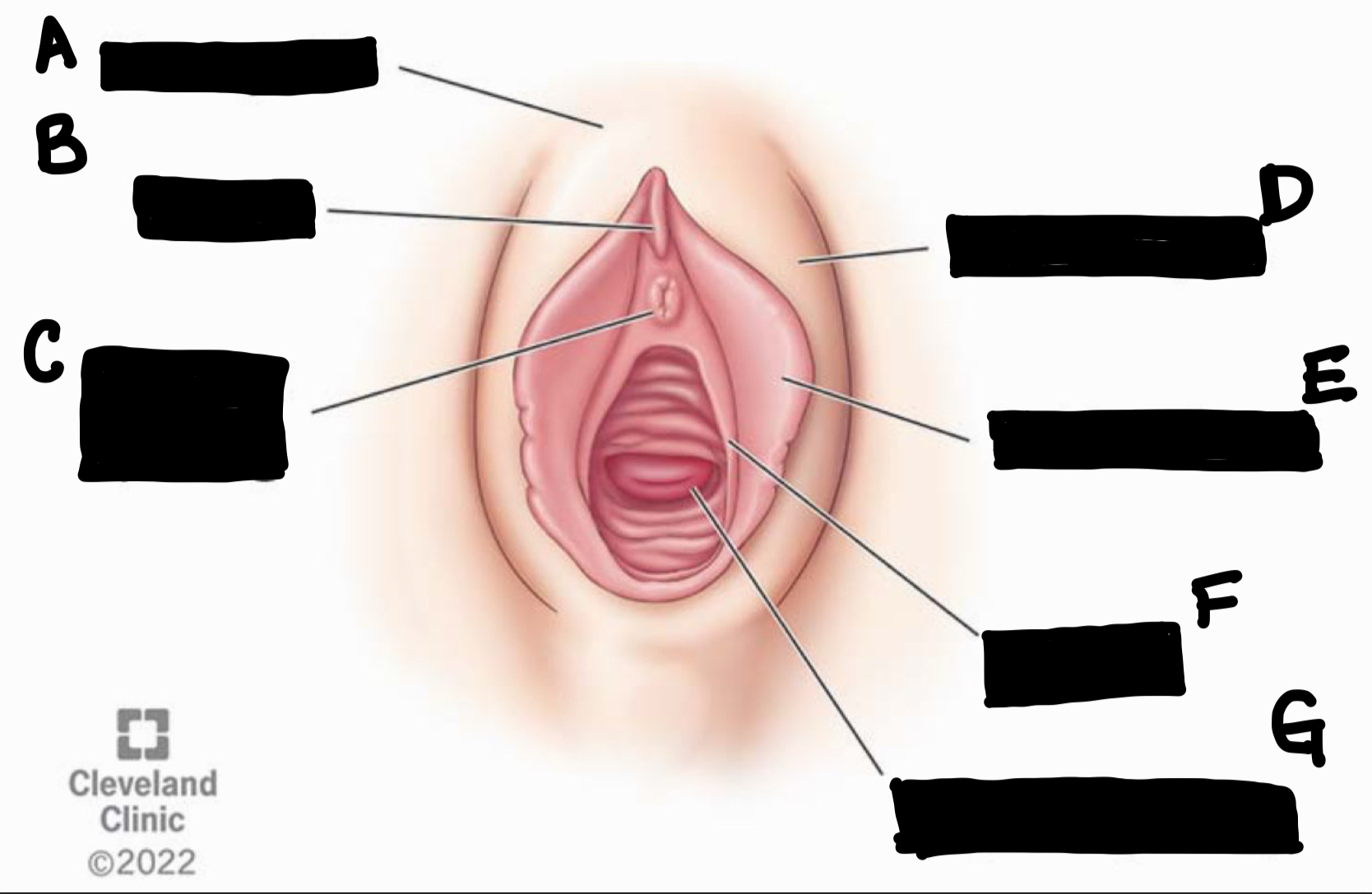
What is the structure labeled “A”?
Mons pubis
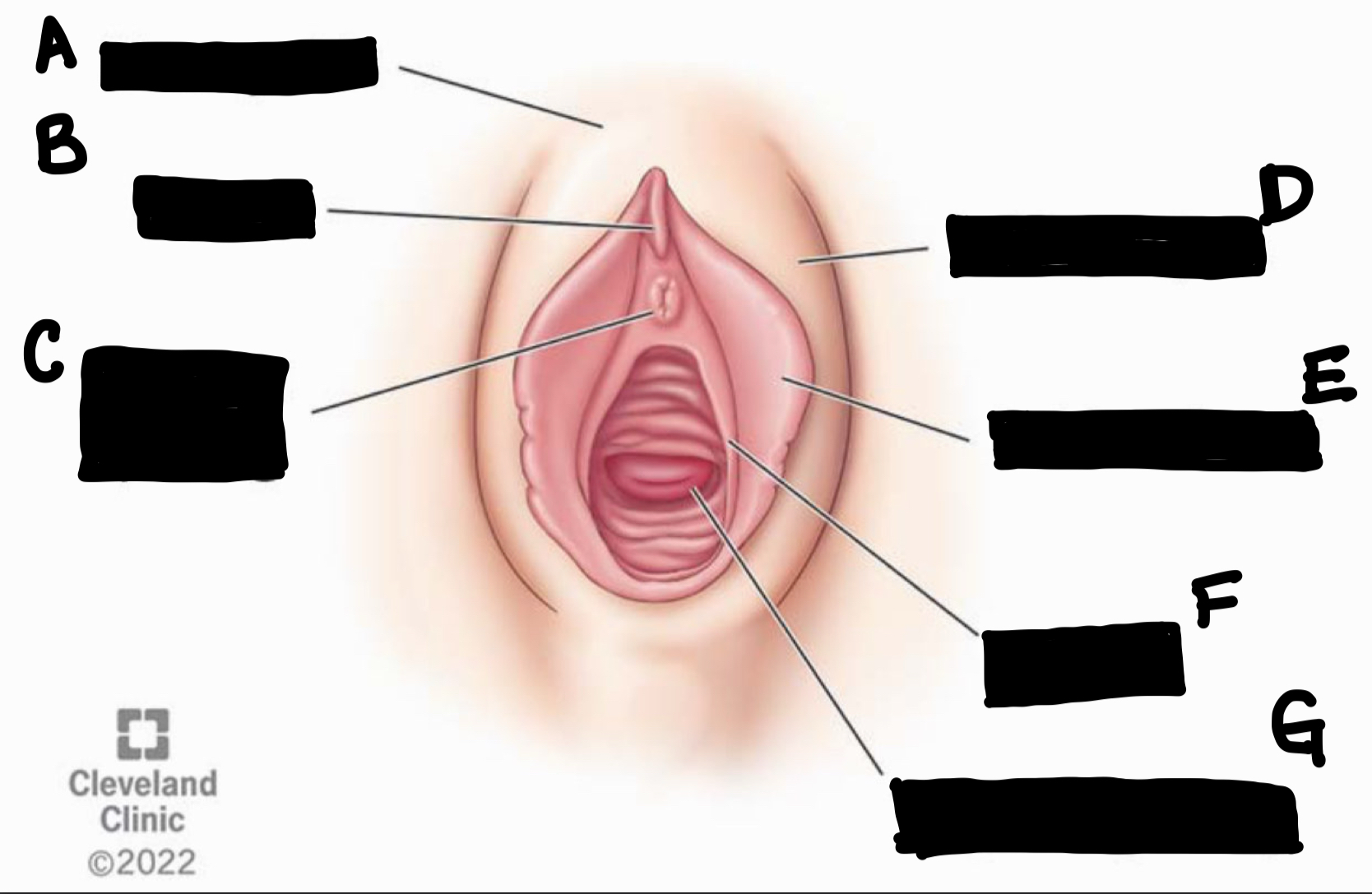
What is the structure labeled “B”?
Clitoris
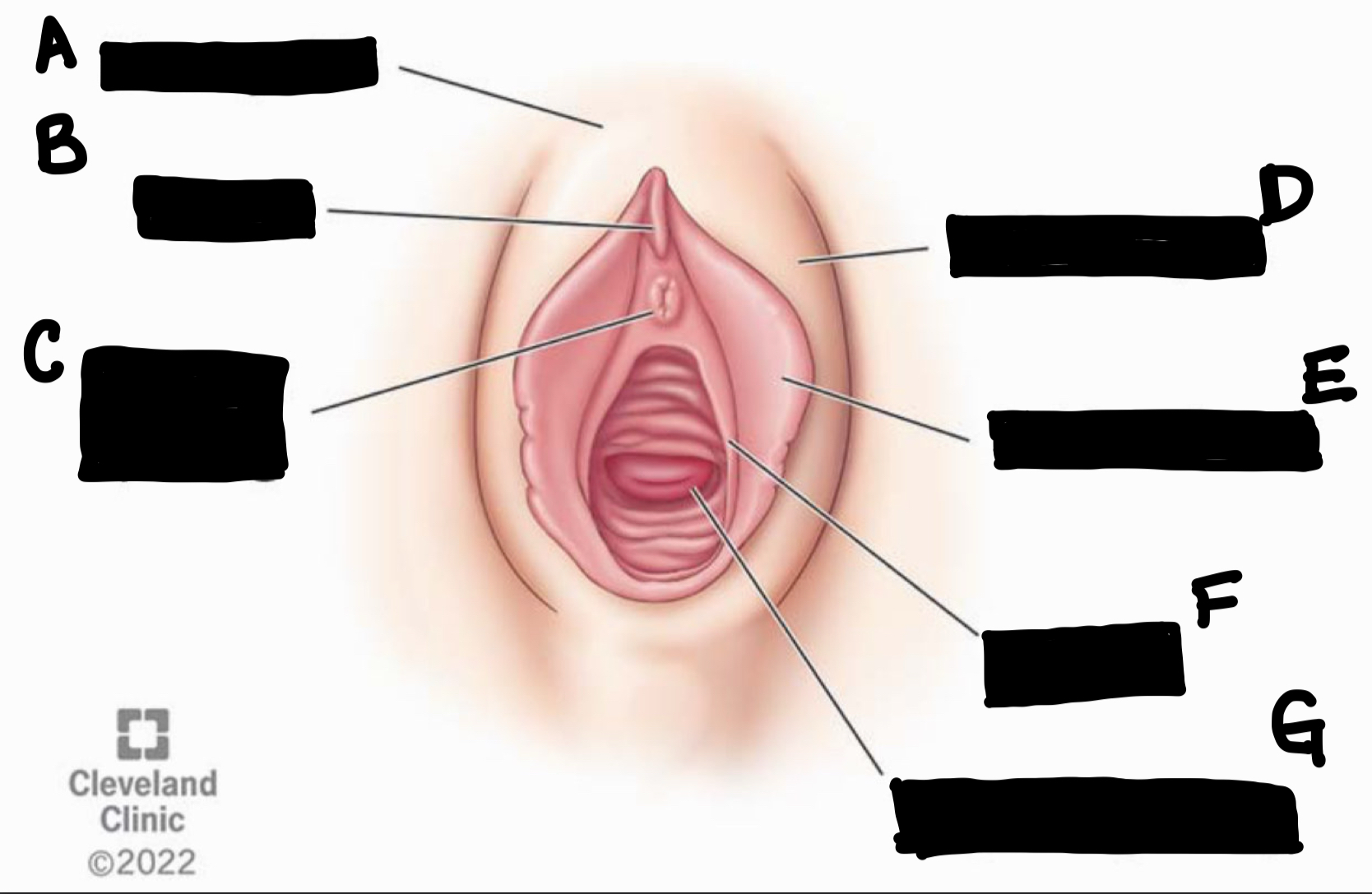
What is the structure labeled “C”
Urethral opening
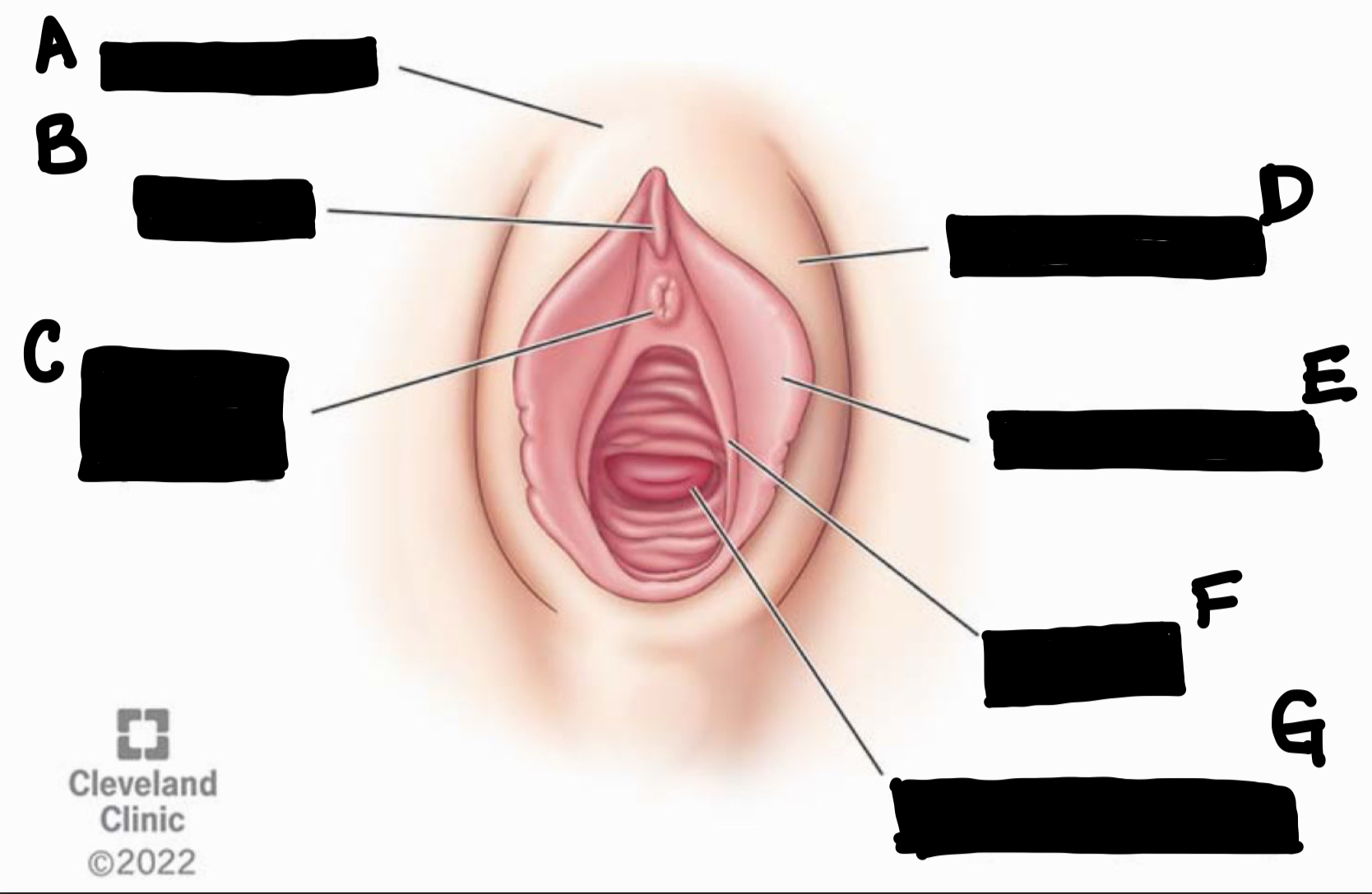
What is the structure labeled “D” in the image?
Labia majora
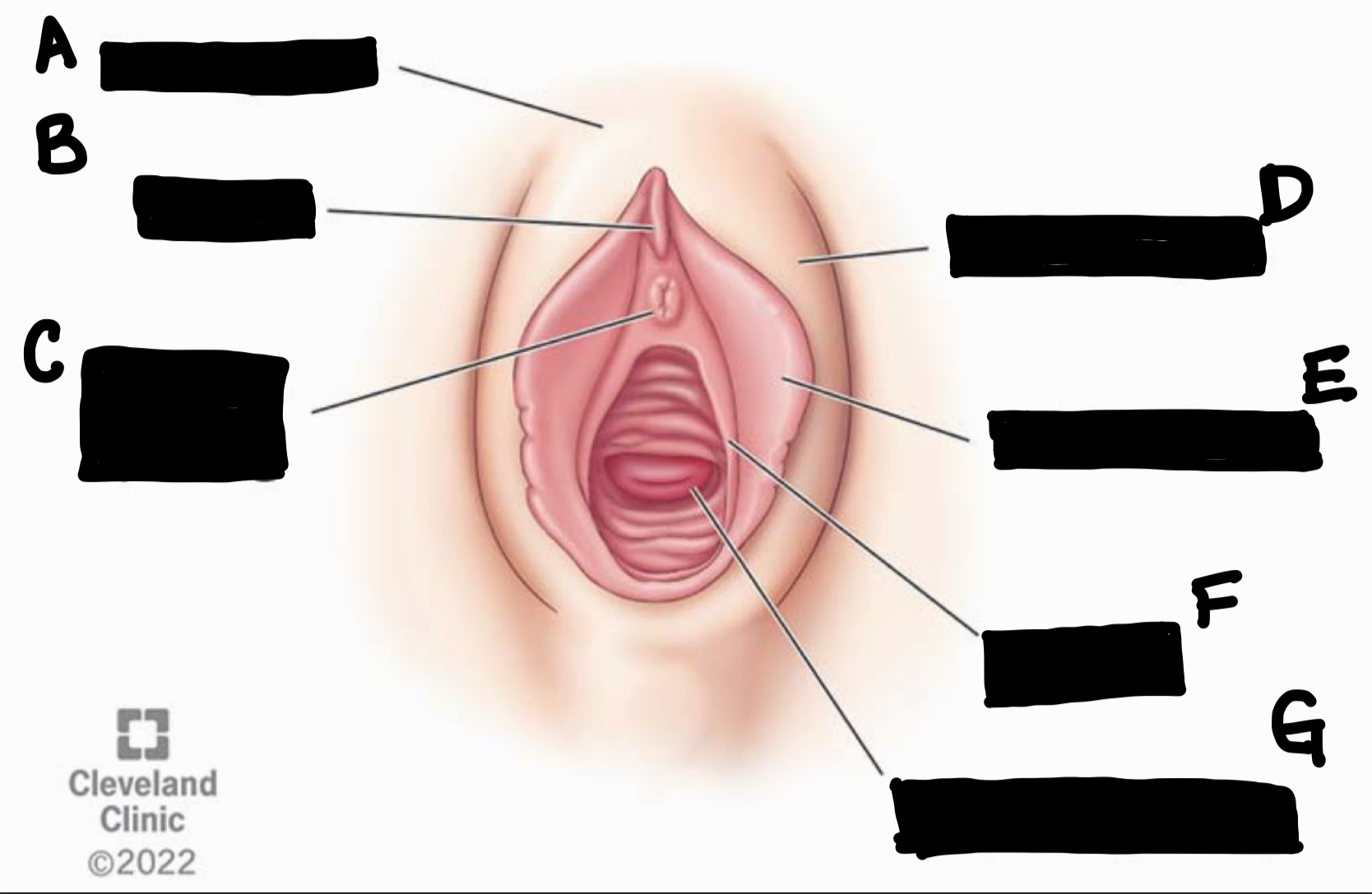
What is the structure labeled “E”?
Labia minora
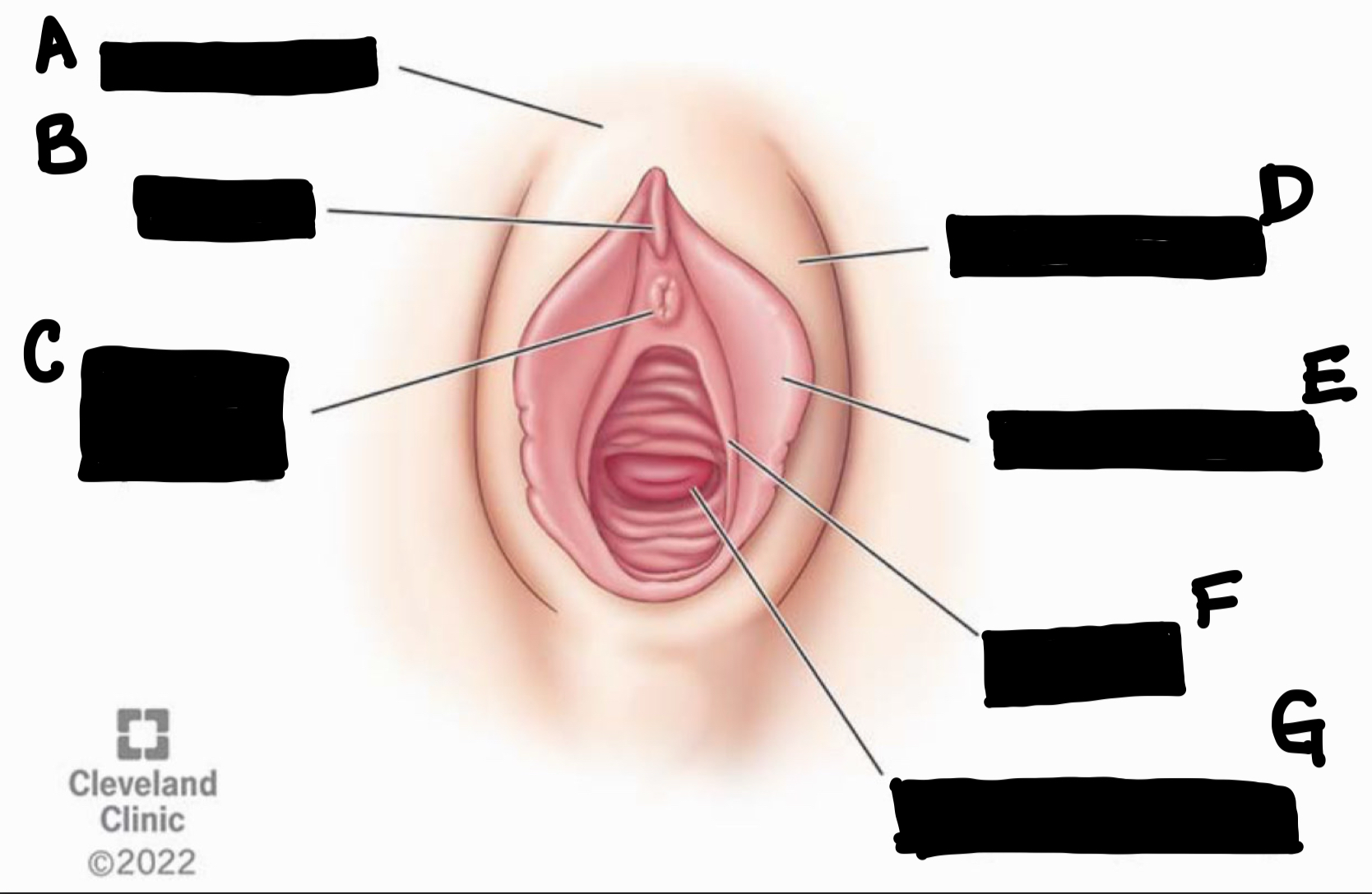
What structure is labeled “F”
Vaginal opening
Which organ would you expect to find in the Right Upper Quadrant (RUQ) of the abdomen?
A. Appendix
B. Spleen
C. Gallbladder
D. Left ovary
C. Gallbladder
A medical assistant submits an insurance claim stating a patient received a full physical exam when only vital signs were taken. This is an example of:
A. Malpractice
B. Fraud
C. Negligence
D. Slander
B. Fraud
A patient with a valid living will becomes incapacitated. What must be true about the patient for the living will to be legally recognized?
A. They must have had a healthcare proxy also on file
B. They must have been A&O ×4 when they created it
C. They must have been admitted to the hospital at the time of signing
D. They must have had a physician co-sign it
B. They must have been A&O ×4 when they created it
A nurse overhears a colleague sharing a patient's diagnosis with another patient in the hallway. What is the nurse's responsibility?
A. Nothing — it's the colleague's responsibility alone
B. Report it only if the patient complains
C. The nurse is responsible because HIPAA violations are a shared accountability
D. Document it and wait for the charge nurse to act
A nurse is about to listen to a patient's heart sounds and knows the patient has a history of arrhythmia. How long should the nurse count the apical pulse, and why?
A. 15 seconds, then multiply by 4 — it's faster and accurate enough
B. 30 seconds, then multiply by 2 — standard for most patients
C. A full 60 seconds — especially important for patients with heart abnormalities
D. 10 seconds, then multiply by 6 — used for cardiac patients specifically
C. A full 60 seconds — especially important for patients with heart abnormalities
An ethical theory states that a nurse should always tell a patient the truth about their diagnosis, even if it causes distress, because honesty is a moral duty. This reflects which ethical theory?
A. Utilitarianism
B. Deontology
C. Beneficence
D. Fidelity
B. Deontology
A patient comes to the ER without insurance and in an unstable condition. The hospital refuses to treat them. Which federal law does this violate?
A. COBRA
B. OBRA
C. HIPAA
D. EMTALA
D. EMTALA
A nurse verbally threatens a patient, saying 'If you don't cooperate, I'll tie you to this bed.' No physical contact occurs. What tort has the nurse committed?
A. Battery
B. False imprisonment
C. Assault
D. Negligence
B. Assault
When should a male patient perform a testicular self-exam, and why is timing important?
A. Once a year during an annual physical — more frequent checks create unnecessary anxiety
B. Once a month after a warm shower — the scrotum is relaxed and easier to examine
C. Once a week before bed — consistency matters more than temperature
D. Once a month in the morning — testosterone levels are highest then
B. Once a month after a warm shower — the scrotum is relaxed and easier to examine.
A nursing professor pulls a student aside to discuss documenting a patient’s blood pressure of 202/122 but not reporting this to the primary nurse. When discovered, the patient was transferred to the intensive care unit for treatment and monitoring. How does the faculty best explain to the student that their inaction reflects negligence?
A. “You did not re-assess your patient.”
B. “There was poor inter-professional communication with the health care team.”
C. You failed to act as a reasonably prudent nurse would under similar circumstances.”
D. “This action is consistent with a felony criminal action.”
C. You failed to act as a reasonably prudent nurse would under similar circumstances.”
Nursing students approaching graduation and licensure are required to read the state nurse practice act. Which topics in the law will they identity as guides to professional practice? Select all that apply.
A. Actions resulting in discipline
B. Clinical procedures
C. Medication administration
D. Scope of practice
E.Delegation policies
F. Medicare reimbursement
A. Actions resulting in discipline
D. Scope of practice
A nurse on a surgical unit is concerned about a colleague’s possible substance use disorder. Which signs and symptoms could support the nurse’s suspicion? Select all that apply.
A. Exhibiting diminished alertness and somnolence while working
B. Attending multiple continuing education conferences
C. Offering to medicate coworkers’ patients for pain
D. Making incorrect narcotics counts and creating wastage
E. Leaving the unit frequently
A. Exhibiting diminished alertness and somnolence while working
C. Offering to medicate coworkers’ patients for pain
D. Making incorrect narcotics counts and creating wastage
E. Leaving the unit frequently
The nurse reports to their manager that informed consent was not obtained from a patient for whom HIV testing was already performed. The nurse suggests which intentional tort may have been committed?
A. Assault
B. Battery
C. Invasion of privacy
D. False imprisonment
A. Assault
A patient died during routine outpatient surgery, and the nurse was accused of having failed to monitor and interpret vital signs. Which fact must be established to prove them guilty of malpractice or negligence?
A. The surgeon testifies the nurse’s action was pure negligence, saying that the patient could have been saved.
B. This patient should not have died since they were healthy, physically active, and involved in the community.
C. The nurse intended to harm the patient and was willfully negligent, as evidenced by the tragic outcome.
D. The nurse had a duty to monitor the patient, and due to the nurse’s failure to perform this duty, the patient died.
D. The nurse had a duty to monitor the patient, and due to the nurse’s failure to perform this duty, the patient died.
An attorney representing a patient’s family who is suing for wrongful death calls the nurse to obtain a better understanding of the nurse’s actions. How will the nurse respond?
A. “I can’t talk with you; you will have to contact my attorney.”
B. “I will answer your questions, so you’ll understand how the situation occurred.
C. “I hope I won’t be blamed for the death because it was so busy that day.”
D. “First tell me why you are doing this to me. This could ruin my career!”
A. “I can’t talk with you; you will have to contact my attorney.”
A nurse answers a call light and finds the patient on the floor. After the health care provider examines the patient and finds no injury, the nurse returns the patient to bed and fills out an incident report. What statements are true about incident reports? Select all that apply.
A. They can be used as disciplinary action against staff members.
B. They can be used as a means of identifying risks.
C. They can be used for quality control.
D. They must be completed by the facility manager.
E. They make facts available in litigation cases.
F. They should be documented in the patient record.
B. They can be used as a means of identifying risks.
C. They can be used for quality control.
D. They must be completed by the facility manager.