final exam earth systems
 View linked note
 Call Kai
 Learn
Learn Practice Test
 Spaced Repetition
 Match
Match Flashcards
 Knowt Play
1/17

There's no tags or description
Looks like no tags are added yet.
Name | Mastery | Learn | Test | Matching | Spaced | Call with Kai |
|---|
No analytics yet
Send a link to your students to track their progress
18 Terms
What is the B horizon in soil?
The B horizon, also known as the subsoil, is a layer of soil that is characterized by the accumulation of minerals and nutrients leached from the upper layers.
What are the soil forming processes?
Soil forming processes include weathering of rocks, organic matter decomposition, and the influence of climate, topography, and biological activity.
How many Australian soil orders are there?
There are 14 Australian soil orders.
Is Vertosol the most common soil order in Queensland?
Yes, Vertosol is the most common soil order found in Queensland.
What are the key components of soil?
Key components of soil include minerals, organic matter, water, and air.
How are soil particles divided into sand, silt, and clay?
Soil particles are divided based on their size: sand (largest), silt (medium), and clay (smallest).
What are clay colloids?
Clay colloids are tiny clay particles that have a large surface area and are responsible for many soil properties, including chemical reactions.
Which component affects soil chemical properties the most?
Clay content affects soil chemical properties the most due to its surface area and charge.
What role does organic matter play in soil?
Organic matter improves soil structure, water retention, and provides nutrients.
What is one key role of soil organisms in ecological function?
Soil organisms decompose organic matter, enhancing nutrient cycling and soil fertility.
Which of the following is the dominant
exchangeable cation in acidic soils?
(a) Ca+2
(b) Mg+2
(c) Al+3
(d) Na+
(c) Al+3
The biosphere is the part of the _____ that
contains living things.
A) atmosphere
B) lithosphere
C) hydrosphere
D) all of the above
D
A soil pH of 4 would be typical for
which of the following soils:
a) An acid sulfate soil
b) A sodic soil
c) An alkaline soil
d) A limed soil
acid sulfate soil
The largest reservoir of carbon is the
a) soil.
b) atmosphere.
c) ocean.
d) vegetation.
e) Sedimentary rocks.
Sedimentary rocks
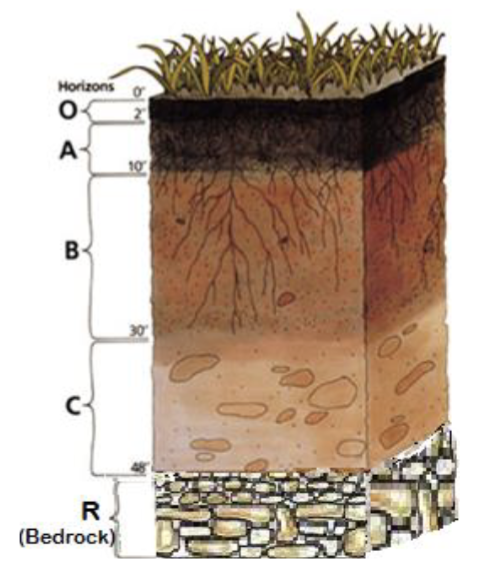
Which soil horizon generally has the highest
organic carbon content:
a) 0-20 cm
b) 20-40 cm
c) 40-60 cm
d) None of the above
A: 0-20cm
Carbon is released into the atmosphere by:
a) the respiration of organisms,
b) the burning of fossil fuel,
c) deforestation/ forest fires, and
d) All of above
All of the above
Which of the following best describes the major
consequence of climate change?
a) Extreme weather pattern (drought or flood)
b) Ice melting;
c) Rise in sea level;
d) All of the above
D- all of the above
Global warming occurs naturally
• A) True
• B) false
False