BIOM1001 MOD4 LEC5 - Gas Exchange
 Call Kai
 Learn
Learn Practice Test
 Spaced Repetition
 Match
Match Flashcards
 Knowt Play
1/10

There's no tags or description
Looks like no tags are added yet.
Name | Mastery | Learn | Test | Matching | Spaced | Call with Kai |
|---|
No analytics yet
Send a link to your students to track their progress
11 Terms
What are the Factos affecting alveoli gas exchange
Ventilation
Air way resistance, lung compliance and elasticity, rate & depth of breathing
Amount of oxygen in air
Amount of water in air
Solubility of oxygen in water
How does airway resistance affect gas exchange.
Flow (proportionate to) Pressure difference (inversely proportional) Resistance
reduce radius of airways → increased resistance
Can occur through mucus in upper airways and bronchoconstriction
What i lung compliance, and what are factors reducing it.
Compliance:
the stretchability of lungs during inspiration
High compliance = easily stretched
low compliance = hard to stretch
Factors reducing compliance:
high surface tension (reduced surfactant)
Scarring of lung tissue (fibrosis)
What is elastic recoil, what are factors that reduce it
Elastic recoil:
ability of lungs to rebound after stretching
Creates some expiratory force during expiration
Factors reducing:
Broken down elastic fibres around alveoli.
Emphysema (obstructive lung disease)
What is Atmospheric pressure & partial pressure
Atmospheric Pressure:
pressure exerted by weight of air on objects on earth’s surface.
Partial Pressure:
pressure one gas contributes to total pressure.
Daltons Law:
total pressure = sum of all partial pressure
how to calculate partial pressure with amount of water in air
water vapour ‘dilutes’ air
To calculate partial pressure of a gas in humid air, subtract water Vapor pressure.
What is the solubility o oxygen in water
Henrys Law:
at a given temperature, amount of gas in solution is proportional to partial pressure of that gas.
Gases must dissolve in fluid before undergoing gas exchange.
What is in the Alveoli
Alveolar Sacs contain clusters of alveoli:
tiny thin-walled structures surrounded by high number of capillaries
High blood flow through capillaries: perfusion (Q)
What is Fick’s Law of Diffusion
Shorter diffusion distance → faster rate of diffusion
Greater surface area of diffusion → faster rate of diffusion
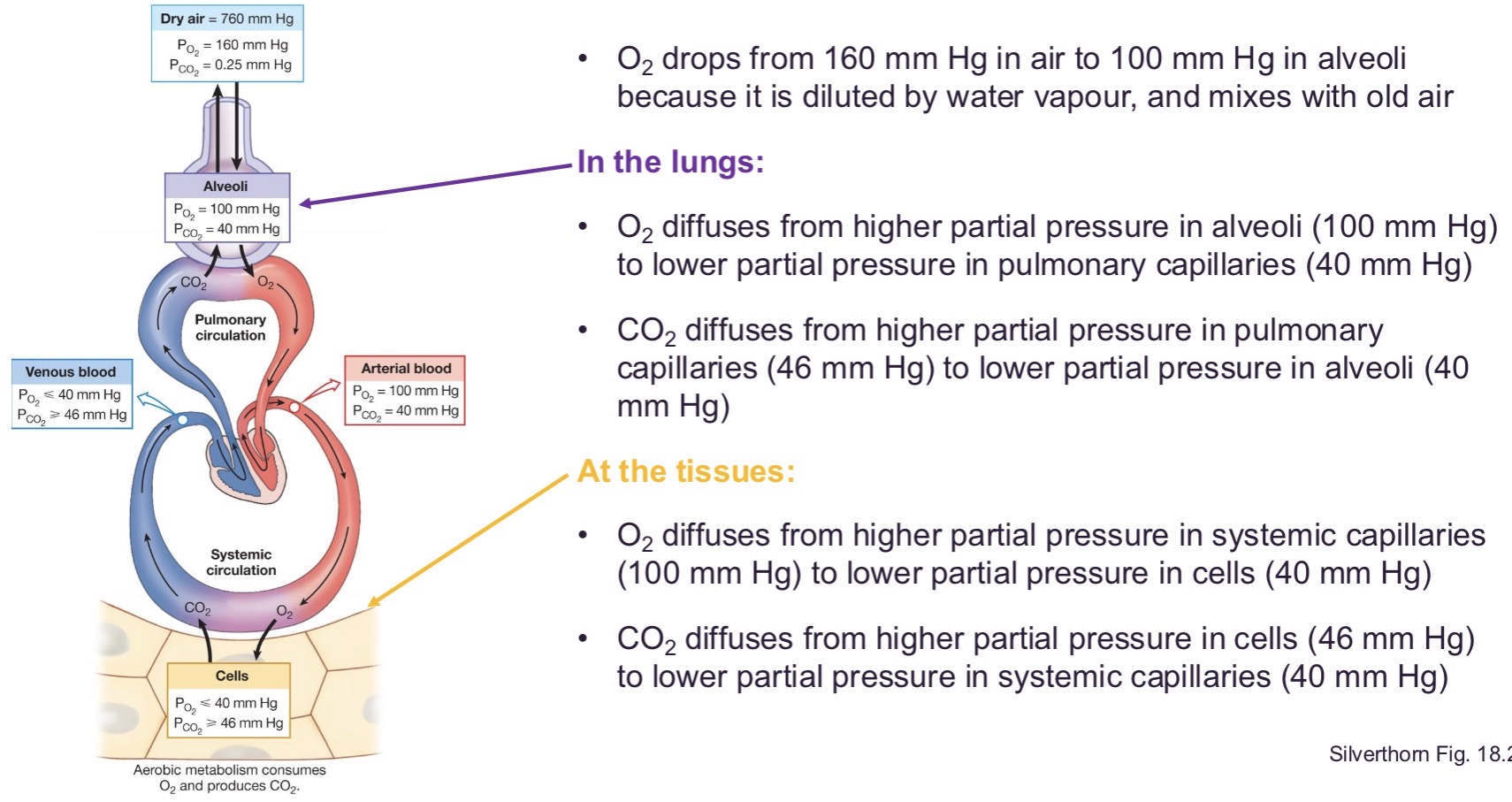
How does Gas exchange work?
The movement of gases across respiratory membrane is driven by differences in partial pressures.
O2 diffuses from alveoli into blood, CO2 diffuses from blood to alveoli
Gases diffuse down pressure gradients