Physics electricity magnetism
 Call Kai
 Learn
 Practice Test
 Spaced Repetition
 Match
 Flashcards
 Knowt Play
1/60

Earn XP
Description and Tags
Lets a go ok the system is a lil messy no lie.... but green or yellow.... or most things yellow at least... could be assumed green to a certain extent.... anyways... good to know more than less...
61 Terms
What are electric forces?
.
.
Section: Electric and Magnetic Fields
SACE Terms: None
Note: Just know what it is.
Electrostatically charged forces exert a force upon one another.
Like charges repel, and unlike charges attract.
(ie: like charges exert a repulsive force; unlike charges exert an attractive force.)
Electric forces are non-contact forces.
(Like charges repel; simple. However, the way the attractive force works is specific).
A positively charged object will exert an attractive force upon a negatively charged object that will draw the two objects together.
What is Coulomb’s Law?
.
.
Section: Electric and Magnetic Fields
SACE Terms: Solve problems using the formula
Note: Be able to state it
Coulomb’s Law: The electric force of attraction or repulsion between two charged objects is directly proportional to the product of the two charges, and inversely proportional inversely proportional to the square of the distance between the two centres.
Coulomb’s Law refers to any two stationary charges which experience a mutual force along a line joining the two charges.
These forces are attractive if the charges are opposite in nature, and repulsive if the charges are alike. (Like charges repel; unlike charges attract).
Electrostatically charged objects exert forces upon one another; the magnitude of these forces can be calculated using Coulombs Law:
 Where k is the Coulombic constant:
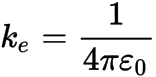 k = 8.99 × 10⁹ Nm2C-2 (or 9.0 × 10⁹ Nm2C-2)
ε0 (epsilon nought) is called the permittivity of a vacuum.
The unit of this equation is (as force always is) in terms of Newtons, NOT COULOMBS.
What is the concept of proportionality in relation to electric forces?
.
.
Section: Electric and Magnetic Fields
SACE Terms: Apply. Using proportionality, discuss changes in the magnitude of the force on each of the charges.
Note: None
The electric force is proportional to one charge, provided that the other charge and distance between the charges does not change.
F∝q1 when q2, r constant.
e.g., If one charge is replaced with one having twice the charge, the electric force between the two charges will double. Similarly, if one charge is replaced with one having a charge of ten-times-smaller, then the electric force between the two charges will decrease by a factor of ten.The electric force is proportional to the product of the two charges, provided that the distance between the centre of the two charges does not change.
F∝q1q2 when r constant.
e.g., If one charge is replaced with one having double its charge and the other is replaced with a charge having five times its charge, then the electric force between the two charges becomes ten times larger.The electric force is inversely proportional to the square of the distance between the centre of the two charges, provided that the charges do not change.
F∝1/r2 when q1, q2 constant.
e.g., If the distance between the centre of the two charges is increased by a factor of five, then the electric force becomes 25 times smaller.
Note: An attractive force becomes a repulsive force and vice versa if the sign of one of the charges is reversed.
What is the charge of an electron?
.
.
Section: Electric and Magnetic Fields
SACE Terms: Assumed.
Note: IF IN A QUESTION, the charge is already given, and the value given differs slightly; Use the given charge.
It will be assumed that you know that the magnitude of the charge of an electron and proton are the same, and that the charge of a proton is positive, while an electron has a negative charge.
e = -1.60 × 10⁻¹⁹ C
proton = 1.60 × 10⁻¹⁹ C
How are electric forces consistent with Newton’s Third Law?
.
.
Section: Electric and Magnetic Fields
SACE Terms: Explain
Note: None
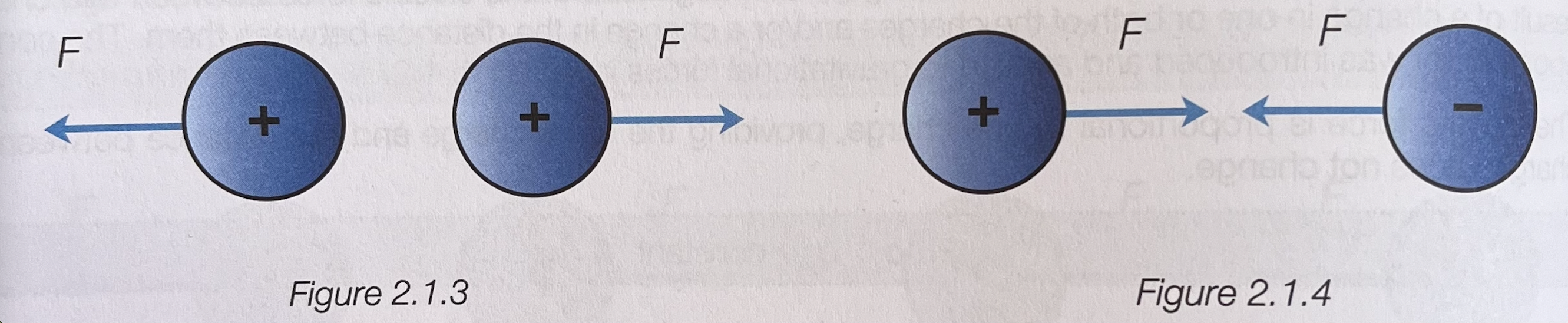
The magnitude of force between two charges (given by Coulombs Law) is a mutual force.
Hence, the magnitude of force of each charge exerted upon each other is the same.
In the attached figure, the diagrams clearly show that the direction of force on each charge acts in the opposite.
Newton’s Third Law states that if object A exerts a force on another object B, then object B exerts an equal but opposite force on object A.
Electric forces are therefore consistent with Newton’s Third Law.
What is the principle of superposition?
.
.
Section: Electric and Magnetic Fields
SACE Terms: Be able to solve one dimensional and two dimensional situations involving right angled, isosceles, or equilateral triangles.
Note: Be able to apply it
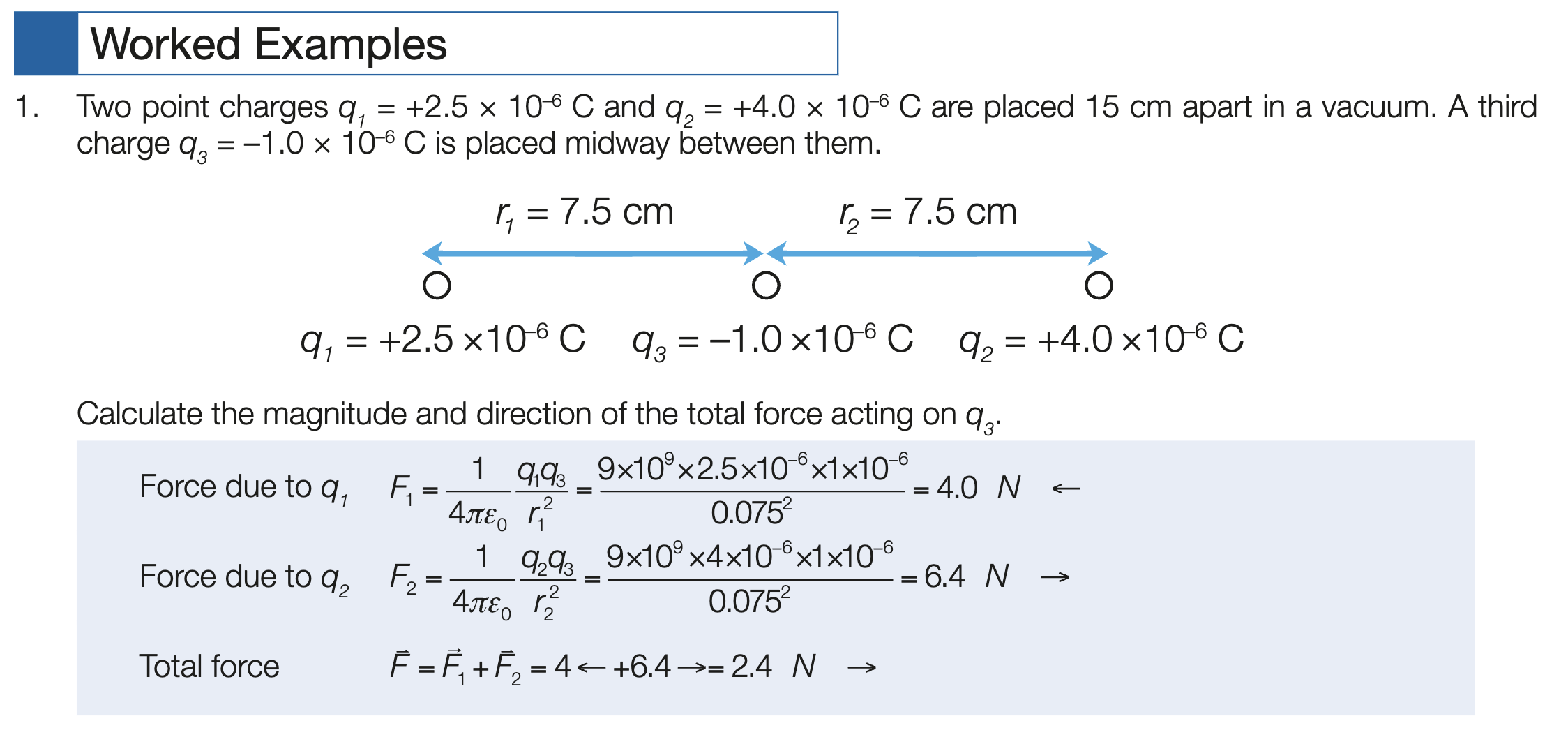
When more than two charges are present, the force on any one of them is a vector sum of the electric forces acting due to the presence of each of the other point charges.
So what do we do when there’s an isosceles vector triangle!
.
.
Section: Flipping everything goddamn
SACE Terms: None T_T
Note: Be able to apply it
We half it! To make 90 degrees! and two 30 degree angles!
Whoohoo!
What is an electric field?
.
.
Section: Electric and Magnetic Fields
SACE Terms: None, Textbook definition
Note: None
In accordance with Coulomb’s Law, two charges exert a force on each other even though the charges are not in contact. This is because there is a field around each charge, known as an electric field.
It is the electric field around each charge that produces a force on the other charge (the field on on charge exerts a force on the other charge).\
An electric field exists in a region of space. If a body is placed in that region, it will experience a force due to this charge.
Electric charges establish an electric field (E) in the surrounding space.
They are invisible, and hence need a way to represent them (electric field lines with direction and magnitude).
What are the rules for representing electric field lines?
.
.
Section: Electric and Magnetic Fields
SACE Terms:
Note: Be able to apply it!!!
By definition, the direction of an electric field is taken as the direction a positive test charge would move. (A test charge is simply as very small charge with a weak electric field in the space surrounding it. It will not interfere with the electric field created by a charge).
The direction of the lines of force show the direction a positive test charge would experience it (the force).
Where lines of force are closer together, the field is stronger.
The electric field strength vector, E, at any point in an electric field is defined as the force per unit of positive test charge placed at that point in the field.
Lines of force are drawn away from positive charges towards negative charges.
Lines of force are always drawn at right angles to the surface of a charged object.
Lines of force never cross.
What is the unit of electric field strength?
.
.
Section: Electric and Magnetic Fields
SACE Terms:
Note: Be able to apply it
The electric field strength vector, E, at any point in an electric field is defined as the force per unit of positive test charge placed at that point in the field.
The unit of electric field strength is Newtons per Coulombs (NC-1).
E=F/q
F=(k)(Qq/r2)
∴ E= k(Q/r2)
(The q’s cancel out).

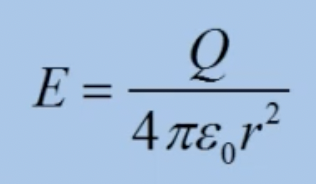
What does this equation find? E= k(Q/r2)
.
.
Section: Electric and Magnetic Fields
SACE Terms:
Note: Be able to apply it.
This equation finds the magnitude of the electric field, only (not force).
Direction is determined by the charge of the object.
Points that are equidistance (equal distance) from the charge will have the same magnitude for E (since r2 would be the same).
The electric field is also directly proportional to the charge, and inversely proportional to the squared vale of the distance away.
Can superposition be applied to electric fields?
.
.
Section: Electric and Magnetic Fields
SACE Terms:
Note: Be able to apply it.
Yes, calculate the individual field strengths, then add vectorially.
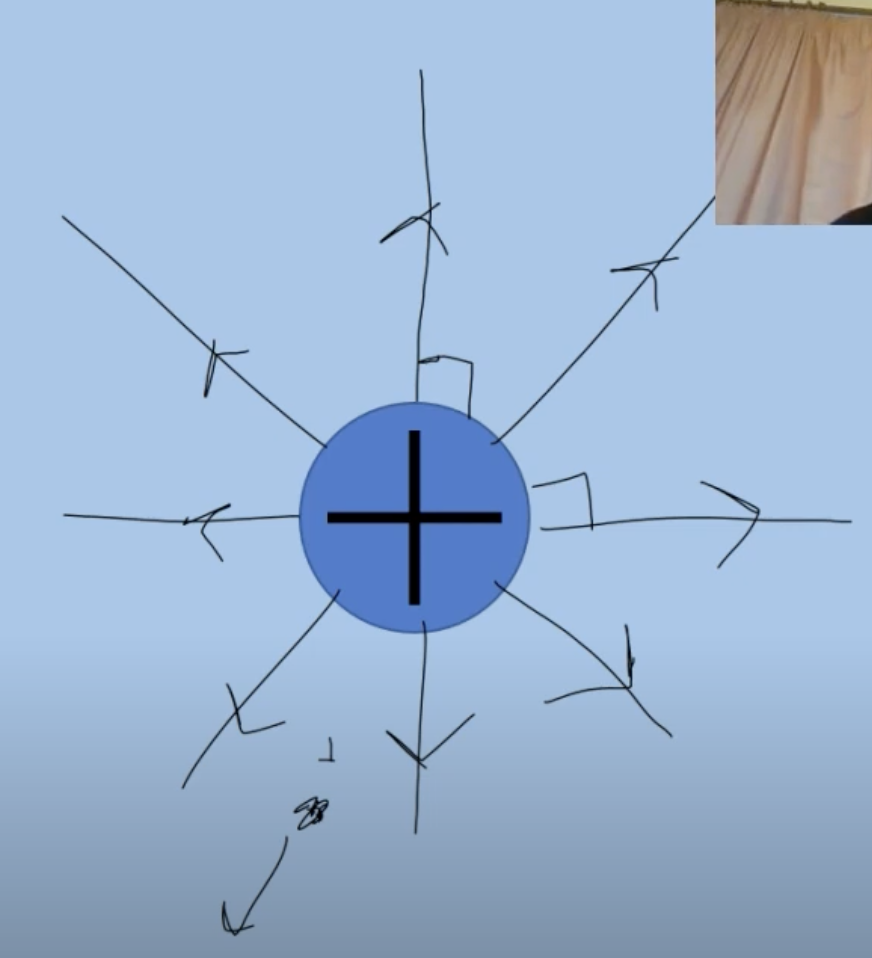
Draw the electric field lines of a positively charged particle.
.
.
Section: Electric and Magnetic Fields
SACE Terms: Be able to apply it.
Note: None
Refer to attached image.
Lines must be draw at 90° angles from the particle’s surface.
Since positive, arrows are drawn radially outwards.
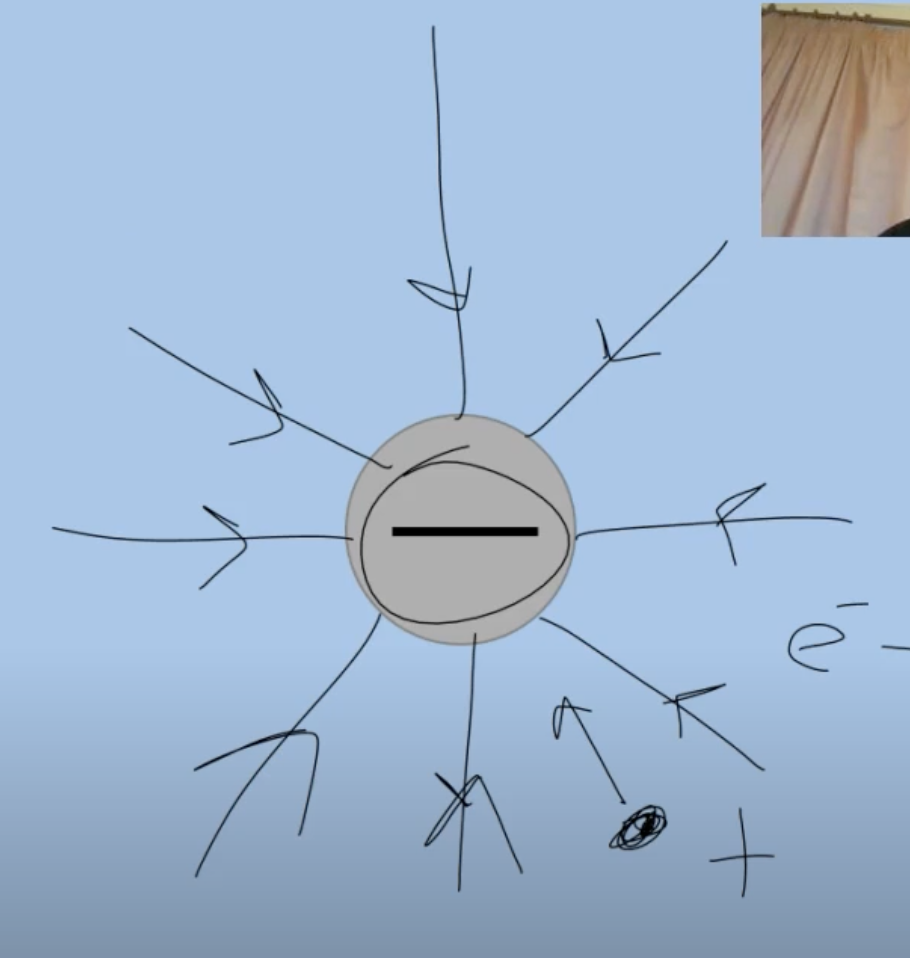
Draw the electric field lines of a negatively charged particle.
.
.
Section: Electric and Magnetic Fields
SACE Terms: Be able to apply it.
Note: None
Refer to attached image (ignore the electron and + particle that was an example).
Lines must be drawn at 90° angles from the particle’s surface.
Since negative, arrows are drawn radially inwards.
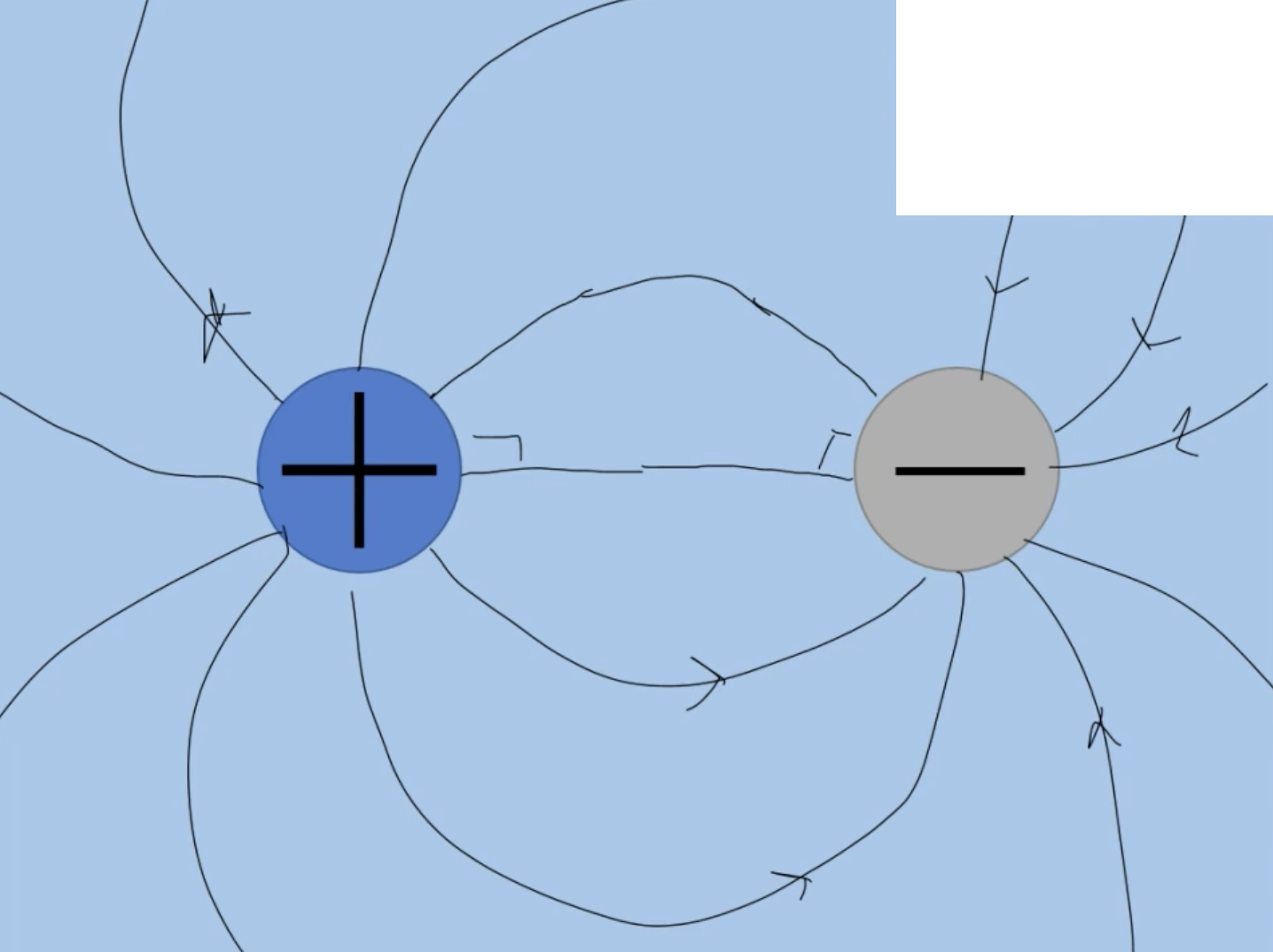
Draw the electric field lines of a positively charged particle and a negatively charged particle (of which are next to each other).
.
.
Section: Electric and Magnetic Fields
SACE Terms: Be able to apply it.
Note: None
Refer to the attached image.
Lines must be drawn at 90° angles from the particle’s surface.
Electric field lines “meet up.”
Arrows are drawn from positive to negative (note as it gets further apart, they may exist beyond the drawing space, but it can be interpreted as them still eventually “meeting up.”
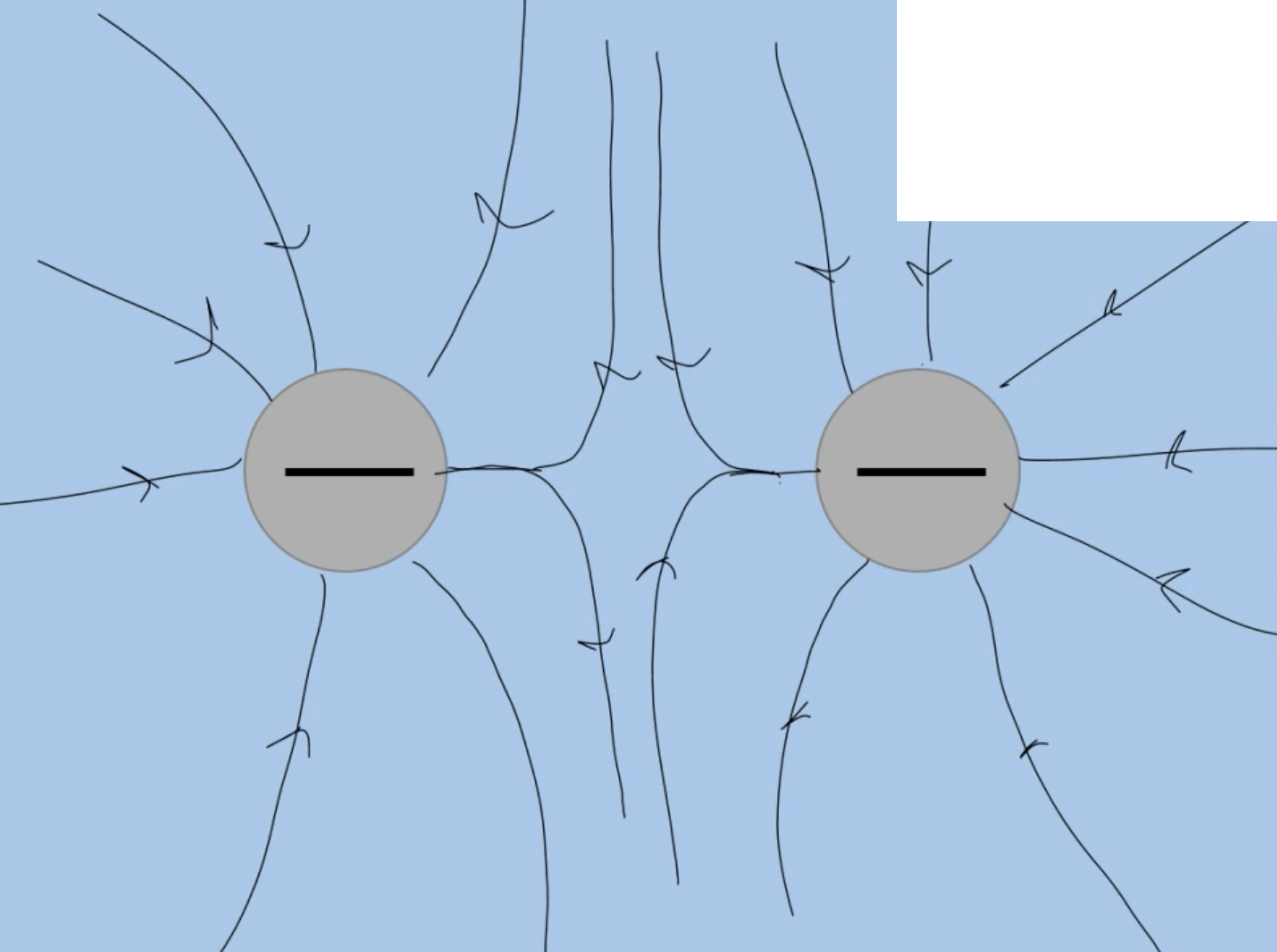
Draw the electric field lines of a two negatively charged particles (of which are next to each other).
.
.
Section: Electric and Magnetic Fields
SACE Terms: Be able to apply it.
Note: None
Refer to attached image.
Lines must be drawn at 90° angles from the particle’s surface.
Electric field lines do not “meet up.”
Arrows are drawn towards radially inwards.
Draw the electric field lines of a positively charged charged plate.
.
.
Section: Electric and Magnetic Fields
SACE Terms: Be able to apply it.
Note: None
Refer to the attached image.
The plate is a conductor, so charges will distribute evenly across the plate.
It is not a uniform field.
Lines must be draw at 90° angles from the particle’s surface.
Since positive, arrows are drawn outwards away from the plate.
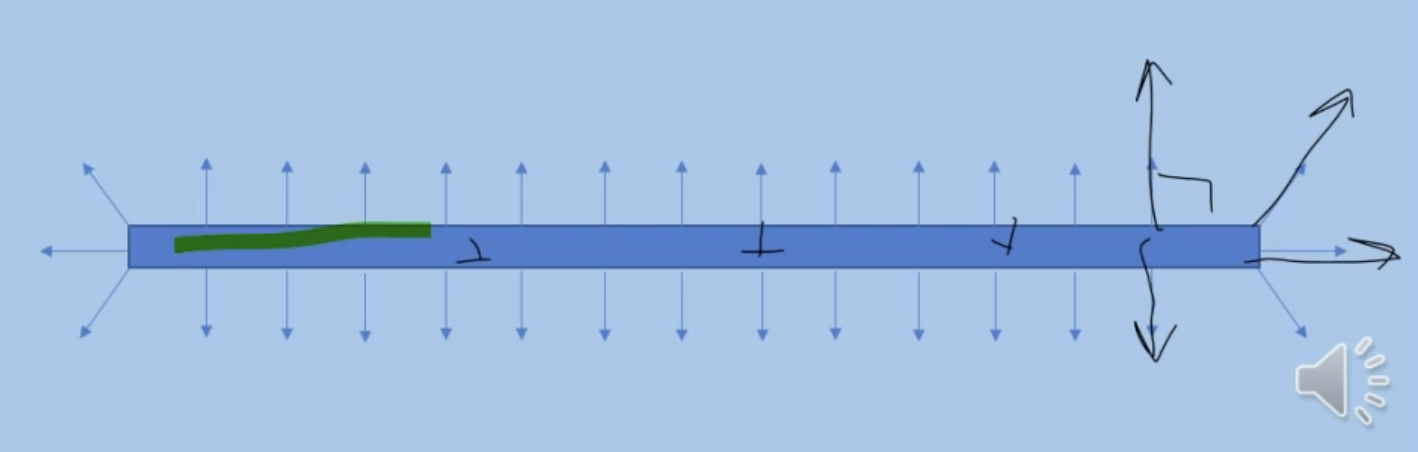
Draw the electric field lines of a negatively charged plate.
.
.
Section: Electric and Magnetic Fields
SACE Terms: Be able to apply it.
Note: None
Refer to the attached image.
The plate is a conductor, so charges will distribute evenly across the plate.
It is not a uniform field.
Lines must be draw at 90° angles from the particle’s surface.
Since positive, arrows are drawn inwards towards the plate.
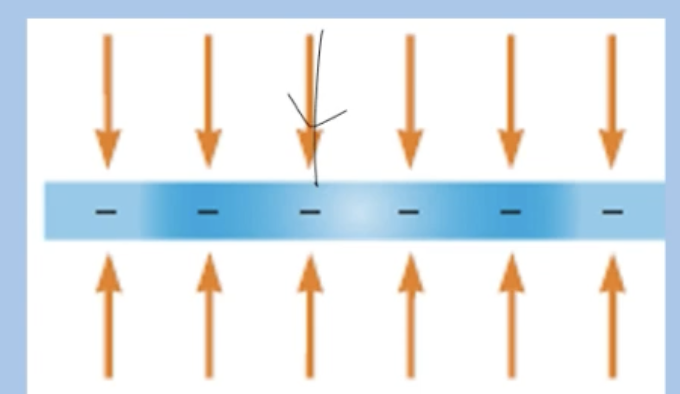
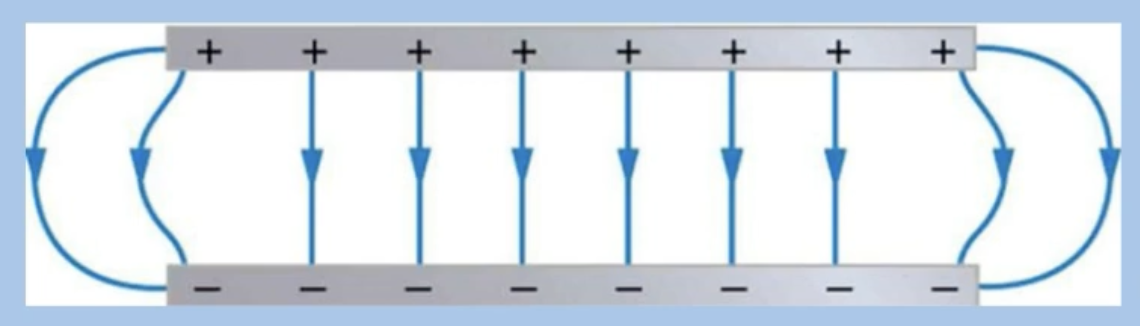
Draw the electric field lines of a positively charged plate and a negatively charged plate (of which are parallel to each other - finite plate).
.
.
Section: Electric and Magnetic Fields
SACE Terms: Be able to apply it.
Note: None
Refer to attached image.
A (pretty much) uniform field forms between them (centres).
Outside field lines curve.
Arrows are drawn from positive to negative.
ON A FINITE PLATE THE FIELD LINES ARE NOT ALWAYS UNIFORM… there is curvature, and non-uniformity on the edges of the plates (on an infinite plate, field is uniform).
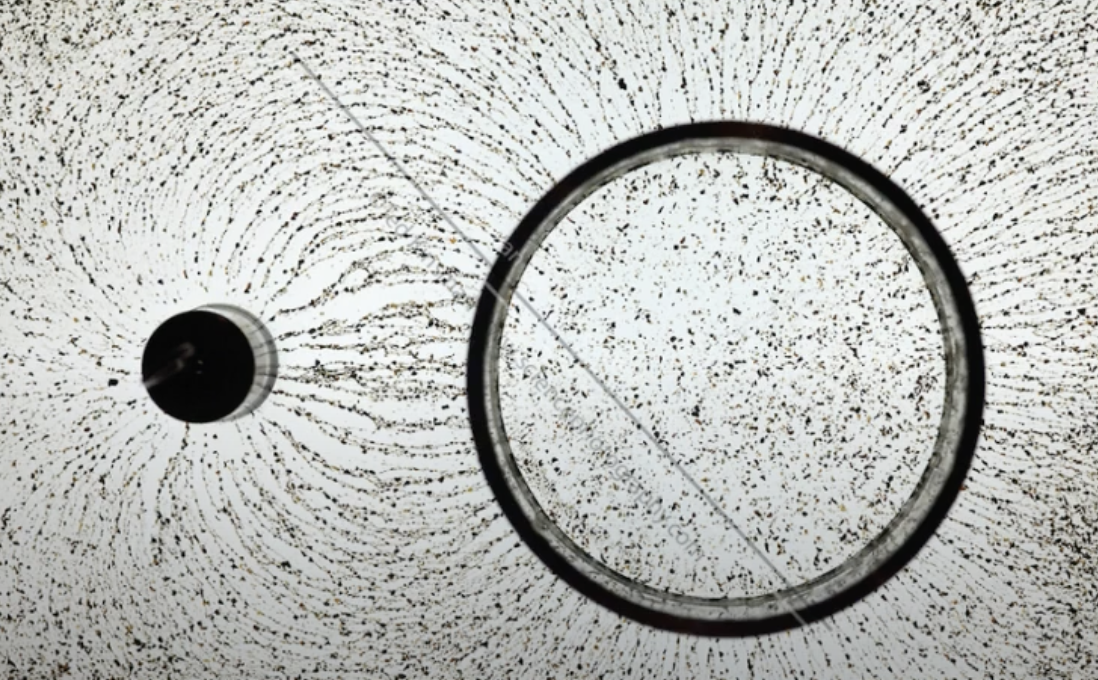
Draw the electric field lines of a hollow conductor.
.
.
Section: Electric and Magnetic Fields
SACE Terms: Sketch the electric field produced by a hollow spherical charged conductor.
Note: None
Refer to attached image.
Lines must be drawn at 90° angles from the particle’s surface (before curving)
Electric field lines flow from the substance.
There is no electric field present inside the conductor.
SACE: There is no electric field inside a hollow conductor of any shape, provided that there is no charge in the cavity.
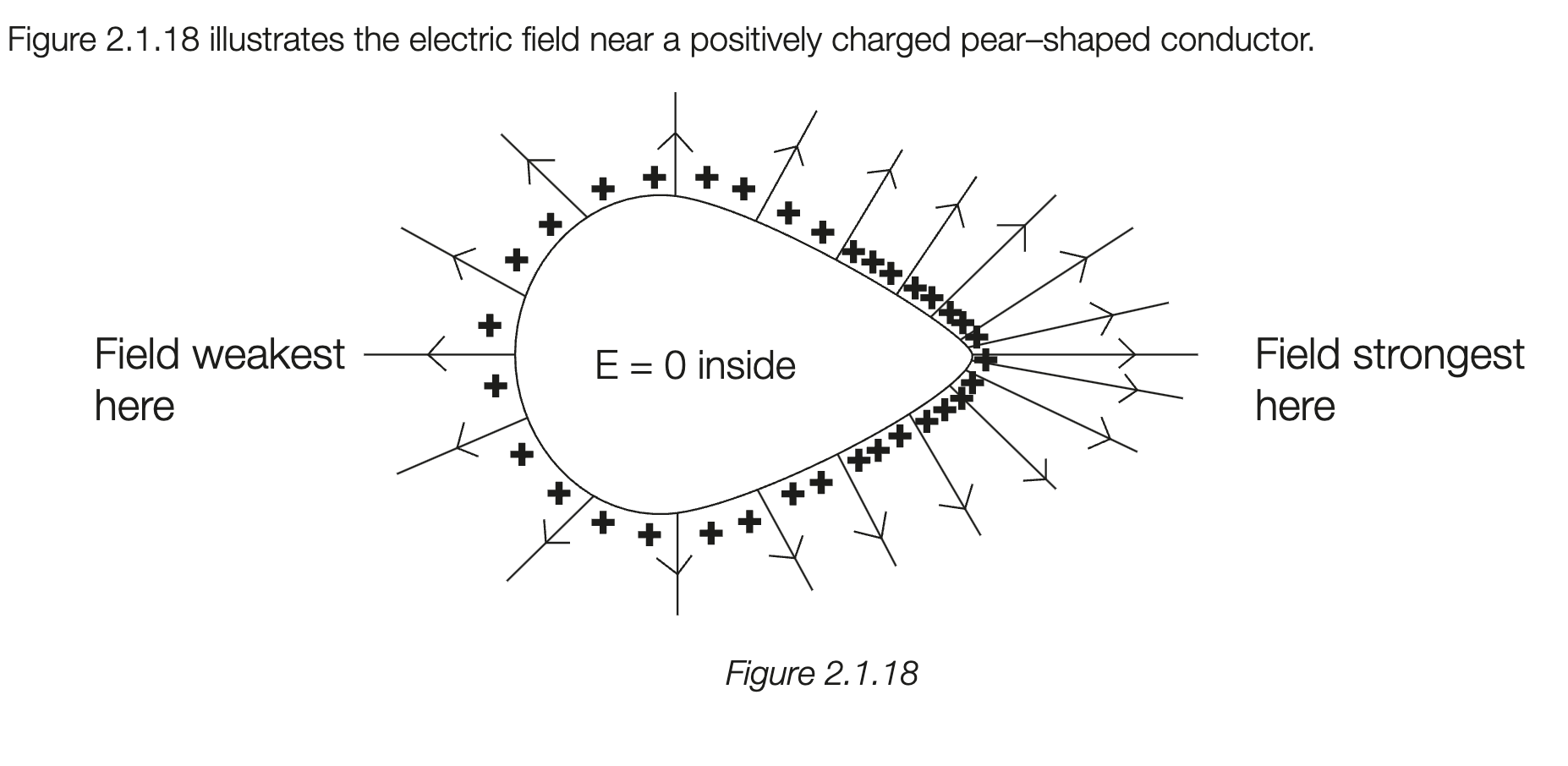
Draw the electric field lines of a pear-shaped conductor.
.
.
Section: Electric and Magnetic Fields
SACE Terms: Sketch the electric field produced by a charged conductor of an irregular shape.
Note: None
Refer to attached image.
Lines must be drawn at 90° angles from the particle’s surface.
Charge is not distributed evenly.
Larger separation between the field lines means weaker field.
Curvature causes stronger field (this is because the field comes out at right angles, since curved, more electric field lines come out).
Field is strongest at pointed/sharp areas.
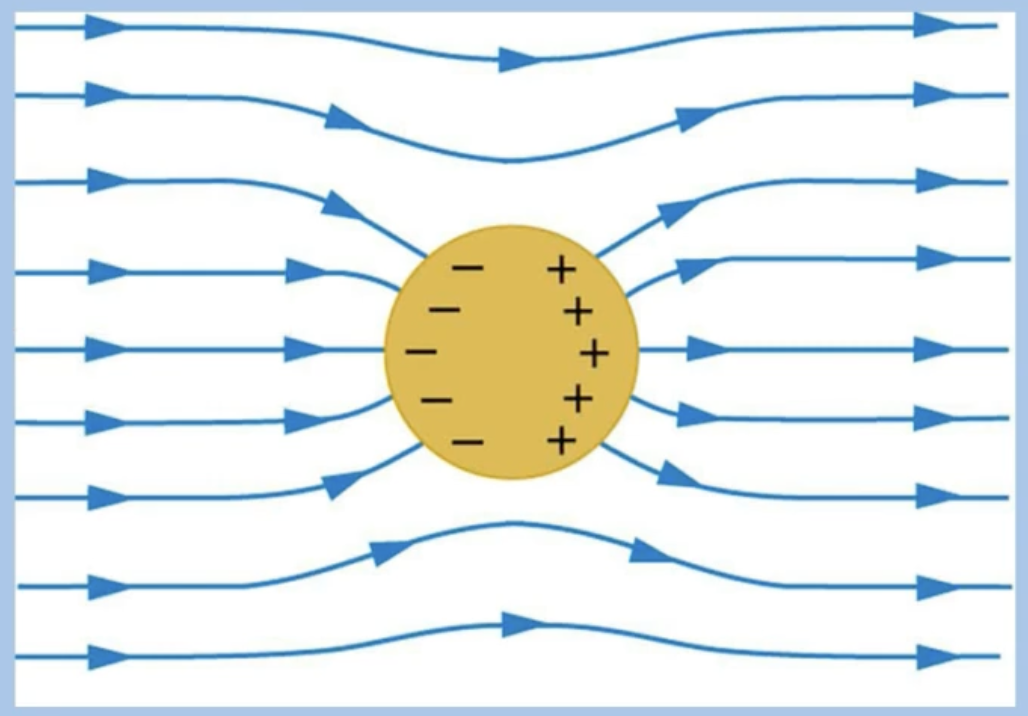
Draw the electric field lines of a solid conductor within a uniform electric field.
.
.
Section: Electric and Magnetic Fields
SACE Terms: None.
Note: This one is less important, but still good to know.
Refer to attached image.
Conductors will separate (negative charge on one side, positive charge on other).
Electric field lines come in (towards negative), joining at 90° angles, and exits (mirrored) at the other side.
Solid conductors distort the field (see how electric field lines curve in toward it)
No electric field inside.
What are corona wires?
.
.
Section: Electric and Magnetic Fields
SACE Terms: Describe how the electric field near sharp points may ionise the air.
Note: None
Electric charges tend to accumulate near curves or sharp points.
Therefore, the electric field near sharp curves and points is larger than electric fields near more rounded corners.
A ‘corona discharge’ is a leakage of charged particles away from a highly charged object.
SACE: Electric fields are strongest near sharp points on conductors. These fields may be large enough to ionise molecules in the air near of the sharp points, resulting in charge movement away from the conductor. This is called a ‘corona discharge.’
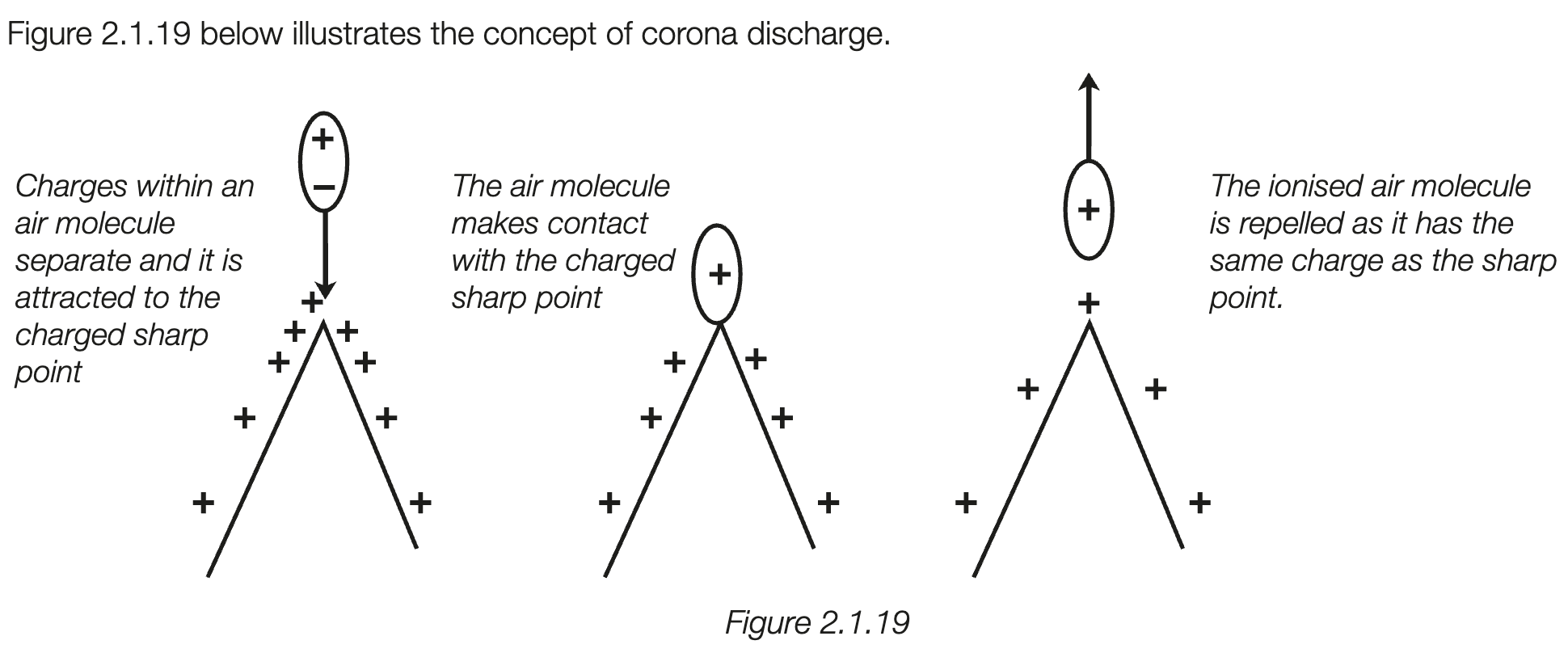
What is corona discharge?
.
.
Section: Electric and Magnetic Fields
SACE Terms: Describe how the electric field near sharp points may ionise the air.
Note: Explain the process.
SACE: Electric fields are strongest near sharp points on conductors. These fields may be large enough to ionise molecules in the air near of the sharp points, resulting in charge movement away from the conductor. This is called a ‘corona discharge.’
The Process:
Charges accumulate at sharp points on a conductor to produce a strong electric field.
If the electric field is strong enough, it can cause a separation of charges in nearby air molecules.
This is because negative charges are attracted to the strong point, while positive charges repelled (refer to attached figure).
Since electric forces are inversely proportional to the square of the distance between them, the force of attraction from the negative charges in the air molecule to the positively charged sharp point are greater than the air molecule’s positive charges which are further away from each other.
Air particles are charged by induction. Consequently, they are attracted to the charge point.When air molecules come into contact with the sharp point of the conductor, they gain the same charge as the conductor, and the particle becomes ionised (refer to attached figure: positive).
The ionised air molecules are then repelled away from the sharp point due to the repulsive electric force between like charges.
When this happens to many air molecules, the stream of charge moves away from the conductor (a net movement of positive—or negative charge depending on given scenario—away from the conductor). This is a corona discharge.
Essentially, there’s a build up of charges. These leak into the air, and react with particles in the air, and cause a colour glow near the conductor.
Another definition/description:
Electric charges accumulate near curve sor sharp points.
Therefore, the electric field near sharp curves and points is larger than electric fields near more rounded corners.
A ‘corona discharge’ is a leakage of charged particles away from a highly charged object.
These escaped charged particles interact with ionised particles in the air.
There are always a few charged particles within the air due to the interaction of cosmic rays with air particles.
These charged air particles are attracted to strong charges such as those at sharp points, or repelled (depending on sign of charge).
The strong electric fields accelerate the ionised air particles to very high speeds, making them collide with other air particles, and ionise them too.
This process repeats producing more ionised particles surrounding that area, which then becomes a conductor (air becomes conductor).
A corona discharge occurs, which can often be viewed as a glow near the sharp point of the conductor.
Define “work.”
.
.
Section: Electric and Magnetic Fields
SACE Terms: Non-specific.
Note: Need to know this though
SACE: When a charged body moves, or is moved, from one point to another in an electric field, work is done on (the field) or by the field.
What is work?
For an object to be moved over a distance, a force must be applied.
The amount of “work” done on an object can be measured when the force and the distance it moved is known.
W=Fd“Work” is a scalar quantity that measures the amount of energy used to move objects, and its units are Joules (J).
Back to electric fields….
There is work done on a charge when it is made to move in an electric field.
Speaking in terms of energy: the charge either gains kinetic energy, or gains potential energy (potential for work to be done).
Which is dependent on the way the object moves (direction!).
So if a charge is placed in the electric field, it will have an energy due to its position in the field.
If a charge moves in the electric field, there is a change in energy.
This means that work has been done.
But more specifically, work only occurs when there is a change in energy.
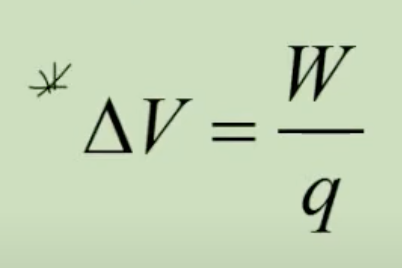
SACE: The electric potential difference, ΔV, between two points is the work done per unit of charge on a small positive test charge moved between the points, provided that all other charges remain undisturbed.
The electronvolt (eV) is a unit of measurement which describes the energy carried by a particle. It is the work done when an electron moves through a potential difference of 1 volt.
Solve problems involving the use of W = qΔV
Convert energy from joules into electronvolts and vice versa
What is the amount of potential energy gained by a charge dependent on?
.
.
Section: Electric and Magnetic Fields
SACE Terms: Non-specific.
Note: Should prooooobballly know this though; Be able to apply it
Include unit.
The work done.
Size of the charge on the particle.
Dividing the two gives the potential difference.
ΔV - potential difference (V), JC-1
Work done (W or ΔE) - J
A volt is defined as the work done per unit of charge.
SACE: The electric potential difference, ΔV, between two points is the work done per unit of charge on a small positive test charge moved between the points, provided that all other charges remain undisturbed.
The electronvolt (eV) is a unit of measurement which describes the energy carried by a particle. It is the work done when an electron moves through a potential difference of 1 volt.
Solve problems involving the use of W = qΔV
Convert energy from joules into electronvolts and vice versa
What is the conversion for electronvolts to joules?.
.
.
Section: Electric and Magnetic Fields
SACE Terms: Convert energy from joules into electronvolts and vice versa.
Note: Need to know!
1 eV = 1.6×10⁻¹⁹ J.
eV → Joules = times by 1.6×10⁻¹⁹
Joules → eV = divide by 1.6×10⁻¹⁹
always calculate in joules, then convert afterwards.
NEVER DO CALCULATIONS IN eV.
ALWAYS. CONVERT TO JOULES FIRST.
Do we ever calculate using eV?
.
.
Section: Electric and Magnetic Fields
SACE Terms: Convert energy from joules into electronvolts and vice versa.
Note: Need to know!
NO WE DO NAWT!
Convert to Joules first. Or if answer is asked to be in eV, calculate using Joules, and then convert to eV at the end.
What is the unit of potential difference?
.
.
Section: Electric and Magnetic Fields
SACE Terms: None
Note: Need to know!
V or one Joule per Coulomb (JC-1)
What is Work also equivalent to?
.
.
Section: Electric and Magnetic Fields
SACE Terms: None
Note: Be able to apply it. The situation depends, however.
W = Ek = ½ mv2
qΔV = ½ mv2
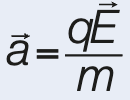
Show that the magnitude of the acceleration of the particle is given by a=qE/m.
.
.
Section: Electric and Magnetic Fields
SACE Terms: Derive the formula
Note: Derivation.
Refer to attached image.
Using Newton’s second law, Force is equal to mass times acceleration, which can be rearranged for acceleration, given by a=F/m.
Since E=F/q, then F=qE.
Thus, it follows that a = F/m = qE/m.
Could also be written as:
F=ma, but F=qE
F=F
ma= qE
divide both sides by m.
∴ a = qE/m
In terms of this formula and SACE:
Be able to derive the formula (as shown above).
Solve problems using a=qE/m and the motion formula for the movement of charged particles parallel or antiparallel to a uniform electric field.
Describe the motion of charged particles parallel or antiparallel to a uniform electric field.

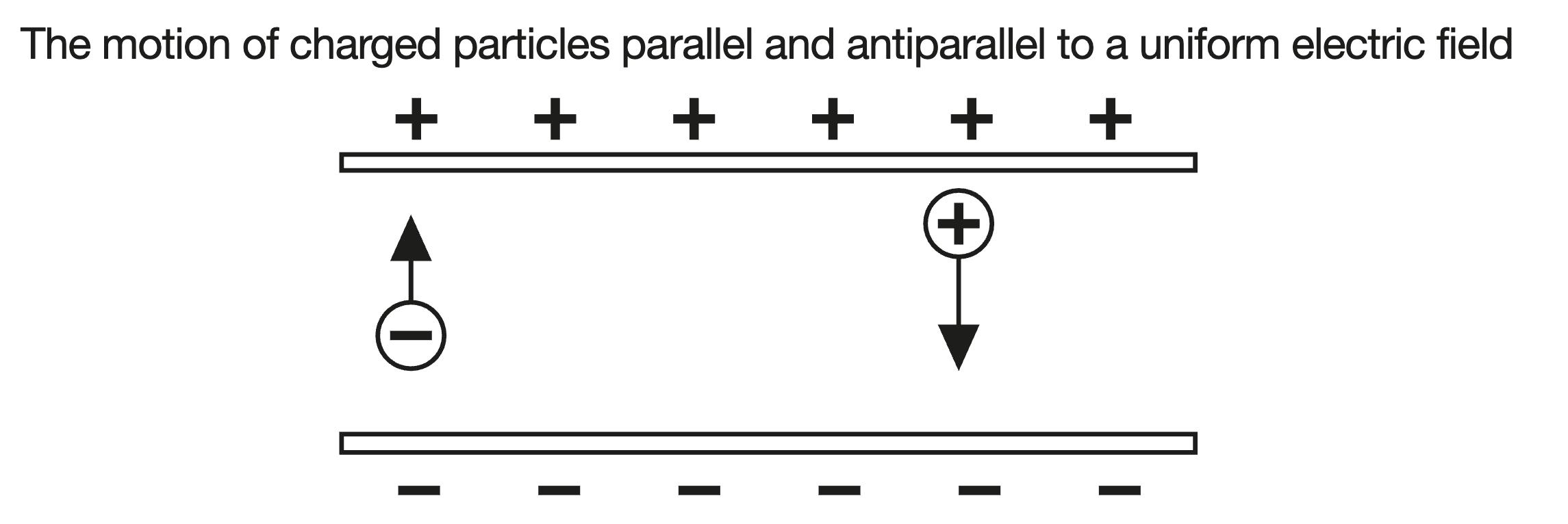
If there are two plates, an upper, positive plate, and a lower, negative plate. The electric field flows downwards (since, positive to negative).
If a positive and negative charge are place within this uniform electric field, what happens?
.
Section: Electric and Magnetic Fields
SACE Terms: Other side
Note: I don’t know if we need to word this out… but i will confirm…
The positive charge experiences a downward force due to the electric field, and accelerates towards the negative plate. Its motion is parallel to the electric field.
The negative charge experiences an upward force due to the electric field, and accelerates towards the positive plate. Its motion is antiparallel to the electric field.
SACE Terms: Describe the motion of charged particles parallel or antiparallel to a uniform electric field.
NOTE THE MOTION of a charged particle parallel and antiparallel to a uniform electric field can be analysed using the equations of motion described in topic 1.
v = vo + at
s = vot + ½ at2
v2 = vo2 + 2as
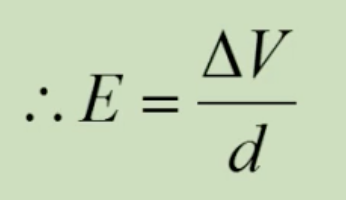
Derive E=ΔV/d.
.
.
Section: Electric and Magnetic Fields
SACE Terms: None
Note: Derivation….
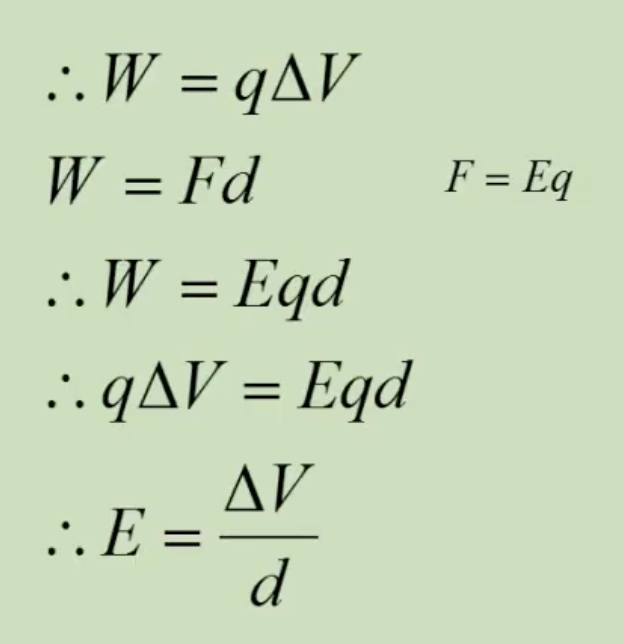
Refer to attached image.
The three formulas are W=qV, F=Eq, and W=Fs
What is the unit of uniform potential difference?
.
.
Section: Electric and Magnetic Fields
SACE Terms: None
Note: None
Vm-1
Ok this is essentially just another unit for electric fields (E)
(similar concept to how momentum can be sN or kgms)

What is the proportionality rules related to electric field strength?
.
.
Section: Electric and Magnetic Fields
SACE Terms: None
Note: None
Electric field strength is direction proportional to the potential difference between the two plates.
The electric field strength is inversely proportional to the distance between the plates.
What are the assumptions made when discussing the motion of a charged particle that enters a uniform electric field perpendicular to the field?
.
.
Section: Electric and Magnetic Fields
SACE Terms: There’s a lot.
Note: None
Ignore fringe effects: assume that the field is completely uniform.
Ignore gravity: it is quite easy to show that the acceleration due to gravity is insignificant compared with the acceleration caused by the electric field.
The magnitude of acceleration of the charge needs to be calculated using a=qE/m.
Before entering the electric field, the charge follows a straight line path: since there is no net force.
As soon as the charge enters the field, it begins to follow a parabolic path: because it has constant force always in the same direction.
As soon as the charge exits the field, it follows a straight line path: since there is no net force.
Horizontal component of velocity is constant (since the force of electric field is downwards; there is no force in the horizontal direction).
SACE Terms:
A charged particle moving at an angle to a uniform electric field experiences a force which effects both components of its horizontal velocity differently. The component of velocity parallel to the electric field changes due to the electric force, and the perpendicular component to the field remains constant.
Compare the motion of a projectile in the absence of air resistance with the motion of a charged particle in a uniform electric field.
Solve problems for the motion of charged particles that enter a uniform electric field perpendicular to the field.
Solve problems for the motion of charged particles that enter a uniform electric field at an angle to the field where the displacement of the charged particle parallel to the field is zero.
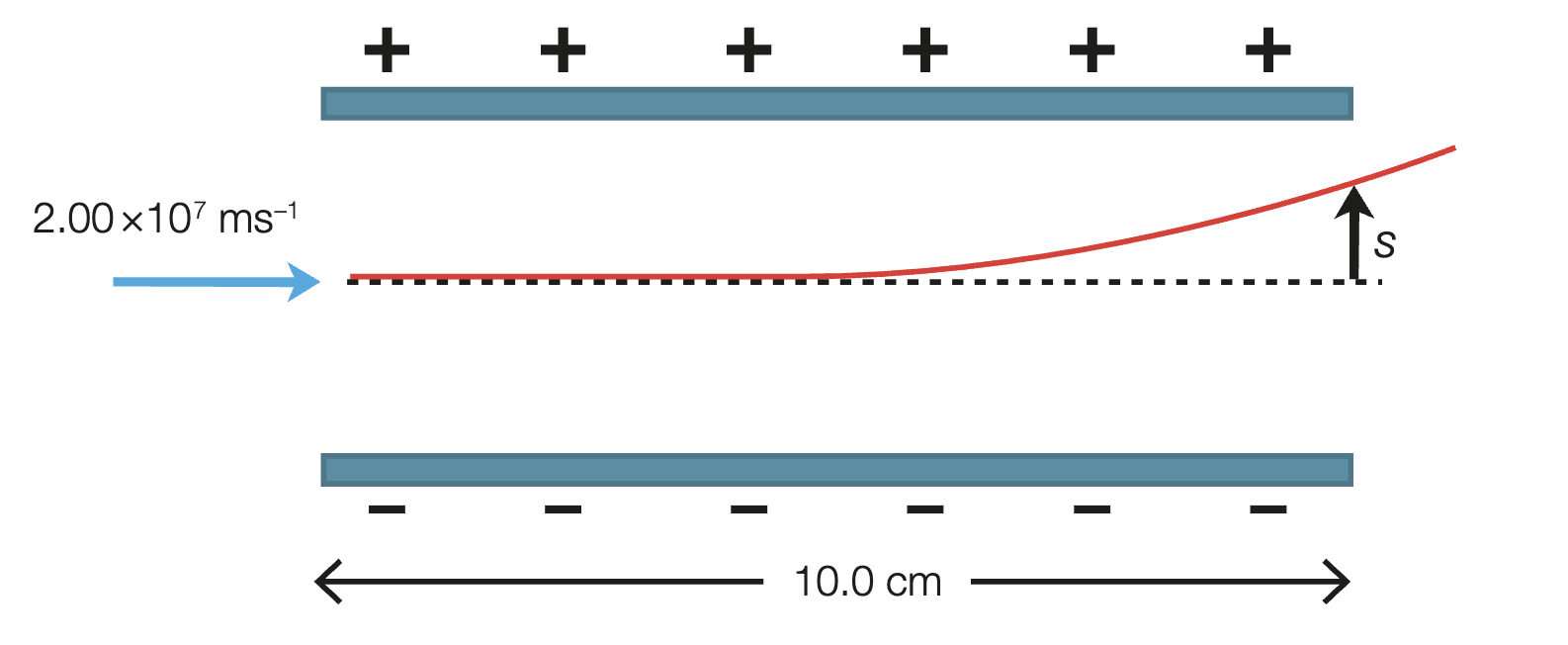
Consider the parallel conducting plates in the attached figure. Explain why the path of the electron is parabolic.
.
.
Section: Electric and Magnetic Fields
SACE Terms: There’s a lot.
Note: None
The electron enters in a direction that is perpendicular to the uniform electric field. The electric field exerts a constant vertical force (f=qE) towards the upper plate.
The electric field does not exert any horizontal force on the charge, so it follows that the component of velocity perpendicular to the electric field remains constant. (simply: horizontal component of velocity is constant).
The result is that the charge follows a parabolic path towards the upper plate.
SACE Terms:
A charged particle moving at an angle to a uniform electric field experiences a force which effects both components of its horizontal velocity differently. The component of velocity parallel to the electric field changes due to the electric force, and the perpendicular component to the field remains constant.
Compare the motion of a projectile in the absence of air resistance with the motion of a charged particle in a uniform electric field.
Solve problems for the motion of charged particles that enter a uniform electric field perpendicular to the field.
Solve problems for the motion of charged particles that enter a uniform electric field at an angle to the field where the displacement of the charged particle parallel to the field is zero.
Compare electric fields and magnetic fields.
.
.
Section: Electric and Magnetic Fields
SACE Terms: None
Note: Don’t think we need to write, but its good to know.
Electric Fields | Magnetic Fields |
|---|---|
Created by charges. | Created by natural magnetics (dipoles) or by moving charges.
|
Attractive or repulsive. | Attractive or repulsive. |
Dependent upon charge. | Dependent upon pole. |
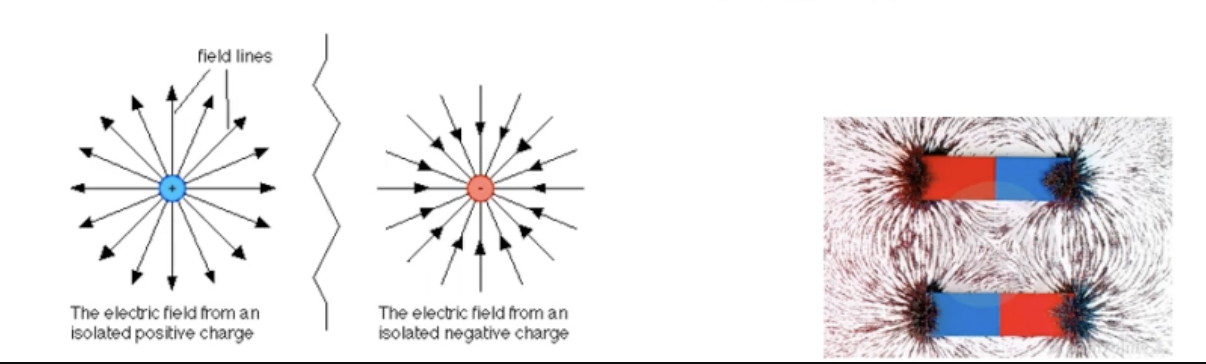
The two charges are distinct (can have charges which radiate fields inwards/outwards - refer to attached image). | The two poles are always connected (always connected forming a north and south pole - refer to attached image). |
What is the direction of a magnetic field?
.
.
Section: Electric and Magnetic Fields
SACE Terms: Sketch and/or interpret.
Note: Be able to apply it/sketch
In a magnet or something:
From North, towards South.
Direction of field is from North to South.
If not labelled, or in a wire:
SACE: The direction of the magnetic field depends on the direction of the moving charge that is producing the magnetic field.
Use a compass, whichever way that points; is the direction of the magnetic field.
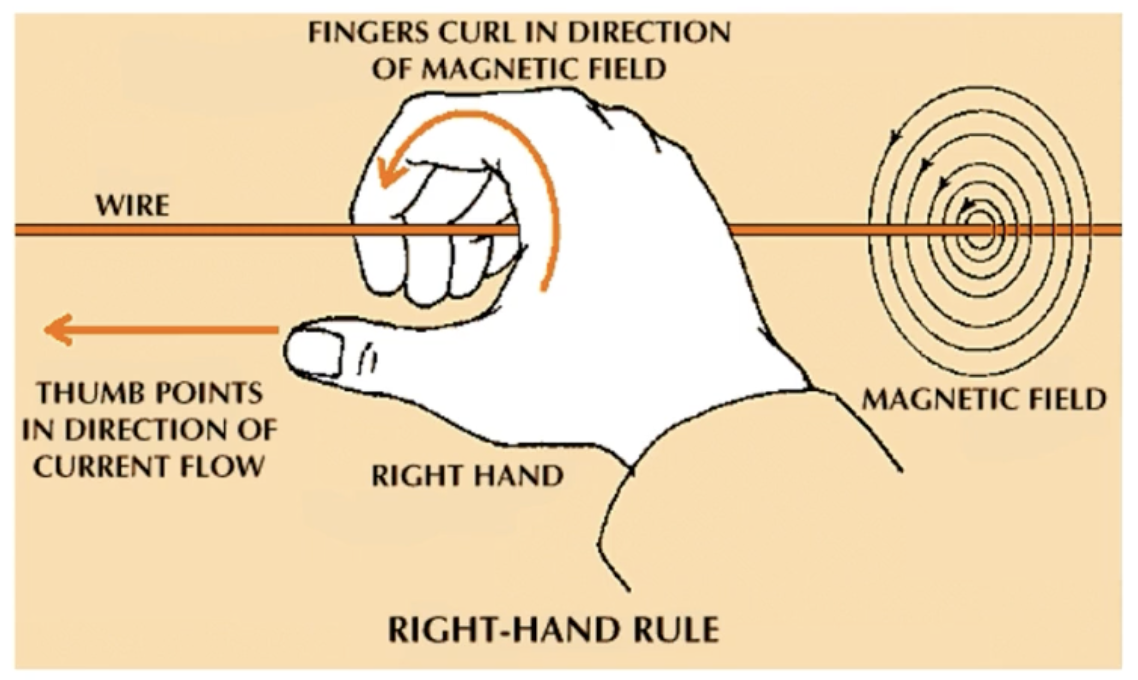
Magnetic fields follow the right hand curl rule.
How do you use the right hand curl rule to measure the direction of magnetic fields?
.
.
Section: Electric and Magnetic Fields
SACE Terms: None
Note: Be able to apply!!!!
Use right hand.
Thumb points in the direction of the conventional current.
Current is flow of electrons, but CONVENTIONAL CURRENT is the flow of protons.
Let fingers curl around naturally.
This motion depicts the direction of magnetic fields.
Some more notation: The wire is like O shaped not — shaped (if that makes sense), wire facing towards/aways from you).
If the current is coming out of the page towards you, you can see the “arrow tip.”
Drawn as a circle with a dot in middle.
If current is going into the page away from you, you can see the “cross of the arrow’s tail-feathers.”
Drawn as a circle with a cross in the middle.
This notation works for any vector not just current.
Do magnetic fields always form close loops?
.
.
Section: Electric and Magnetic Fields
SACE Terms: Sketch and/or interpret.
Note: Be able to apply
Yes.
There’s never any never-ending lines that radiate outwards (like in some electric fields).
Where does a compass point in relation to current?
.
.
Section: Electric and Magnetic Fields
SACE Terms: Sketch and/or interpret.
Note: Be able to apply
Perpendicular to current.
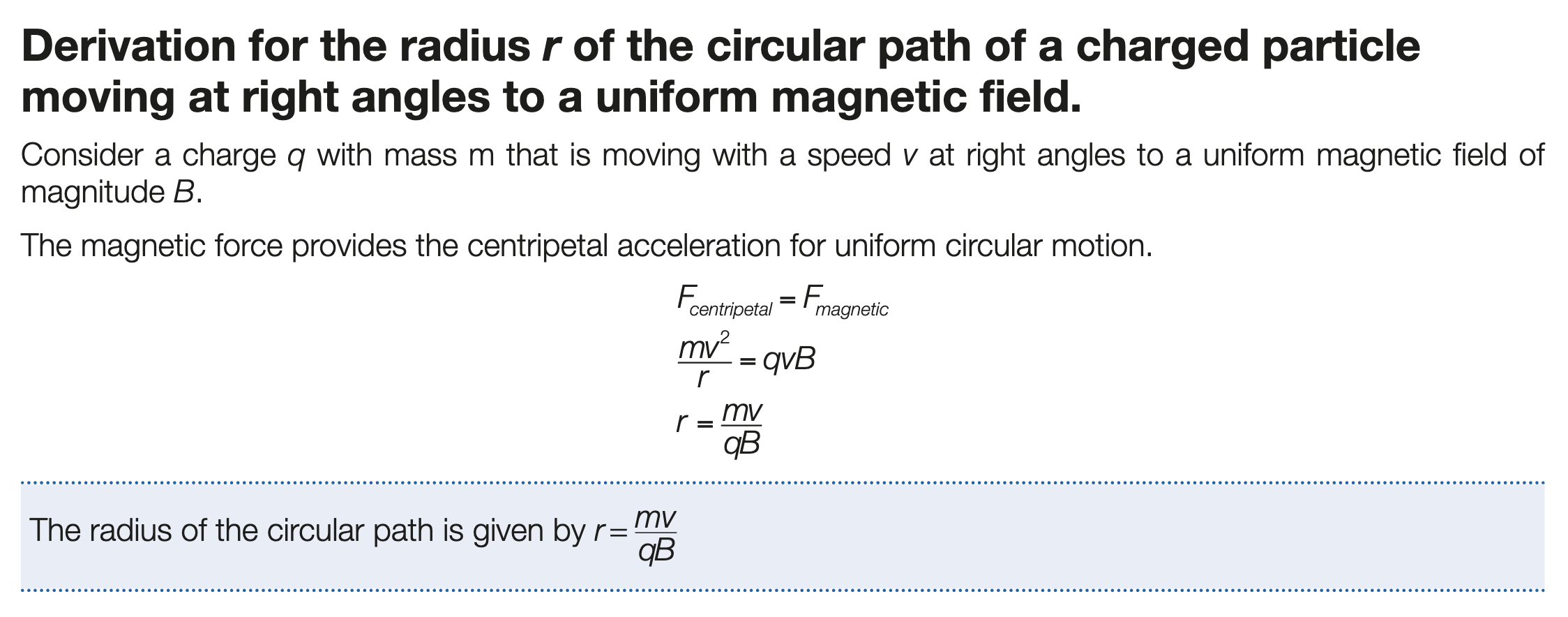
Derive r=mv/qB
.
.
Section: Electric and Magnetic Fields
SACE Terms: Derive.
Note: Be able to derive
Fcentripetal = Fmagnetic
mv2/r = qvB
(times by r, divide by qvB is essentially what happens)
r = mv/qB
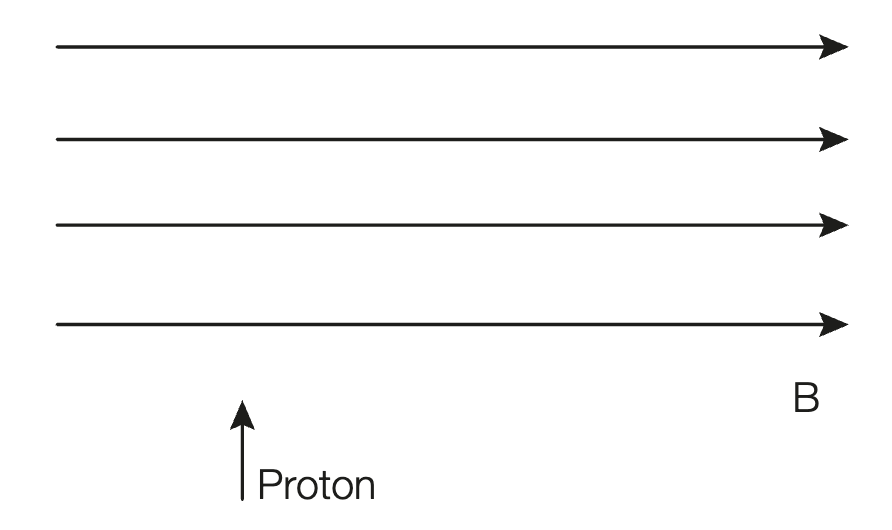
The diagram below shows a proton as it enters a uniform magnetic field of magnitude 1.80T with a speed of 2.50×10⁵ ms-1. The force acting on the proton as it enters the field is 7.20×10⁻¹³ N into the plane of the page (or into the screen).
.
.
Section: Electric and Magnetic Fields
SACE Terms: Non-specific (other side of card)
Note: None
The proton moves at right angles to the uniform magnetic field, and experiences a constance magnitude of force at right angles to its velocity.
This causes a change in direction, without a change in speed.
The magnetic force provides the centripetal acceleration required for uniform circular motion.
SACE:
A charged particle moving at right angles to a uniform magnetic field experiences a force of constant magnitude at right angles to the velocity. The force changes the direction but not the speed of the charged particle and hence the particle moves with uniform circular motion.
Explain how the velocity dependence of the magnetic force on a charge particle causes the particle to move with uniform circular motion when it enters a uniform magnetic field at right angles.
An electron and a proton travelling with the same velocity enter a uniform magnetic field at right angles to the magnetic field direction.
Compare the magnitude of force on the electron and proton as they enter the magnetic field.
.
.
Section: Electric and Magnetic Fields
SACE Terms: None
Note: Good to know since it’s talking about the formula
Force is given by F=qvBsinθ. Since q, v, B, and θ are constant, the force exerted on each the electron and proton as they enter the magnetic field is the same.
SACE:
A charged particle moving at right angles to a uniform magnetic field experiences a force of constant magnitude at right angles to the velocity. The force changes the direction but not the speed of the charged particle and hence the particle moves with uniform circular motion.
Explain how the velocity dependence of the magnetic force on a charge particle causes the particle to move with uniform circular motion when it enters a uniform magnetic field at right angles.
An electron and a proton travelling with the same velocity enter a uniform magnetic field at right angles to the magnetic field direction.
Explain whether the electron or the proton travels through the magnetic field in a circular path with greater radius.
.
.
Section: Electric and Magnetic Fields
SACE Terms: None
Note: Good to know since it’s talking about the formula
Radius is given by r=mv/qB, therefore r∝m. Since the mass of a proton is greater than the mass of an electron, the proton would thus travel in a circular path of greater radius.
SACE:
A charged particle moving at right angles to a uniform magnetic field experiences a force of constant magnitude at right angles to the velocity. The force changes the direction but not the speed of the charged particle and hence the particle moves with uniform circular motion.
Explain how the velocity dependence of the magnetic force on a charge particle causes the particle to move with uniform circular motion when it enters a uniform magnetic field at right angles.
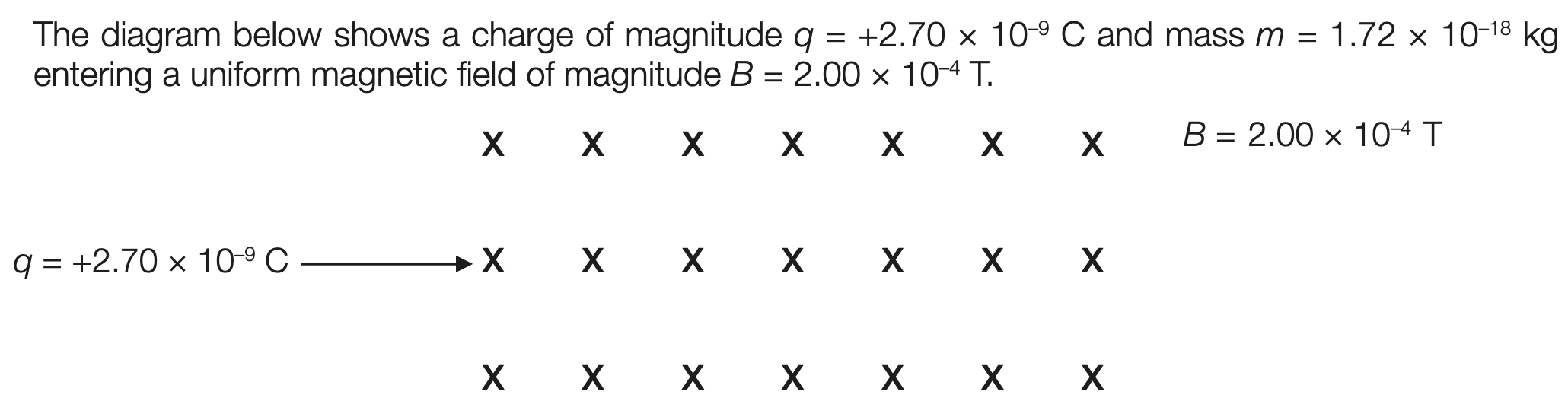
Refer to attached Image:
The charged particle traces a circular path with a radius of 5mm.
Determine the kinetic energy of the charge in eV as it enters the magnetic field.
.
.
Section: Electric and Magnetic Fields
SACE Terms: None
Note: (on other side)
Refer to attached image.
The formula: Ek = q2B2r2/2m cannot be used since it is with reference to the cyclotron.

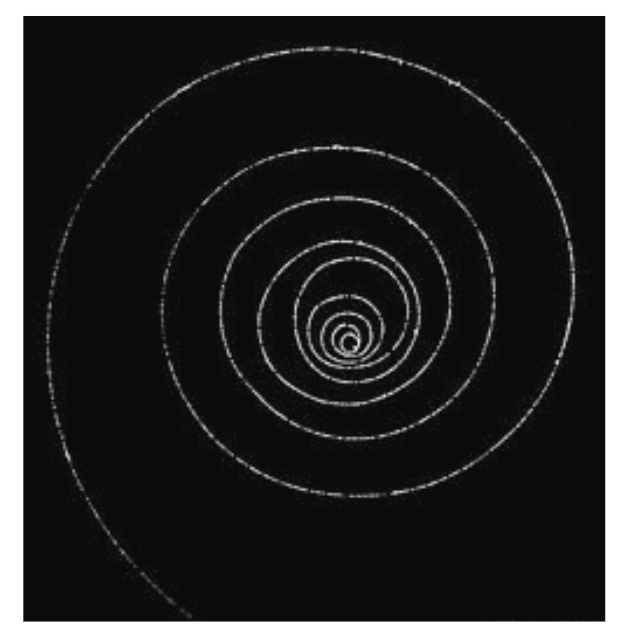
A bubble chamber containing hydrogen is placed in a magnetic field. When ions move through the chamber, they collide with H atoms. This ionises H atoms and the path of the ions become visible.
The attached figure depicts the path of an electron as it moves through a bubble chamber under the influence of a magnetic field perpendicular to the plane of the diagram.
The electron moves in a circular path that spirals inwards.
Explain why the radius of the circular path decreases as the electron moves through the bubble chamber.
.
.
Section: Electric and Magnetic Fields
SACE Terms: None
Note: Good to know
Radius is given by r=mv/qB, therefore r∝v.
As the electrons collide with the hydrogen atoms, they lose kinetic energy, and hence, speed.
Therefore, the radius of their circular path decreases as they spiral inwards.
What is the nature and direction of the magnetic field needed to deflect ions into a circular path in the dees of a cyclotron?
.
.
Section: Electric and Magnetic Fields
SACE Terms: Describe
Note: None
idcajcma
SACE:
Cyclotrons are used to accelerate ions to high speeds. Radioisotopes used in medicine and industry may be produced from collisions between high speed ions and nuclei.
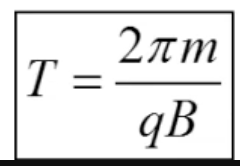
Derive T=2πm/qB.
.
.
Section: Electric and Magnetic Fields
SACE Terms: Derive
Note: None
Refer to attached figure.
SACE:
Derive for the formula for the period, T, of the circular motion of an ion, and hence show that the period is independent of the speed of the ion.
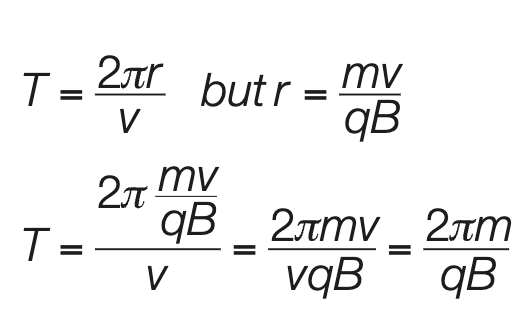
Does the period of the ions in cyclotron depend on the speed of the ion?
.
.
Section: Electric and Magnetic Fields
SACE Terms: Show that
Note: None
The period does not depend on the speed of the ions.
This means that the period of all the ions in the cyclotron is the same, and they all reach the gap between the dees, and hence the uniform electric field, at the same time.
Ions closer to the centre of the cyclotron travel in a circular path with a smaller radius, and therefore travel a smaller distance at a slower speed.
Ions closer to the outside of the cyclotron travel in a circular path with a larger radius, and hence travel further at a greater speed.
Since t=s/v, all the ions reach the electric field at the same time.
The potential difference can be reversed on a regular basis so that the charges continue to move through the cyclotron in on direction.
The potential difference applied across the dees is reversed every half revolution, ie. every πm/qB seconds.
SACE:
Derive for the formula for the period, T, of the circular motion of an ion, and hence show that the period is independent of the speed of the ion.
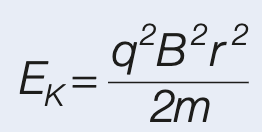
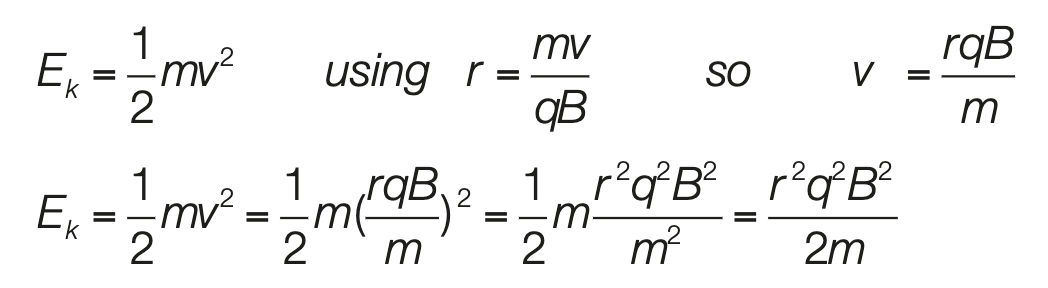
Derive Ek = q2B2r2/2m.
.
.
Section: Electric and Magnetic Fields
SACE Terms: Derive
Note: None
Refer to attached figure.
SACE:
Derive the formula Ek = q2B2r2/2m for the kinetic energy Ek of the ions emerging at radius, r, from a cyclotron.
Explain why Ek is independent of potential difference across the dees, and, for given ions, depends only on the magnetic field and the radius of the cyclotron.
Why is Ek independent of potential difference across the dees, and, for given ions, depends only on the magnetic field and the radius of the cyclotron?
.
.
Section: Electric and Magnetic Fields
SACE Terms: Explain
Note: None
The kinetic energy of emerging ions is independent to the potential difference across the dees.
A larger potential difference across the dees transfers more kinetic energy to the ions. Hence, they travel faster, and in circular paths of greater radii.
The ions cross the electric field fewer times before they emerge from the cyclotron.
A smaller potential difference across the dees transfers less kinetic energy to the ions. Hence, they travel slower, and in circular paths of smaller radii.
The ions cross the electric field more times before they emerge from the cyclotron.
The result is that the ions gain the same kinetic energy by the time they emerge from the cyclotron.
The kinetic energy of the emerging ions depends only on the magnetic field and the radius of the final circular path, ie. radius of the cyclotron.
SACE:
Derive the formula Ek = q2B2r2/2m for the kinetic energy Ek of the ions emerging at radius, r, from a cyclotron.
Explain why Ek is independent of potential difference across the dees, and, for given ions, depends only on the magnetic field and the radius of the cyclotron.
What is magnetic flux and electromagnetic induction?
.
.
Section: Electric and Magnetic Fields
SACE Terms: None
Note: None
SACE:
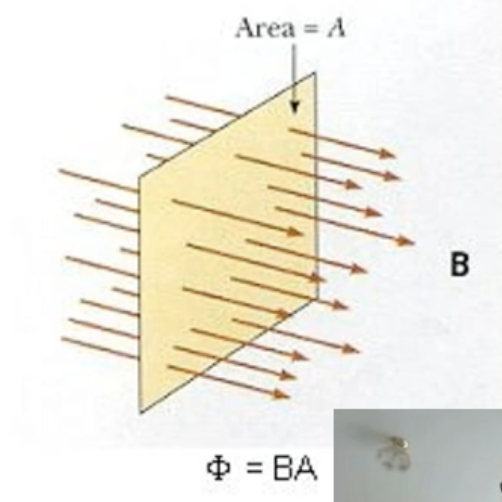
Magnetic flux (Φ) is defined as the product of magnetic field strength (B) and the area perpendicular to the magnetic field (A). Hence, Φ=BA (units: Wb).
Electromagnetic induction is the process in which a changing magnetic flux induces a potential difference in a conductor.
The induced potential difference is referred to as an electromotive force (emf).
The changing magnetic flux is due to relative movement of the conductor or variation of the magnetic field strength.
So essentially, it’s like putting a magnetic field through a wire to create a current (which is exact opposite to when there is a current flowing through a wire to create a magnetic field).
What is Faraday’s Law and what is Lenz’s Law?
.
.
Section: Electric and Magnetic Fields
SACE Terms: None
Note: None
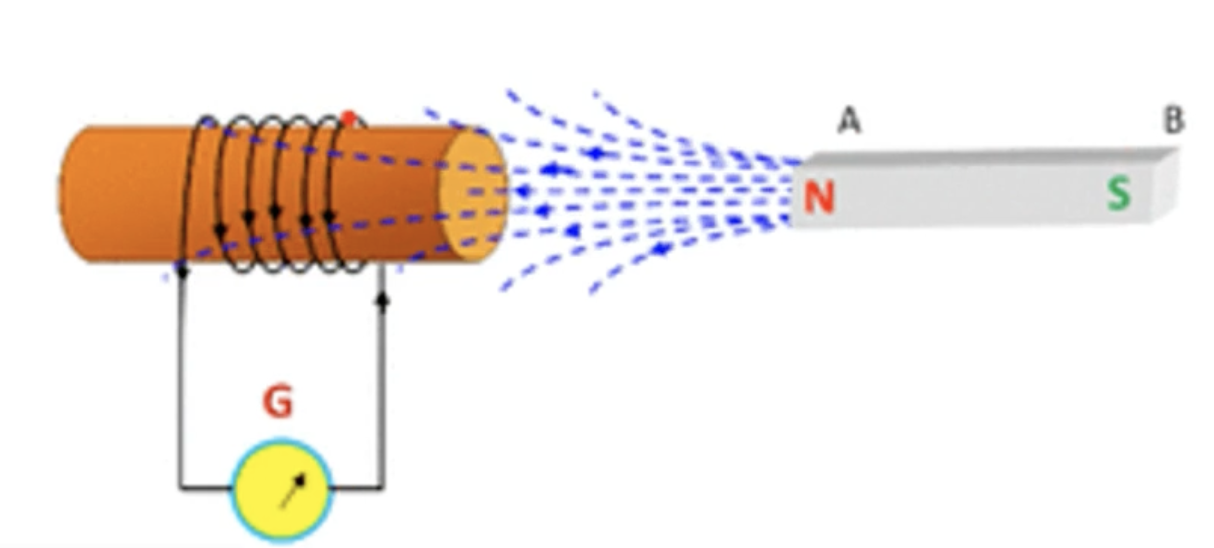
Faraday’s Law states that the induced emf is equal to the rate of change of the magnetic flux.
This means that the potential difference, or the current, that is picked up by the galvanometer, is equal to how much the magnetic field is changing through the loops (of the wire) — refer to attached figure.
Lenz’s Law states that the direction of a current created by an induced emf opposes the change in magnetic flux producing the emf. Hence, emf=ΔΦ/Δt.
The induced emf (the emf that causes the current), creates a current in the direction that opposes the magnetic flux.
This means that the current made spins in a certain direction so that the magnetic field (using right hand-curl rule) opposes it (opposite direction of the blue lines shown in attached figure).
The formula: emf=ΔΦ/Δt, only works for one loop (of the conductor), for N conducting loops, the induced emf is given by emf=NΔΦ/Δt.
In the attached figure there are 6 loops.
SACE:
Solve problems involving the induction of an emf in a straight conductor.
Solve problems involving the induction of an emf in N conducting loops.
Use Lenz’s Law to determine the direction of the current produced by an induced emf.
Use the law of conservation of energy to explain Lenz’s Law
Use Lenz’s Law to explain the production of eddy currents.
What is Lenz’s Law in terms of conservation of energy?
.
.
Section: Electric and Magnetic Fields
SACE Terms: Use the law of conservation of energy to explain Lenz’s Law.
Note: This card needs some working on.
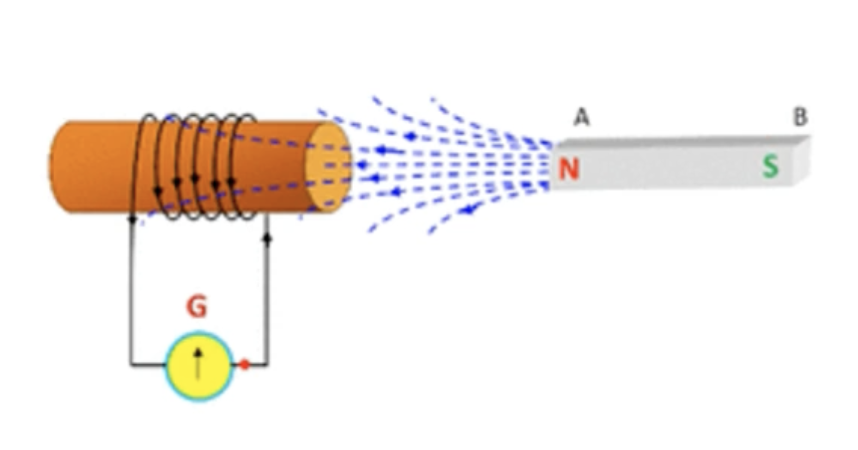
Lenz’s Law obeys the conservation of energy.
When the magnet is moved back and forward, a current is created in the bottom wire (refer to attached figure).
The conservation of energy states that energy can neither be created nor destroyed.
However, as the magnet is moving forward energy is ‘created,’ which means it must be lost elsewhere.
The way it is lost is when the magnet is moving, the magnetic field created by the wires opposes that (experience a repulsive force).
How does Lenz’s Law explain the production of eddy currents?
.
.
Section: Electric and Magnetic Fields
SACE Terms: Use Lenz’s Law to explain the production of eddy currents.
Note: None
An eddy current is the current inducted in little swirls (“eddies”) on a large solid conductor due to a changing magnetic field.
Eddy currents are created to oppose the magnetic field that is on a piece of metal.
How are generators used to produced electric current?
.
.
Section: Electric and Magnetic Fields
SACE Terms: Explain
Note: This card needs working on.
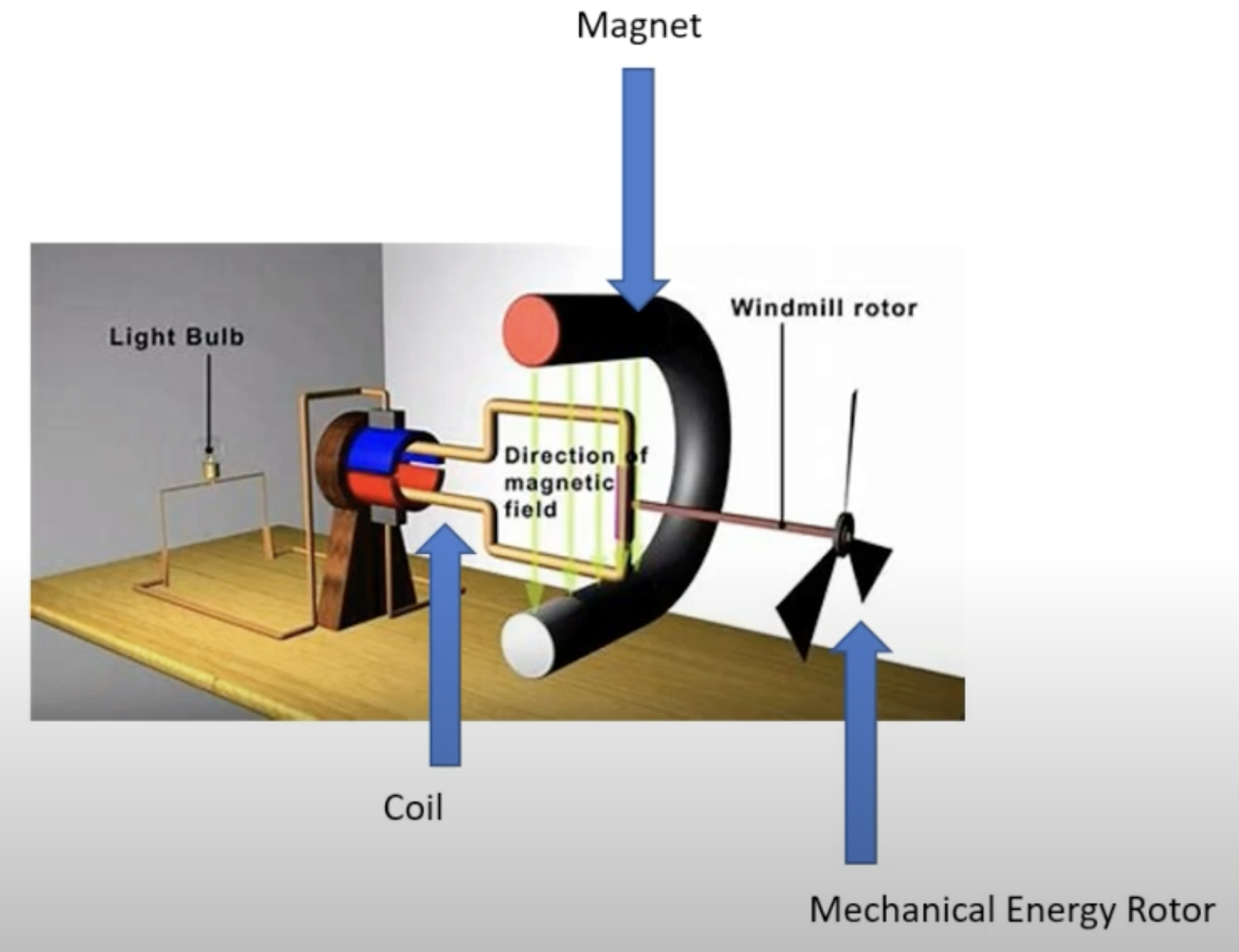
A generator uses a fixed magnet to generate emfs in rotating conducting loops for electricity production.
A generator therefore converts rotational mechanical energy into electrical energy.
Refer to attached figure.
The mechanical energy rotor causes the coil to rotate within the magnetic field.
This produces emfs (potential differences).
These potential differences can then converted into electric current.
Potential differences cause electricity to flow.
The voltage produced would then alternate from high (full area of coil exposed), to low (minimal area of coil exposed), thus producing alternating (AC) current.
need to work on this card since there’s also DC current too, and how those are produced…
What is the purpose of a transformer in electrical circuits?
.
.
Section: Electric and Magnetic Fields
SACE Terms: Explain
Note: None
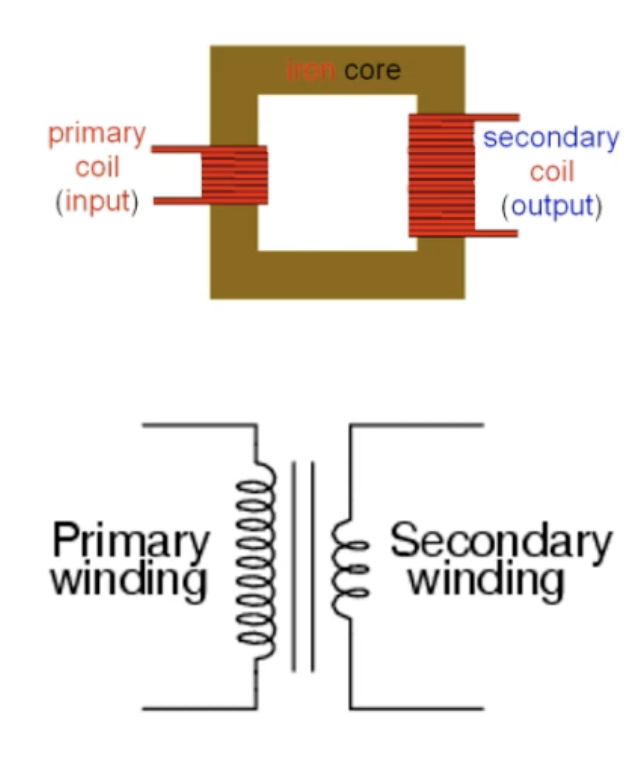
Transformers allow generated voltages to be either increased or decreased before they are used.
A transformer consists of a primary coil (with Np turns) with a potential difference (Vp), and a secondary coil (with Ns turns) with a potential difference (Vs).
Primary coil (input), where electricity is put in.
The relationship between the potential differences across the primary and secondary coils is given by: Vp/Vs = Np/Ns.
What is the difference between step-up and step-down transformers?
.
.
Section: Electric and Magnetic Fields
SACE Terms: Compare
Note: None
If the number of turns in the secondary coil is greater than the number of turns in the primary coil, then the transformer is referred to as a step-up transformer. This is because the potential difference in the primary coil is less than that in the secondary coil. The output current is lower than the input current.
If the number of turns in the secondary coil is smaller than the number of turns in the primary coil, then the transformer is referred to as a step-down transformer. This is because the potential difference in the primary coil is greater than that in the secondary coil. The output current in higher than the input current.
Step-up:
Step-up transformers are designed to increase the potential difference from primary to secondary.
Potential difference goes in, because there is an increase of number of coils in the output, there is larger potential difference.
Number of coils at start is smaller than number of coils at the end.
Step-down:
Step-down transformers are designed to decrease the potential difference from primary to secondary.
Large amount of coils at the start, and smaller amount at the end.
Decreases potential difference.
What is the difference between EMF and potential difference?
.
.
Section: Electric and Magnetic Fields
SACE Terms: None
Note: what emf was really confused me so here we are
In a basic circuit there is something which supplies or is a source of voltage (emf), and another which uses the voltage (potential difference - voltage which arises from a use of voltage).
EMF is defined: when something takes a different form of energy and converts in into electrical energy (e.g batter → chemical to electrical).