Perfectly Competitive Market Clearing Model
 Call Kai
 Learn
Learn Practice Test
 Spaced Repetition
 Match
Match Flashcards
 Knowt Play
1/17

There's no tags or description
Looks like no tags are added yet.
Name | Mastery | Learn | Test | Matching | Spaced | Call with Kai |
|---|
No analytics yet
Send a link to your students to track their progress
18 Terms
Demand
The quantity of some good or service consumers are willing and able to purchase at each price
Law of Demand - Ceteris Paribus
If price goes up, then quantity demanded goes down.
If price does down, then quantity demanded goes up.
Normal Good
A product for which demand increases when income rises, and vice versa
Inferior Good
A product for which demand decreases when income rises, and vice versa
Substitute
A good or service that we can use in place of another good or service
Complements
Goods or services that are often used together so that consumption of one good tends to enhance consumption of the other
Market Demand Curve
A graph plotting the total quantity of an item demanded by the entire market, at each price.
Shift in Demand
Happens when a change in some economic factor (other than price) causes a different quantity to be demanded at every price
Demand Determinants
Income
Changing tastes or preferences
Changes in the population
Price of substitute or complement changes
Changes in expectations about future
Supply
The amount of some good or service a producer is willing to supply at each price
Law of Supply - Ceteris Paribus
If price goes up, then quantity supplied goes up
If price goes down, then quantity supplied goes down
Shift In Supply
When a change in some economic factor (other than price) causes a different quantity to be supplied at every price. Also explains why quantity supplied changes when price stays constant.
Inputs or Factors of Production
The combination of labor, materials, and machinery that is used to produce goods and services
Supply Determinants
Natural conditions
Input Prices
Technology
Government Policies
Number of firms producing the good
Perfect Competition
Markets in which all firms in an industry sell an identical good and there are many buyers and sellers, each of whom is small relative to the size of the market
Equilibrium
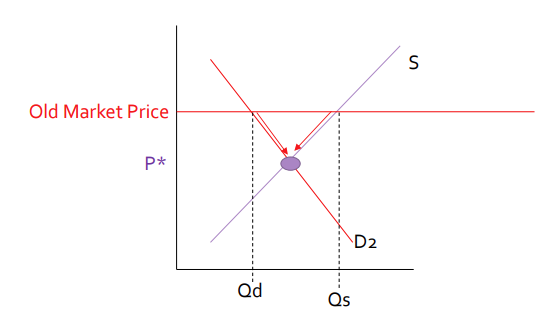
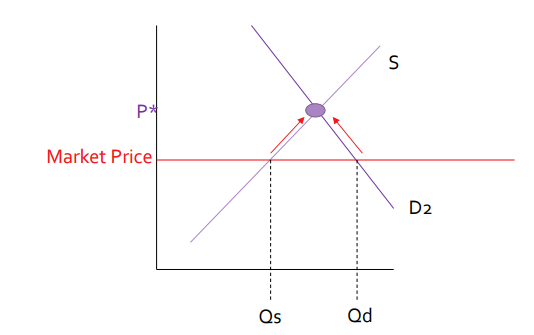
The point at which there is no tendency for change. A market is in equilibrium when the quantity supplied equals the quantity demanded.
Shortage
When the quantity demanded exceeds the quantity supplied
Surplus
When the quantity demanded is less than the quantity supplied