Updated CT IV
 Call Kai
 Learn
Learn Practice Test
 Spaced Repetition
 Match
Match Flashcards
 Knowt Play
1/38

There's no tags or description
Looks like no tags are added yet.
Name | Mastery | Learn | Test | Matching | Spaced | Call with Kai |
|---|
No analytics yet
Send a link to your students to track their progress
39 Terms
for two materials to be differentiated
they have to be atleast 10 HUs away from each other
max dose of contrast medium given in a day
200 ml contrast + 64 g iodine
total volume given: 50-150 ml
studies for chest, abdomen injection rate
1-3 ml/sec
special procedure injection rate
CTAs, cardiac imaging
up to 4-5 ml/sec
which phase of contrast enhancement to use
depends on pt size, cardiac output, contrast agent [], injection rate
multiphase protocol
getting images from different ehancement phases
arterial phase I
immediately follows contrast administration, lasts for 60 s
arterial structure enhancement (can see difference between artery and vein)
arterial phase requires
arterial venous iodine difference of 30 or more Hus
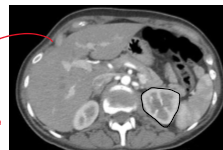
venous phase
follows arterial phase, begins 1 min after injection
contrast still in artery, vein, organ parenchyema
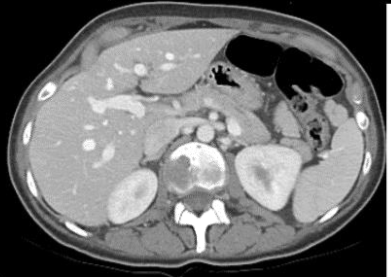
what is the contrast phase that most studies use
venous phase
equilibrium delay phase
last phase, 2 mins after venous
requires arterial venous iodine difference <10 Hus
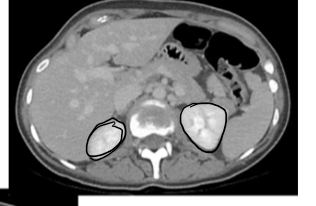
venous phase requires
difference of 10 to 30 HU of arterial venous iodine difference
equilibrium delay phase II
contrast mostly empty from artery, diluted in vein, entered organ parenchyma, see more contrast in kidney/ureter (bc contrast start to exit bodY0
what is the most common, easiest, and accurate dosimeter
ion chamver
ion chamber process
collect electron charge
electrometer removes charge and measures RT dose
what are the type of dosi phantoms
16 cm (head) or 32 cm (body) (diameter)
16 cm diameter dosi phantom
used to simulate adult head or child abdomen
holes to position ion chamber
32 cm diameter phantom
sim adult abdomen
holes to position ion chamber
CT dose descriptors
Multiple scan average dose
ct dose index
dose length product
effective dose
size specific dose estimate
every scan must have which CT dose descriptors
multiple scan average dose (MSAD)
CT dose index (DLP)
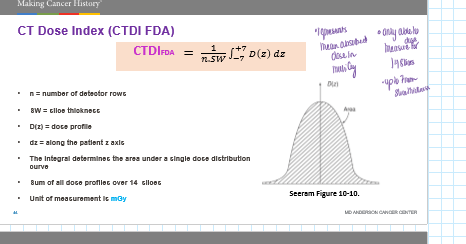
CT Dose index: CTDI FDA
represents mean absorbed dose in mGy
only able to measure dose for 14 slices, up to 7 mm thickness
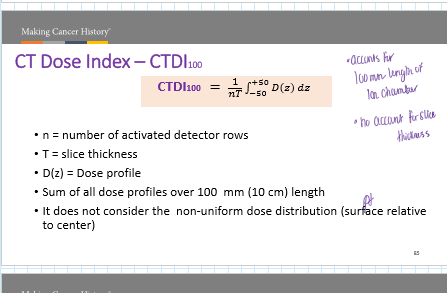
CTDI 100-what does it account for
accounts for 100 mm length of ion chamber
sum of all dose profiles over 100 mm length
CTDI 100 no account for
no acocunt for slice thicnkess
no account for the non-unfirom dose distribution (surface relative to center)
CTDI weighted (w)
accounts for non uniform distribution (center vs periphery)
no account for pitch

what CT dose index is used for calc today
CTDI volume
what is CTDI vol
standardized measure of radiation output of CT system and no represent actual absorbed dose in patient
no consider the total scan length
what does CTDI vol account for and not account for
account for dose in the z axis by inclusion of pitch
does not consider total scan length

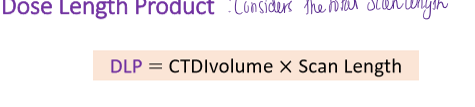
what is dose length product
provides estimate of total amount of radiation absorbed by patient for a series of scans
measurement unit: mGy-cm
what does dose length product account for and not account for
considers total scan length
no consider organ/tissue relative radiosensitivty
iodine is an example of
positive contrast agent
the most accurate method of estimating CT dose involves
ion chamber
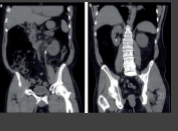
which of the follow pathologies can be diagnosed in this CT image
aortic dissecition
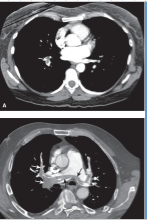
pulmonary embolism
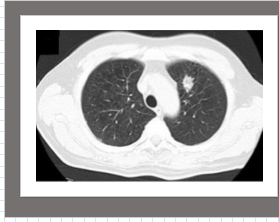
lung carcinoma
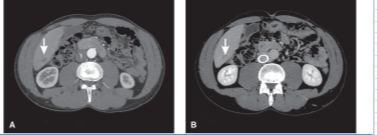
hemangioma
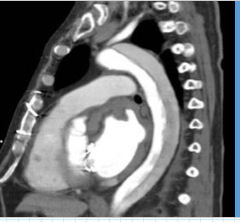
aortic dissection
focal nodular hyperplasia
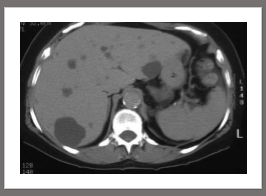
hepatic cyst
renal calculus