Introduction to Cognitive Rehabilitation in Occupational Therapy
 Call Kai
 Learn
Learn Practice Test
 Spaced Repetition
 Match
Match Flashcards
1/41

There's no tags or description
Looks like no tags are added yet.
Name | Mastery | Learn | Test | Matching | Spaced | Call with Kai |
|---|
No analytics yet
Send a link to your students to track their progress
42 Terms
What is cognition?
The mental process of knowing, learning, understanding, and the way knowledge is implemented in everyday life.
What are cognitive deficits?
Impairments in cognitive functions such as memory, orientation, perception, and language processing.
Define functional cognition.
The ability to use and integrate thinking and performance skills to accomplish complex everyday activities.
What is the ultimate goal of occupational therapy practitioners?
To enhance participation in daily activities.
What methods are used to assess cognition?
Self-report questionnaires, direct observation, standardized cognitive assessments, and environmental assessments.
What does neuroplasticity refer to?
The brain's ability to reorganize itself by forming new neural connections throughout life.
How can active participation in activities affect cognitive decline?
Engaging in social, physical, and cognitive activities can prevent cognitive decline.
What is the remedial approach in cognitive rehabilitation?
A strategy that focuses on restoring cognitive skills through direct retraining.
What is the adaptive approach in cognitive rehabilitation?
A strategy that adapts tasks or environments to match a person's abilities.
What is the top-down approach in cognitive rehabilitation?
An approach that focuses on the tasks and functions individuals want or need to perform.
What is the bottom-up approach in cognitive rehabilitation?
An approach that focuses on the underlying causes of functional limitations.
What is an example of a compensatory strategy in cognitive rehabilitation?
Using a calendar to remember appointments or alarms to complete chores.
What is the focus of the functional-experiential approach?
Improving a person's ability to perform meaningful tasks without distinguishing between remediation and compensation.
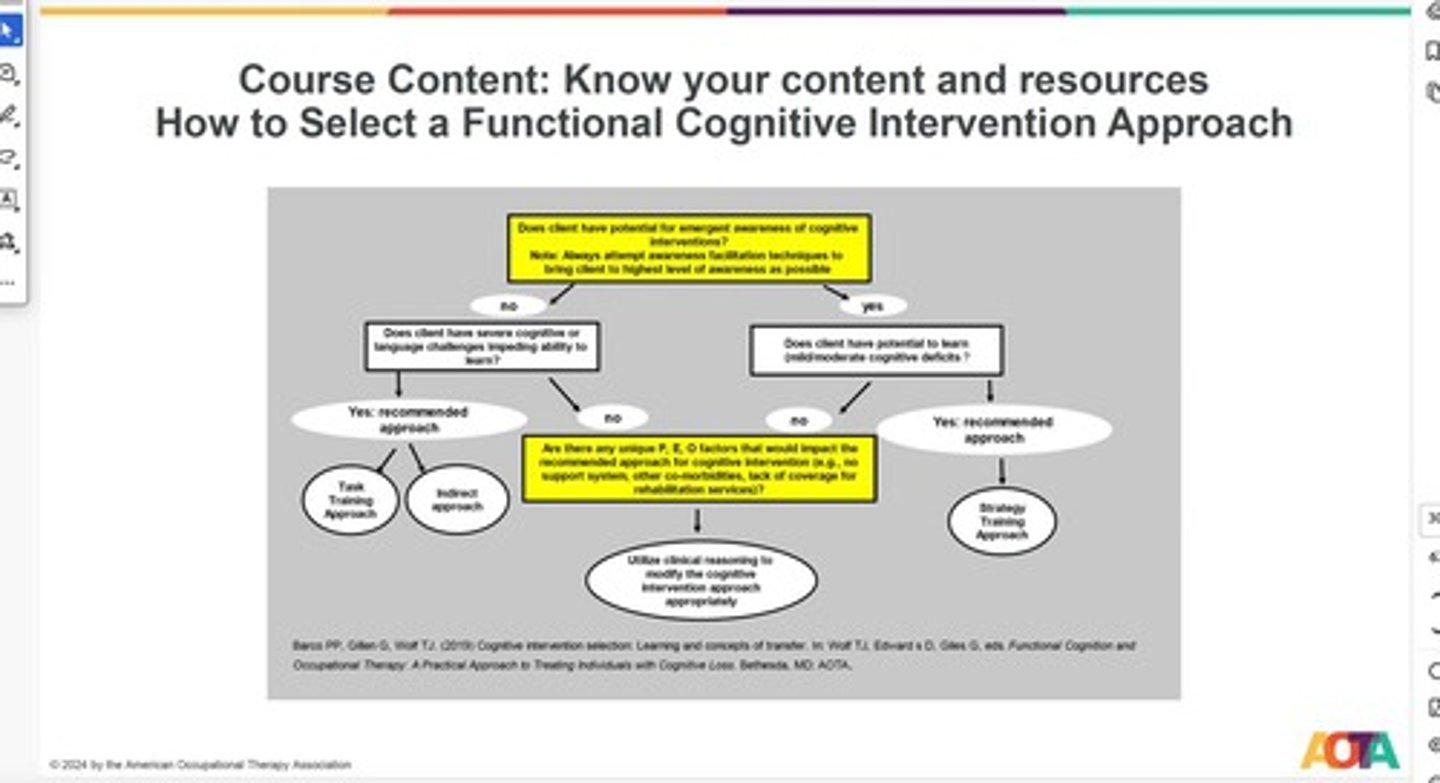
What cognitive rehabilitation approach is used when a client has memory lapses and difficulty organizing thoughts?
Bottom-up approach, focusing on activities specific to the client's needs.
What are the steps in the evaluation process for cognitive rehabilitation?
Vision, perceptual, and cognitive evaluations.
What factors can influence the brain according to neuroscience?
Experiences and environmental demands.
What is the significance of self-awareness in cognitive rehabilitation?
It is crucial for the person to recognize their cognitive deficits for effective rehabilitation.
What role does task-specific training play in cognitive rehabilitation?
It directly teaches and trains individuals to perform specific tasks.
How can cognitive rehabilitation address attention and executive function?
Through targeted exercises and strategies that improve these cognitive skills.
What is the impact of neuroreservation on cognitive function?
People who challenge themselves cognitively have a greater neuroresilience.
What is the relationship between cognitive engagement and neuroplasticity?
Cognitive engagement enhances neuroplasticity, leading to better cognitive outcomes.
What is the importance of assessing the environment in cognitive rehabilitation?
It helps to ensure safety and quality of life for individuals undergoing rehabilitation.
What is a common example of an adaptive strategy in cognitive rehabilitation?
Using online shopping instead of going to a physical store.
What is the first step in the assessment process?
Reviewing the medical record and speaking to team members who previously worked with the client.
What is involved in interviewing the client?
Gathering information from the client and caregivers about their needs and experiences.
What are bottom-up assessments designed to measure?
Component skills and deficit areas related to occupational performance tasks.
What is the focus of top-down assessments?
Examining the client's performance in specific occupational tasks without looking at their habits.
What is a quantitative (static) assessment?
An assessment that provides numerical measurements and does not allow active intervention during evaluation.
What do standardized quantitative assessments compare?
A client's performance with established norms.
What is the purpose of static evaluations?
To diagnose, monitor progress, plan discharge, educate clients/caregivers, and conduct clinical research.
What does dynamic assessment measure?
A client's learning potential through interaction and planned teaching or intervention.
What type of data does qualitative assessment provide?
Non-numerical data, such as motivation, depression, and confidence levels.
What are the three primary methods of qualitative evaluation?
Clinical observation, interviews, and visual data from medical records.
What is the role of clinical observation in assessments?
To monitor progress and response to therapy while noting factors affecting performance.
How can interviewing contribute to the assessment process?
By building rapport, understanding the client's role and routines, and identifying goals.
What client-related questions should be considered when choosing an evaluation?
Is the client ready for assessment? What is their age and diagnosis? What further information is needed?
What assessment-related questions should therapists consider?
What model guides practice? For what population was the tool developed? Is the assessment reliable and valid?
What is the difference between static and dynamic assessments?
Static assessments provide no feedback and focus on pre-existing skills, while dynamic assessments involve feedback and emphasize learning.
What is the relationship between examiner and test-taker in static assessments?
It is a one-way relationship with no feedback provided to the test-taker.
What is the relationship between examiner and test-taker in dynamic assessments?
It is a two-way interactive relationship where feedback is provided until the test-taker succeeds or gives up.
What is an example of a standardized static assessment?
SLUMS (Saint Louis University Mental Status) examination.
What is an example of a standardized dynamic assessment?
Allen Cognitive Level Screen.