ESS 17 Final Review
 Call Kai
 Learn
Learn Practice Test
 Spaced Repetition
 Match
Match Flashcards
 Knowt Play
1/70

Earn XP
Description and Tags
picks up from where midterm content ended - final cumulative of all content
Name | Mastery | Learn | Test | Matching | Spaced | Call with Kai |
|---|
No analytics yet
Send a link to your students to track their progress
71 Terms
The Atmosphere
What is electromagnetic radiation? What emits electromagnetic radiation?
waves that move at the speed of later, regardless of amplitude/wavelength
shorter wavelengths = higher energy
longer wavelengths = lower energy
everything with mass emits radiation
hotter bodies emit shorter wavelengths with high energy
What is luminosity? What is albedo? What is the greenhouse effect?
luminosity: sun’s power output, often measured in Watts
albedo: fraction of solar energy reflected away
larger albedo = larger reflection
smaller albedo = smaller reflection
greenhouse effect: natural process where atmospheric gases (ex. carbon dioxide, methane) trap heat from sun
ozone traps high intensity shortwave radiation (“ozone layer”) → why we have life on earth
How do Earth’s mechanics explain the global distribution of heat on the planet?
geometry of heating
the Earth is a sphere so sun rays strike equator perpendicularly (concentrates intense heat into small area)
at higher latitudes (closer to poles) the same amt of solar energy strikes globe at oblique angle & spreads heat over larger surface area
atmospheric & oceanic redistribution
unequal heating → massive convection currents
warm air rises at equator, cools & drops around 30 degrees latitude → creates global trade winds & major deserts
Coriolis Effect: earth’s rotation deflects moving air/water to…
RIGHT in Northern hem
LEFT in Southern hem
ocean currents
warm currents move massive amts of heat from tropics → higher latitudes
energy balance
occurring atmospheric gases trap portion of outgoing heat, ensuring planet remains warm enough to support life
How does the tilt of the Earth explain the seasons? Be able to identify the seasons given a diagram.
Earth’s axis is tilted at 23.5 degrees
Obliquity (41,000 year cycle) determines how tilted the earth’s axis is
the higher the tilt the warmer the summers & cooler the winters (extremities)
without tilt everywhere would have exactly 12hrs of daylight
tilt affects the amount of solar energy reaching diff locations on earth' throughout the year (influences period of daylight)
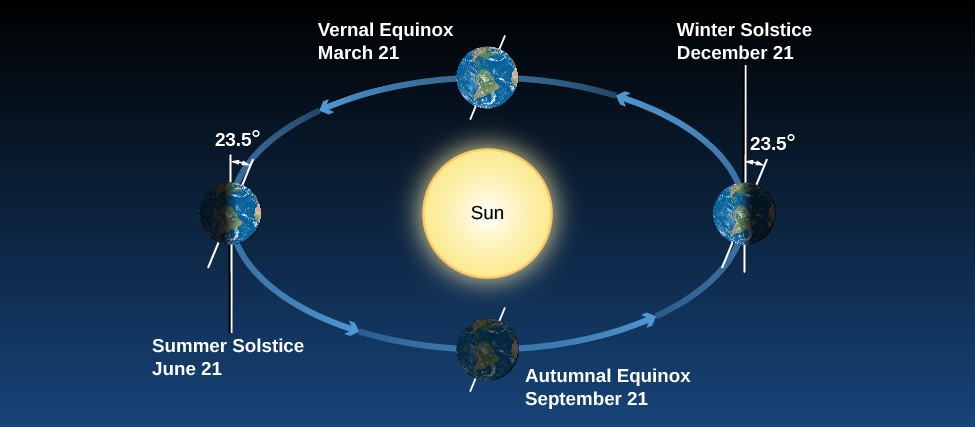
summer = tilted toward the sun
winter = tilted away from the sun
What is the difference between perihelion and aphelion?
perihelion = point of earth’s orbit nearest the sun
happens in early January ~2 weeks after December (winter) solstice
aphelion = point of earth’s orbit furthest away from sun
happens in early July ~2 weeks after June (summer) solstice
What is pressure, and what causes changes of air pressure on our planet?
air pressure = weight of air molecules in atmosphere pressing down on surface below
causes in changes of air pressure
warm air molecules move faster & spread further apart → air less dense & lighter → rising warm area creates LOW pressure area
cool air molecules pack close together → dense & heavier → sinks toward earth creating HIGH pressure area
higher altitudes = pressure drop
humid moist air is less dense than dry air → low pressure
low pressure systems associated with rising air (clouds, storms)
high pressure systems associated with sinking air (clear, fair weather)
What are the winds, and which way would they flow on a non-rotating planet?
winds are horizontal movements of air across a planet’s surface, driven by sun heating atmosphere unevenly
on a non-rotating planet winds would flow straight from the poles to the equator at the surface then back from equator to the poles high in the atmosphere
Predict how the coriolis effect may impact the movement of a parcel of air.
Coriolis effect causes moving air to CURVE due to earth’s rotation
in Northern hem = deflects to right
in Southern hem = deflects to the left
results in major global wind belts, cyclonic rotations, jet streams
What are the ways in which we can measure atmospheric moisture?
relative humidity = ratio of water vapor currently in air to the max amount the air could hold at specific temp (%)
dew point temp = temp to which air must be cooled to become fully saturated (100% RH)
how air “feels”
absolute humidity = mass of water vapor in specific volume of air
specific humidity = mass of water vapor relative to total mass of air parcel
total precipitable water = total depth of liquid water if all water vapor in atmospheric column were condensed
Be able to draw and utilize the saturation vapor pressure graph to determine the dew point temperature and relative humidity of a parcel of air.
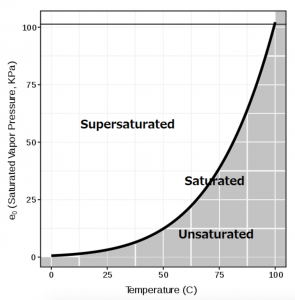
find RH
locate air temp (x axis)
move vertically up until you reach curve
move left to y axis to find saturation vapor pressure (max moisture air can hold)
locate actual vapor pressure on y axis
RH = actual/saturation x 100%
find dew point temp
locate actual vapor pressure on y axis
follow value until it reaches SVP curve
move straight down to x-axis (temp is dew point)
Calculate relative humidity
RH = actual/saturation x 100%
Explain adiabatic cooling and heating.
adiabatic cooling = air cools down as it expands without any heat being added/removed from outside environment
adiabatic heating = air warms up as it compresses without heat added/removed
Explain how clouds form
as unsaturated air rises, temp drops at dry adiabatic lapse rate = 10 C/km
relative humidity increases
air becomes saturated (dew point)
condensation starts at altitude
condensation releases altent heat
heat released decreases rate of cooling = saturated adiabatic lapse rate = 5 C/km
Weather/Thunderstorms
What are the similarities and differences between weather and climate?
weather = state of atmosphere at a given time & place
climate = average weather over a long period of time
both involve describing events taking place in our atmosphere
Predict how cold and warm fronts impact severe weather events
cold fronts
trigger sudden & violent severe weather
wedges UNDER warm air to create rapid updrafts
warm fronts
drive less explosive but prolonged severe weather
overrides cold air → generates extensive stratiform clouds & ocassional thunderstorms
Describe the formation of a thunderstorm, be able to draw a diagram of a thunderstorm.
cumulus/developing stage
sun heats earth’s surface → creates pockets of warm buoyant air
warm air rises (updraft) into the atmosphere, causing moisture in air to cool and condense into cumulus cloud
as water vapor condenses it releases latent eat which keeps air warming that surroundings (rises higher and faster)
mature stage
updrafts feed storm but heavy rain falls, dragging cool air down with it (downdraft)
as precipitation falls it cools surrounding air more
moisture extends high into atmosphere were temps drop below freezing
dissipating stage
storm weakens when downdrafts become stronger than updrafts
without warm moist updraft to feed storm the moisture condenses less, precipitation decreases, cloud evaporates from bottom up
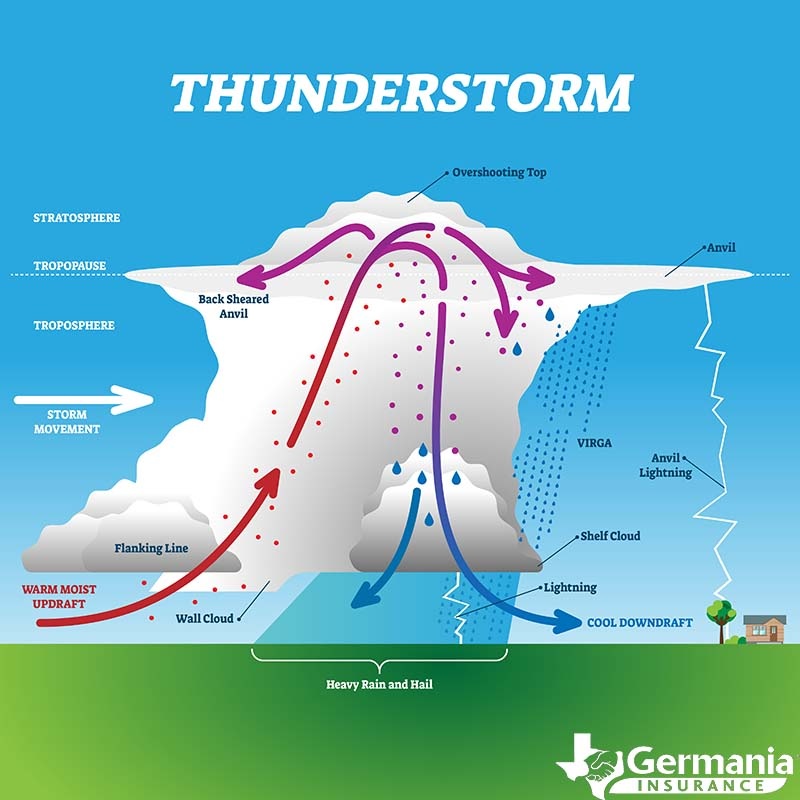
Describe the formation of a lightning bolt
charge separation = rising ice crystals gain positive charge while heavier hair/slush/droplets gain negative charge
positively charged upper cloud, negatively charged lower cloud
negative region induces buildup of positive charge on ground below
stepped leader = once charge difference becomes too great for insulating air to hold back, channel of negative charge (stepped elader) rushes down from cloud in zigzag steps
upward streamers = stepped leader approaches surface so positive charges gather on tall objects on the ground
ground charges “reach up” toward approaching electrical current through channels called streamers
What is thunder and how quickly does it travel compared to lightning?
thunder: acoustic shockwave caused by lightning superheating the surrounding air
it travels much slower at the speed of sound compared to lightning (speed of light)
What is the difference between an air mass thunderstorm and a severe thunderstorm?
air mass thunderstorm: brief, isolated storm fueled by local daytime heating
less than 50 mph
significant moisture in air
unstable air mass
severe thunderstorm: intense, long lasting storming
requires wind shear (changing wind speed/direction with altitude) to sustain
58+ mph
very moist lower atmosphere
What are the different types of severe thunderstorms?
squall line (linear)
form bands up to 500km long
usually ahead of a cold front
mesoscale convection complexes (MCCs) (circular)
squall lines that develop into larger systems (up to 10,000 km²
supercell
20-50km diameter
single cloud
violent & large scale rotation (mesocyclone)
Tornadoes
Describe the formation of a supercell thunderstorm and the steps required to form a mesocyclone
supercell formation
warm moist air at surface becomes unstable and rises rapidly by pushed upward
strong winds change speed & direction with height → creates shearing environment where rising air twists
wind shear tilts updraft tower, allowing downdraft to fall SEPARATE from warm rising air (storm is long lived)
mesocyclone formation
vertical shear of winds cause air to rotate horizontally (spinning cylinder)
powerful updraft acts as massive vacuum → brings horizontally spinning air into storm
updraft tilts vortex from horizontal to vertical orientation
once rotation is vertical it forms a deep spinning column of air within updraft → mesocyclone
What are the steps required to form a tornado?
needs combo of warm moist air near the ground and cooler, drier air aloft
makes atmosphere highly unstable & warm air to rise rapidly
rising warm air encounters wind shear (dramatic change in wind speed/direction with incr. altitude)
forces rising column of air to roll horizontally
thunderstorms develop to create strong updrafts of warm air
brings horizontal spinning air into storm which tilts rotation to vertically
creates mesocyclone
cold dense air in downdrafts pushes rotation down to lower altitudes
decrease in pressure causes moisture in air to condense & create spiral funnel cloud extending from base of storm
downdraft intensifies and spinning column meets ground
funnel cloud begins kicking up dust, debris → tornado
Why is “Tornado Alley” so prone to tornadoes?
due to warm moist air coming northbound from the Gulf of Mexico meeting dry cold air coming south from Canada
What is a "rear flank downdraft"? How does it cause a tornado to form?
mass of dry, rain-cooled air that descends on backside of supercell thunderstorm’s rotating updraft
as cool air rushes to the ground and wraps around lower level of storm, it causes upper level rotation to surface to form a tornado
What is a "hook echo?"
hook shaped radar signature found in supercell thunderstorms
indicates presence of mesocyclone
serves as indicator that the storm is capable of producing a tornado
What scale do we use for measuring the strength of tornadoes?
Enhanced Fujita (EF) scale
rates tornadoes from 0 to 5 based on est. 3 second wind gusts and the specific damage they inflict on structures/vegetation
not based on direct wind measurements
How does one stay safe in a tornado?
seek shelter in basement, small windowless interior room, or lowest floor of sturdy building
stay away from windows, exterior doors, outside walls
find heavy cover underneath sturdy piece of furniture
shield yourself against head injuries
if trapped in car, pull over under an overpass and buckle your seatbelt
if completely outdoors lie flat in low-lying area (ditch, ravine) and avoid being the tallest thing around
Hurricanes
In what regions are tropical cyclones most likely to occur and why? What are the main reasons for the global distribution of hurricanes?
tropical cyclones (hurricanes) form in ocean basins between 5 and 30 degrees latitude north/south of equator
most active region is Western North Pacific
also occurs in eastern pacific, north atlantic, north indian, southwest indian, australian/south pacific regions
reason for distribution
requires warm ocean temperatures that provide necessary moisture & latent heat to fuel storm
Coriolis effect (rotational force) is too weak within 5 degrees of equator
low wind shear in these areas won’t tear the storm apart
high relative humidity doesn’t cause evaporation in the storm’s clouds which would cool the updraft and weaken the system
intertropical convergence zone (ITCZ) initiates rotation/uplift required for the storm to form
Describe the steps necessary to form a hurricane. What processes contribute to hurricane intensification?
warm ocean water
atmospheric instability
high humidity
coriolis effect
disturbances such as tropical wave, cluster of thunderstorms, pre-frontal boundary
low vertical wind shear
processes:
latent heat release
pressure drop/inflow
rapid intensification
eyewall replacement cycles
What is the positive feedback mechanism associated with hurricanes?
warm tropical oceans heat the air above the water and evaporates massive amts of water vapor
warm humid air forces water vapor to condense into massive thunderstorm clouds
process releases latent heat (warms surrounding air) and causes air to rise faster
since so much air is pulled upward and pushed out at the top of storm, atmospheric pressure at sea surface decreases
causes surrounding air to rush inward at surface faster to replace rising air
as pressure drops & air rushes in, surface wind speeds increases
enhances evaporation and transfers more heat/moisture into storm’s core
leads to more condensation, faster rising air, lower pressure, stronger winds
Be able to interpret a feedback diagram. What are positive and negative couplings? How do you connect the boxes?
What impacts are associated with hurricanes? Which one is typically the most damaging?
storm surge: strong winds push water inland and sea levels rise rapidly (deadliest)
flooding: prolonged rainfall can continue for days after storm passes
high winds: 74+ mph, can uproot trees, snap power lines, etc.
tornadoes: can be spawned in the hurricane’s outer bands
Determine which part of a hurricane is the strongest, and describe which parts of a coast will be most impacted by a hurricane.
the EYEWALL is the strongest part of the hurricane (most intense winds and rainfall)
the right front quadrant (Northern Hem) or left front quadrant (Southern Hem) is considered most dangerous as it couples the storm’s forward motion
this part of the coast relative to where the hurricane makes landfall will receive the most impact
Be able to calculate the speed of hurricane winds in different “quadrants” of the storm, depending on the average wind velocity and the direction of storm movement. Be able to do this for the northern hemisphere (counterclockwise) and southern hemisphere (counterclockwise) storms.
Northern Hem
right-front (max winds)
rotational wind + forward speed (rotational winds blow in same direction of storm travel)
left-front
rotational wind - forward speed (rotational wind blows opposite to storm’s forward motion)
right-back
rotational wind - forward speed
left-back
rotational wind + forward speed
Southern Hem
right-front (max winds)
rotational wind - forward speed
left-front (max winds)
rotational wind + forward speed
right-back
rotational wind + forward speed
left-back
rotational wind - forward speed
Streams and Floods
Determine how various components of the hydrologic cycle impact water cycling from the oceans to the atmosphere and back to the oceans.
ocean to atmosphere evaporation
solar radiation heats ocean surface → causes liquid water to gain energy and transform into water vapor
86-90% of global evaporation
atmospheric transport
rising air current lift water vapor high into atmosphere
cooler temps cause it to condense around particles into clouds
wind patters and circulation transport clouds across the globe
precipitation
water droplets in cloud become too heavy to be supported by rising air → fall back to earth
78% falls back to ocean, rest falls on land
runoff & infiltration
water falling on land infiltrates soil (groundwater) or flows over surface as runoff
runoff gathers into rivers, streams, lakes, etc. until it drains back into ocean
What is a watershed?
area of land where water falling within its boundaries drains downhill into a single common body of water
How do you determine the discharge of stream?
discharge (Q) = area (A) x velocity (V)
discharge (Q) = volume/time
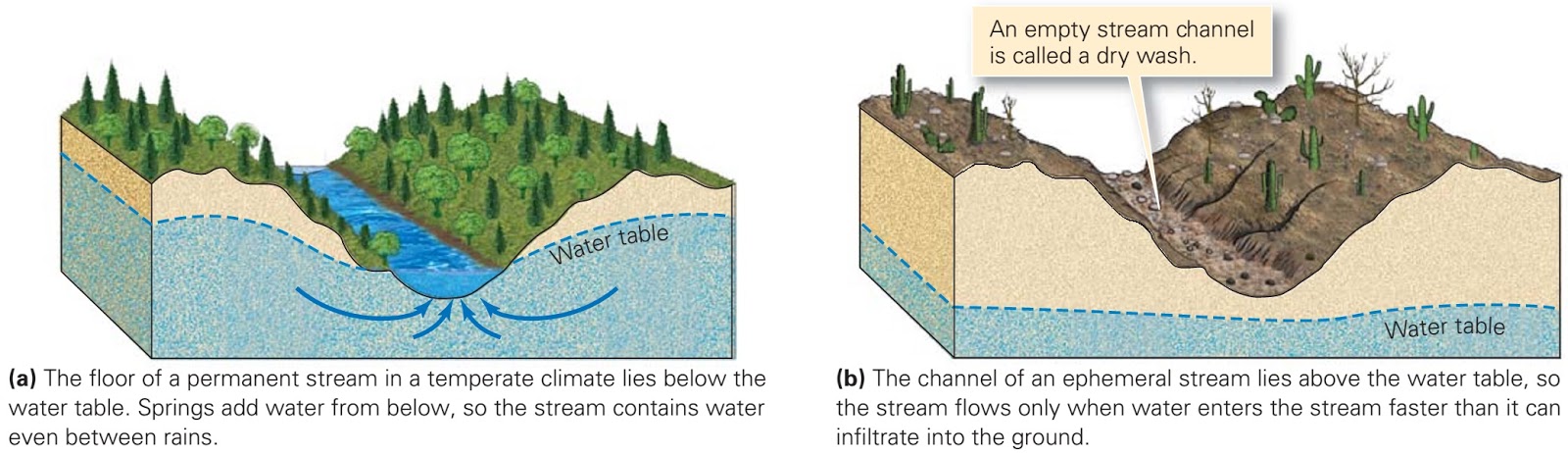
Compare gaining streams to losing streams. What happens to a drop of rainwater in both stream types? Where does the drop of water ultimately end up?
gaining/permanent streams
water flows all year
is at or below water table
humid or temperate climate
sufficient rainfall
lower evaporation
seasonal discharge variation
losing/ephemeral streams
don’t follow all year
above water table
dry climates
low rainfall
high evaporation
flows mostly during flash floods
Predict which regions will be most susceptible to a flash flood and describe the outcomes of a flash flood event
urban areas
impervious surfaces prevent water from absorbing into ground → high runoff = water quickly ponds in streets
mountains/hilly terrain
steep slopes accelerate runoff
funnels fast moving water into small channels which can transform dry creek-beds into violent rivers
deforested areas
no vegetation/root systems to absorb moisture & hold soil together or areas with hydrophobic conditions lead to runoff & mudslides
low-lying areas
act as bottlenecks for water to pool & rise rapidly
flash flood: arrive with little warning → immediate physical danger, widespread structural damage, power outages, contaminated drinking water, severs transportation routes
Predict how climate, human use, and soil type will impact the type of flood
climate: as global temp rises, atmosphere holds more water vapor → intense short downpours
overwhelms local drainage capacities → more flash floods
humans
urbanization prevents water infiltration → larger surface runoff → more flash floods
clearing forests/agriculture removes healthy soil to absorb water → more runoff → flash floods
soil type
clay & silt have low permeability, resulting in soil to reach saturation point quickly → runoff → flash floods
Be able to reconstruct a hydrograph based on stream type.
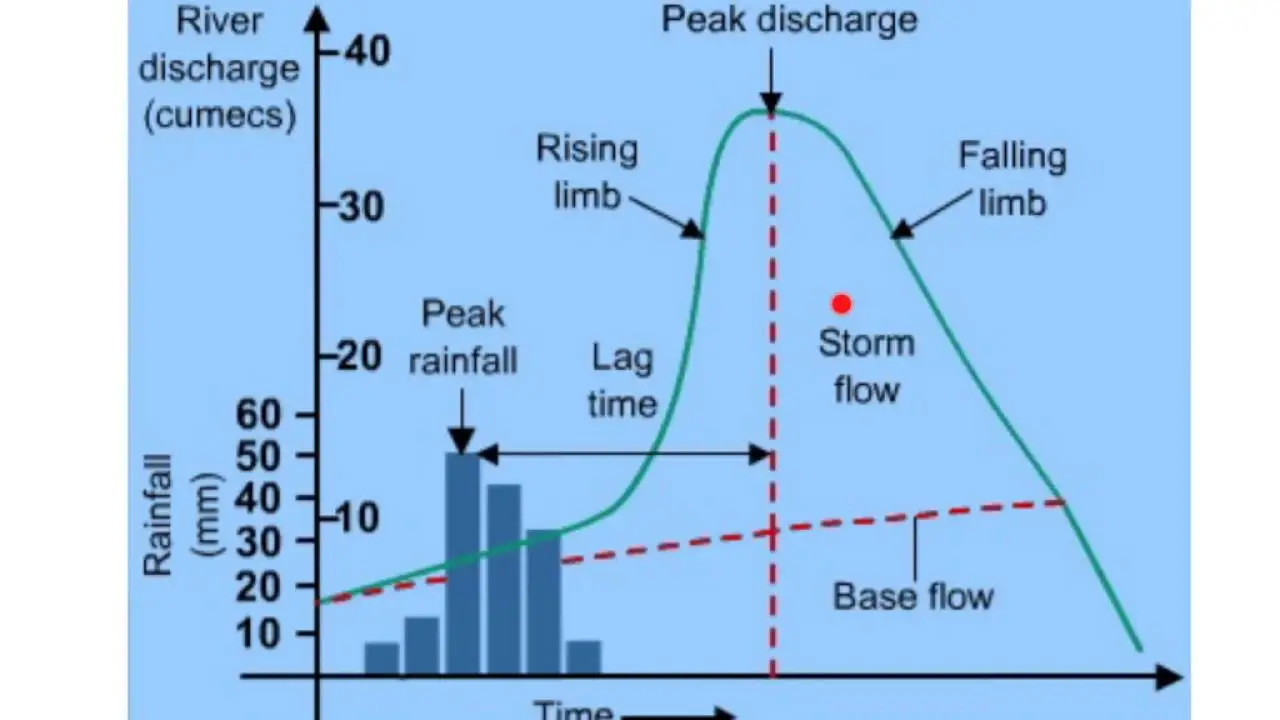
How will climate change and human urbanization impact flood intensity in the future?
cause dramatic increases in future flood intensity
supercharge storms + massive surface runoff = overwhelming surrounding environment with flooding
rising sea levels amplify storm surges
Identify hard and soft solutions to flood risk management
hard solutions
build dams and reservoirs
levees and floodwalls
storm surge barriers
more storm drains
porous concrete
soft solution
safety education
zoning
warning/alert systems
Climate Change
What are the 4 main reasons that climate can change? What is the timescale for each, and which are responsible for current climate change?
greenhouse gases: changes in atmospheric gases that trap heat
greenhouse effect: ozone traps high intensity shortwave radiation → reason why we have life on earth
albedo: fraction of solar energy reflected away
changes in earth’s orbit (Milankovitch cycles) → roughly a 150k year cycle for when they all line up
What are the Milankovitch cycles? Be sure you can diagram each part of the cycle
eccentricity (100k years): how elliptical orbit is
obliquity (41k years): how tilted earth’s axis is
precession (23k years): wobble of the axis
What is the difference between shortwave and longwave radiation?
shortwave = high energy, incoming sunlight
longwave = low energy heat radiated outward by the earth
What is the greenhouse effect? How does the Greenhouse effect increase our average planetary temperatures?
certain gases are good at trapping heat → known as greenhouse gases
allows shortwave sunlight to pass through atmosphere to warm the earth’s surface while absorbing & re-radiating longwave infrared heat back to ground (slows escape into space)
this process is necessary to support life (warms earth enough)
What are greenhouse gases?
atmospheric gases that trap heat
carbon dioxide (most significant), methane, nitrous oxide, fluorinated gases, etc.
What is the keeling curve? Why does the keeling curve have a saw-tooth pattern?
graph that plots ongoing change in concentration of CO2 in earth’s atmosphere (Mauna Loa University)
has a saw-tooth pattern due to seasonal breathing of earth’s biosphere
drops in spring/summer as planets in northern hem grow and absorb massive amts of CO2 (decreases it in atmosphere)
rises in fall/winter as leaves fall and planets die → decay releases CO2 back into the atmosphere
What are the main impacts to Earth associated with our current changing climate?
rising temperatures
persistent heat waves, alters growing seasons, contributes to rising CO2 levels
extreme weather
warming atmospheric conditions = extreme weather (prolonged droughts, high rainfall, severe flooding, intense dry spells, etc.)
melting ice/rising sea levels
erodes coastal ecosystems & polar/glacial regions experience massive ice loss
ocean acidification
oceans absorb excess heat & CO2 → causes water temps to increase & water to become more acidic → threatens marine life & coral reef systems
ecosystem/health disruptions
alters habitats, migration patterns, water scarcity, spread of infectious diseases
Why might climate change be considered a catastrophe?
acts as a “threat multiplier” by accelerating extreme weather, threatening food/water security, and pushes ecosystems to extremes
has the potential to impact ALL life on earth
What are the potential solutions to climate change?
shift to renewable energy
upgrade infrastructure to reduce energy consumption
expand public transit & other forms of sustainable transportation
protect/restore ecosystems
shift to regenerative agriculture
upgrade efficiency of high-emission industries
carbon removal from air
early warning systems/policies
Wildfires
Describe how each part of the fire triangle impacts fires specifically in Southern California.
fuel
native vegetation (chaparral environment is highly flammable & thrives on consistent fires)
droughts reduce moisture content in plants which makes them prone to catching fire
dense brush allows for fires to spread quickly
oxygen
santa ana winds are very fast as they move through narrow canyons → feed flames
heat
radiant heat
dries out fuel source
ignites fuel source
Describe the formation of the Santa Ana Winds
high pressure build up from Great Basin area
air flows CW around HP systems → pushes cool, dry air in southwest direction toward west coast
outward pusing air is pulled to areas of low pressure over Pacific Ocean off southern CA coast
pressure gradient is very high → winds will blow much faster
as air drops in elevation it is compressed by increasing atmospheric weight
forces temps to rise rapidly
as air warms up it can carry more moisture -< drops relative humidity
“thirsty” air acts like a sponge → strips moisture from local vegetation → makes region highly susceptible to ignition
air is squeezed through narrow canyons/mountain passes
results in dramatically fast moving winds
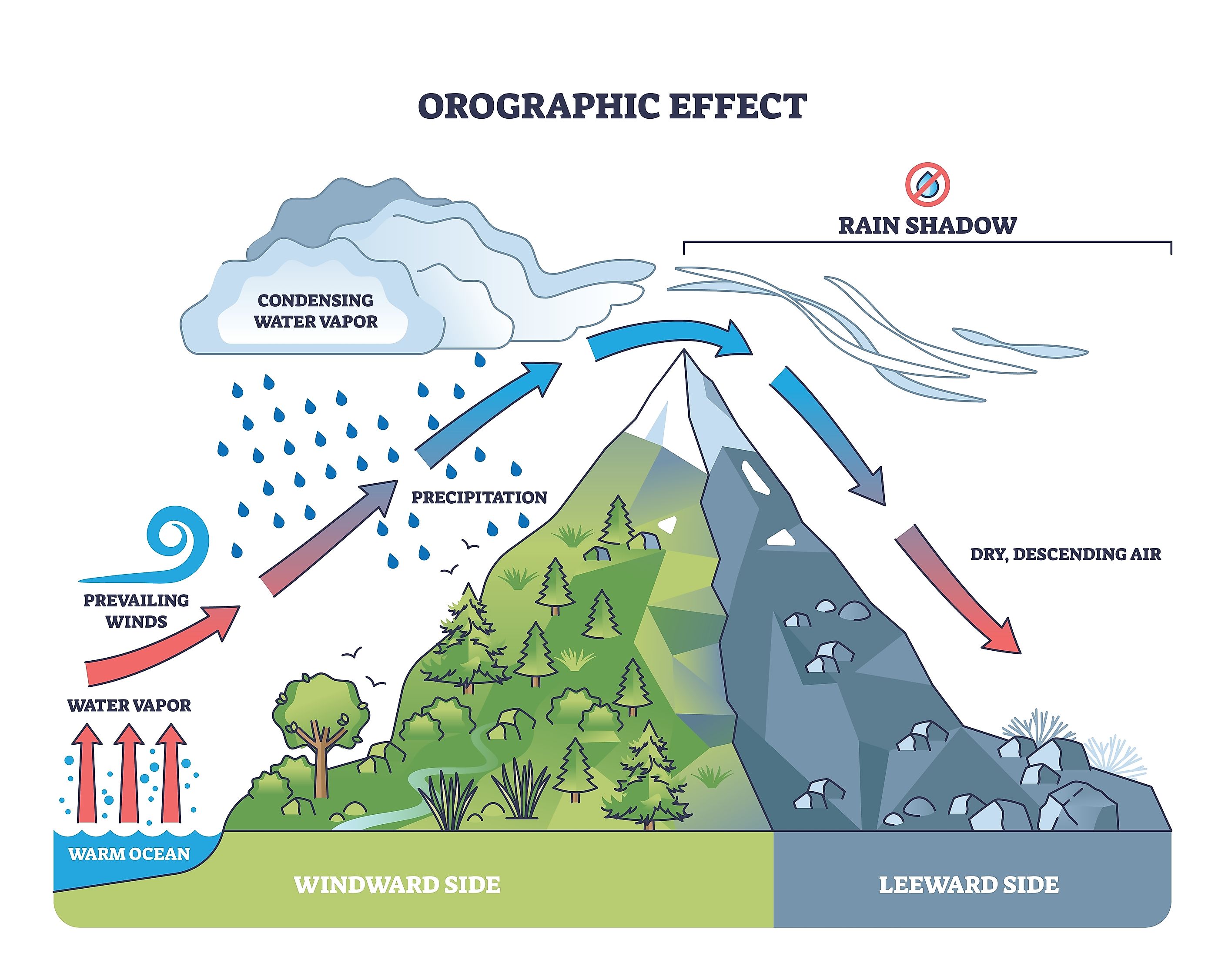
Describe the orographic effect and how it impacts regional climate
meteorological phenomenon where a topographic barrier (ex. mountain range) forces prevailing winds to rose
as air expands it cools and condenses moisture into preciptation, leaving windward side went and leeward side arid
results in one side developing lush, green ecosystems and the other dry, and desert-like
How might fires be impacted by climate change?
severe heat & drought can fuel wildfires to become more extreme and fast-moving
Impact Events
Describe the similarities and differences between asteroids and comets
Identify the problems associated with an impact event.
Identify the signs that an impact event has occurred in the past
What happened to those poor, poor dinosaurs?
Where did the dinosaur-killing asteroid originate from?
Where will likely future asteroids originate?
How might future impact events be mitigated?