DNA, genes, and protein synthesis
 Call Kai
 Learn
Learn Practice Test
 Spaced Repetition
 Match
Match Flashcards
 Knowt Play
1/36

Earn XP
Description and Tags
Name | Mastery | Learn | Test | Matching | Spaced | Call with Kai |
|---|
No analytics yet
Send a link to your students to track their progress
37 Terms
What are ribosomes made of?
rRNA and proteins.
Give three differences between the DNA in prokaryotic cells and the DNA in eukaryotic cells.
Prokaryotic cell DNA:
Short
Circular
Not associated with histones
Eukaryotic cell DNA:
Long
Linear
Associated with histones
What is formed when DNA is wrapped around histones?
Chromosomes.
What is a base triplet and what does it do?
Three consecutive bases that code for the production of a single amino acid.
What is a base triplet called on mRNA?
A codon (complementary to base triplet).
What is a base triplet called on tRNA?
An anticodon (complementary to codon).
What is a gene?
A sequences of bases on a DNA molecule that codes for the production of a sequence of amino acids that make up a polypeptide.
What is the location of a gene called (singular and plural)?
Locus (singular), loci (plural).
True or false? The entirety of a DNA molecule codes for the production of polypeptides.
False. NOT ALL BASE SEQUENCES ON A DNA MOLECULE CODE FOR THE PRODUCTION OF POLYPEPTIDES.
What is an intron?
A section of DNA that doesn’t code for the production of a polypeptide (non-coding DNA).
What is
How many amino acids are naturally produced?
How many possible base triplets are there?
Give three features of the genetic code.
Universal
Non-overlapping
Degenerate
What does non-overlapping mean in terms of the genetic code?
Each triplet is only read once and different triplets do not share bases.
True or false? Genes are separated by introns.
True.
What does degenerate mean in terms of the genetic code?
More than one triplet can code for the production of the same amino acid.
Give an advantage of the genetic code being degenerate.
It means that mutations have a lower likelihood of having an effect on the polypeptide produced by the gene (minimises the effect of mutation).
What are start and stop codons?
Start codons signal the start of protein synthesis while stop codons signal the end of protein synthesis.
Where is DNA found in eukaryotic cells?
In the nucleus.
Where else in eukaryotic cells can you find DNA apart from in the nucleus?
In the mitochondria, in the chloroplasts.
Describe what the DNA found in mitochondria and chloroplasts is like.
Short, circular, not associated with histones (like prokaryotic DNA).
What is a homologous pair of chromosomes?
A pair of chromosomes that carry the same genes at the same loci.
True or false? Homologous chromosomes are always identical as they carry the same genes at the same loci.
False. HOMOLOGOUS CHROMOSOMES CAN CARRY DIFFERENT ALLELES OF THE SAME GENE MAKING THEM NON-IDENTICAL.
What is an alleles?
Alternative versions of the same gene.
Name the two stages of protein synthesis.
1) Transcription.
2) Translation.
What else can DNA code for apart from proteins?
Functional RNA.
Describe the structure of mRNA.
Long, single-stranded, complementary to gene and tRNA.
Describe the structure of tRNA by drawing a diagram.
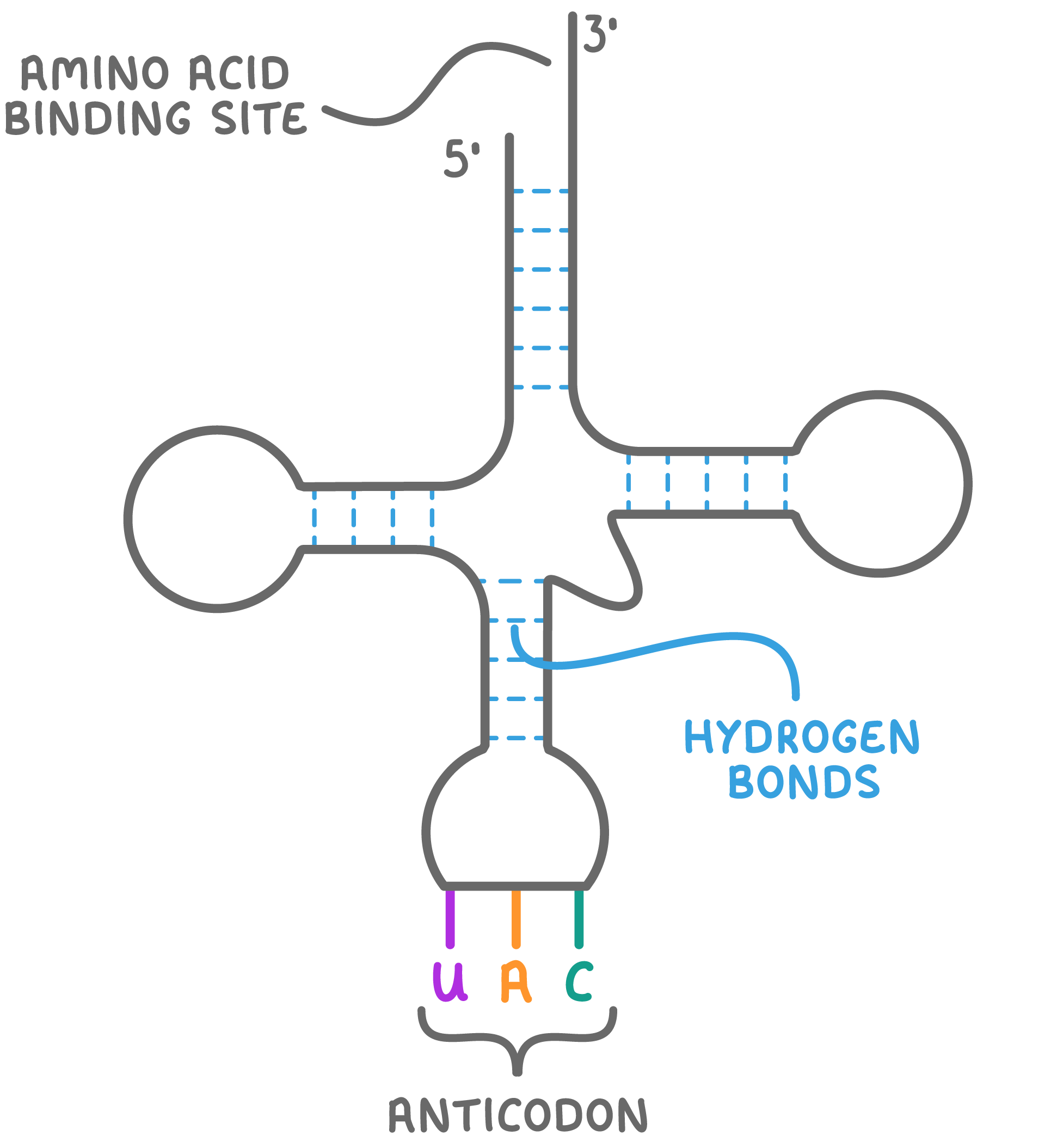
How would you describe the shape of a tRNA molecule?
Clover leaf shaped.
Talk me through the process of transcription.
1) DNA helicase breaks the hydrogen bonds between complementary base pairs in DNA, exposing the bases on both DNA strands (one of these strands will act as the template strand.
2) Free RNA nucleotides line up via complementary base pairing with the DNA template strand.
3) RNA polymerase joins the free RNA nucleotides with phosphodiester bonds until a stop codon is reached, forming a molecule of pre-mRNA.
4) The pre-mRNA passes through a spliceosome in order to remove the introns from it, forming mRNA.
5) The mRNA moves out of the nucleus via a nuclear pore.
6) The mRNA attaches to a ribosome in the cytoplasm…
What is pre-mRNA?
mRNA that contains introns.
What is the genome of a cell?
The complete set of genes in a cell.
What is the proteome of a cell?
The entire range of proteins that a cell is capable of producing.
True or false? Prokaryotic DNA does not contain introns.
True.
Talk me through the process of translation.
1) tRNA collects amino acids from the cytoplasm and carries them to the ribosome.
2) tRNA attaches it’s anticodon to it’s complementary codon on mRNA.
In translation,