Neuroendocrine and the Pituitary Gland
 Call Kai
 Learn
Learn Practice Test
 Spaced Repetition
 Match
Match Flashcards
 Knowt Play
1/42

There's no tags or description
Looks like no tags are added yet.
Name | Mastery | Learn | Test | Matching | Spaced | Call with Kai |
|---|
No analytics yet
Send a link to your students to track their progress
43 Terms
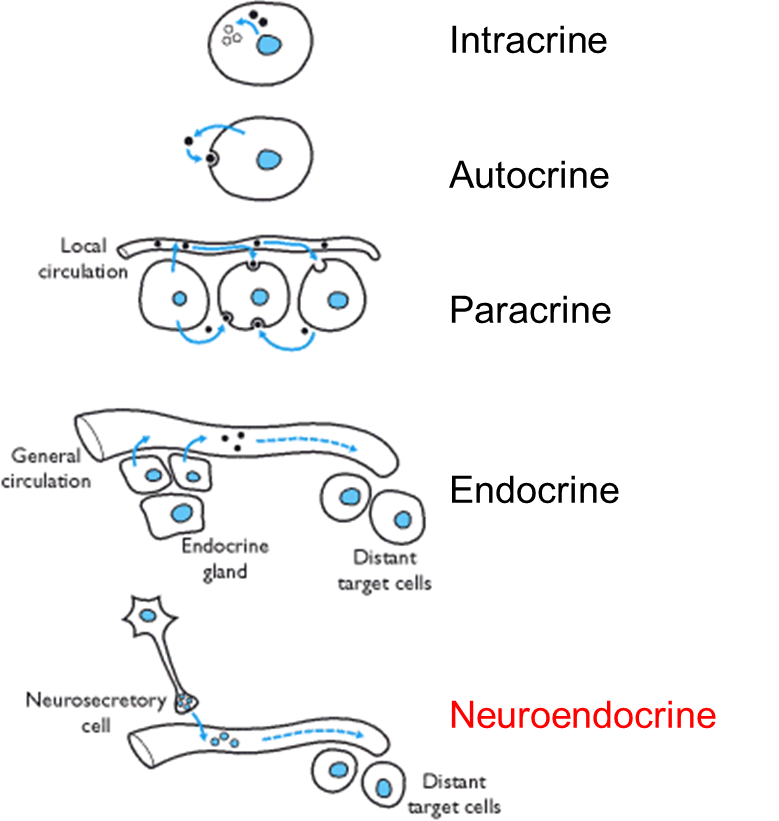
Diagram showing intracrine, autocrine, paracrine, endocrine, neuroendocrine
Where is the hypothalamus located?
At the base of the brain
What is the role of the hypothalamic pituitary axis?
The hypothalamus detects stimuli
It secretes multiple hormones to control widespread homeostatic functions
Uses the pituitary gland as an output organ (initiates response)
What is the pituitary gland also known as?
Hypophysis
Name the 2 nuclei in the hypothalamus
Paraventricular nucleus
Suprachiasmatic nucleus
What are the functions of the paraventricular nucleus (PVN) of the hypothalamus?
Neuroendocrine role: Secretes CRH and TRH
Integrates sympathetic and parasympathetic output to regulate the autonomic nervous system
What are the key functions of the suprachiasmatic nucleus (SCN) of the hypothalamus?
Suprachiasmatic nucleus receives light input from the retina and synchronises circadian rhythms with the light dark cycle
What is the key function of the hypothalamus?
Hypothalamus regulates sleep-wake cycle, feeding behaviour, and body temperatures
How does the hypothalamus control the anterior pituitary?
The hypothalamus indirectly controls the anterior pituitary
The hypothalamus releases regulatory hormones which act on the anterior pituitary to control hormone secretion
What does the anterior pituitary release?
Regulatory hormones
Primary hormones that act on target endocrine cells
How does the hypothalamus control the posterior pituitary?
It controls it directly
Primary hormones are produced in the hypothalamus
Which hormones are associated with the posterior pituitary and where are they mainly produced?
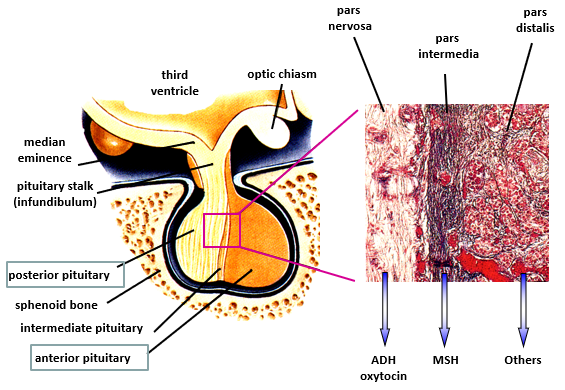
Oxytocin is mainly produced in the supraoptic nucleus
ADH is mainly produced in the paraventricular nucleus
What are hypothalamic releasing factors?
Hormones produced by the hypothalamus that stimulate the anterior pituitary to release specific hormones
Name the main hypothalamic releasing factors
CRF
TRH
GHRH
GnRH
PRF
What do the following releasing factors stimulate?
CRF
TRH
GHRH
GnRH
PRF
CRF stimulates ACTH release.
TRH stimulates TSH release.
GHRH stimulates growth hormone release.
GnRH stimulates LH and FSH release.
PRF stimulates prolactin release.
What is the anatomy of the pituitary gland?
What is the difference between trophic and primary hormones of the anterior pituitary?
Trophic hormones act on other endocrine glands
Primary hormones act directly on target tissues
Which anterior pituitary hormones are trophic?
ACTH
TSH
FSH
LH
Which anterior pituitary hormone stimulates the adrenal cortex?
ACTH
Which anterior pituitary hormone stimulates the thyroidal gland?
TSH
Which anterior pituitary hormones regulate reproductive function?
FSH and LH
What are the main functions of growth hormone and prolactin?
Growth hormone stimulates growth and metabolism, while prolactin stimulates milk production
How does the hypothalamus control hormone secretion from the anterior pituitary?
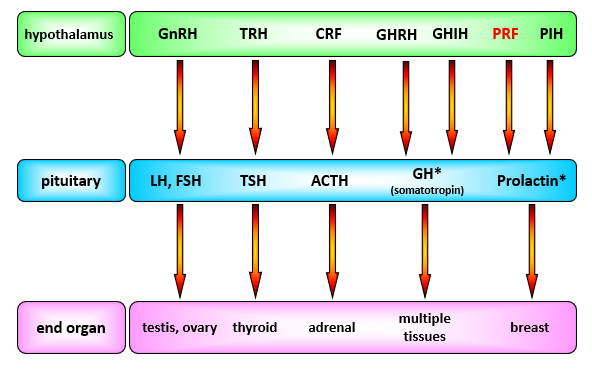
Hypothalamic neurones release hypophysiotropic hormones into capillaries in the median eminence
These travel through the hypothalamo-pituitary portal vessels to the anterior pituitary, where they regulate hormone secretion from pituitary cells into the blood stream.
Diagram of the hypothalamic-pituitary axis
What are the effects of growth hormone (a.k.a somatotrophin, somatotropin)
Increase cell size, number, and differentiation
Stimulate protein synthesis
Stimulate fat utilization
Alter carbohydrate metabolism
What is IGF-1 and what are its key roles and properties?
Insulin-like growth factors (IGFs) are polypeptide hormones mainly produced by the liver in response to growth hormone
IGF-1 mediates many effects of GH
Both IGF-1 and GH act via cell surface receptor tyrosine kinases
IGF-1 has a long half life compared to GH
IGF-1 is important for bone growth and overall tissue growth
Where do IGFs act?
At a receptor tyrosine kinase
When is GH released?
In response to growth hormone releasing hormone (GHRH)
When is GH release decreased?
By growth hormone-inhibiting hormone (GHIH)
What releases GHRH?
Arcuate nucleus
Where is somatostatin released from?
Periventricular nucleus
Why is growth hormone important?
GH stimulates growth and metabolism, largely by increasing protein synthesis and acting via IGF-1 to promote tissue and bone growth
What happens in GH deficiency?
Reduced protein synthesis and impaired growth and metabolism due to lack of GH/IGF-1 action.
What is pituitary dwarfism?
Short stature caused by GH deficiency, often due to general anterior pituitary dysfunction or specific GH deficiency.
Can dwarfism occur even if GH levels are normal?
Yes - if there is a hereditary IGF-1 deficiency, GH is present but cannot stimulate growth effectively.
What is the effect of GH decline after adolescence?
Accelerated aging-like effects, including reduced protein synthesis and tissue maintenance.
What is gigantism?
Excess GH secretion during childhood (before epiphyseal plates close), usually due to a pituitary tumour, causing excessive linear growth.
What is acromegaly?
Excess GH secretion after adolescence (after epiphyseal closure), usually from a pituitary tumour, causing enlarged hands, feet, and facial features.
What are the indirect effects of GH?
Growth
Bone
Protein synthesis
What are the direct effects of GH?
Increased lipolysis
Increased blood glucose
IGF-1 is produced mainly by liver in response to GH. It mediates long term growth effects. How does it regulate RH?
IGF-1 is produced mainly by the liver in response to GH and mediates the long-term growth effects of GH.
What stimulates GH release?
GHRH, sleep, exercise, stress, and low blood glucose.
What inhibits GH release?
Somatostatin (GHIH) and negative feedback from GH and IGF-1.