Lecture 20 - Geochemistry of the Continental Crust
 Call Kai
 Learn
Learn Practice Test
 Spaced Repetition
 Match
Match Flashcards
 Knowt Play
1/30

There's no tags or description
Looks like no tags are added yet.
Name | Mastery | Learn | Test | Matching | Spaced | Call with Kai |
|---|
No analytics yet
Send a link to your students to track their progress
31 Terms
What is the continental crust?
Extends vertically from the Earth’s surface to the Moho seismic discontinuity
extends laterally to the break in slope on the continental shelves
What is the average thickness of the continental crust?
~40 km
How much of the Earth is continental crust?
0.6% of the Earth by mass
Is there chemical variation in the continental crust with depth?
Becomes more felsic as you move closer to the surface (must fractionate)
Upper = higher abundance of trace elements (more evolved)
lower = overlaps with OIBs (why?)
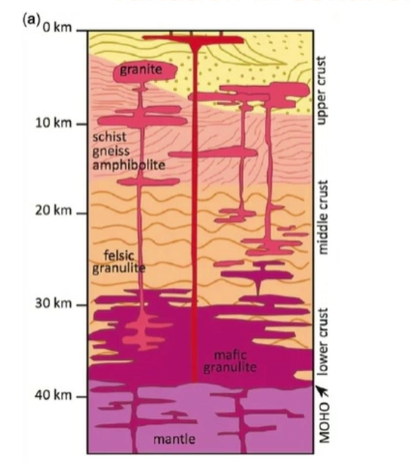
What are the 3 methods to estimate deep crust composition?
Studying samples derived from the deep crust
By correlating seismic velocities with rock lithologies
Use surface heat-flow measurements
How can we study samples derived from the deep crust?
surface outcrops of high-grade metamorphic terranes
tectonically uplifted crustal cross sections
Deep crustal xenoliths (lavas rip up during eruption)
How do we correlate seismic velocities with rock lithologies?
P-wave can have a general correlation with silica content (faster p-wave = lower silica content)
measure the P-wave throughout the continental crust and get an idea of its average velocities (= average SiO2)
How do we use surface heat-flow measurements to access the deep crust?
use heat measurements from radioactive elements (U, Th, K)
Heat flow throughout the crust is not as high as we would expect if the concentration we see at the surface is the same all the way through the crust
mafic/lower section of the crust does not have as much U, Th, and K (missing heat producing elements)
What is the composition of the deep crust?
Middle crust: rocks of amphibolite facies to lower granulite facies (felsic gneisses of tonalitic composition (k-poor diorites))
Lower crust: consists mainly of granulite facies rocks of mafic composition (strongly depleted in K and other highly incompatible elements relative to higher levels in the crust)
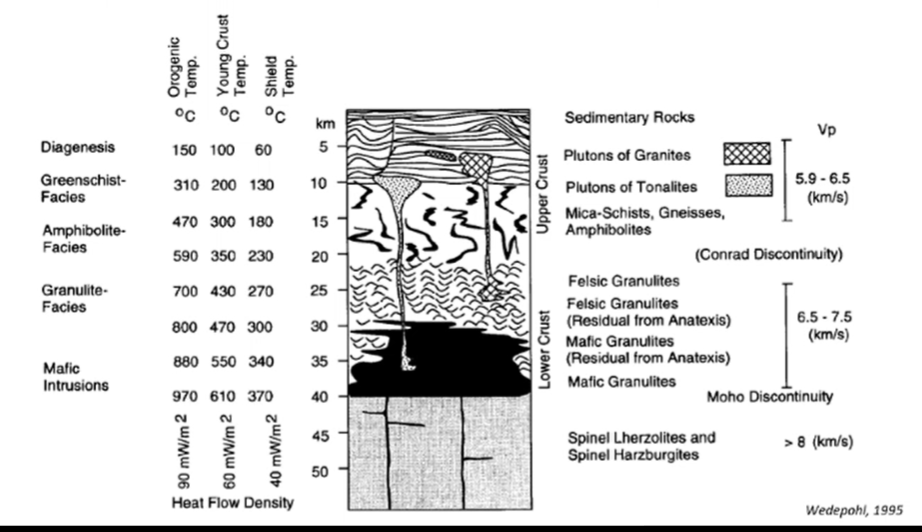
2 methods to estimate upper crust composition
Establishing weighted averages of the compositions of rocks exposed at the surface (Surface average)
Determining averages of the composition of insoluble elements in fine-grained clastic rocks or glacial deposits and using them to infer upper crust composition (Insoluble elements in sedimentary rocks)
How do we establish a weighted surface average?
Based on tens of thousands of samples
Careful of weathering
What are the most common plutonic and sedimentary rocks of the upper crust?
Plutonic = Granite, granodiorite
Sedimentary = Shales
How do we determine averages of the composition of insoluble elements in fine-grained clastic rocks?
Plot samples on a Partition Coefficient (K) vs Residence time (t)
K = element comp (seawater)/element comp (upper crust)
t = mass of element in ocean (M)/ annual mean flux of element of an oceanic reservoir (F)
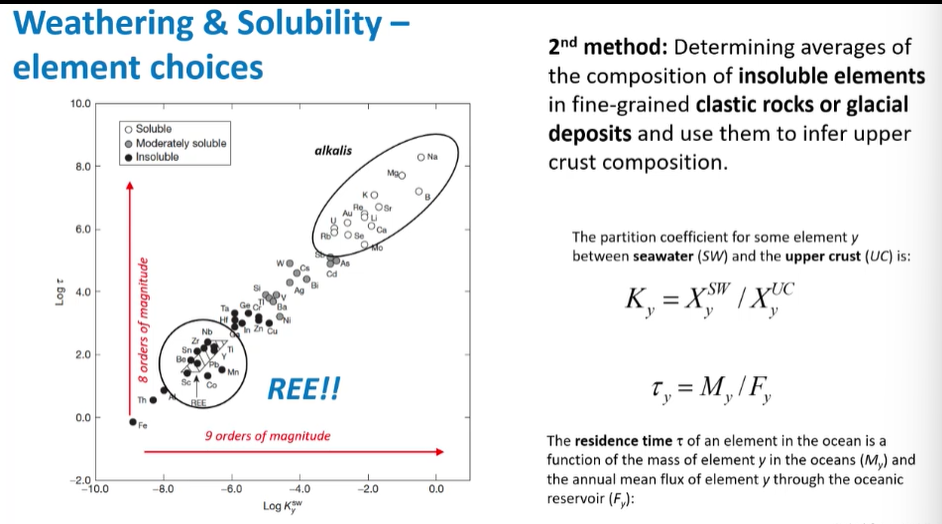
Who proposed that the REE distribution in sedimentary rocks should be nearly constant? Why?
Goldschmidt was the first to propose this in 1938.
Average shale compositions are remarkably uniform worldwide
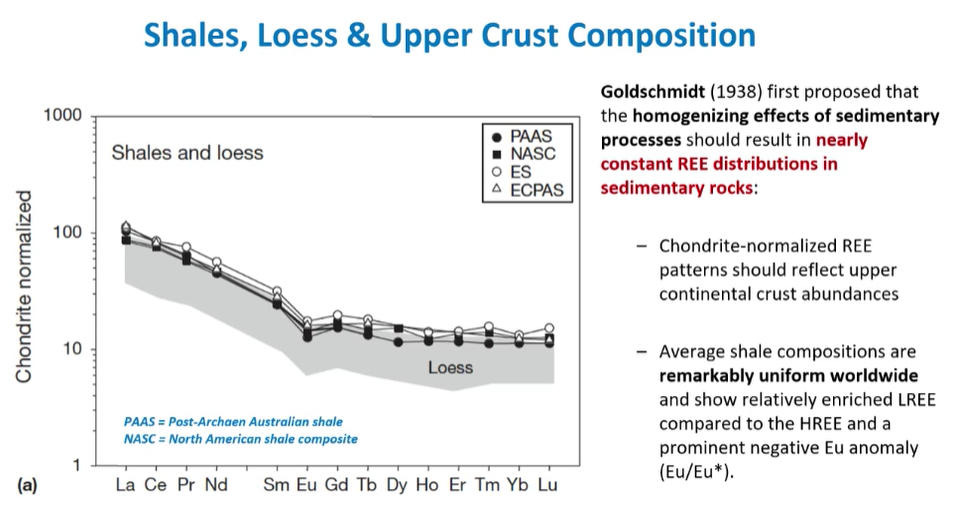
How does SiO2 content change from the lower, middle, and upper crust?
Lower: 53.4% SiO2
Middle: 63.5% SiO2
Upper: 66.6% SiO2
How does the Mg# change from the lower, middle, and upper crust?
Lower: 60.1
Middle: 51.5
Upper: 46.7
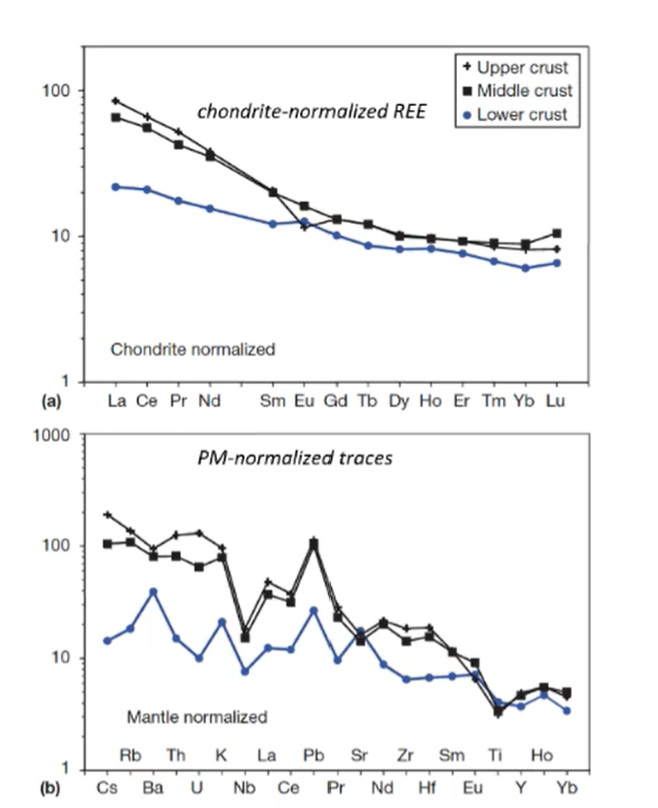
What can we interpret from these continental crust trace elements?
Upper crust: has a higher concentration (more fractionation)
Lower crust: has a lower concentration (less fractionation), positive Eu anomaly
Nd (Ta+) depletion in all parts of the crust
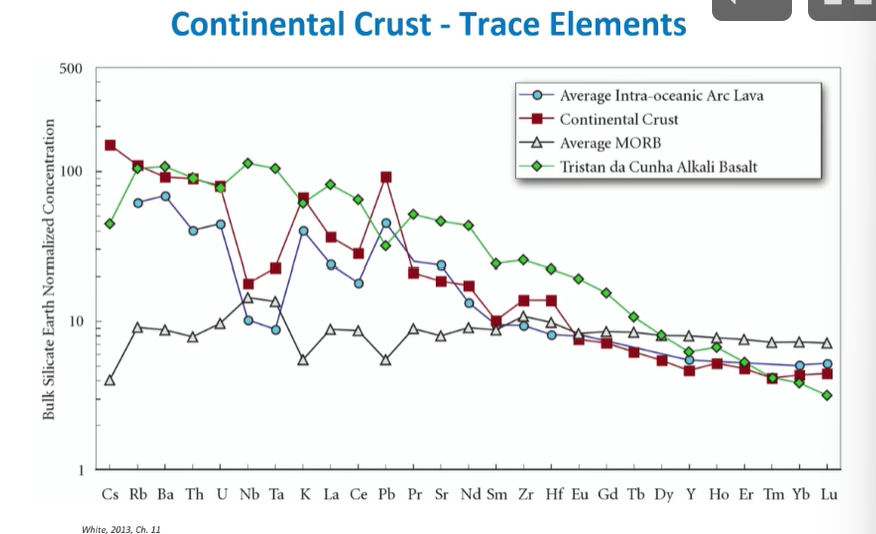
Compare and contrast Continental Crust Element patterns with MORB and Arc Lavas
MORB is 10x more concentrated than bulk silicate Earth (incompatible elements have gone into the melt)
OIB has a sloping pattern from Garnet (represents deep melt)
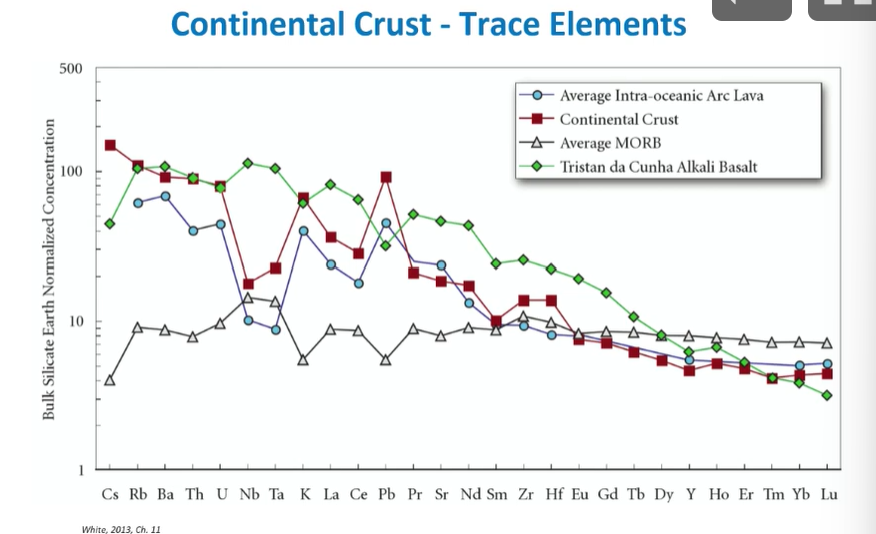
Implication of the Crust Composition
The continental crust grows by igneous processes - the magmatic transport of mass from the mantle to the crust above subduction zone
What characterizes the continental crust?
An overall intermediate igneous composition (andesite), with a relatively high Mg#
Enrichment in incompatible elements, with up to 50% of the silicate Earth’s budget for these elements
depletion in Nb (relative to other incompatible elements such as La)
Can you get the characteristics of the continental crust through single stage melting?
No
If you melt peridotite, it produces basalts, not andesites
What processes must operate to increase the total silica content of the crust?
Recycling of mafic/ultramafic lower crust and upper mantle via density foundering or delamination (lower crust detaches from the crust back into the mantle)
Production of crust from a mixture of silicic melts derived from subducted oceanic crust, and basaltic melts from peridotite (probably important in the Archean, but not today) - could have melted the oceanic crust to produce adakites back in the Archean because we may have been hot enough = higher SiO2 content
What is a craton?
A segment of continental crust that has attained and maintained long-term stability (thick lithosphere with cool but buoyant keel of Fe-depleted upper mantle)
When did the first continental crust form?
Back from the hadean
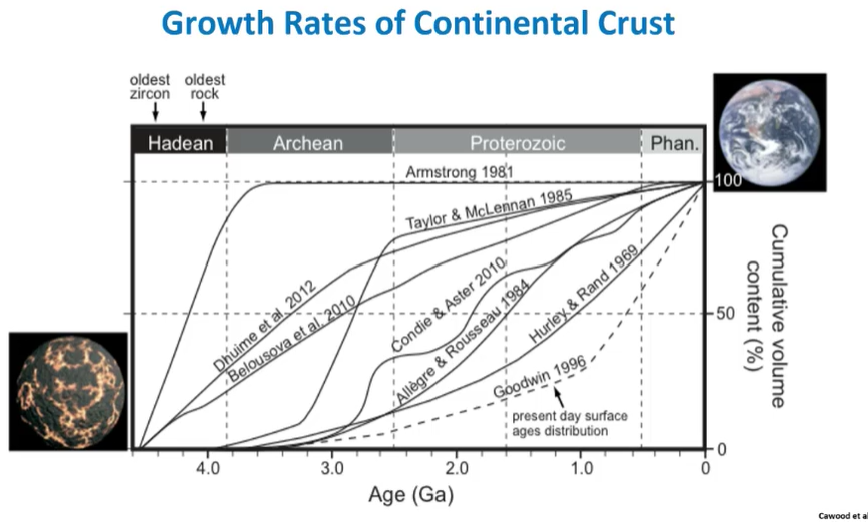
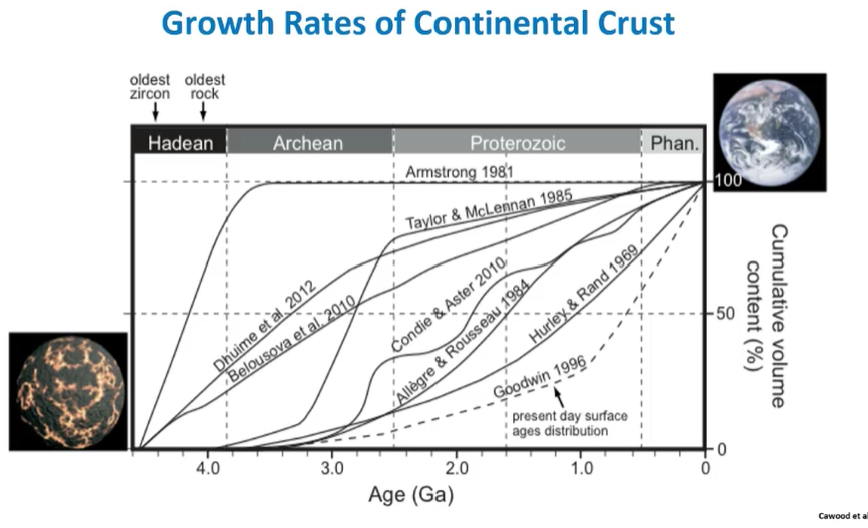
Range of crustal growth models
How do we date the crust?
must determine the age of the material we’re able to access
Why is zircon such a useful mineral?
Can give precise ages because.
very resistant to weathering/hydrothermal alteration
zircon incorporates lots of U and basically no Pb (so all Pb in zircon is from U decay)
Zircon is usually present as an accessory phase in felsic igneous rocks
How can Zircon’s 2 different decay systems help us?
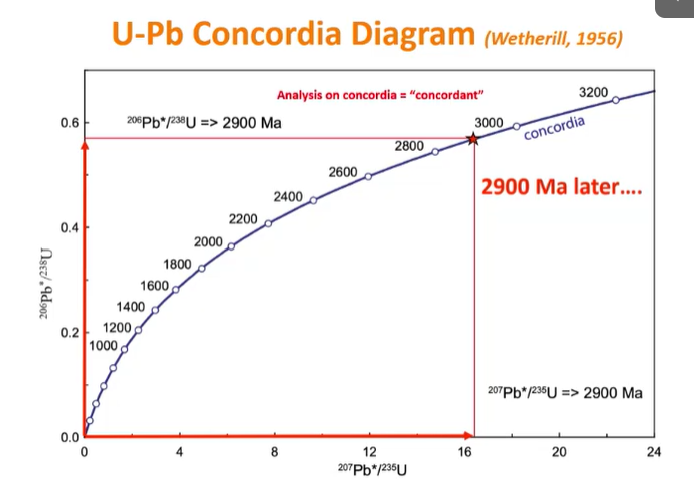
Gives us a way to see if we had a closed evolution through time (if we’ve had a disturbance in the U→ Pb system)
Can tell if dates are good via Concordia diagram
**Note the differing U-Pb isotope system on the axis and how they are used to determine age
What was a major step in history that allowed us to date zircons in situ?
Creation of SHRIMP - allows us to date certain sections of the zircon (zoning)
What does it mean to have an old zircon? What can we infer?
There must be magma with a granitic composition
provides evidence for 4.2 Ga granite = continents
How does CA-ID-TIMS help with the analysis of zircon?
Ca = Chemical abrasion - helps get rid of all the younger-aged parts of a zircon crystal
allows for thermal ionization mass spectrometry to get a more precise age (within 30,000 yrs)