BIOL 1090
 Call Kai
 Learn
Learn Practice Test
 Spaced Repetition
 Match
Match Flashcards
 Knowt Play
1/218

There's no tags or description
Looks like no tags are added yet.
Name | Mastery | Learn | Test | Matching | Spaced | Call with Kai |
|---|
No analytics yet
Send a link to your students to track their progress
219 Terms
What does it take to make a cell
information, chemistry, compartments
What is the Information of a cell
all cells possess DNA, which provides the information necessary to build various proteins
The central Dogma of Biology
DNA —> RNA —> Proteins through transcription and translation
What did the Miller Urey Experiment prove?
Simulated early earth conditions, which shows that amino acids can be made from inorganic compounds
What does compartments mean when it comes to what it take sit make a cell
Single or double lipid layer where cells can preform important functions (communication, protection etc.)
What is cell theory
All living organisms are composed of one or more cells
Cells=basic unit of life
All cells arise from preexisting cells
Evidence of endosymbiotic theory
Have their own DNA
Replicate independently
Double Membrane
Similar size to bacteria
What are the 9 basic properties of cells
Highly complex and organized
Controlled by genetics
Can reproduce
Assimilate and utilize energy
Carry out chemical reactions
Mechanical activities
Respond to stimuli
Self-regulate
Evolve
What are the 5 basic properties of viruses
Highly complexed and organized
Activity controlled by genes
Can reproduce only with a host
Carry out chemical reactions if in host
Evolve
What is a viron
Exist as an inanimate particle
What is baltimore classification
categorizes viruses based on type of genome and their method of replication
What is CRISPR-Cas
Immune-like system that bacteria have to battle bacteriophages
Narrow host range vs Wide Host Range
Narrow host range: Human cold
Wide host range: Rabies which can infect humans, dogs, foxes, bats, raccoons
Which type of virus infection ruptures and kills cells
Lytic cells
What is lytic infection and what are some examples
Production of virus particles ruptures (and kills) cells
Influenza
Rabies
What is non-lytic infection
Viral DNA is inserted into host genome, and these infected cells can survive and reproduce the virus cells
HIV
Chicken Pox
What is the life cycle of a Rabies Virus
Absorptions
Endocytosis
Fusion
Release
Replication
Transcription
Glycoprotein synthesis
Transport
Fusion
Matrix and nucleocapsid synthesis
Progeny capsid
Association at membrane
Budding
What 5 genes does the RNA genome encode for in Rabies Virus
Nucleoprotein
Phosphoprotein
Matrix protein
Glycoprotein
Viral RNA polymerase
How do RNA Vaccines work
Trick the body’s cell to produce a fragment of a virus.
Instructions to assemble a replicase, which can make a lot of copies of the DNA template for producing antigens
What are the functions of biological membranes
Define cell boundary
Define enclose compartments
Control movement of material into and out of the cell
Allow response to external stimuli
Enable interactions between cells
Provide scaffold for biochemical activities
What is the Sarcoplasmic Reticulum
A specialized type of smooth ER that is found within muscle cells. Its main function is to store and regulate calcium ions, which is used for muscle contraction
What do amino acids make and with what bond
Amino acids make proteins which are linked with peptide bonds
What do nucleotides make and with what bond
Nucleotides make nucleic acids via phosphodiester bonds
What do sugars make and with what bond
Sugars make carbohydrates via glycosidic bonds.
What are the building blocks of life
Polymers
Amino acids
Nucleotide
Sugar
Not a polymer
Phospholipid
What are the steps for phospholipid synthesis
In cytosol, fatty acids are activated by the attachment of CoA
They bond to glycerol-phosphate and are inserted into the cytosolic leaflet of the ER via acyl transferase
The phosphate is removed by an enzyme (phosphatase)
Choline (already linked) is attached via choline phosphotransferase
Flippases transfer some of the phospholipid
Moves to the golgi by vesicles and then to the cytoplasmic cellular membrane through exocytosis
Where does phospholipid synthesis occur
Cytosol and outer ER membrane
What is exocytosis
molecules moved out of cell “exit”
What is endocytosis
Molecules brought inside
What are the 3 types of endocytosis
Phagocytosis
Pinocytosis
Receptor-mediated
What are carbohydrates attached to lipids or proteins on the membrane important for
Cell-cell recognition and adhesion
What do fatty acids do to the phospholipids
They make the phospholipids both flexible and fluid, making a rapid lateral movement of molecules
What is the meaning of Fluid Mosaic
Fluid = individual lipid molecules move
Mosaic- Diverse particles like proteins, carbohydrates and cholesterol
Who proposed the fluid mosaic model
Seymour Jonathan Singer and Garth Nicolson in 1972
How can membrane fluidity vary
lipid composition, short unsaturated chains increase fluidity, as they create more spaces, cholesterol alters interactions, fills up the spaces
Temperature, decreases in cold conditions
How do phospholipids vary
fatty acid chain length
Degree of saturation
Polar groups
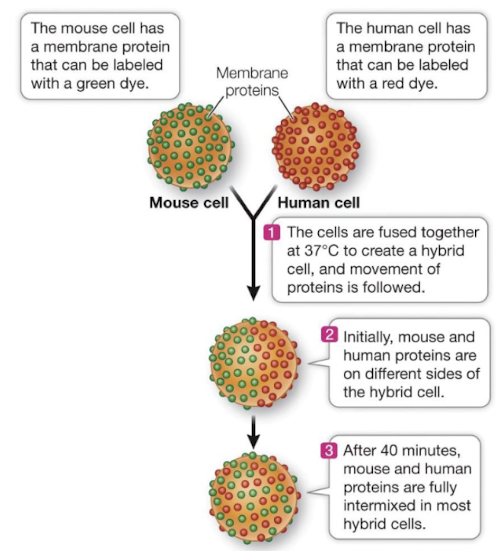
The Frye-Edidin experiment
Greater intermixing at higher temperatures
Mouse cells x human cell
The cells are fused together at 37 degrees Celsius to create a hybrid cell
Initital the proteins are separate
After 40 minutes the proteins of the mouse and human cells are fully intermixed
What are structural characteristics of biological membranes
6nm thick
Stable
Flexible
Capable of self assembly
Three classes of membrane proteins
Integral membrane proteins
Peripheral
Lipid anchored
What are the functions of integral membrane proteins
Transport of nutrients and ions
Cell-cell communication
attachement
How does the biological membranes change with temperature
Warming increases fluidity → Liquid crystal
Cooling decreases fluidity → crystalline gel
What does Cholesterol do for the membrane
Modulates membrane fluidity, as it acts a bidirectional regulator of membrane fluidity
High temperatures, stabilizes, raises melting point
At low temperature, intercalates between the phospholipids and prevents them from clustering together
Types of transmembrane proteins
Transporter
Receptor
Enzyme
Anchor
What is the most common protein structure element crossing biological membrane
Alpha helice
What are tetraspanins
A family of membrane proteins found in all multicellular eukaryotes
Functions:
Adhesion
Motility
Proliferation
Movement of substances across membranes
Small uncharged molecules move easily
Large, polar, charged compounds cannot easily cross the membranes because of hydrophobic traits of the tails
Types of controlled transport for large, polar, charged molecules
Simple diffusion
Channel
Facilitated Diffusion
Active Transport
What is Simple Diffusion
The movement of molecules down their concentration gradient does not require any energy, small uncharged molecules
What is facilitated diffusion
need a receptor, open and close, only carry one molecules at a time, high → low concentration, no energy required
Uniporter
Goes in one direction
What do channels do
protein channels provide another way for passive transport
Effective for small charged molecules
Ions move down concentration gradient (do not require any energy)
Selective, only allow specific molecules to pass
What are ion channels
Often gated, can be open or closed
Provides the channel the ability to respond to different stimuli
What are the different stimuli that ion channels react to
Voltage
Ligand
What are voltage-gate channels
Some channels can respond to changes to charge across membrane, different in voltage creates membrane potential, depolarization leads to opening of the gate, action potential
What are ligand-gate channels
The channel responds to the binding of a specific molecules, a ligand (hormone, enzyme, neurotransmitter), which causes a conformational change of the receptor
What is conformational change
Changes the shape of the channel
What are the steps of a Glucose Transporter
Transporter ready to accept glucose molecule
Glucose is accepted by transporter
Intracellular side of transporter opens
Glucose is released and cycle repeats
Symporter
Molecules can go in and out, movement back and forth
What are carrier: symporters
Cells need to move substances from a lower to higher concentration, rely on teh chemical gradient of another molecule.
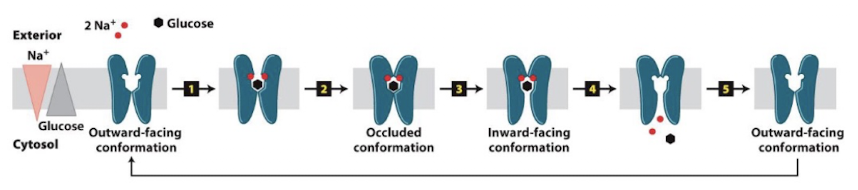
Steps of a Na+ - glucose symporter
Simultaneous binding of 2 Na+ and 1 glucose to the transporter with outward-facing binding site
This causes a conformational change in the transporter
Eventually the transporter adopts and inward-facing conformation that allows
the dissociation of the two Na+ molecules in the cytosol. As a result, glucose gets pushed-in
Return to the outward-facing conformation to repeat the cycle
What is an antiporter
Two things go through together, the concentration gradient of one molecule is used to transfer a second molecule in the opposite direction
What is an example of an antiporter
Sodium-proton exchange
Transports Na+ into the cell and protons out of the cell to maintain pH
What is active transport
Change in the conformation of the transporter caused by the hydrolysis of an ATP molecule allows molecules to be released on the other side of the membrane.
Move against the concentration gradient
What does Active transport use to move molecules
Proton pump
Two types of active transport
Primary: direct hydrolysis of ATP
Secondary: energy comes from an ion concentration gradient that is established by primary active transport
What is an example of primary active transport
Na+ - K+ pump
How does the Na+ and K+ pump work
Pumps Na+ out of the cell against gradient
Pumps K+ into cell against gradient
Use ATP for energy
What are the steps of the sodium potassium pump
3 Na+ and 1 ATP bind to the protein pump
Hydrolysis of ATP releases ADP and phosphorylates an amino acid in the pump
The shape changes causes Na+ ions to be released outside the cell and 2 K+ ions to enter the pump
Two K+ ions bind to the pump
Dephosphorylation of the pump release P causing the two K+ ions to be released into the interior of the cell
Repeat
How many Na+ and K+ move in the pump
3 Na+
2 K+
What is an example of secondary active transport
The glucose-Na+ transporter
How does the glucose Na+ transporter work
Glucose needs to be transported across the membrane against its concentration gradient
Movement of Na+ provides the energy to move glucose molecules (which comes from the primary active transport, Na+ and K+ pump)
What do carbohydrates attach to in the plasma membrane
Lipids - glycolipids
Proteins - glycoproteins
Where are peripheral proteins attached
To either membrane surface or even actin/cytoskeleton
What is signal transduction
telephone game, a signal is passed on form one molecule to another, but the signal must remain the same
What do receptors do in signal transduction
changes the morphology of the protein
What are the chemical and physical stimulus
Chemical: nutrient, waste, ion, hormone
Physical: light, sound, temperature
Where can signals come from
Inside the cell or outside, they can travel a short or great distance
How does signal transduction work
Transmitted → cells on the outside of the cell can communicate inside the cell → ligand binds to the receptor → morphology changes → cascae effect
What are the common themes in signal transduction pathways
Specificity
Ligand binding causes receptor protein to change change
Activate receptor alters function (amplification)
Response is executed
What does specificity mean
Receptor proteins have a very specific binding sites for chemical signal molecules
What are ligands
are chemical messengers, released by a cell, which can be sent to a different cell or stay at the same cell, cancer cells send the signals to themselves, to divide again
Components of a signal transduction pathway
The signal
A receptor
Response (long or short term)
Amplification by other cellular molecules (cascade)
What is long and short term response in signal transduction
Long term, change in DNA, causes long term changes
Short term, specific movement, enzyme activation, cell movemtn
Steps of signal transduction
signal arrive at a target cell (hormone or enzyme)
The signal molecule binds to a receptor protein on the cell surface or inside the cell
Signal binding changes the three-dimensional shape of the receptor and exposes its active site
The inactive signal transduction then becomes activated
The activated receptor activates a signal transduction pathway
Signal transduction pathway activates the cell’s response
What are allosteric changes and what are they caused by
molecules binding to a protein (like an enzyme or receptor) at a site distinct from the active site and it is caused by phosphorylation.
Signal transduction cascade of mitogen using Kinase
Mitogen binds to receptor
Phosphorylates itself
The activated receptor initiates a series of events that allow RAS to bind GTP and become activated
Activated RAS binds and activates MAP3K
Activated MAP3K is a protein kinase that phosphorylates many MAP2K molecules
Activated MAP2K is protein kinase that phosphorylates many molecules of MAP kinase
MAP kinase, when activated by phosphorylation can enter the nucleus
Cellular Response, cell division
What is the strutcure of the mitogen receptor
two dimers and two receptors which come together to activate
Signal transduction allows for cell to
Grow
Divide
Survive (or not, apoptosis)
Move
Differentiate
What side of the receptor protein is effected by the conformation change
Cytosolic
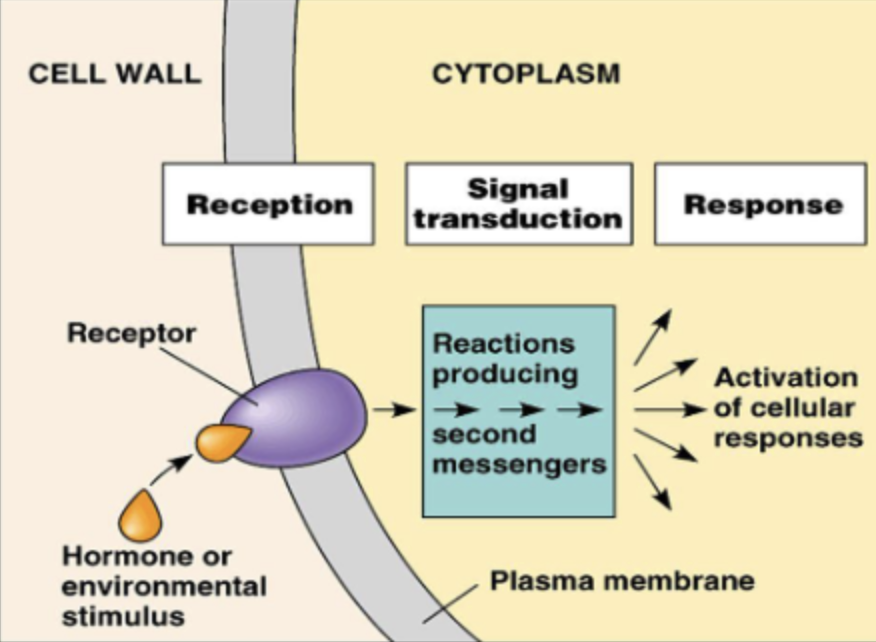
What are the three stages of signal transduction
Reception: ligand binds to receptor
Signal Transduction: cascade of message
Response (cellular growth, division, movement
What are the steps of Insulin receptor
The alpha subunits of the receptor binds insulin (signal)
The conformational change in the beta subunits transmit a signal to the cytosol that insulin is present
Insulin binding causes autophosphorylation or tyrosines in the cytosolic region of the receptor, activating its protein kinase
Phosphorylates insulin-response substrates, triggering a cascade of chemical responses inside the cell
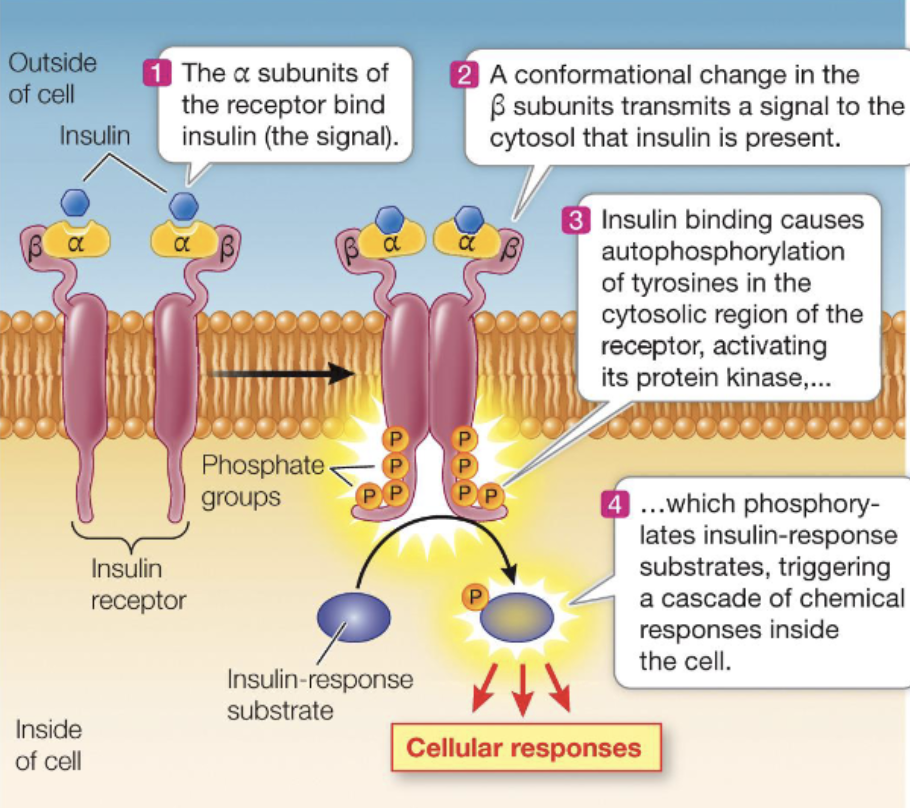
What subunit does insulin bind to
Alpha subunit
What are G-proteins
are mobile membrane proteins with three subunits (alpha, gamma, beta)
How does the g protein-linked receptor work
Signal binds to the G protein-linked receptor and inactive G protein has a GDP bound to it
Causes G protein to activate, by causing the GDP to become GTP
The GTP-subunit alpha separates from G protein and moves through plasma membrane until it encounter an effector protein
The activated G protein alphas subunit activates an effector protein which catalyzes a reaction of a cytoplasmic reactant
Amplification
GTP (hydrolyzed)
GDP
Finds gamma and beta subunit
What is glycogenolysis
How epinephrine (adrenaline) activate conversion of glycogen stored in the liver to glucose
(signal transduction)
What is glycogenin
an enzyme that acts as a primer to polymerize the first glucose molecules
Where is epinephrine made
the adrenal glands on the kidney
How is glycogen turned into glucose via Epinephrine
Epinephrine binds to a receptor on the liver, which turns a G-protein on, which will bind to GTP, the G-protein will then turn on an enzyme called adenyl cyclase, which will cause the accumulation of cAMP inside the cell (secondary messenger), which then causes a molecular cascade
What do anchor membrane proteins do
play an important role by interacting with components of the extracellular matrix
What are the Extracellular matrix (ECM) functions
Cell adherence
Cell communication
Cell shape
Filteration
Barrier