Theory of Numbers pt. 2
 Call Kai
 Learn
Learn Practice Test
 Spaced Repetition
 Match
Match Flashcards
 Knowt Play
1/19

There's no tags or description
Looks like no tags are added yet.
Name | Mastery | Learn | Test | Matching | Spaced | Call with Kai |
|---|
No analytics yet
Send a link to your students to track their progress
20 Terms

False, n is perfect if sigma(n)=2n, not n

True, n is even perfect implies n=2p-1(2p-1) = (q(q+1))/2 (note that 2p-1=q) which then implies 8n+1 = 4q(q+1)+1 = 4q2+4q+1 = (2q+1)².

False, f(x)=0(mod p) has at most deg(f) solutions, or p divides all coefficients of f. Essentially this statement says you can only have an amount of solutions that is equal to the degree of the polynomial (in the context of modular arithmetic) which is not true because you can have infinite solutions if p divides all coefficients.

True, converse of part c. ex, x2-1=0(mod m) has 4 solutions

False, 24 does not equal 2, 4, pk, 2pk (24 doesn’t have primitive roots) and phi(phi(n)) only works if n has a primitive root in the first place

True, 121=11², 11²=pk

False, ordm(a)=phi(m) implies a is a primitive root mod m, but m may not have any primitive roots

True
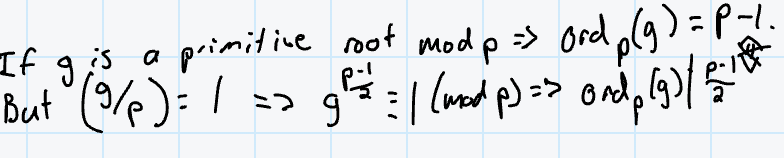

True

True

True,piggybacks off of part j

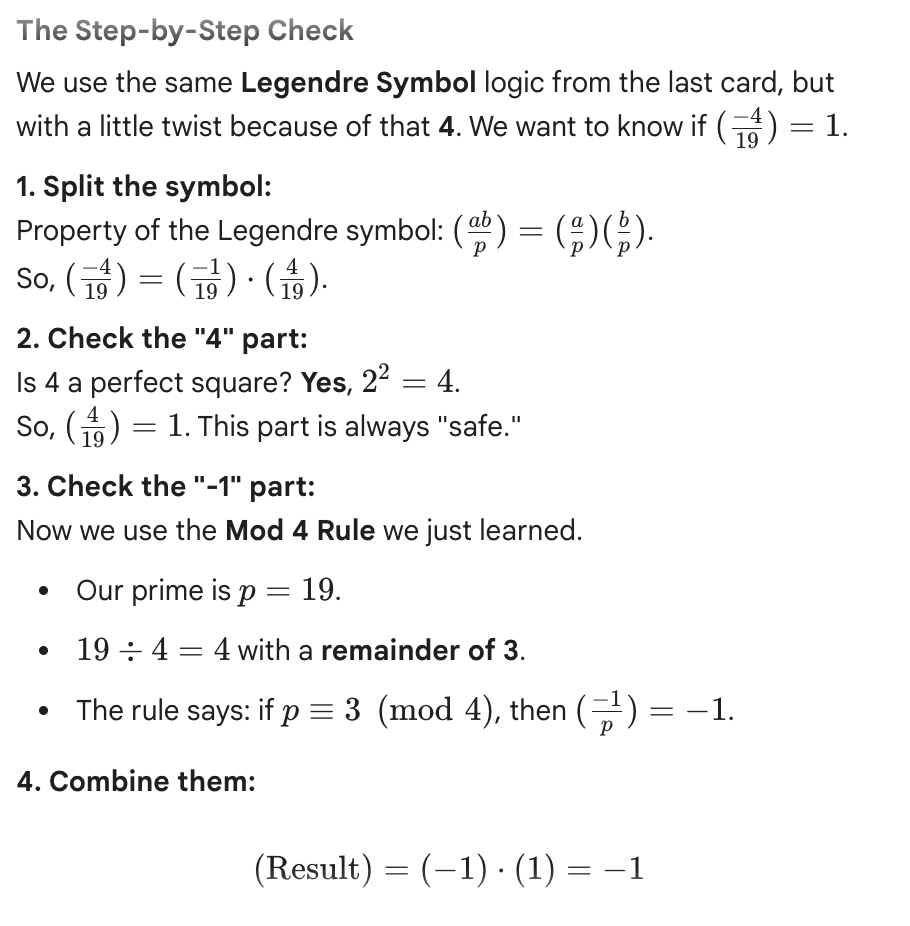
True, because 17=1(mod 4) implies that (-1/17)=1 which implies that x2+1=0(mod 17) is solvable. This is because of the rule n²=-1 (mod p) has a solution iff p=2 or p=1 (mod 4), no solution if p=3(mod 4)

False, need a solution to find n²=-4 (mod 19)

True, this talks about when (2/p)=-1 and (-2/p)=-1, so what values of make both 2 and -2 a non-quadratic residue(nonperfect square). Note that the law when dealing with 2 is (2/p)=(-1)(p²-1)/8
So we need the exponent to be odd, 3 does this and so does 5. For -2, we already know (2/p)=-1 so now we just need to prove (-1/p)=1 so that we have (-1) from the 2/p X (1) from the -1/p which will equal -1. To do this we just use the law when dealing with (-1), (-1/p)=(-1)(p-1)/2 so we need the exponent to be even, 5 and 7 do this. REMEMBER P IS AN ODD PRIME, IGNORE P VALUES (don’t check) THAT ARE NOT ODD PRIMES. START WITH 3

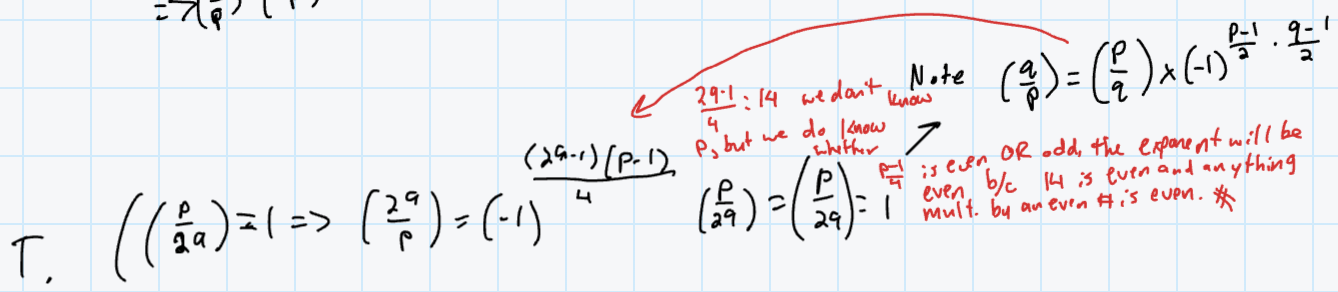
True, in other words is (p/29)=(29/p) always true? Yes because you can flip a Legendre symbol as long both p and q (q is 29) are NOT =3 (mod 4)… 29=1 (mod 4) so (p/29) will always equal (29/p) because if one is square (value 1), the other must be square. Another way to attack is attached. We know to use (-1) as the multiplier b/c that is what is always used for law of quadratic reciprocity

True, there are 20 different numbers n, that is given. However there are only 15 quadratic residues mod 31 since (p-1)/2=15 (p is 31). i cannot equal j, however ni=nj (mod 31) for example if n5=5, then nj could equal 36(mod 31) which simplifies to 5 (mod 31). well 36-5=31 and 31 divides 31.

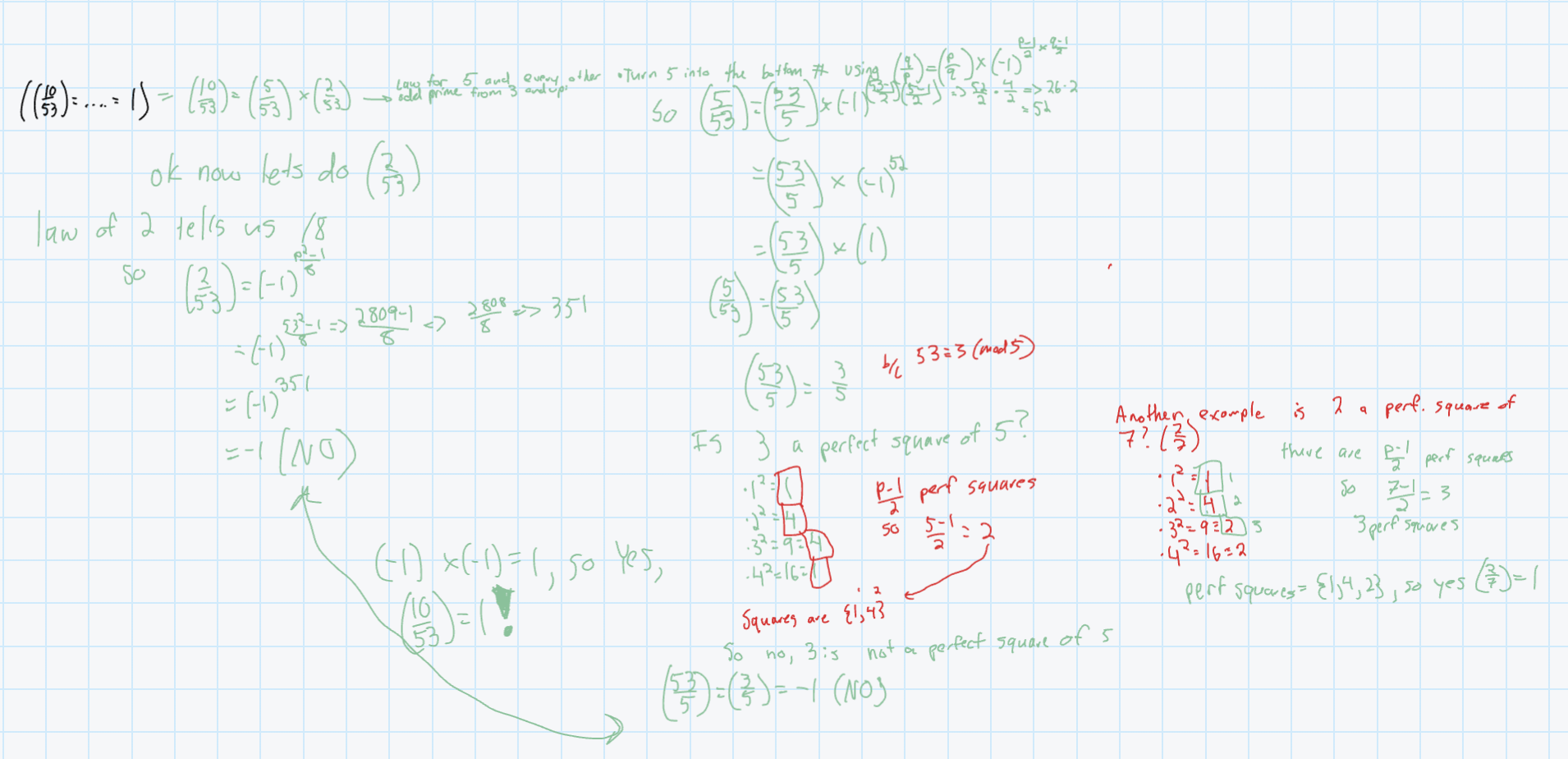
True, we can break (10/53) into (2/53)x(5/53) then use the law for 2 and the flip rule for 5 (quadratic reciprocity) and hope that the combonation of congruences is (1)yes x (1)yes or (-1)No x (-1)No so that the final answer =1
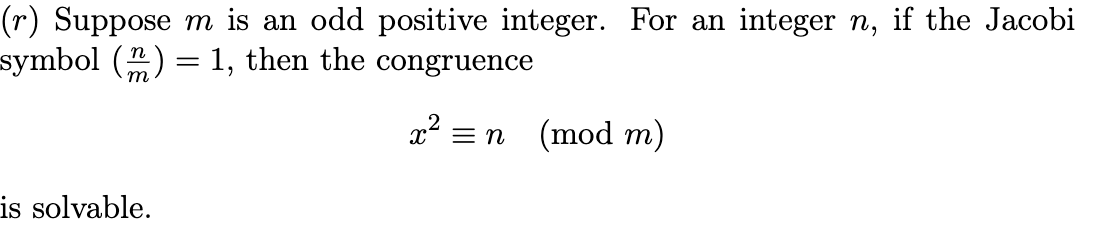
False, would be true if we were talking about Legendre symbols, but Jacobi is a whole different game. Jacobi symbol means the bottom number (m) is composite. Jacobi sysmbols are really just multiplication of legendre symbols. (n/m)=(n/p)x(n/q) so if the result ends up being (1)yes x (1)yes or (-1)no x (-1) no the congruence would be solvable, but because of the case where you can get -1 it is not ALWAYS solvable so this statement is false.

True, means multiplication of two legendre symbols ended up being equal to -1.
Define phi, what is phi(24) equal to?
phi is how many integers from 1 to n are relatively prime to n(they don’t share any common factors with n other than 1), phi(24)=8