VMED 5172 - Hypersensitivity
 Call Kai
 Learn
Learn Practice Test
 Spaced Repetition
 Match
Match Flashcards
 Knowt Play
1/39

There's no tags or description
Looks like no tags are added yet.
Name | Mastery | Learn | Test | Matching | Spaced | Call with Kai |
|---|
No analytics yet
Send a link to your students to track their progress
40 Terms
Mast cells and eosinophils
Type I hypersensitivity is mediated by what cell types?
Type II
Which hypersensitivity type is associated with antibodies?
Immune complexes and neutrophils
Type III hypersensitivity is associated with what immune cells?
Type IV
Which type of hypersensitivity is mediated by T cells?
IgE receptors
What type of immunoglobulin is seen in a mast cell associated hypersensitivity?
Within seconds to minutes; mast cells are located close to the skin
A type I hypersensitivity reaction happens within what timeframe? Why is this?
Degranulation
Once an allergen binds to a mast cell, what process occurs which leads to symptoms?
Anaphylaxis
A systemic, life-threatening reaction to an allergen is known as?
Lungs
In most domestic animals, the 'shock organ' is the?
Dogs
In which species is the shock organ considered to be the liver?
Hepatic veins constrict, causing blood backup and systemic hypotension, leading to circulatory collapse
Physiologically, how does the liver cause death via anaphylaxis?
Atopy
An exaggerated response to environmental antigens is known as?
Sensitization and elicitation
The development of a type I hypersensitivity requires what steps?
Activation of B cells and isotype switching to IgE takes at least two weeks
Why do signs of a type I hypersensitivity reaction not appear upon first exposure?
Atopic dermatitis, asthma, food allergies, allergic conjunctivitis/rhinits
What clinical issues are associated with type I hypersensitivity?
Type I
This is an example of what type of hypersensitivity?
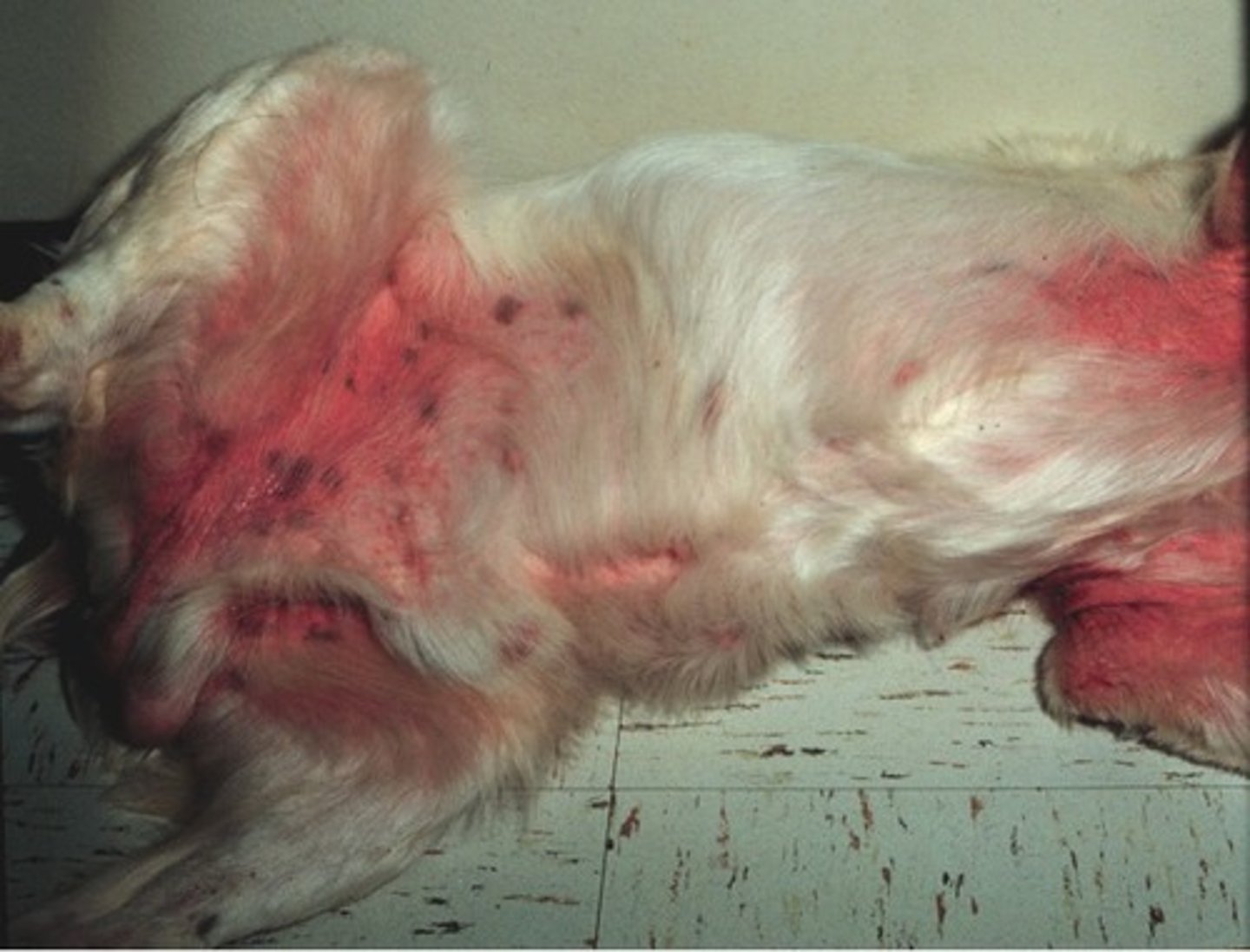
Anti-inflammatories and antihistamines
When allergen avoidance is not possible, what treatment is recommended for type I hypersensitivity reactions?
Desensitization, or allergen specific immunotherapy
What process can be used to reduce the severity of a hypersensitivity reaction?
Increased quantities of an allergen are administered to an animal in order to reduce the subsequent severity of a reaction
Describe the process of allergen specific immunotherapy
The number of mast cells and IgE decreases, and mediator release from mast cells is decreased
What effect does increase dosage of an allergen have on an immune response?
Via an antibody binding to either self or foreign cells
How are type II hypersensitivity reactions triggered?
The complement is activated and the immune response destroys normal cells
Once an antibody binds to a cell and induces a hypersensitivity reaction, what is the effect on the body?
May cause destruction of newborn's red cells if these antibodies are ingested in milk; hemolytic disease of the newborn
When mothers make antibodies against fetal red cells, it can have what effect on a newborn? What is this called?
Different erythrocyte antigens are expressed on red cells of different types, and individuals may make antibodies against these antigens without prior exposure
Why do reactions to differing blood types occur?
IgM
What immunoglobulin type is associated with hypersensitivity in blood transfusions?
Transplacental hemorrhage or repeated pregnancies
In order for neonatal isoerythrolysis to occur, a mother's response to the fetal blood antigen must be boosted via?
Immune mediated hemolytic anemia
Some drugs and infectious agents can bind to red blood cells and cause lysis as a part of what disease?
An antibody and its bound antigen
Immune complexes are formed by what components?
Lattices
Type III hypersensitivity can result when the correct ratio of antigen to antibody is present and ___ form
Local and systemic reactions
What are the forms of type III hypersensitivity reactions?
Within tissues
Local type III hypersensitivity reactions are caused by immune complexes formed where?
Systemic
What form of type III hypersensitivity is characterized by immune complexes forming within the bloodstream?
Neutrophils, complement, etc.
In a local type III hypersensitivity reaction, there is activation of what immune cells locally?
Type III; triggered by infusion of anti-tetanus toxoid or anti-snake venom
Which hypersensitivity reaction type is 'serum sickness'? What is this triggered by?
If immune complexes get deposited in glomeruli, it can cause damage to the endothelium, which is worsened by neutrophils, leading to decreased kidney function
How can type III hypersensitivity reactions affect the kidney?
Delayed
Type IV hypersensitivity is also known as ___ hypersensitivity
T cells get activated and attack all antigen, even if it is bound to self cells
How is a type IV hypersensitivity reaction triggered?
Feet, ventral abdomen, neck region
Contact hypersensitivity is often seen on what areas of the body?
A
Which one of the following is an example of peripheral tolerance?
A. Preventing an immune response to harmless food allergens in the gut
B. Certain bacteria blocks the T cell receptors in the skin so that T cell does not recognize the antigen
C. T cells attack the blood cells in hemolytic anemia
D. In bone marrow, immature B cells undergo negative selection if their B cell receptors (BCRs_ strongly recognize self-peptides
B
Which of the following is an example of molecular mimicry?
A. Autoantibodies generated after a breach of the blood-brain barrier
B. Antibodies generated against Trypanosome cruzi cross-react with cardiac myocytes
C. Hypersensitivity reaction caused by poison ivy
D. Removal of aged red blood cells by the reticuloendothelial system