T-cell development
 Call Kai
 Learn
Learn Practice Test
 Spaced Repetition
 Match
Match Flashcards
 Knowt Play
1/15

There's no tags or description
Looks like no tags are added yet.
Name | Mastery | Learn | Test | Matching | Spaced | Call with Kai |
|---|
No analytics yet
Send a link to your students to track their progress
16 Terms
What are the two interaction points that are needed for TCR recognition?
Interaction between the TCR and antigen
Interaction between TCR and MHC molecule
What determines the diversity in HLA molecules?
genetics
we can express upto 12 HLA molecules (x3MHCI and x3MHCII from both mother and father)
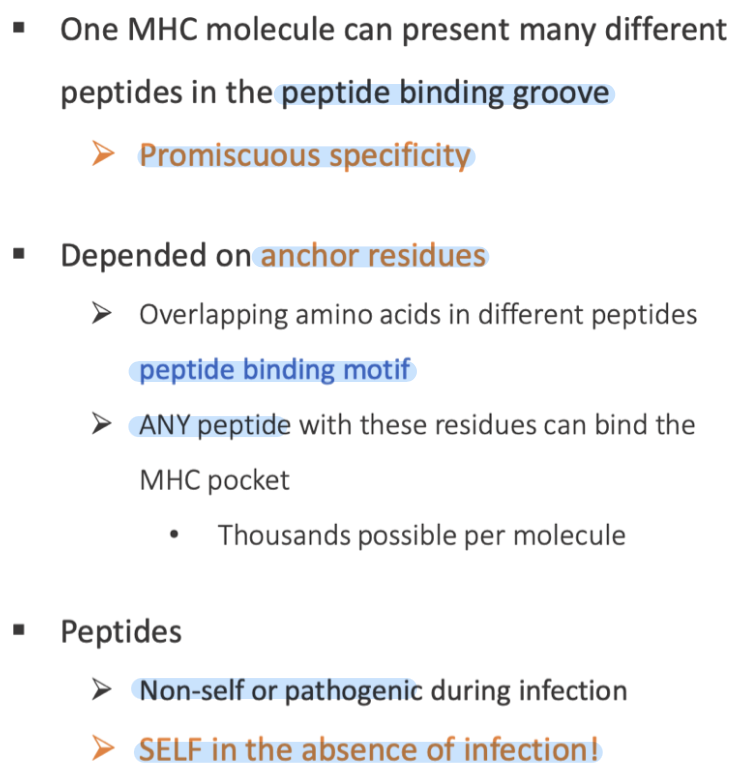
What is promiscuous binding specificity?
Where do T-cells originate and where do they develop?
originate from bone marrow and develop in thymus via blood circulation
What happens to thymus quality with age?
A year after birth T cell development in the thymus slowly decreases
How do cells prepare for positive selection?
Step 1 in cortex of thymus → positive Selection for binding of TCR To Self MHC
T cell precursors enter the thymic medulla via the blood and move into cortex for positive selection
During positive Selection T cells gain expression of the TCR which is checked for functionality: (before positive selection)
first checkpoint is for functional Beta chain → if no 4 attempts before apoptosis if yes → continue
second checkpoint for functional alpha chain → if no rearrange until exhaustion, if yes → continue to selection
Explain positive selection
Positive selection ensures we express T-cells that can bind to our MHC molecules.
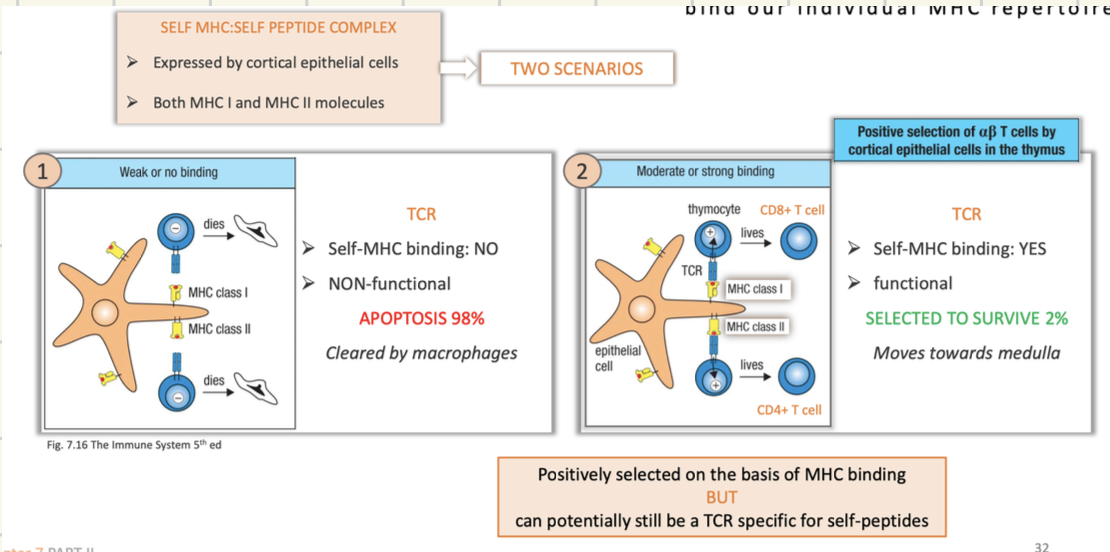
What happens to T-cells that have TCRs specifically for self-MHC?
they travel inti the thymic stroma towards the corticomedullary junction.
What is negative selection for T-cells?
negative selection for binding of TCR to self-peptides and deletion
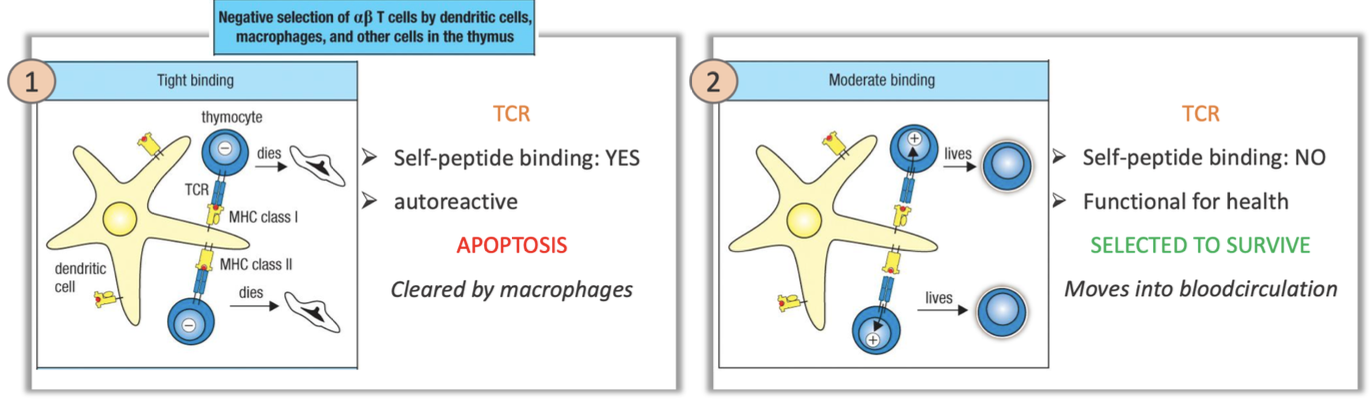
to make sure the T-cells dont attack the body
What is AIRE and where is it expressed?
Autoimmune Regulator — transcription factor expressed in medullary epithelial cells of the thymus. Drives expression of tissue-specific peptides (e.g. insulin) so autoreactive T cells can be deleted before leaving the thymus.
What happens if AIRE is deficient?
Tissue-specific peptides are not presented in thymus → autoreactive T cells escape to periphery → attack tissues → autoimmunity (e.g. APECED)
What is central tolerance and what does it prevent?
Deletion of autoreactive T cells in the thymus. Prevents T cell responses against self-peptides in the absence of infection → avoids autoimmunity
How do Tregs arise and what activates them?
Arise from autoreactive CD4+ T cells during negative selection that are NOT deleted → instead activate transcription factor Foxp3 → become Tregs
How do Tregs suppress autoreactive T cells?
Must interact with the same APC as the autoreactive T cell → suppress via anti-inflammatory cytokines (e.g. IL-10, TGF-β)
What happens to T cells after passing thymic selection?
Exit thymus as mature, self-tolerant, MHC-restricted CD4 or CD8 T cells → enter blood circulation → recirculate through secondary lymphoid organs until they encounter their specific antigen
What is lymphocyte recirculation and why does it matter?
T cells continuously cycle between blood → secondary lymphoid organs (via arteries) → exit via lymphatics → back to blood. Ensures naïve T cells keep patrolling until they find their antigen.