4. INTERIM-PROVISION RESTORATION
 Call Kai
 Learn
Learn Practice Test
 Spaced Repetition
 Match
Match Flashcards
 Knowt Play
1/38

There's no tags or description
Looks like no tags are added yet.
Name | Mastery | Learn | Test | Matching | Spaced | Call with Kai |
|---|
No analytics yet
Send a link to your students to track their progress
39 Terms
What is an interim?
an essential part of fixed prosthodontic treatment,
biologically and biomechanically.
When should we use it?
Patients must be provided with an interim restoration after initial tooth
preparation until the definitive prosthesis (crown) is delivered and
cemented in place.
An interim restoration is defined as
a ‘temporary restoration’ designed to:
1. Provide
- Aesthetics
- Stabilization of the dentition for a limited period of time, it is replaced by a definitive or permanent restoration ( a crown).
2. To protect tooth preparation and soft tissues
3. To keep patient comfortable while the definitive restoration is fabricated at lab
Interim restorations serve what role?
diagnostic role in the functional blueprint for the design of permanent
crown(s)
The interim restoration helps to determine if the proposed solution for the
patient’s presenting condition, ‘satisfies’ the functional, phonetical and esthetic expectations of the patient
Temporary (interim) restorations are not just placeholders—they help evaluate and guide how the final (permanent) crowns should be designed. Specifically, they allow the dentist to:
1.Test function: How the bite (occlusion) works with the restoration.
2.Assess aesthetics: How the crown looks in terms of shape, size, and color.
3.Monitor comfort and fit: Check how the patient adapts to the restoration.
4.Identify adjustments: Catch any issues in speech, chewing, or contact points.
Essentially, interim restorations act like a trial version or
prototype, helping dentists plan the final restoration more
accurately and predictably.
example of interim use for orthodontics
As the complexity of prosthodontic treatment continues, the importance of the interim restoration as a key diagnostic tool is magnified.
Ex. Occlusion
With properly designed interim restorations, changes in the vertical dimension of occlusion, with centric, protrusive and lateral guidance, can readily be evaluated.
Once the dentist and patient are satisfied with the interim restoration’s function, phonetics and esthetics, a duplicate of the interim via an impression, serves as a guide for the lab technician in the fabrication of the definitive crown(s).
This interim restoration becomes a more predicable definitive crown.
The purpose of an interim restoration?
It is the same as the final restoration with the exception of longevity and a matching tooth color
This includes:
1. Pulpal protection
2. Positional stability (dentition)
3. Maintenance of occlusal function
4. Esthetic
5. An interim restoration must maintain the health of the pulpal and periodontal tissues
Basic Requirement- BIOLOGIC
An interim restoration must maintain the health of the pulpal and periodontal tissues.
Once the dentinal tubules are exposed through tooth preparation, requirements that help protect the pulp from the adverse effects of bacterial microleakage and chemical/thermal irritation are:
1. The internal adaptation of the interim restoration
2. The marginal integrity (fit) of the interim restoration
3. The retention of the interim with the luting agent (cement)
For endontically treated teeth, the interim will help maintain the biologic seal and prevent coronal microleakage that may result in contamination of the root canal seal resulting in failure of the root canal.
Patients undergoing complex fixed prosthodontic treatment over an extended amount of time must have properly adapted interim margins for gingival and pulpal health.
Typically, a single crown interim functions for 2-3 weeks. This can vary due to patient function, interim material used and how well the interim was made by dentist
The interim must maintain the health of pulpal and periodontal tissues. how is this accomplished?
1. maintaining marginal integrity (fit)
2. ensuring that the interim contours do not impact on the periodontal
tissues.
The interim margin must be smooth and highly polished.
Proper emergence-profile of the interim restoration is essential to maintaining periodontal health.
Over extended and over contoured interims cause gingival irritation. This may cause plaque retention with inflammation to the gingival tissue.
emergence profile in dentistry
the contour of the tooth or dental restoration where it meets, or “emerges” from the gingiva
Basic Requirement— BIOMECHANICAL
Resist the functional forces of mastication without fracture or displacement
Maintain the position of the prepared tooth and the stability of inter / intra - arch relationships through the proximal and occlusal contacts.
These requirements maintains the relationship of the teeth to each other.
This is important for the purpose of the final impression and final
restorative ‘relationship’ remaining the same
types of interim
2 types
1. Custom-formed:
- Direct (chairside)
- Indirect (in office lab/ lab)
2. Commercial:
- Crown form
Commercial Crown forms
1.Nickel chromium
2. Aluminum and tin-silver
3.Cellulose acetate
4.polycarbonate
custom formed vs commercial formed
Custom-formed (interim) generally fits better than commercial crown forms and they can be shaded to match the patient’s adjacent teeth.
The ‘matrix’ in which a custom (provisional) interim is formed is typically made directly in the patient’s mouth with an impression, putty stent, vacuum form stent or indirectly from a study cast model.
Both methods ensure that the patient’s original tooth anatomy is reproduced in the ‘custom’ interim crown(if it is intended to keep the original size, anatomy& position)
Custom formed: Direct Method
The internal adaption of the interim restoration is formed directly on the
prepared tooth, chairside.
Custom formed: Indirect Method
creating the restoration outside the mouth using a stone models.
This is usually for multiple interim restorations
What dental materials are commonly used as a temporary restoration?
ACRYLIC RESIN
AlikeTM is a tooth colored, self-curing acrylic resin for the fabrication of an interim restoration.
As with most dental procedures, the technique used for fabrication has a greater effect on the final result than the specific material chosen.
Alike™ Temporary Crown & Bridge Resin Powder/Monomer Liquid - GC America Inc
a quick-setting, temporary crown and bridge resin that fully cures
within 5-6 minutes.
may be trimmed and polished easily without clogging burs.
Whatever size of the restoration, AlikeTM is easy to place and maintains a tight seal on the teeth until you are ready for the final restoration
Wet sand stage
Monomers completely surrounds polymer spheres
Stringy/sticky stage
The liquid dissolves the long chains of the polymer, resulting in countless thin, sticky threads
Dough stage
Phase chosen to adapt and mould the resin
Rubbery stage
Increased concentration of polymer chains in the monomer.
Bis Acryl (Provisa plus)
Provisional crown and bridge material commonly used for chairside fabrication of temporary restorations such as single crowns, FPDs, inlays, onlays, veneers, and long-span
Requires a dispensing gun.
Automatically mixed via a mixing tip upon extrusion from the cartridge
Bis Acryl curing stages
1. Working (Manipulation) Stage: The material is in a paste
form, freshly extruded from an automix syringe. It is easily
manipulated and seated into the impression or matrix.
2. Gel Stage: The material begins to cross-link, transitioning
from a workable paste to a rubbery, elastic state. Crucial
Note: Excess flash or "skirts" must be removed while the
material is in this stage to avoid locking it into undercuts.
3. Initial Set (Cure) Stage: The material hardens completely and
loses its rubbery feel, taking on the shape of the provisional
restoration.
4. Final Polymerization Stage: The material reaches its ultimate
mechanical strength, though it undergoes a slight exothermic
reaction (heat release) during this time.
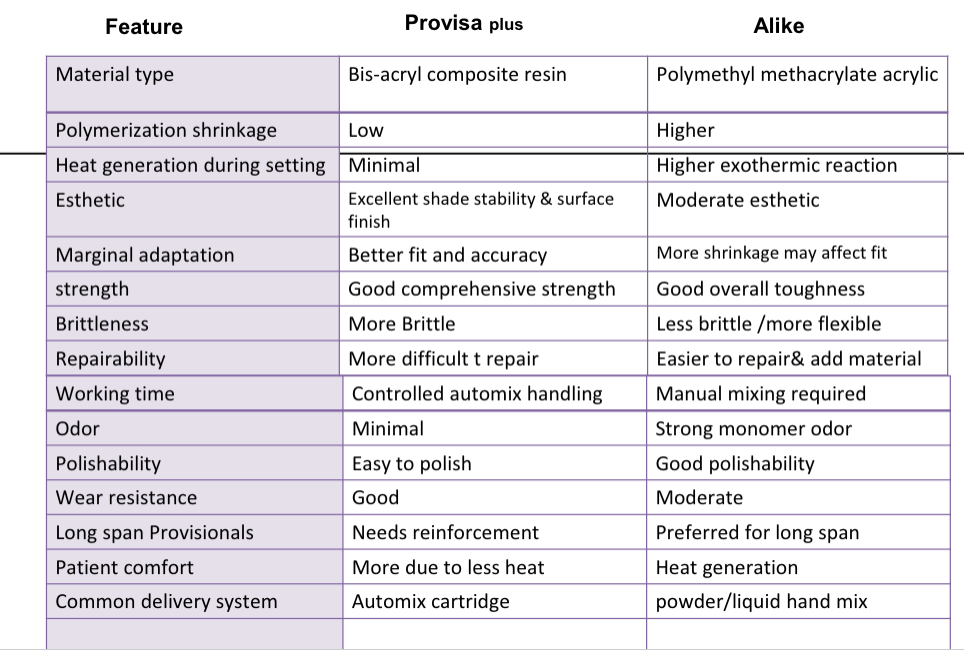
provisa plus vs alike table
Direct method
a custom stent is fabricated to create the external axial and occlusal contours of the interim restoration.
Used at UDM Dental:
2 Types with use of a stone model
a. Vacuum Form Stent
b. Putty Matrix
Vacuum-Form Stent
Diagnostic Casts – Trimmed to horse-shoe shape with 12mm base
Vacuum Form machine (Wet Lab)
Plastic template material .02 inches (Wet Lab)
Crown and bridge scissors
making interim
Typodont
*-Approved crown preparationBis acrylic provisional material
(Provisa+)/AlikeTM acrylic powder and
liquidVaseline and brushes
High speed handpiece
Slow speed handpiece
Putty Stent
Explorer
Spatula
Moore’s mandrel and disks (Fine)
Miller forceps / marking paper
Acrylic burs
The advantages of the direct method are:
Most efficient use of time
Convenience with interim materials used at chairside
The disadvantages of the direct method: Alike-Acrylic Interim material
***related to the interim materials you may use
1. The newly cut dentin and the indirect vital pulpal tissues are exposed to the heat that is generated during the exothermic reaction of the from powder/monomer in the Alike acrylic material.
2.The free monomer and other chemicals that are present in the unpolymerized acrylic interim restorative materials cause marginal shrinkage.
3. Limited color selections.
The disadvantages of the direct method:
***related to the interim materials you may use
1. Polymerization Shrinkage: Like many bis-acryl composites, it experiences dimensional changes during the curing process
2. Brittle in Thin Sections: While it boasts excellent flexural and compressive strength, the material can become brittle at thin margins
3. Staining & Wear: If worn as a long-term provisional, the material is susceptible to staining from coffee, tea, and tobacco, and may gradually wear down under heavy occlusal forces or bruxism
4. Allergic Potential
Regardless of which technique is used in fabricating an interim, one of the key requirements of an interim is to
provide a definitive marginal seal to prevent:
1. pulpal sensitivity
2 . provisional cement wash out
3. bacterial ingress
4.Secondary caries
5.pulp necrosis.
A definitive marginal seal promotes
1. Optimal periodontal and gingival health
2. Facilitates the impression and cementation procedures that are to follow
what to do If there is an open margin
Alike: Add acrylic to the margin using the salt and pepper technique.
Bis Acryl: Difficult to correct an open margin; make a new one
Evaluation of interim (provisional) restoration.
Interim fit should approximately be the same as the desired definitive crown
including interproximal contacts, contour and occlusion
The interim help in evaluating and guide the final restoration
1. True
2. False
1. True
The basic interim requirements are:
How may types of interim restoration are?
a. 3
b. 1
c. 2
2
The chemical reaction between the powder and liquid in the Alike is_________
reaction.
exothermic
A 32-year-old patient presents for a provisional crown after preparation of tooth #9. At
the follow-up visit, the patient reports sensitivity to cold and sweets. Clinical
evaluation reveals an inadequate marginal seal on the provisional crown.
Which biological requirement of Provisionals was most likely compromised?
A. Occlusal compatibility
B. Pulp protection
C. Maintenance of tooth position
D. Resistance against functional load
B