Audiology(131) - Unit 1 Exam
 Call Kai
 Learn
Learn Practice Test
 Spaced Repetition
 Match
Match Flashcards
 Knowt Play
1/85

There's no tags or description
Looks like no tags are added yet.
Name | Mastery | Learn | Test | Matching | Spaced | Call with Kai |
|---|
No analytics yet
Send a link to your students to track their progress
86 Terms
Specific historical event (mid-20th century) that created a sudden need for hearing rehabilitation
WWII caused many noised induced hearing losses in veterans
(Post WWII - 1960, Audiology formally recognized as profession)
Why did WWII “hearing event” force Otology and Speech Pathology to collaborate?
To provide aural rehabilitation
Collaboration created audiologists (Hearing assessments, diagnostic examinations, rehabilitative care)
Degree Progression: The entry-level degree requirement from the start of the field to NOW(the present day)
Initially only needed Bachelor’s Degree
Then required Masters
Coursework included Communicative sciences, electronics, and clinical practicum
NOW need Doctor of Audiology
Every state requires to practice audiology
4 year program (including professional prep)
instruction in hearing and speech science, anatomy and physiology of hearing and balance, counseling, electronics, and computer science
last years focus on clinical practice
What is the current designator for the professional doctorate required to practice? (e.g., PhD, ScD, EdD, or AuD?)
AuD
The “Big Three” - Three regulatory categories
Licensure, Certification, Accreditation
Licensure:
o Voluntary or mandatory?
o Who issues it (State vs. National)?
Mandatory, Legal requirement in ALL states
Issued at state level
For California licensure (after Jan 1, 2008), how many hours of supervised clinical practicum are required?
300 hours of supervised clinical practicum in 3 diff clinical settings
Must have AuD not masters
Certification:
o Voluntary or mandatory?
o Who issues it?
Voluntary
Issued by:
ASHA offers CCC-A (Certificate of Clinical Competence in Audiology)
ABA offers American Board of Audiology Certified (ABAC), pediatric, vestibular, etc.
Accreditation:
o Who does this apply to?
Graduate-level educational programs (Doctor of Audiology/Au.D.) and institutions
Voluntary
AAA (American Academy of Audiology) primary focus
Advancing audiology services and public awareness.
Continuing education programs, professional journals, annual conferences
The world's largest professional organization for audiologists
ASHA (American Speech-Language-Hearing Association) primary focus
Standards, accreditation, continuing education.
Professional development, networking, advocacy efforts.
Certifies both speech pathologists and audiologists
ADA (Academy of Doctors of Audiology) primary focus
Historically focused on the business aspects and interests of audiologists in private practice
From a physical perspective, how is sound defined?
A series of disturbances of molecules within an elastic medium
Define Sound Psychologically
Sound as an auditory experience perceived by the brain
In a longitudinal wave, particle displacement is _______ to the direction of wave propagation.
parallel
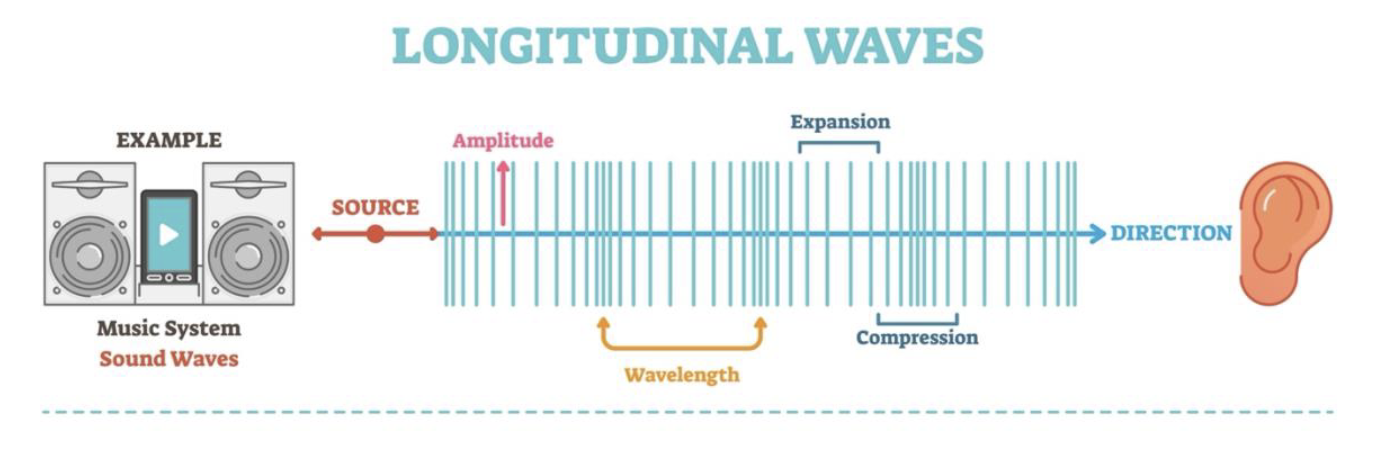
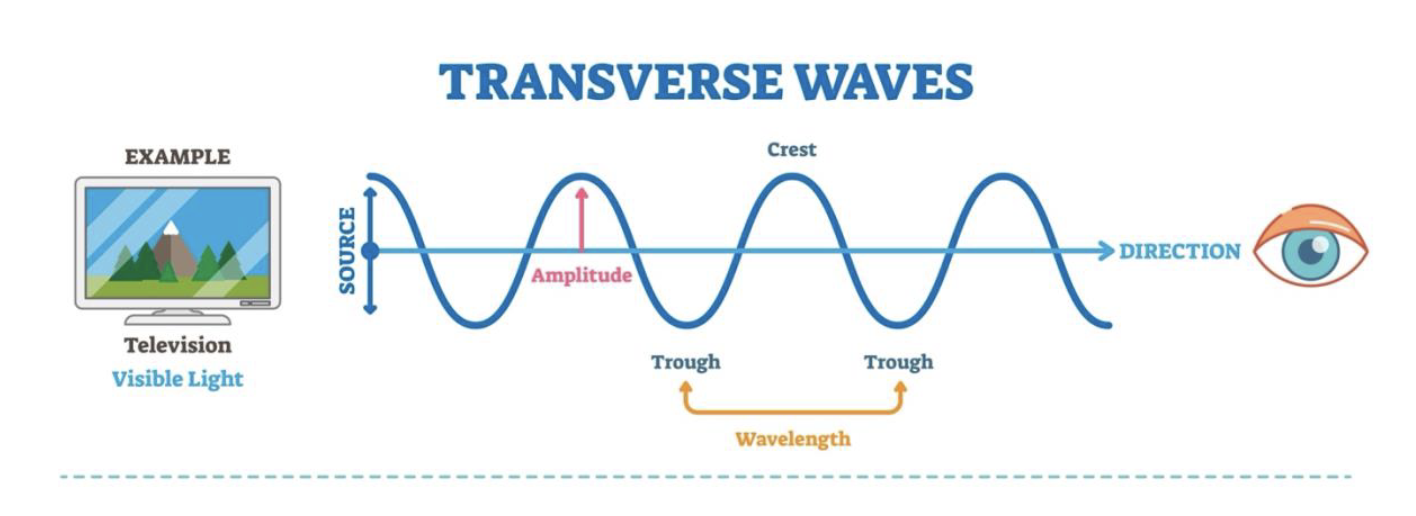
Transverse Waves
particle displacement is perpendicular to the direction of wave propagation
Ex: ripples in water
Frequency
Number of cycles (of a sound wave) per second (Hz)
Period
Amount of time taken to complete ONE cycle
Velocity
the speed sound travels through a medium
In air is approx. 344 m/s (at 20°C)
Why does sound travel faster in steel than in air?
steel is a stiffer medium and molecules are more packed than air
denser molecules = sound vibrations can travel faster
Damping
The loss of energy due to friction
difference between Light, Heavy, and Critical damping
Light - Slow decay of vibrations (gradual)
Heavy - Rapid cessation of vibrations
Critical - Vibration stops almost immediately after displacement (before oscillation)
Impedance component - Resistance
Friction (independent of frequency).
Impedance component - Reactance
mass = ?
stiffness = ?
frequency dependent resistance (Stores energy)
Mass Reactance: Opposes high frequencies.
Stiffness Reactance: Opposes low frequencies.
Brownian Motion
The random movement of air molecules caused by thermal energy
Amplitude
Height of the sound wave
Maximum displacement of particles from their resting position
directly related to loudness
Impedance
the resistance a medium offers to the propagation of sound
depends on the medium’s density, elasticity, etc.
Decible (dB) scale
expresses ratio between two values
LOGARITHMIC, not linear
dB SPL (Sound Pressure Level)
measures intensity of sound/Physical pressure.
sound pressure = force of sound on a surface area
Reference is 20 dacapasals
dB HL (Hearing Level)
the number of decibels above an average normal threshold at a particular frequency.
Normalized to human hearing.
0 dB HL is the average threshold for normal hearing.
dB SL (Sensation Level)
The number of dB above a patient's auditory threshold
Tone presented (dB) - patients threshold = sensation level
negative if going backwards
Ex: tone is presented at 50 dB HL & person's threshold is 5 dB HL,
the sensation level is 45 dB SL.
Psychoacoustics
the perception of sound
pitch, loudness, localization, masking
subjective perception of frequencies (Mels)
Pitch
higher frequ percieved as higher pitch
Loudness (and units of measurement)
subjective perception of intensity of sound
(measured in phon or sone)
Phon: equal loudness
Sone: relative loudness
Localization
ability to determine the direction and distance of a sound source
Interaural Time Difference (ITD)
[low or high frequ]
difference in time it takes for a sound to reach each ear
useful for low-frequency sounds.
(cue for localization)
Interaural Level Difference (ILD)
The difference in sound pressure level (SPL) reaching each ear
useful for high-frequency sounds
(cue for localization)
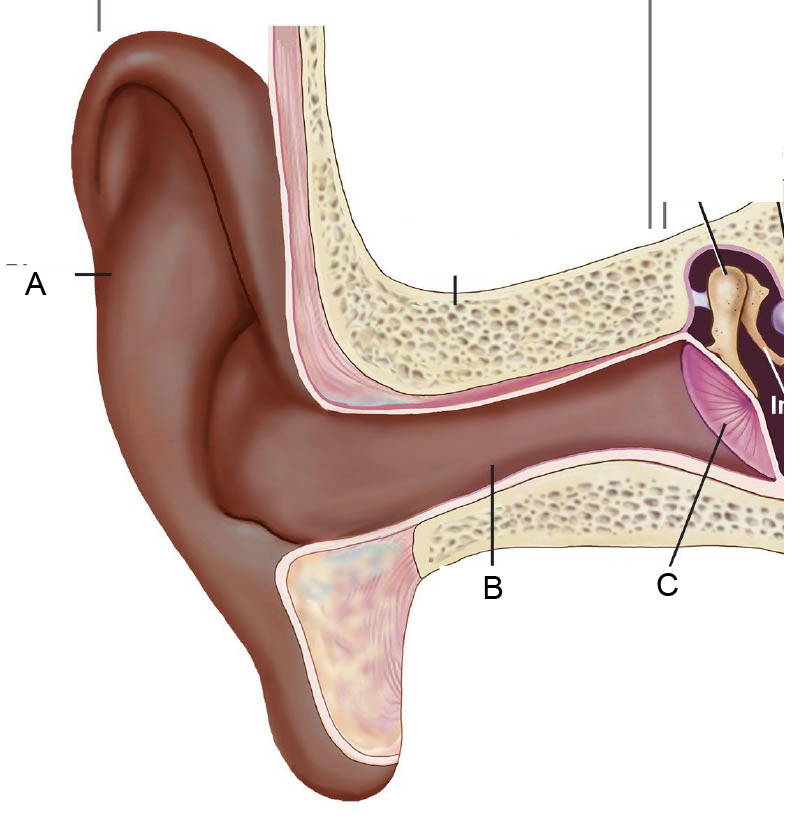
A
Pinna (Auricle)
B
External Auditory Canal (EAC)
C
Tympanic Membrane (Eardrum)
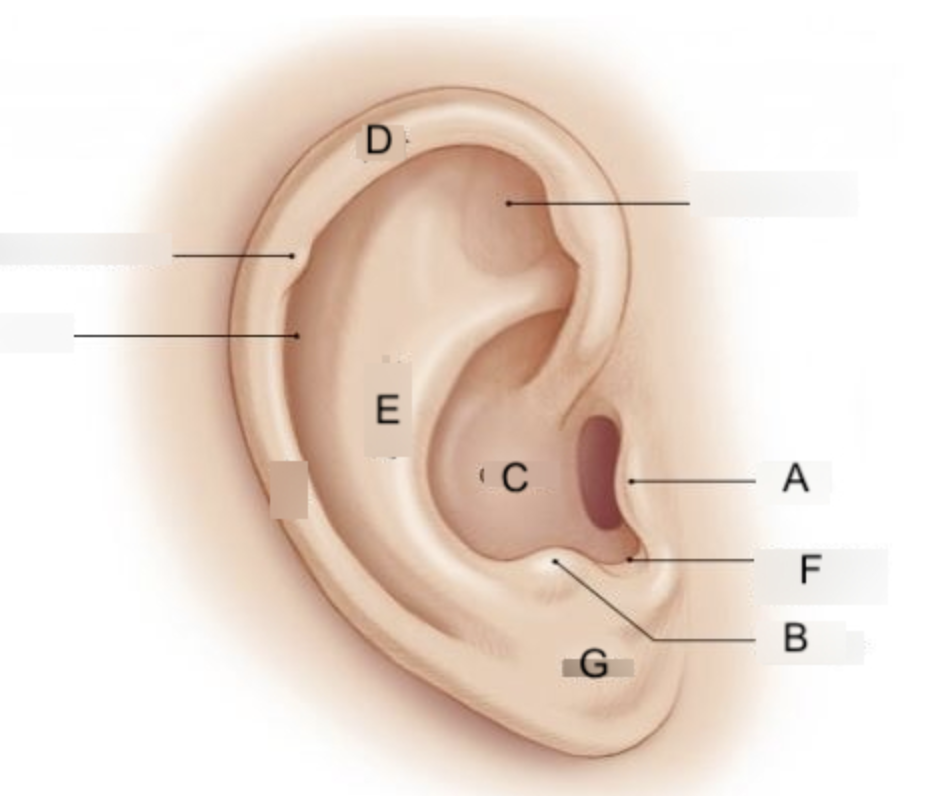
A
Tragus
B
Antitragus
C
Concha
D
Helix
E
Antihelix
G
Lobule
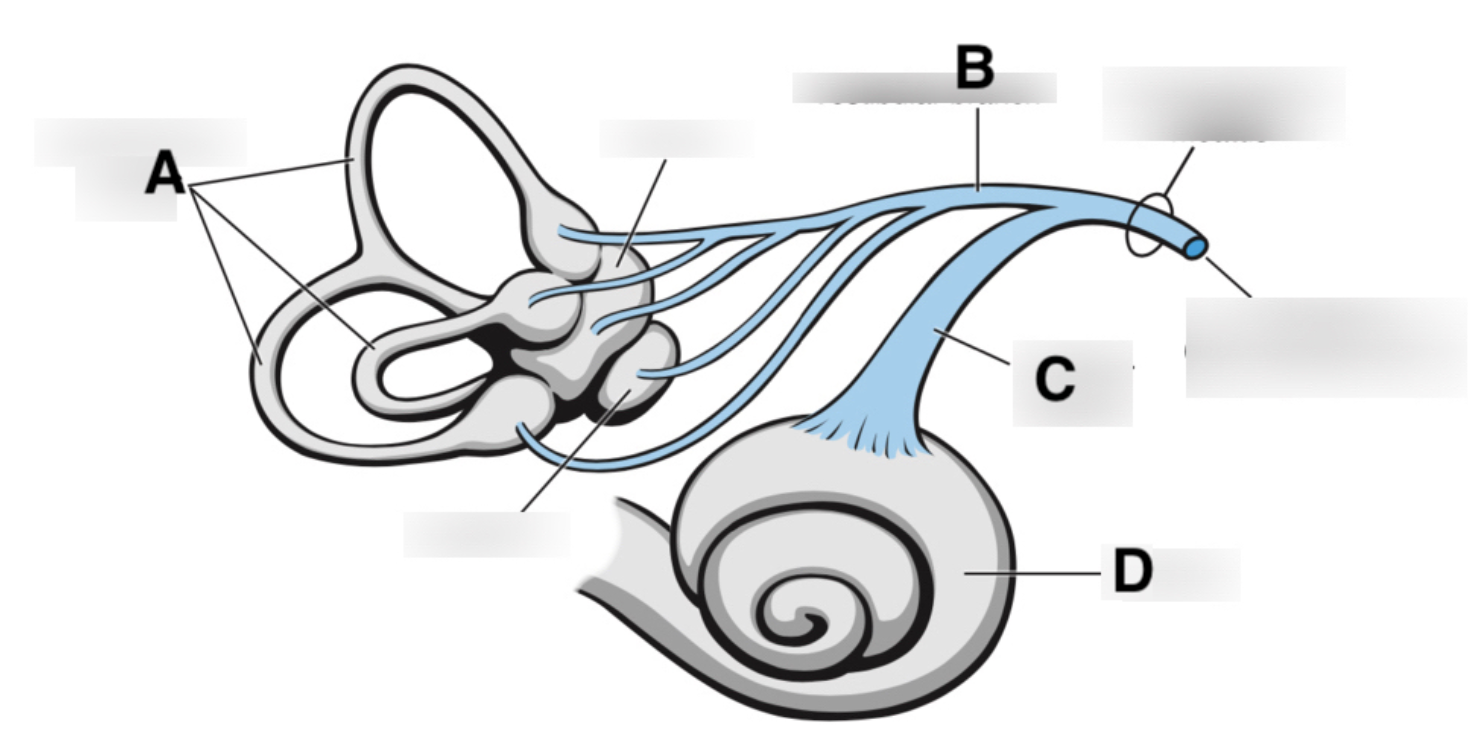
A
Semicircular Canals
B
Vestibular Nerve
C
Cochlear Nerve
D
Cochlea
What are names for the outer ear?
pinna, auricle, ear
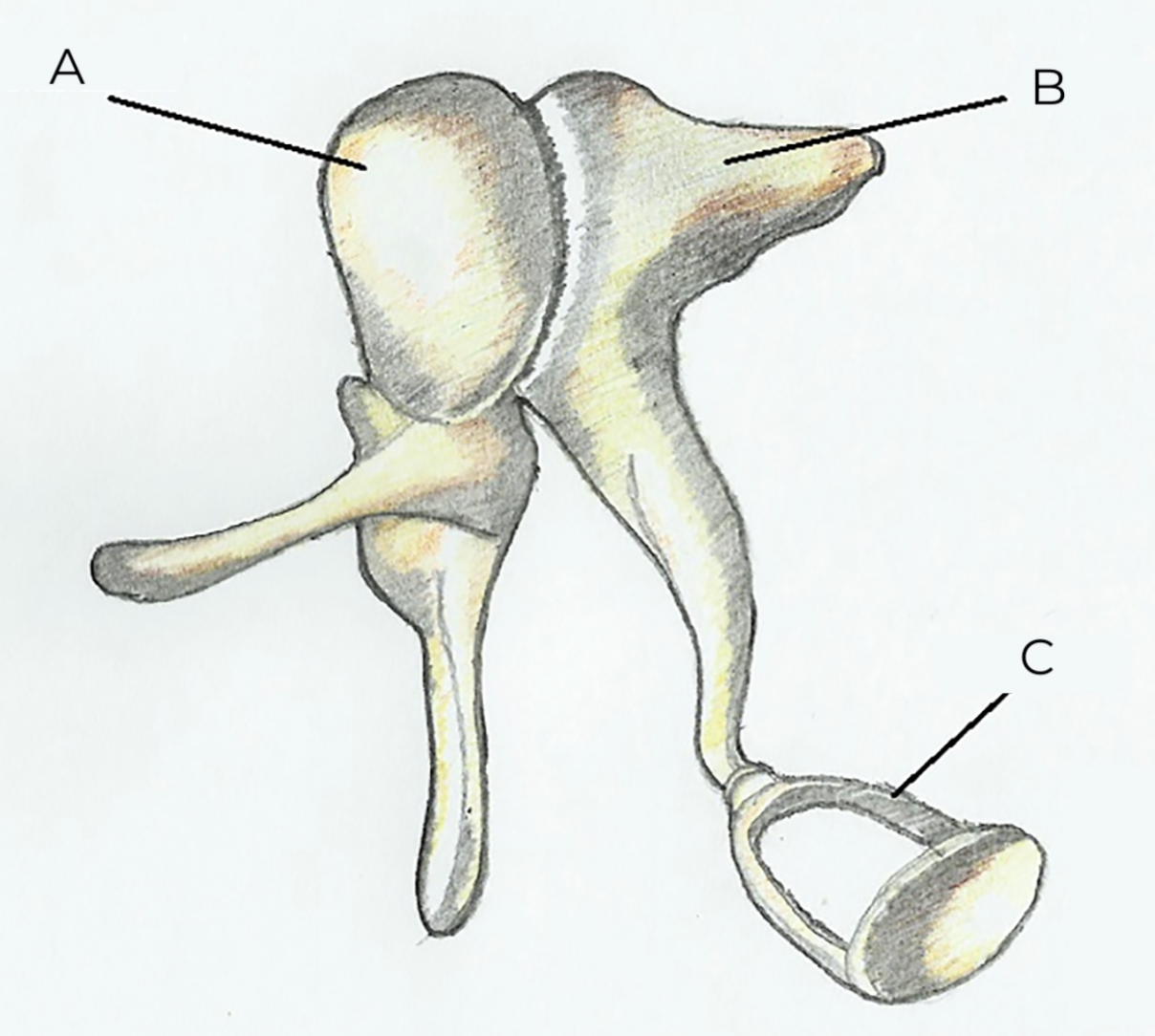
A
Malleus
B
Incus
C
Stapes
Function of the Outer Ear
funnel/gather sound, protection, resonance
EAC Resonance (enhances what range of frequencies?)
EAC functions as a resonator
enhances sounds between 2000 - 7000 Hz
"quarter-wave resonator" effect of the canal boosts frequencies
How does the middle ear compensate for the impedance mismatch between air and cochlear fluid?
The “transformer” action
transforms sound energy from air to fluid in cochlea
tympanic membrane → oval window
lever action of ossicles amplifies sound pressure
(Total gain approx 30 dB)
Mid ear - Area Ratio
tympanic membrane’s larger surface area compared to the oval window concentrates sound pressure
Mid ear - Lever Action
ossicles = lever system amplifying sound vibrations
M & I transfer sound vibes from eardrum → stapes → oval window → inner ear fluids
Mid ear - Buckling Action (increase pressure by ___ dB)
Flexibility of the tympanic membrane
increases sound pressure by approx 6 dB
Mid Ear - Pressure Equalization
Eustachian Tube maintains equal air pressure WHICH optimizes movement of tympanic membrane and ossicles
connected to the nasopharynx to allow for pressure equalization
Tonotopic Organization
where diff frequencies are detected in the cochlea
could theoretically point to certain part and show where 1000 Hz is detected
Base: high frequ
Apex: low frequ
Inner Ear function
hearing and balance
Inner Ear Fluids - Perilymph
Found in Scala Vestibuli & Scala Tympani
High Sodium (Na+), similar to Cerebrospinal fluid (CSF) in brain
Inner Ear Fluids - Endolymph
Found in Scala Media (cochlear duct)
High Potassium (K+)
Inner Hair Cells (IHC) function
(afferent or efferent?)
The true sensory receptors
primarily responsible for sending auditory signals to the brain(afferent/ascending)
Outer Hair Cells (OHC)
enhance sound sensitivity and frequency discrimination (“cochlear amplifier”)
efferent/tuning
Organ of Corti (location and function)
located on basilar membrane in cochlea
contains hair cells that convert mechanical energy into electrical signals
Vestibular system (function and contains..)
responsible for balance
contains: utricle, saccule, semicircular canals
Semicircular Canals function
senses angular acceleration (rotational movements).
Anterior, lateral, posterior
Otolith Organs (Utricle & Saccule) function
Detect Linear acceleration (gravity/elevator)
and head position
Central Auditory Pathway (CAP)
(function)
responsible for transmitting neural signals from the cochlea to the brain
crucial for perceiving sound meaningfully
Hearing Pathway - Air Conduction (AC)
sound travels through outer and middle ear → inner ear → nerve
If AC is abnormal, problem could be anywhere in auditory system
Bone Conduction (BC)
bypasses outer and middle ears by vibrating the skull and directly stimulating the inner ear → nerve
Distortional BC
Direct vibration of the temporal bone compresses the cochlear capsule
Inertial (BC)
The ossicles (due to mass) lag behind the skull movement, moving the stapes in/out of the oval window
Osseotympanic (BC)
Vibrations of the ear canal wall radiates sound into the canal which is heard via AC route
enhanced by occlusion effect
The Vestibulocochlear Nerve (= 8th CN)
[carries..]
carriers neural signals from cochlea → internal auditory canal → brainstem
The Vestibulocochlear Nerve (8th CN) STRUCTURE
Two branches:
Cochlear/Auditory branch
Vestibular branch
carriers 30,000 auditory and 20,000 vestibular nerve fibers
Auditory Branch (vestcoch nerve VIII)
carriers hearing information from cochlea
Vestibular Branch (vestcoch nerve VIII)
carriers balance info from semicircular canals and otolith organs
Vestibulocochlear Nerve Pathway (branches, through)
BOTH branches travel from the inner ear → brainstem
through bony tunnel called Internal Auditory Metus (IAM)
Tonotopic Organization of the Nerve
auditory nerve is organized by frequency
High-frequ fibers (Basal): Derived from cochlea base, located on the outer portion(surface) of nerve trunk
tumors on outside of nerve often affect high-frequ hearing first beacuse they compress outer fibers
Low-Frequ Fibers (Apical): derived from cochlea apex. located in center (core) of nerve trunk
The Junction (where does the auditory nerve (CN VIII) connect to the brainstem?)
Cerebellopontine Angle (CPA)
this is junction of Cerebellum, Pons, and Medulla
First Relay Station (in Central Auditory Nervous System)
(and function)
Cochlear Nucleus
separates input based on frequ of sound
where nerve fibers terminate
Afferent vs Efferent
Afferent (Ascending): signals travel from ear to brain (mostly inner hair cells)
Efferent (descending): signals travel from brain to ear (mostly outer hair cells)
help with tuning and noise management