Language
 Call Kai
 Learn
Learn Practice Test
 Spaced Repetition
 Match
Match Flashcards
 Knowt Play
1/53

There's no tags or description
Looks like no tags are added yet.
Name | Mastery | Learn | Test | Matching | Spaced | Call with Kai |
|---|
No analytics yet
Send a link to your students to track their progress
54 Terms
Psycholinguistics
Study of the psychological and neurobiological factors that enable humans to acquire, perceive, produce, use, and comprehend language
Linguistics
language structure and change
Neurolinguistics
links between brain, cognition, and language
Sociolinguistics
links between social behavior and language
Computational linguistics
computational modeling of language
What is Language?
A system of communication composed of symbols that are arranged according to a set of rules (i.e. grammar) to form meaningful expressions
Symbolic
auditory sounds and visual icons are combined to represent objects, ideas, experiences, etc.
• The assignment of a symbol is arbitrar
Semantic
Symbolic combinations carry meaning
Infinitely Generative
A limited number of symbols can be combined an infinite number of ways
Allows for the creation of new words – fungivorous; sunburstery; normie; on fleek; hangry
Recursive
New ideas can be nested within a sentence
Unlimited number of grammatical sentences are possible
Phoneme
Smallest linguistic unit of speech sounds
Different languages use different phonemes
English is made up of vowel and consonant sounds
Morpheme
Smallest linguistic unit with meaning
root words, prefixes, and suffixes
Content Morphemes
Convey the bulk of meaning
Function Morphemes
The Lexicon
Hierarchical
A series of smaller components are combined to create larger units
phonemes → morphemes → words → phrases → sentences → thoughts / ideas
Syntax
Arbitrary rules that govern how words/sounds are put together (grammar)
Semantics
The meaning of a word, phrase, or sentence
Denotation
Strict, literal definition of a word
Connotation
Emotional content — varies between individuals and cultures
Speech Perception
Humans can process up to 50 phonemes per second
Continuous flow of sound perceived as discrete items
Influenced by experience/expertise
Coarticulation
We pronounce more than one phoneme at a time — each sound influenced by the next
Speech Segmentation
Often no pause between words in natural speech
Template/Feature-Matching
Speech sounds broken into components
Analyzed for patterns, matched to prototype/templat
Phonetic Refinement Theory
Analysis shifts to higher processing levels
Words identified by progressively narrowing phoneme matches
The TRACE Model
Three levels: acoustic features, phonemes, words
Uses spreading activation — lower and higher levels interact bidirectionally
Cognition and context influence perception
Is Speech Processing Special?
All models debate whether speech uses general or dedicated cognitive processes
Evidence points to top-down influences from meaning and contex
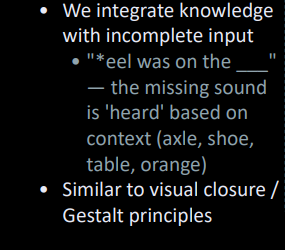
Phonemic Restoration Effect
Categorical Perception
The McGurk Effect
Your other senses interact with audio
Auditory Pareidolia
• Hearing illusory patterns (such as words) in random noise
The Word Superiority Effect
Letters are identified more accurately when they appear inside a real word than in isolation or in a non-word string
Classic finding (Reicher 1969; Wheeler 1970):
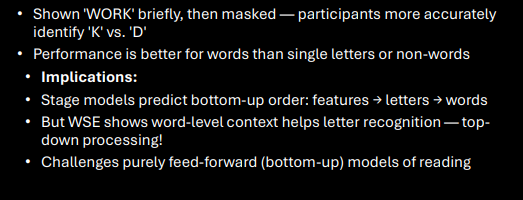
Sentence superiority effect:
Unrelated words take 2× longer to read than words in a sentence — context speeds processing
Dyslexia
difficulty in phonological processing → impaired word identification
affected processes:
phonological awareness
word decoding
lexical access speed
Brain bases in dyslexia
Reduced activation in left temporo-parietal cortex
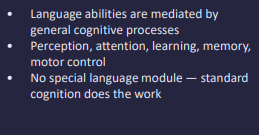
General Process Theory
Special Process Theory
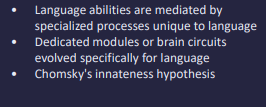
Noam Chomsky (1928 – now!)
Proposed the Language Acquisition Device
An innate (cognitive) mechanism that facilitates the learning of language
Argued that there is a universal course of language development
Nature and nurture are necessary for language development
Surface Structure
The visible form of a sentence that can be parsed conventionally
Deep Structure
An underlying form containing the information necessary for meaning
Transformational Rules
The laws governing how surface and deep structures map onto each other
Innateness Claim:
Essential components of grammar are innate — humans possess an inborn language schema
Particular grammars are learned, but the capacity for grammar is wired in
Critical Periods in lang acquisition
Developmental period in which a skill is most easily acquired
Infants can distinguish between and produce phonemes from ALL existing languages
This ability is lost by 12 Months Old
Approach (Jamieson et al., 2022):
Train model on a large corpus of text (millions of sentences) to approximate human experience
Model extracts statistical associations about word co-occurrence in context
LSA (Latent Semantic Analysis)
Most recent large language models (e.g., GPT series) perform remarkably well on language tasks using similar principles
The Distributional Hypothesis:
You shall know a word by the company it keeps" — meaning is derived from context
Feed the model millions of text examples
Model learns which words co-occur with which other words
Representations emerge from statistical regularities — no hand-coded grammar
Lexical Ambiguity
Many words have multiple meanings: 'fast,' 'buckle,' 'clip,' 'sanction,' 'cleave'
Context rapidly disambiguates meaning
Mental Models
Internal representations of the situation described in text
Next sentence can shift which mental model is active
Discourse & Macrostructure
Working memory holds propositions, not just words
Thematically crucial ideas (macropropositions) retained longer
Broca’s Area
Language production
damaged and trouble speaking = Broca’s Aphasia
Wernicke’s Area
Language comprehension
damaged and trouble understanding = Wernicke’s Aphasia