Biochem Oct. 8th
 View linked note
 Call Kai
 Learn
Learn Practice Test
 Spaced Repetition
 Match
Match Flashcards
 Knowt Play
1/19

Earn XP
Description and Tags
Topic 9
Name | Mastery | Learn | Test | Matching | Spaced | Call with Kai |
|---|
No analytics yet
Send a link to your students to track their progress
20 Terms
What is glycolysis?
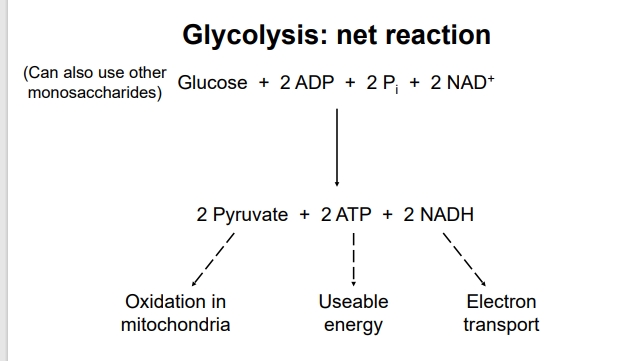
Gycolysis is a central metabolic pathway comprising two main phases:
Energy-Investment Phase
This initial phase requires an input of energy. Glucose is phosphorylated twice (the first time makes glucose-6-phosphate), consuming two molecules of ATP to form fructose-1,6-bisphosphate.
These phosphorylation steps trap glucose within the cell and destabilize it, making it ready for cleavage
Energy-Payoff Phase
In this phase, the six-carbon sugar is split into two three-carbon molecules, G3P (glyceraldehyde-3-phosphate), which are then oxidized.
This leads to the net production of two ATP molecules (via substrate-level phosphorylation) and two NADH molecules per glucose molecule.
The final product of glycolysis is pyruvate.
What is glycogen?
Glycogen is a polysaccharide that serves as a storage form of glucose in animals, primarily found in the liver and muscle tissue
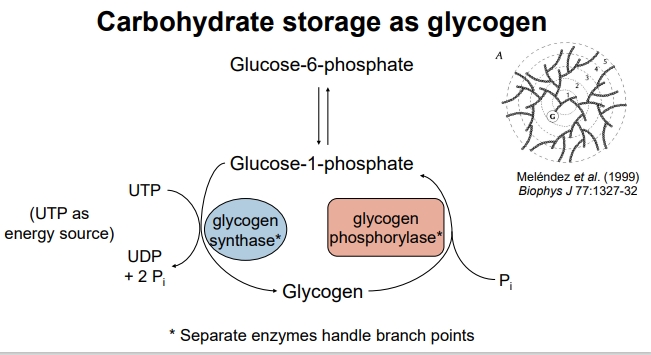
G6P can be converted into G1P (reversible process depending on if cell need energy or not)
G1P is the main form used to build glycogen.
The enzyme glycogen synthase (shown in blue) links glucose molecules together to form glycogen.
This process requires energy, which comes from UTP (Uridine Triphosphate).
During the process, UTP → UDP + 2 Pi (phosphates), showing that energy was used to build glycogen
What is glycogen phorsphorylase?
an enzyme responsible for breaking down glycogen into glucose-1-phosphate through a process called phosphorolysis
What is glycogen synthase?
an enzyme that catalyzes the synthesis of glycogen from glucose-1-phosphate, linking glucose units together and requiring UTP as an energy source
Tell me about allosteric regulation in skeletal muscles?
High level of G6P will activate glycogen synthase (promote storage) because that means the cell has plenty of glucose
ATP signals that their is also high energy available, which will inhibit glycogen phosphorylase (no need to break down glycogen for storage right now)
AMP signals a low energy state, so it’ll activate glycogen phosphorylase (make energy)
Pi signals energy demand increasing so it’ll also activate glycogen phosphorylase (break down glycogen to make energy)
What does the liver do?
The liver plays a vital role in maintaining blood glucose levels by storing glycogen and releasing glucose when needed
Breakdown pathways in the liver are regulated by glucose concentration
Tell me about allosteric regulation in liver cells?
G6P signals that there’s high sugar levels in the blood, so it’ll activate the glycogen synthase to store more glycogen
High glucose levels will also inhibit glycogen phosphorylase (stop the breakdown of glycogen)
*glycogen phosphorylase is activated indirectly by glucose levels
What happens when glycogen synthase is phosphorylated?
It becomes inactive, reducing glycogen synthesis
Active when dephosphorylated
What happens when glycogen phosphorylase is phosphorylated?
It becomes activated, promoting glycogen breakdown
Inactive when dephosphorylated
What is insulin?
A hormone made in the pancreas
Causes dephosphorylation and activation of glycogen synthase when blood glucose levels are high
(in the liver)
What is glucagon?
A hormone produced by the pancreas that prompts glycogen breakdown when blood glucose levels drop, activating glycogen phosphorylase and deactivating glycogen synthase
(in the liver)
What is epinephrine?
A hormone produced by the adrenal glands that enhances blood glucose levels by promoting glycogen breakdown
What is the net reaction of glycolysis?
What is fructose-2,6-biphosphate?
a regulatory molecule (not a glycolysis intermediate) that powerfully controls the balance between glycolysis and gluconeogensis in the liver
When insulin is secreted, it activates PFK-2, increases F2,6B, which then stimulates glycolysis
made in response to insulin?
(When it’s high, burn glucose, when it’s low, make glucose)
Tell me about the regulation of glycolysis
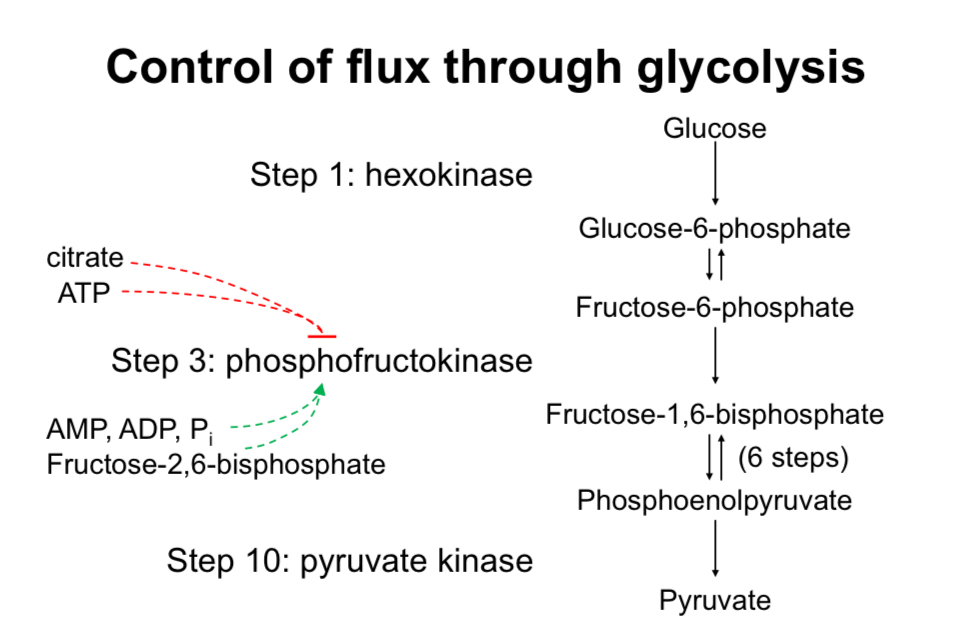
Regulation points in glycolysis focus on irreversible reactions (steps 1, 3, 10) and regulatory enzymes (hexokinase/glucokinase, phosphofructokinase-1 (PFK-1), pyruvate kinase)
Inhibitors:
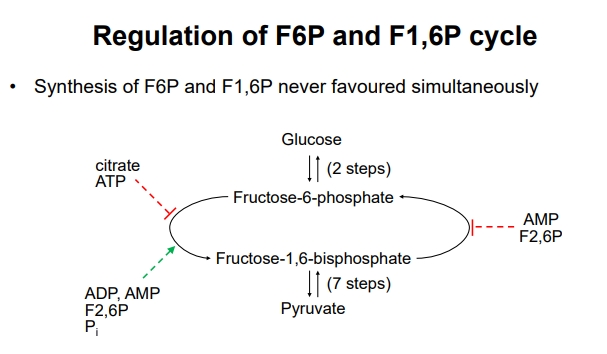
ATP: signals that energy needs are met, inhibits glycolysis.
Citrate: signals sufficient energy (indicating fatty acid oxidation is occurring), inhibits glycolysis.
Activators:
AMP, ADP, inorganic phosphate (Pi): indicate low ATP levels, activate glycolysis.
Fructose-2,6-bisphosphate: Produced in response to insulin (high blood glucose levels so make energy from all this glucose), activates PFK-1, signals need for glycolysis to generate ATP.
(This compound is the most potent allosteric activator of PFK-1)
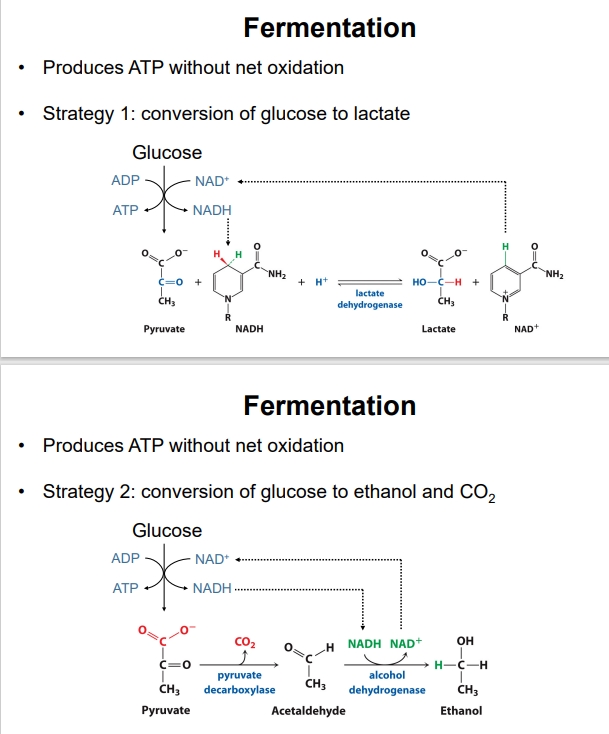
What is fermentation?
Process generating ATP without net oxidation of carbon, used under anaerobic conditions or by organisms lacking a complete electron transport chain. Its primary role is to regenerate NAD+ for glycolysis to continue
Lactic Acid Fermentation (in muscles, red blood cells):
Pyruvate converted to lactate by lactate dehydrogenase, regenerating NAD+ from NADH to sustain glycolysis.
Occurs during intense exercise when oxygen supply is limited.
Alcoholic Fermentation (in yeast):
Pyruvate converted to acetaldehyde (by pyruvate decarboxylase) and then to ethanol and CO2 (by alcohol dehydrogenase), also regenerating NAD+.
Used in baking and brewing.
What is gluconeogenesis?
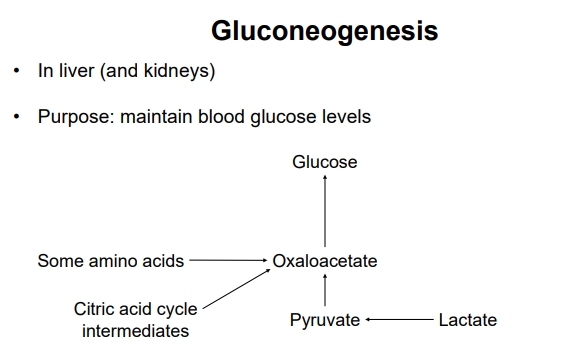
The synthesis of glucose from smaller non-carbohydrate molecules (like pyruvate, lactate, amino acids, and glycerol), effectively the reverse of glycolysis.
It primarily occurs in the liver (90%) and to a lesser extent in the kidneys (10%)
Important for maintaining blood glucose levels during fasting or prolonged exercise, ensuring glucose supply for the brain and red blood cells.
(Acetyl-CoA can’t be used as a precursor for gluconeogenesis because the conversion from pyruvate to acetyl-CoA is irreversible)
2 Pyruvate + 4 ATP + 2 GTP + 2 NADH —> Glucose + 4 ADP + 2 GDP + 6 Pi + 2 NAD+
What is the metabolic pathway for gluconeogenesis?
Starting Material:
Typically starts with pyruvate, but can also use lactate (from muscle via the Cori cycle), glucogenic amino acids (from protein breakdown), and glycerol (from triglyceride breakdown).
Fatty acids cannot be converted to glucose in animals.
Significance:
Ensures blood glucose levels are stable, especially crucial for brain function, which relies almost exclusively on glucose for energy.
Energy Cost:
Requires 6 ATP equivalents (4 ATP and 2 GTP) to produce glucose from pyruvate, emphasizing that it's an energy-consuming pathway. This high energy cost prevents a futile cycle with glycolysis.
How do the regulatory enzymes in gluconeogenesis differ from those in glycolysis?
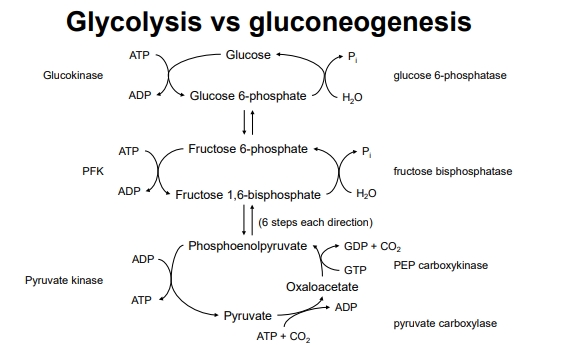
Different enzymes govern irreversible reactions in gluconeogenesis compared to glycolysis (e.g., pyruvate carboxylase and phosphoenolpyruvate carboxykinase bypass pyruvate kinase; fructose-1,6-bisphosphatase bypasses PFK-1; glucose-6-phosphatase bypasses hexokinase)
Fructose-2,6-bisphosphate: Highly regulated, it inhibits gluconeogenesis (by inhibiting fructose-1,6-bisphosphatase) while stimulating glycolysis when insulin levels are high (fed state).
AMP: Signals low ATP levels, inhibiting gluconeogenesis when ATP is needed by the liver for its own function, and activating glycolysis.
Glucagon and Epinephrine: Hormones that promote gluconeogenesis during fasting or stress by increasing the activity of key gluconeogenic enzymes.
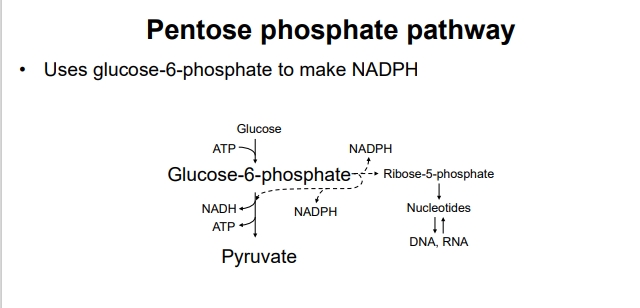
What is the pentose phosphate pathway (PPP)?
Major role in generating NADPH for biosynthetic reactions (e.g., fatty acid and steroid synthesis, detoxification of reactive oxygen species) and ribose-5-phosphate for nucleotide synthesis (DNA, RNA, ATP).
(NADPH is not used in the ETC!)
Pathway:
When ATP is needed:
Glucose-6-phosphate preferentially enters glycolysis, but intermediates from the non-oxidative branch of PPP can return to glycolysis to be metabolized for ATP synthesis (e.g. G3P and F6P can go back to glycolysis). This ensures that biosynthetic needs for NADPH are met while also allowing for energy production.
When nucleotides are needed:
The oxidative phase is active to produce ribulose-5-phosphate, which is then converted to ribose-5-phosphate directly. The intermediates may not return to glycolysis, emphasizing biosynthetic over ATP-producing processes.