chapter 12 - the chromosomal basis of inheritance
 Call Kai
 Learn
Learn Practice Test
 Spaced Repetition
 Match
Match Flashcards
 Knowt Play
1/44

There's no tags or description
Looks like no tags are added yet.
Name | Mastery | Learn | Test | Matching | Spaced | Call with Kai |
|---|
No analytics yet
Send a link to your students to track their progress
45 Terms
Chromosome theory of inheritance
That genes have specific loci (positions) along chromosomes and that’s chromosomes undergo segregation and independent assortment
why did Thomas Morgan choose fruit flies (drosophila) as his experimental organism
single mating results in hundreds of offsprings
New generation every two weeks
easily distinguishable by light microscopy due to having 4 chromosomes
Sex determined by X and Y chromosomes like humans
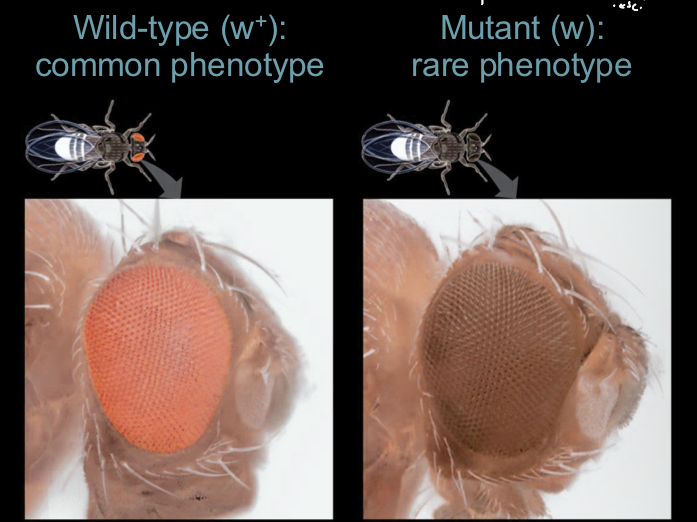
Mutant phenotypes
Due to changes in the original wild type gene sequence
Alleles are indicated by a lower case letter for mutant and with a subscript + added for wild type
Usually dominant but not always
Morgan’s first experiment conclusions
White eyed allele must be recessive as all of the F1 generation had red eyes when parent gen were homozygous for both colours
White allele must be located on the X chromosome since no females had white eyes
Morgans contribution to sex linked trait
Correlated sex of an individual organisms with the presence of a specific trait is a sex linked trait
Demonstrated unique inheritance patterns for sex linked traits
Pattern of inheritance is dependant on who starts with the mutation either maternal or paternal
Provided support for the chromosomal basis of inheritance
Pseudoautosomal
Y chromosomes contain small regions at either end that are homologus to the X chromosome
This allows it to act homologus to the X chromosomes
They’re called pseudoautosomal as they act similar to autosomes
What do early embryo contain
Generic gonads with anatomical signs of sex appearing at 2 months. This is determined largely by the presence or absence of the Y chromosome in humans
What is SRY
This is the sex determine region of the Y chromosome that codes for a protein involved in the regulation of other genes involved in sex determination.
What happens if you dont have SRY
The absence of this gene product Results in the development of ovaries
Y linked genes
78 genes encoding for 25 proteins
Half are expressed in the testes and are involved in testicular function and sperm production
Very few Y linked disorders
X linked genes
1110 genes on the X chromosomes
Recessive X linked disorders are rare in females (XX) as they need 2 affected alleles to show compared to males (XY)
Males are hemizygous and only need one affected allele to show
Paternal vs maternal inheritance
Paternal - sperm donors will always pass on an X linked recessive allele to their XX progeny and not their XY
Maternal - Egg donors can pass an X linked recessive to both types of progeny
Duchenne muscular dystrophy
1/3500 XY individuals in the US are affected by
Progressive weakening of muscles and loss of coordination due to absence of muscle protein, dystrophin
Rarely live past early 20s if untreated
X linked disorders
Hemophilia
absence of one or more proteins involved in blood clotting
Documented in royal families in Europe
Treated with IV injections
X linked disorders
X inactivation
turns off one X chromosome in every female cell to balance gene expression with males
The inactivated X forms a barr body, highly condensed chromosome that get reactivated again in egg gamete formation
This occurs randomly and independently in each embryonic cell
What is XIST and its role in X inactivation
during early embryonic development one X chromosome is randomly chosen to activate the XIST gene
The XIST gene coats and silences that chromosome to initiate inactivation
How are XX individuals mosaics
Because X inactivation is random, XX individuals who are heterozygous for an X linked trait become mosaics, with different groups of cells expressing different alleles which produces patchy traits
Ex. Calico cats
Linked genes
Linked genes are genes located close together on the same chromosome making crossing over unlikely. This results in allelic combinations remaining the same as parents
Recombination of unlinked genes
When 2 genes are unlinked they assort independently during meiosis producing 1:1:1:1 Ratio of offspring in a dihybrid cross test cross. This results in 50% parental types and 50% recombinant type combinations of alleles
Linked genes frequencies
Linked genes demonstrate frequencies of parental phenotypes between 50-100% with a test cross
How to calculate for recombination frequencies and its relation to incomplete linkage
Recombination frequency = recombinants / total offspring X 100
if below 50% but greater than 0%, it suggests incomplete linkage
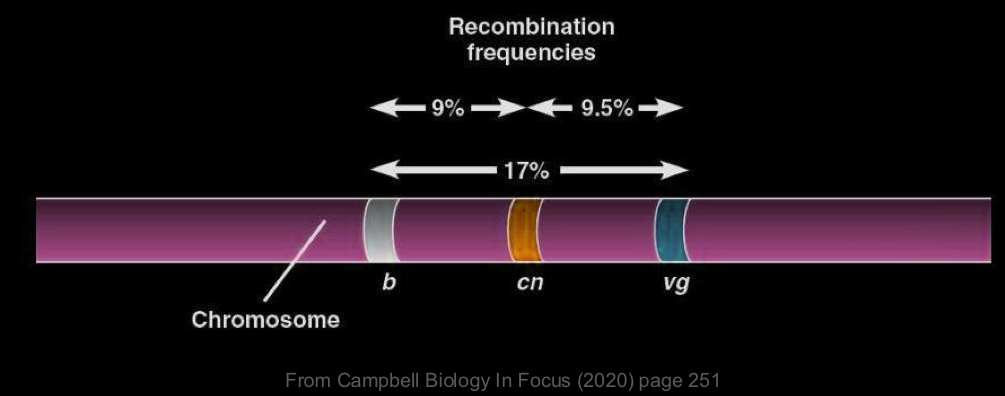
Mapping gene distance
assumes that the chance of crossing over at any point of the chromosomes is equal to
Predicts that the further apart the two genes were the higher chance of crossing over occurs
Uses test cross data to determine recombination frequencies between genes
Linkage map conversions
1 map unit = 1 centimorgan = 1% recombination frequency
Linkage map advantage and disadvantage
Advantage - allow for comparison of several different genes at once
Disadvantage - if genes are too far apart, crossing over is almost certain to occur. Leading to indistinguishable results from genes on separate chromosomes
Nondisjunction
Improper separation of homologus chromosomes in meiosis I or sister chromatids in meiosis II. Leading to gametes with too many or too few chromosomes
Aneuploidy
zygote that has an abnormal number of chromosomes
due to fertilization of gametes with nondisjunction
most common reason for early stage of pregnancy loss
Types of aneuploidy
Monosomic- zygote containing a single copy
Trisomic - zygote containing 3 copies
Polyploidy
organisms with more than 2 complete copies of chromosome sets in all somatic cells
tolerated by some organisims but not humans
Types of polyploidy
Triploidy (3n) - results from fertilization of an abnormal diploid egg
Tetraploidy (4n) - may result from failure of a zygote to divide following replication of its genome
Alterations in chromosome structure
Caused by errors in meiosis or damage which causes breakage of a chromosome
4 types of chromosome structure alterations
Deletion
Duplication
Inversion
Translocation
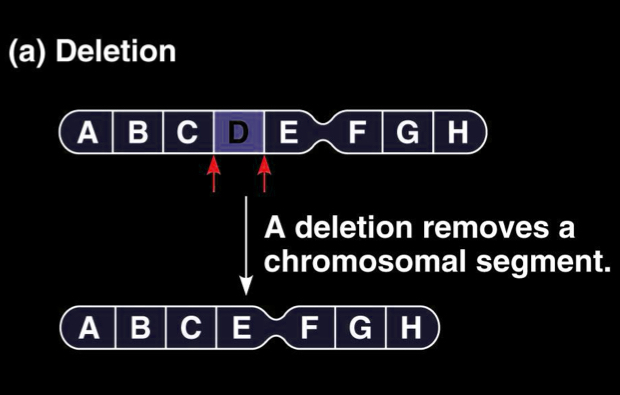
Deletion alteration
most commonly found due to errors in meiosis
Due to unequal crossing over
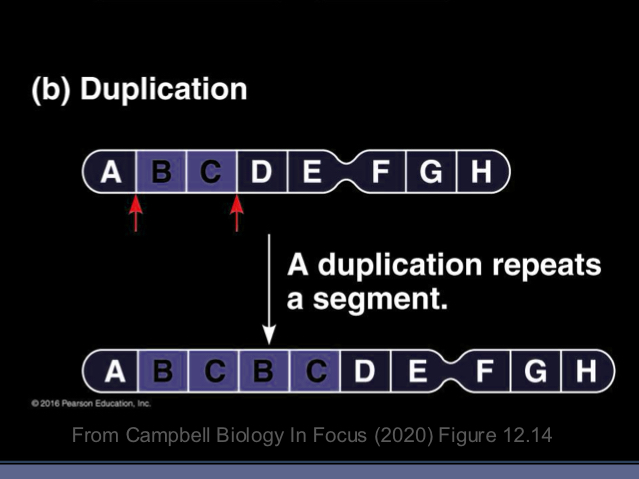
Duplication
may also occur due to the attachment of a fragment from a non sister chromatid
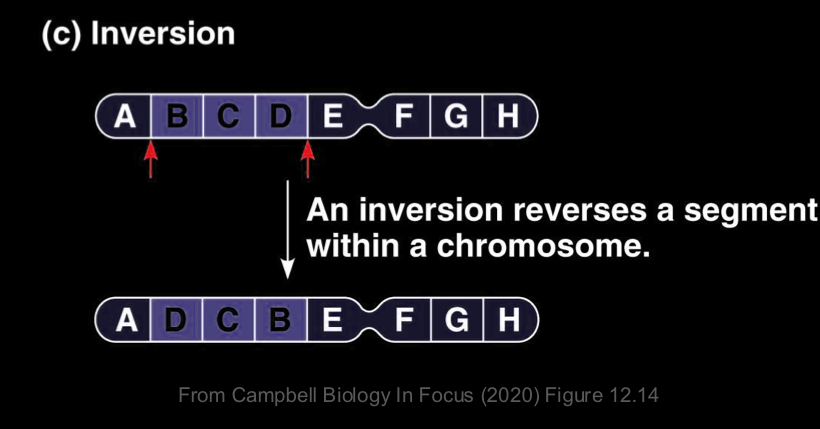
Inversion alteration
occurs when a fragment is inserted in the reverse direction
Copy number of each gene is normal but regulation of genes may be altered.
Potentially harmful to organism
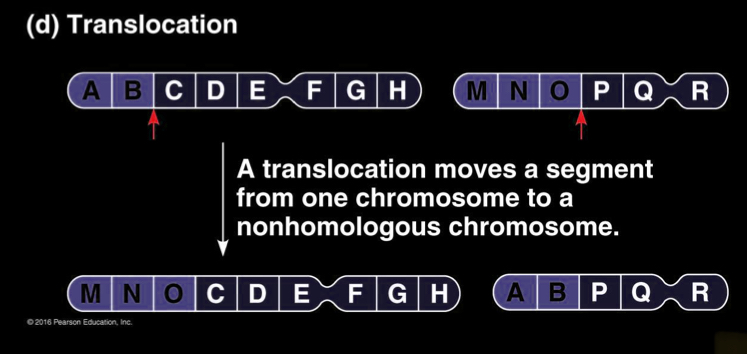
Translocation and its 2 types
Reciprocal translocation - exchange of genetic segments between 2 non homologus chromosomes
save copy number of genes
May alter regulation
Non reciprocal translocation - transfer of segment of one chromosome to another non homologus chromosome with nothing in return
leads to gametes errors
Fetal testing and what its used for
used to create karyotypes by taking cell samples and induces them to divide
Cells are then analyzed in metaphase to create a karyotype
Examples of fetal testing
Amniocentesis and chorionic villus sampling
Aneuploidy and human disorder
Individuals with aneuploidy exhibit specific sets of traits or syndrome which are associated with their condition
Ex. Trisomy 21 - Down syndrome
Maternal age and its effects to aneuploidy
frequency of aneuploidy increases as the mother ages As it’s believed to be in an increase in non disjunction during meiosis I with age in females
Klinefelter syndrome
Extra X chromosome for males
1/500 - 1/1000 individual births
Testes are reduced in size and are infertile
Turner syndrome
loss of X chromosome in female
1/2500 individual births
Lack of maturation of sex organs leading to being sterile (non child producing)
Only known viable monosomy in humans
Cri du chat
deletion of chromosome 5
Cry sounds like mewing cat
Intellectual disability
Wolf hirschhorn syndrome
deletion in chromosome 4
Intellectual disability
Bone development issues
Effects of Nondisjunction in mitosis in embryogenesis
if occurs early in embryogenesis it can cause loss of pregnancy and mosaicism
Effects of Nondisjunction in mitosis in CML
chronic myelogenous leukemia is caused by an error in mitosis because of translocation in the pre white blood cell tissue which produces the philiadelphia chromosome