Developmental Psychology Chapter 10
 Call Kai
 Learn
Learn Practice Test
 Spaced Repetition
 Match
Match Flashcards
 Knowt Play
1/34

Earn XP
Description and Tags
Self-Development and Personality
Name | Mastery | Learn | Test | Matching | Spaced | Call with Kai |
|---|
No analytics yet
Send a link to your students to track their progress
35 Terms
What is Self-Concept?
perceptions of unique attributes and traits of ourselves
What is self-esteem?
Evaluation of the overall worth as a person based on all positive/negative self perceptions that make up the self
Self-Identity?
is who we are based on our social memberships
multiple self identities: gender, race/ethnicity, sexual orientation, SES, nationality, religion, disability status, etc.
What is self control?
ability to manage emotions/desires/behaviors to resits immediate temptations to achieve long-term goals
+self-control → +school outcomes 10’s-20’s and + financial stability in 30s
marshmellow test
What are the states in Erikson’s Psychosocial Theory?
Trust vs. mistrust Birth – (1 year) Can I trust others? Trust/Hope
Autonomy vs. shame and doubt (1-3 years) Can I act on my own? Will
Initiative vs. guilt (3-6 years) Can I carry out my plans successfully? Purpose
Industry vs. inferiority (6-12 years) Am I competent compared to others? Competence
Identity vs. role confusion (12-20 years) Who am I and where am I going? Fidelity
Intimacy vs. isolation (20-35 years) Am I ready for a committed relationship? Love
Generativity vs. stagnation (35-65 years) Have I given something to future generations? Care
Integrity vs. despair (65 years +) Has my life been meaningful? Wisdom
Self Concept in 0-12 months old (infancy)
Infants do not recognize themselves visually as distinct individuals
confusion of self and others
Self Concept in 12-30 months old (Toddlers)
Recognition of self in mirror by 18 months
Form categorical self by 18-24 months, e.g., social categories in age, sex, race, and other visible characteristics
Self-recognition is affected by cognitive development & social interaction
Self-recognition enables them to talk about themselves, assert their wills, experience self-conscious emotions, coordinate their own perspectives with others
Self-Concept in 2.5-6 year olds (preschoolers)
Sense of self is very concrete: what they do, have, or look like; Self = what I can do…
Dichotomized descriptors: good, bad, mean, nice
Autobiographic memory: core self-concept
Overestimate their abilities: “I can do it because I can think of it, or because I want to do it.”
Self-Concept in 5-11 year olds (elementary schoolers)
Structured learning environment & social comparison
More realistic & self-adjustment
Differentiation of multiple self-concepts: 8-10 year old children differentiating self-concept into 5 aspects:
Scholastic Competence
Social Acceptance
Behavioral Conduct
Athletic Competence
Physical Appearance
What is the trajectory of the global self-esteem score?
Rather stable in early elementary school
Declining from 8-10 yrs old & throughout teens (lowest in late teens)
Rising from 17-18 y-o & throughout adulthood, and declining again in late 60s
there is a significant gender difference
What factors affect high/low self-esteem?
Cognitive Development
Social Comparison
Socioeconomic Status
Supportive/Encouraging Parents
Changes in Self-Esteem?
Self-Esteem typically drops through childhood ( as children engage in more social comparisons) and in early adolescence (when adolescents are dealing with multiple changes in their lives)
it rebounds as they gain stronger sense of identity and move toward adulthood
Adolescence is a critical period in
forming an integrated identity
may experience identity crisis
What are some things that Adolescence deal with?
IDENTITY CRISIS (may experience)
Revision of body image
Cognitive growth allows thinking about possible future selves
Social demands require them to grow up
Adjust to being sexual being
Adolescents must integrate
varied perceptions of the self concept into a coherent sense of self
identity vs role confusion
Society supports youths by?
allowing them a moratorium period
a period where young people are allowed to postpone permanent, adult commitments to explore different roles, identities, beliefs, and career paths
What is a critical aspect of identity development?
an ethical racial identity
Sense of personal identification with an ethnic-racial group and its values and cultural traditions
Emerging around 2-3 y-o, further developing during elementary school time, consolidating in adolescence years
Positive ethnic identity serves to
buffer against racial and ethnic discriminaiton
Critical Factors of Ethnic racial Identity?
opportunities to explore, support of the immediate environment, relationship quality w/ parents, etc.
WHo expanded on Erikons’s Psychosocial Theory?
Marcia (identity statuses)
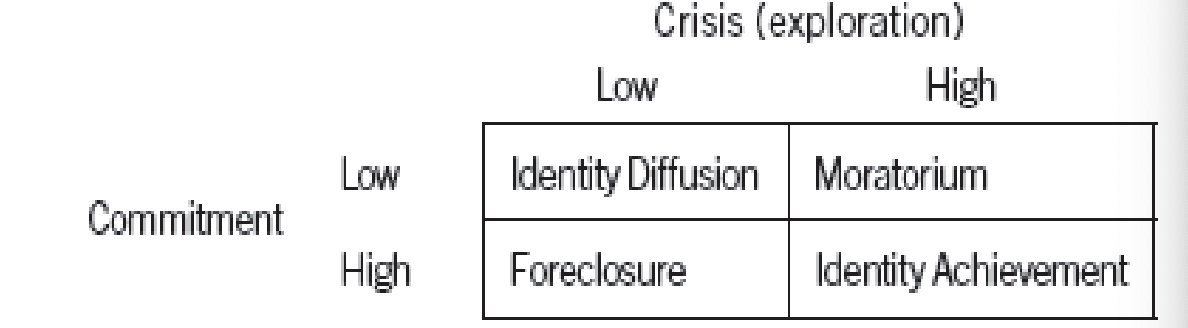
Marcia’s Identity Statuses says that adolescents are classified into
one of four identity statuses depending on two dimensions
Amount of Exploration (crisis & questioning)
Level of Commitment
Identity Diffusion, moratorium, foreclosure, & identity achievement
Marcia’s Identity Statuses says that identity formation
takes time
less than 60% of the 24 year-odls reach identity achievement
Marcias Identity Statuses occurs at
different rates in different domains of identity
Only 5% of the adolescents were in the same identity status in major areas,
EX) Gender, Race/Ethnicity, Career
Marcias Identity Statuses Table
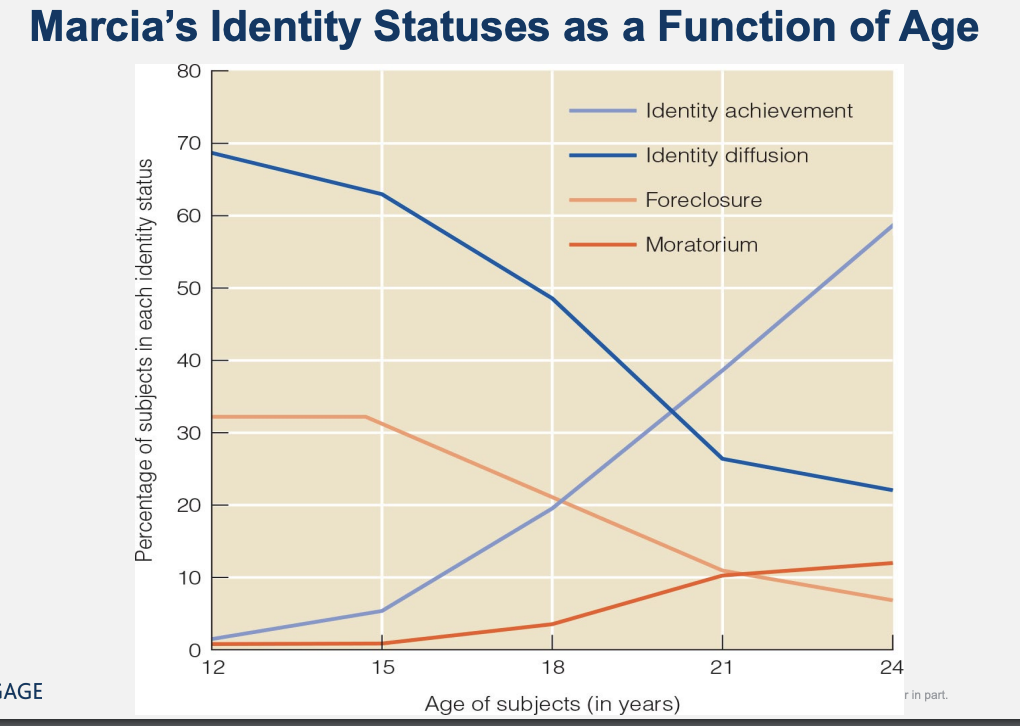
Identity development is a progressive shift. By age 24, the majority of individuals move from "identity-seeking" or "identity-avoidant" phases into Identity Achievement.
Diffusion (High @ 12): No exploration, no commitment. Drops sharply as responsibilities increase.
Foreclosure (Steady then Falls): Commitment without exploration (e.g., following parents' path).
Moratorium (Rising): Active exploration/crisis but no commitment yet. Peaks in late teens/early 20s.
Achievement (Low @ 12, High @ 24): Exploration completed + firm commitment made.
Temperament is
early, mostly genetically based styles of responding to the world that serve as the building blocks later personality
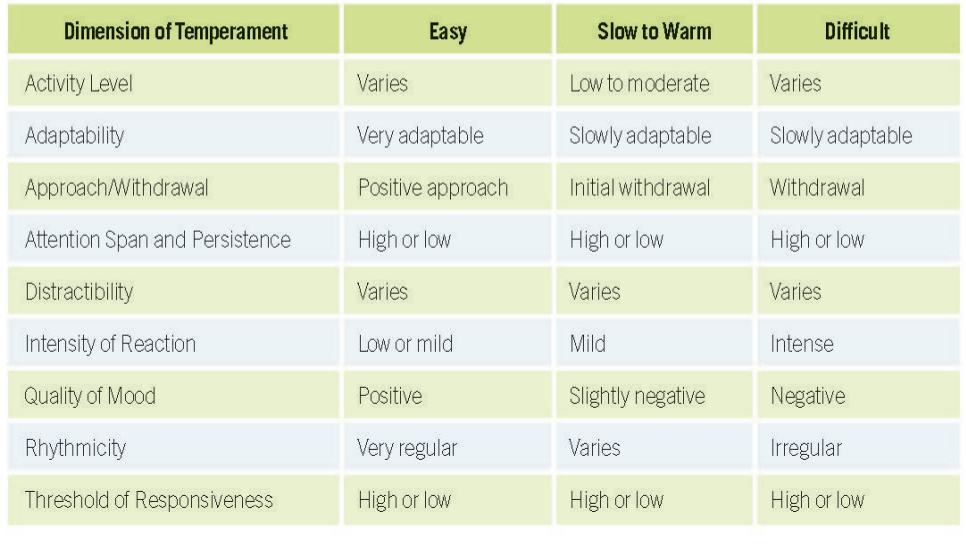
Categorical System (Thomas and Chess)
Dimensional System (Rothbart)
The Categorical System Percentages
Easy Temperament : 40%
Difficult Temperament : 10%
Slow-to-Warm-Up Temperament : 15%
The Dimensional System involves
Extraversion/Surgency : actively, confidently, & energetically approach new experiences w/ positive emotion
Negative Affectivity : Easily Sad, Frustrated, and Irritable
Effortful Control : Ability to focus and shift attention when desired, inhibit responses
Temperament Profiles
Personality is a
organized combination of attributes, motives/interests, values, emotionality, and behaviors unique & lasting to each individual
Dispositional Traits
Characteristic Adaptations
What are dispositional Traits?
interests, emotionality, attributes, values
relatively enduring and somewhat inborn
What are characteristic Adaptations and Behavioral Patterns?
motives, self-concept interpersonal styles, coping
Affected by Environmental Factors
What is the trait theory?
Personality is a set of dispositional trait dimensions
Trait vs State
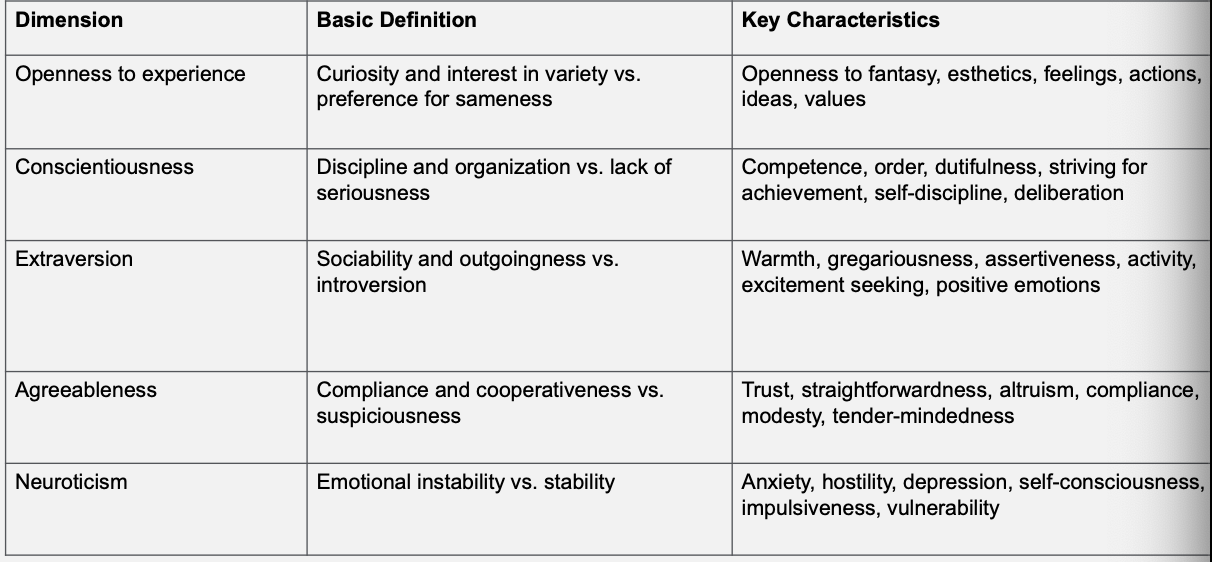
The Big FIVE (OCEAN)
Trait vs State means
personality traits are consistent across situations
What are the BIG FIVE Personality Traits?