Xylem & Phloem
 Call Kai
 Learn
Learn Practice Test
 Spaced Repetition
 Match
Match Flashcards
 Knowt Play
1/20

There's no tags or description
Looks like no tags are added yet.
Name | Mastery | Learn | Test | Matching | Spaced | Call with Kai |
|---|
No analytics yet
Send a link to your students to track their progress
21 Terms
What is the function of transport systems in plants
To move substances over long distances because diffusion is too slow in multicellular plants
Why do plants need transport systems (3 reasons)
multicellular
have a low SA:V
need long distance transport
What are the two main transport tissues in plants
Xylem and phloem
What is xylem
Plant tissue that transports water and mineral ions and provides structural support
What are xylem vessels
Long hollow tubes that make up most of xylem tissue
How are xylem vessels adapted (4 reasons)
hollow
lack organelles
thick lignified walls
pits for lateral movement
Why are xylem vessels hollow
To allow uninterrupted flow of water and minerals
What is lignin in xylem
Strengthening material that thickens walls and prevents collapse
What is the function of pits in xylem
Allow for sideways movement of water and ions between vessels and surrounding cells
What is phloem
Plant tissue that transports sugars and amino acids (assimilates) around the plant
What are sieve tube elements
Cells in phloem that form tubes for transport of sugars
What are sieve plates
Perforated end walls that allow movement of sap between STE
Why do sieve tube elements lack nuclei
To allow more space for transport of assimilates
What are companion cells
Cells that support STE and provide energy for active transport
Why do companion cells have many mitochondria
To provide ATP for active transport in phloem loading
What is the role of plasmodesmata in phloem
They connect CC → STE allowing exchange of substances
Where is xylem found in roots
In the central region forming a central cylinder
Where is phloem found in roots
Surrounding the xylem in the central region
Where is xylem and phloem found in stems
In vascular bundles near the outer region for support
Where are xylem and phloem found in leaves
In veins forming a network for transport and support
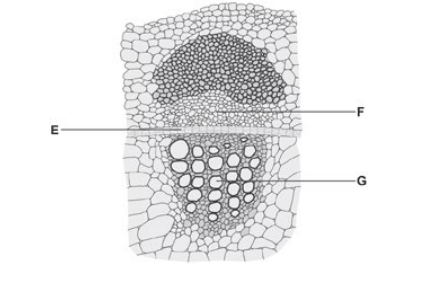
Identify F, E, G
F = phloem
E = cambium
G = xylem