Mitochondria, Pyruvate Dehydrogenase Complex, TCA Cycle
 Call Kai
 Learn
Learn Practice Test
 Spaced Repetition
 Match
Match Flashcards
 Knowt Play
1/72

There's no tags or description
Looks like no tags are added yet.
Name | Mastery | Learn | Test | Matching | Spaced | Call with Kai | Chat |
|---|
No analytics yet
Send a link to your students to track their progress
73 Terms
overall purpose of pyruvate dehdyrogenase complex (PDH) and tricarboxylic acid cycle (TCA pathway)
to extract maximum energy from glucose by converting it into:
- CO₂ (fully oxidized carbon)
- NADH/FADH₂ (energy carriers)
- small amount of ATP/GTP
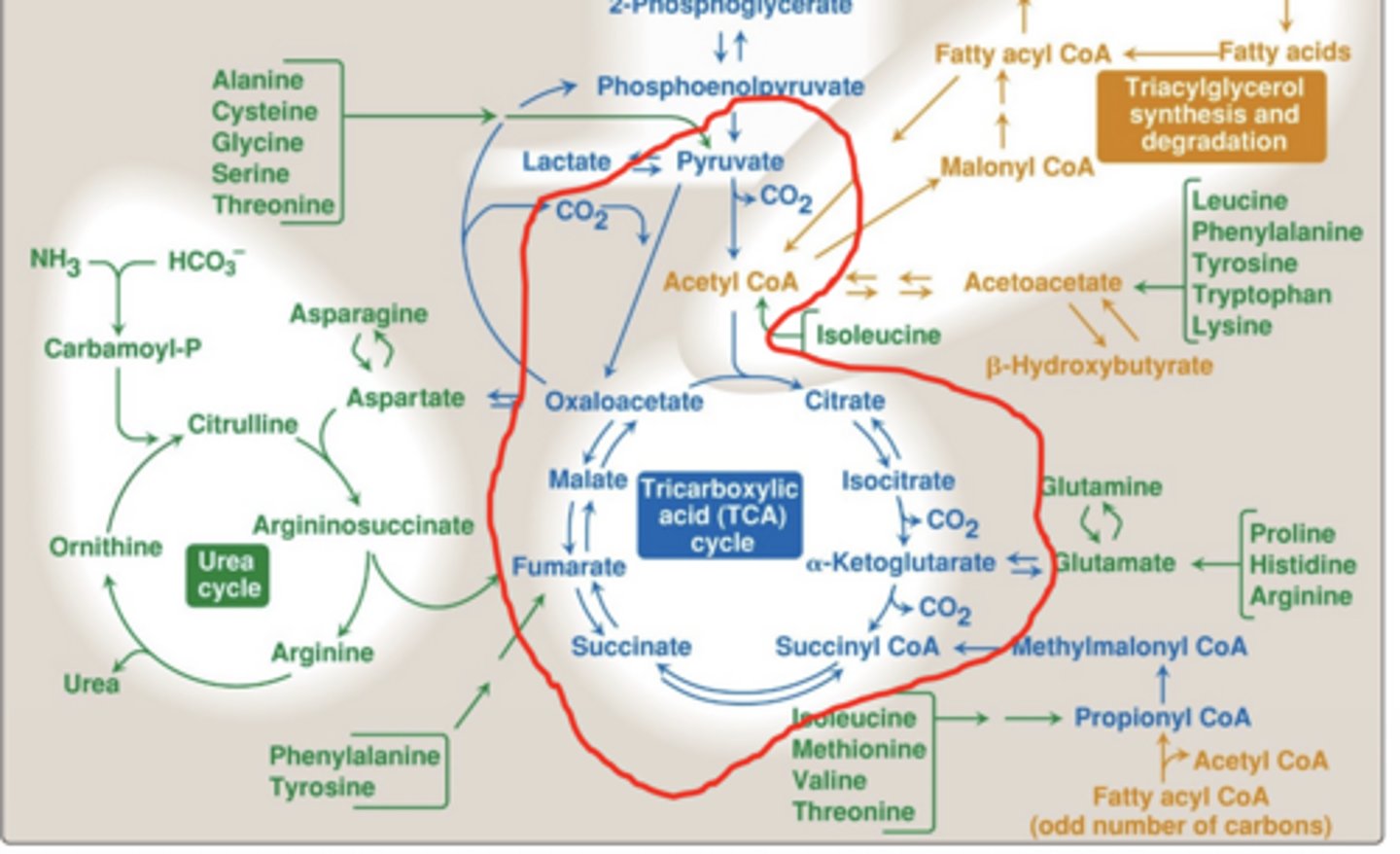
3 names for the TCA cycle
- tricarboxylic acid (TCA) cycle
- citric acid cycle
- krebs cycle
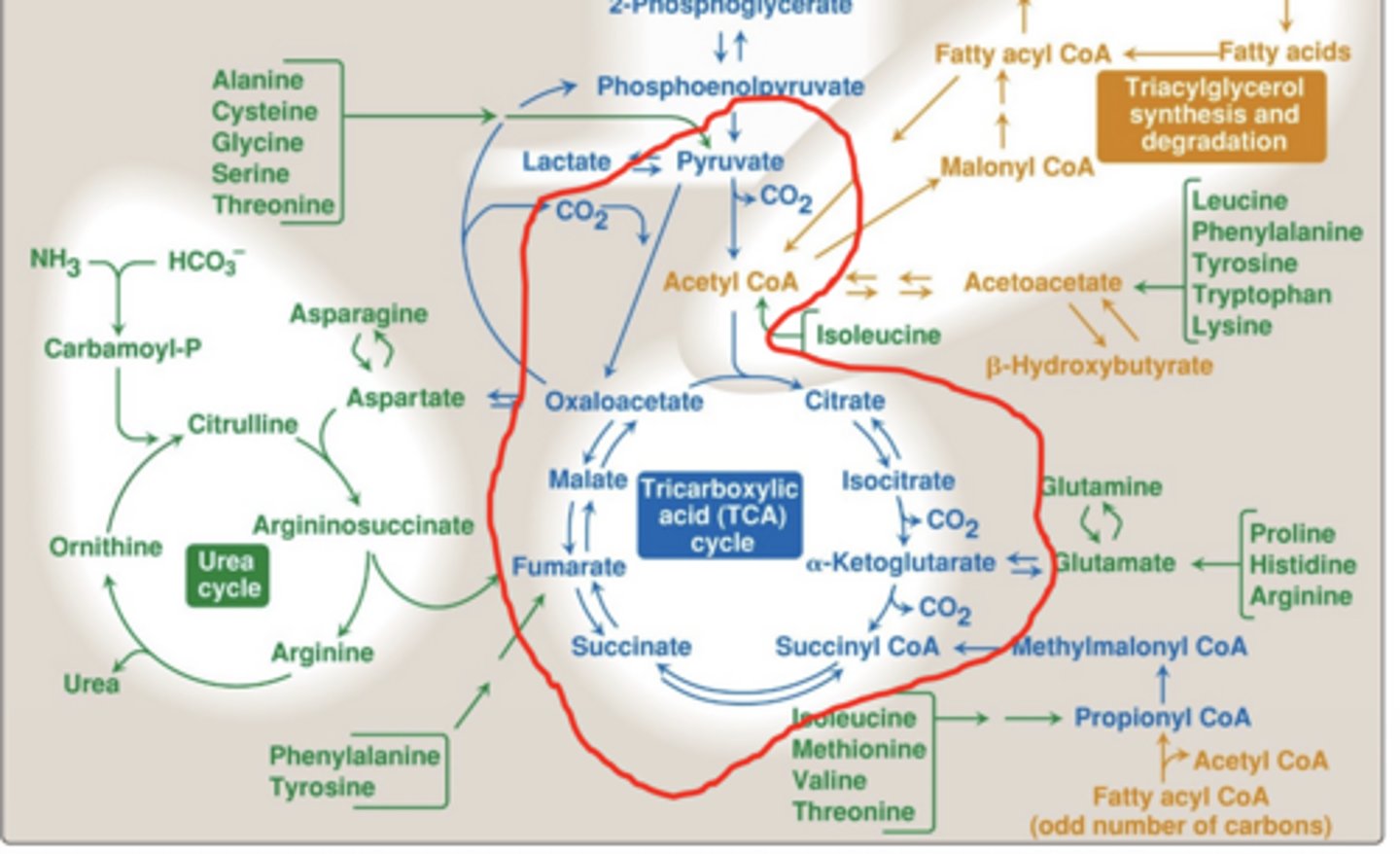
why tricarboxylic
because intermediates contain 3 carbons (-COOH) groups
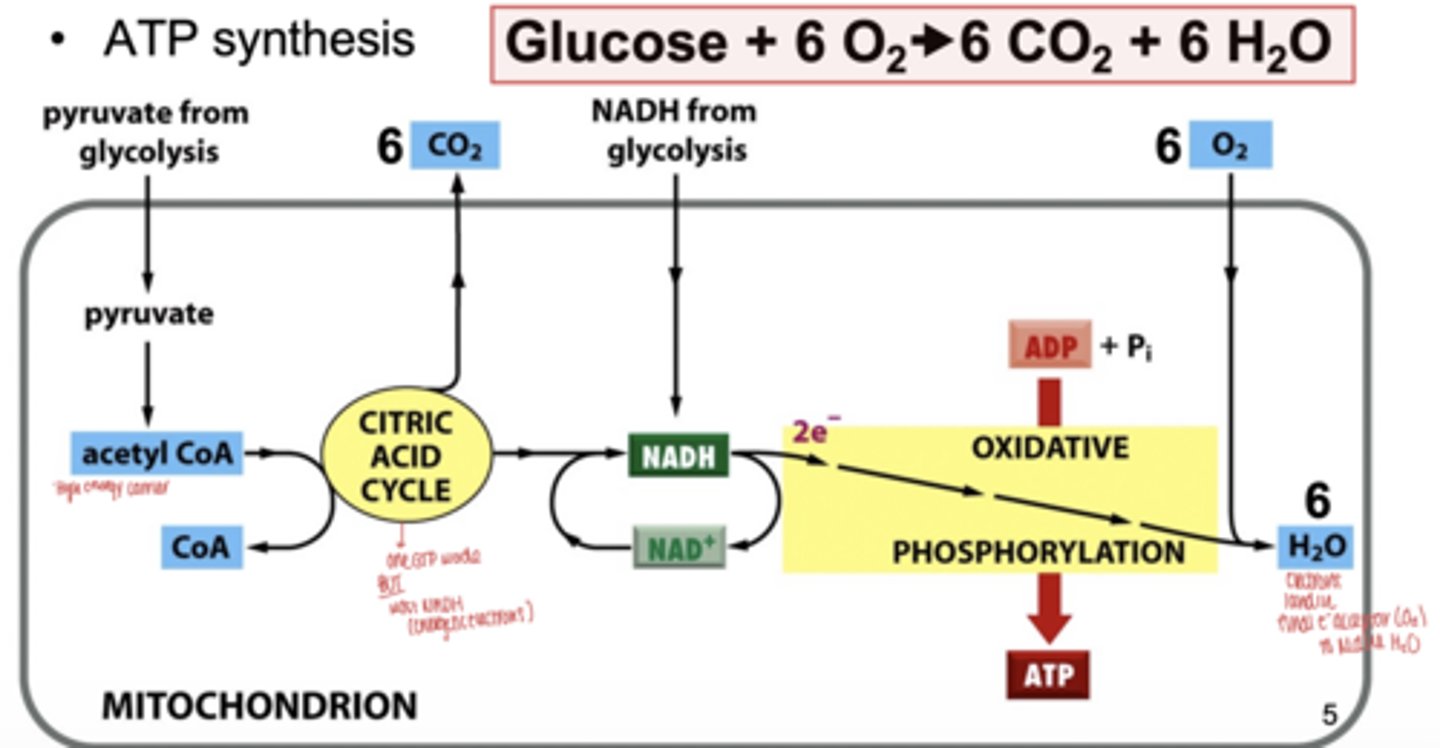
what is the overall equation for glucose metabolism
glucose + O₂ → CO₂ + H₂O
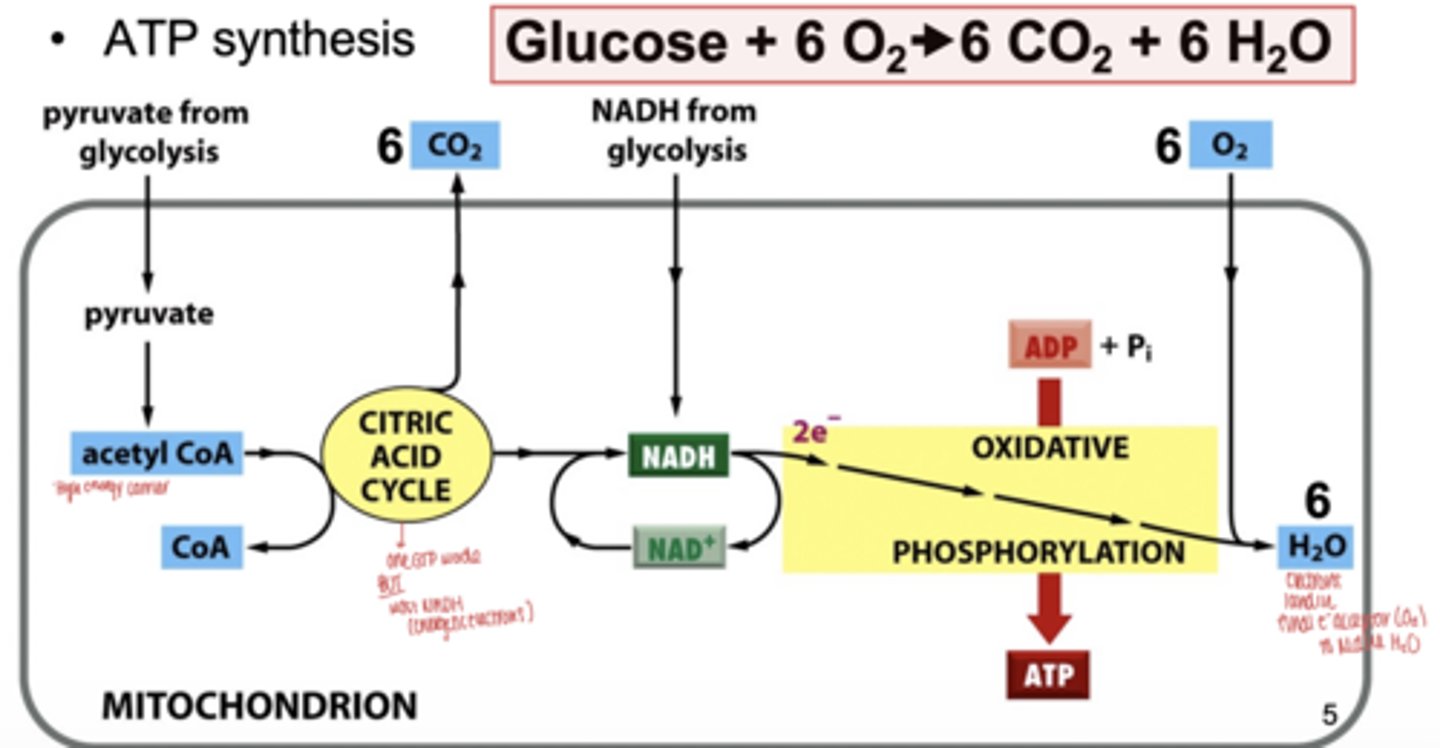
where does energy go
stored in ATP
stored in NADH/FADH₂
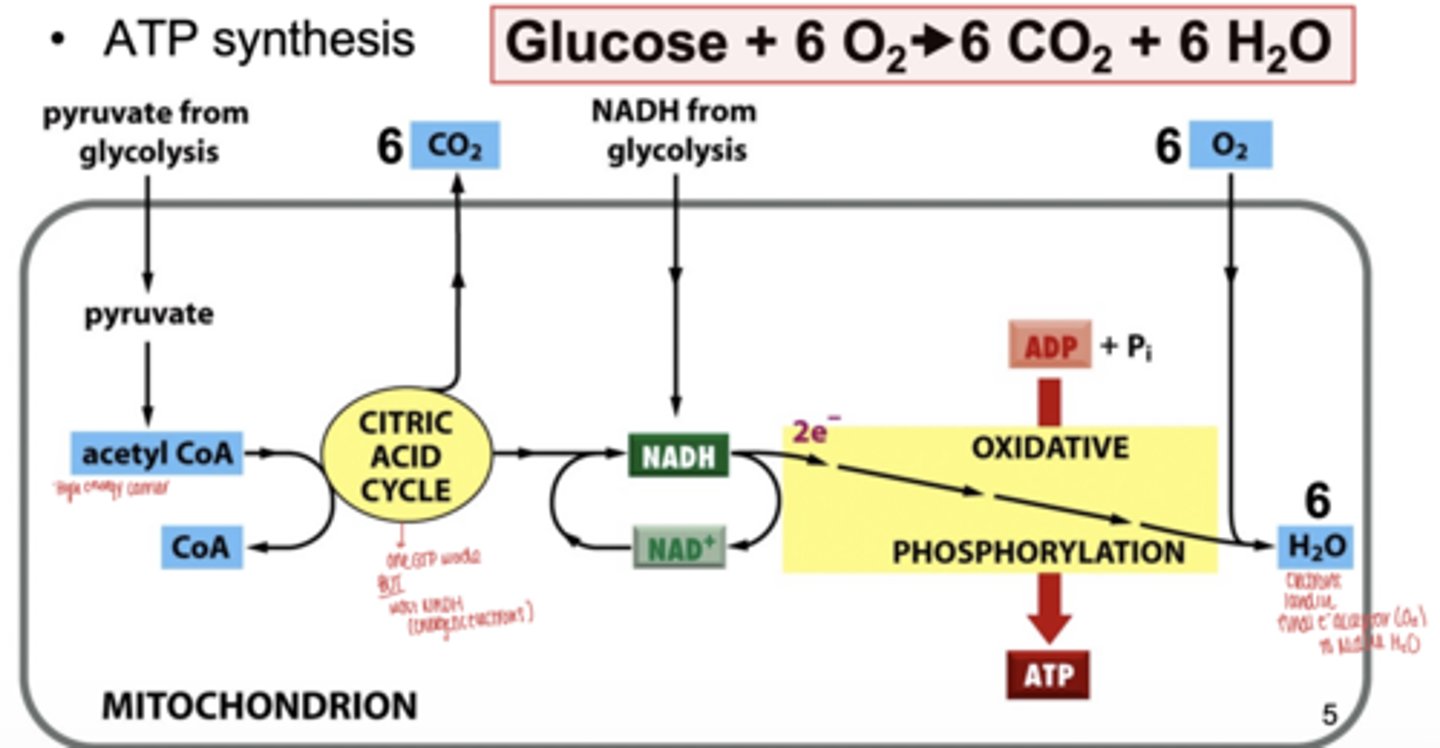
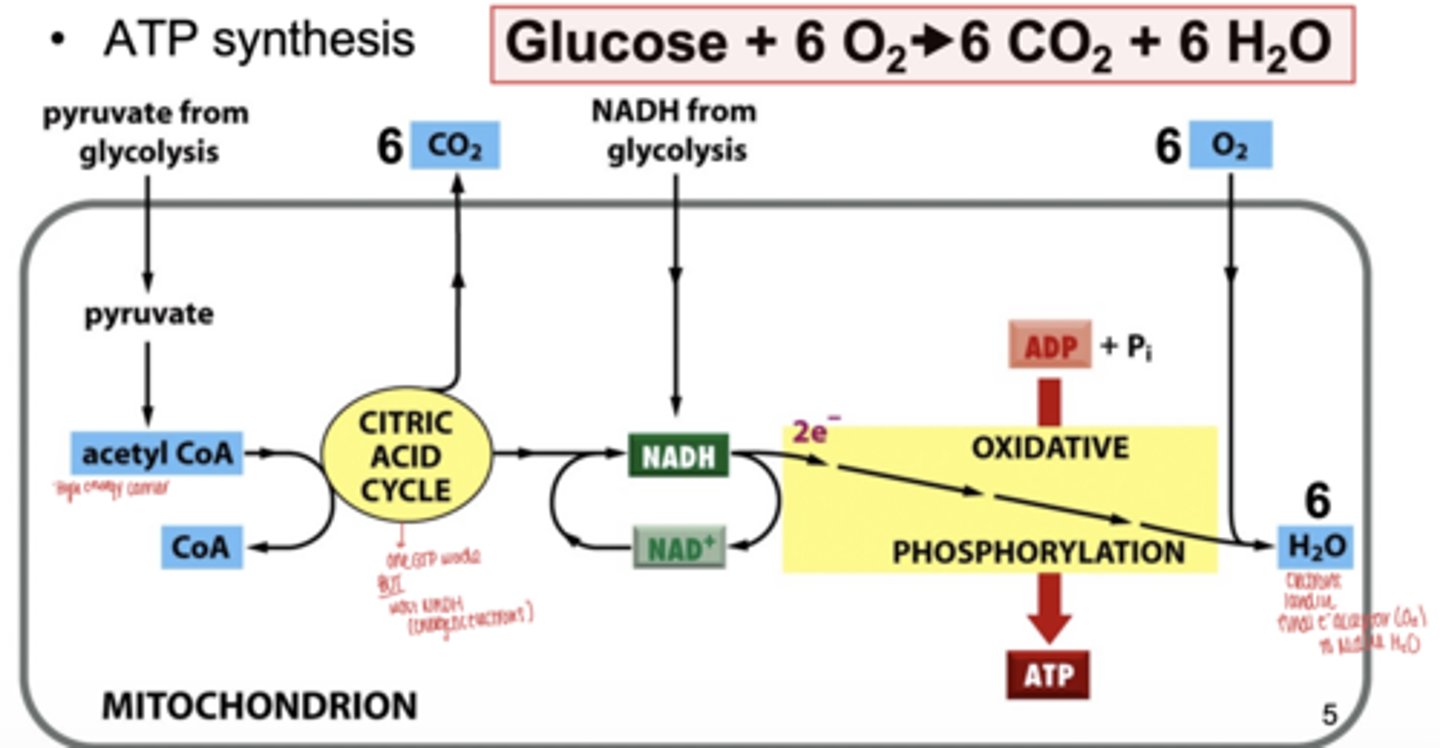
why is NADH considered "high energy"
contains high energy e-
these e- will later drive ATP production
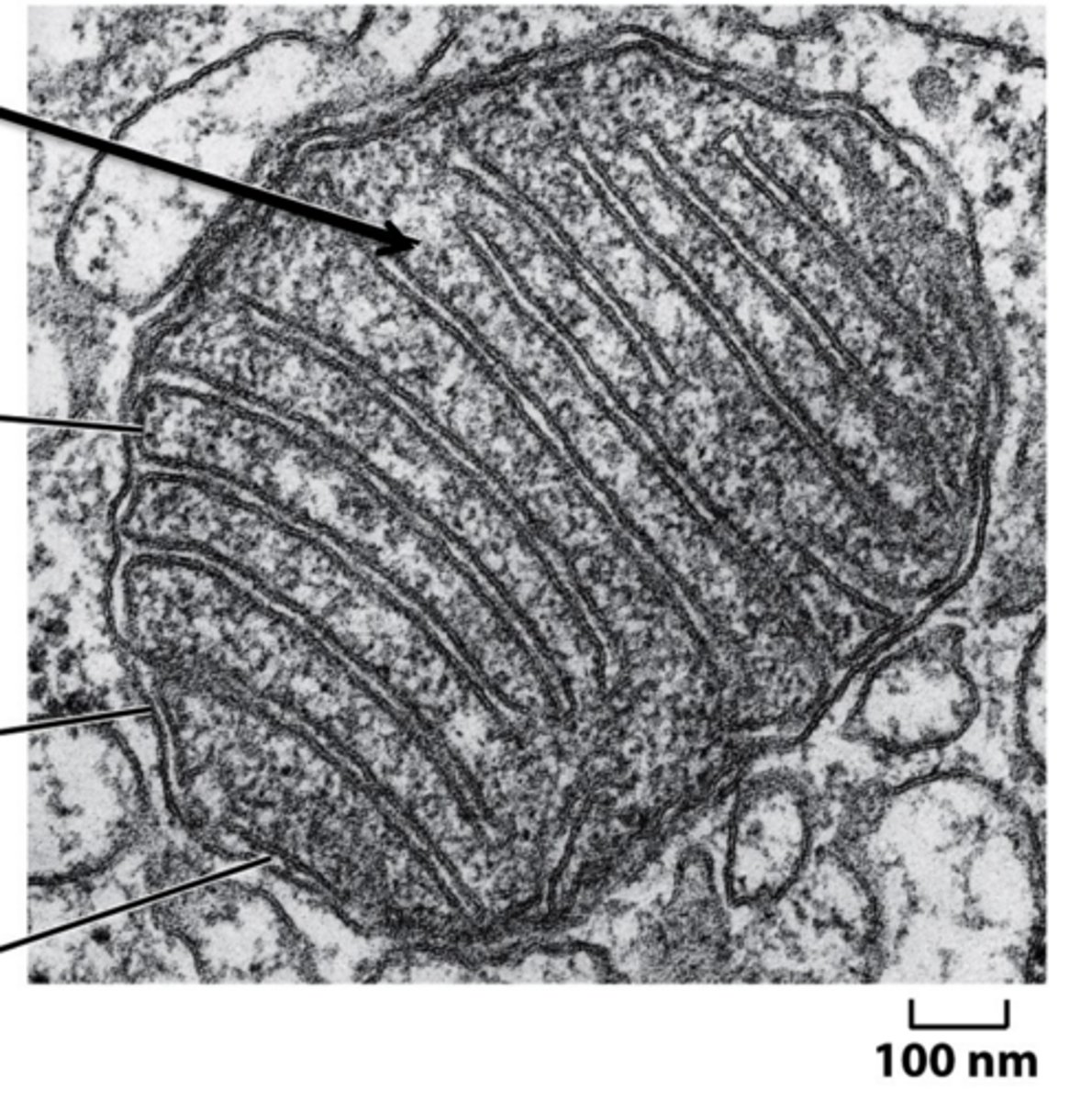
4 parts of mitochondria
outer membrane
inner membrane
intermembrane space
matrix
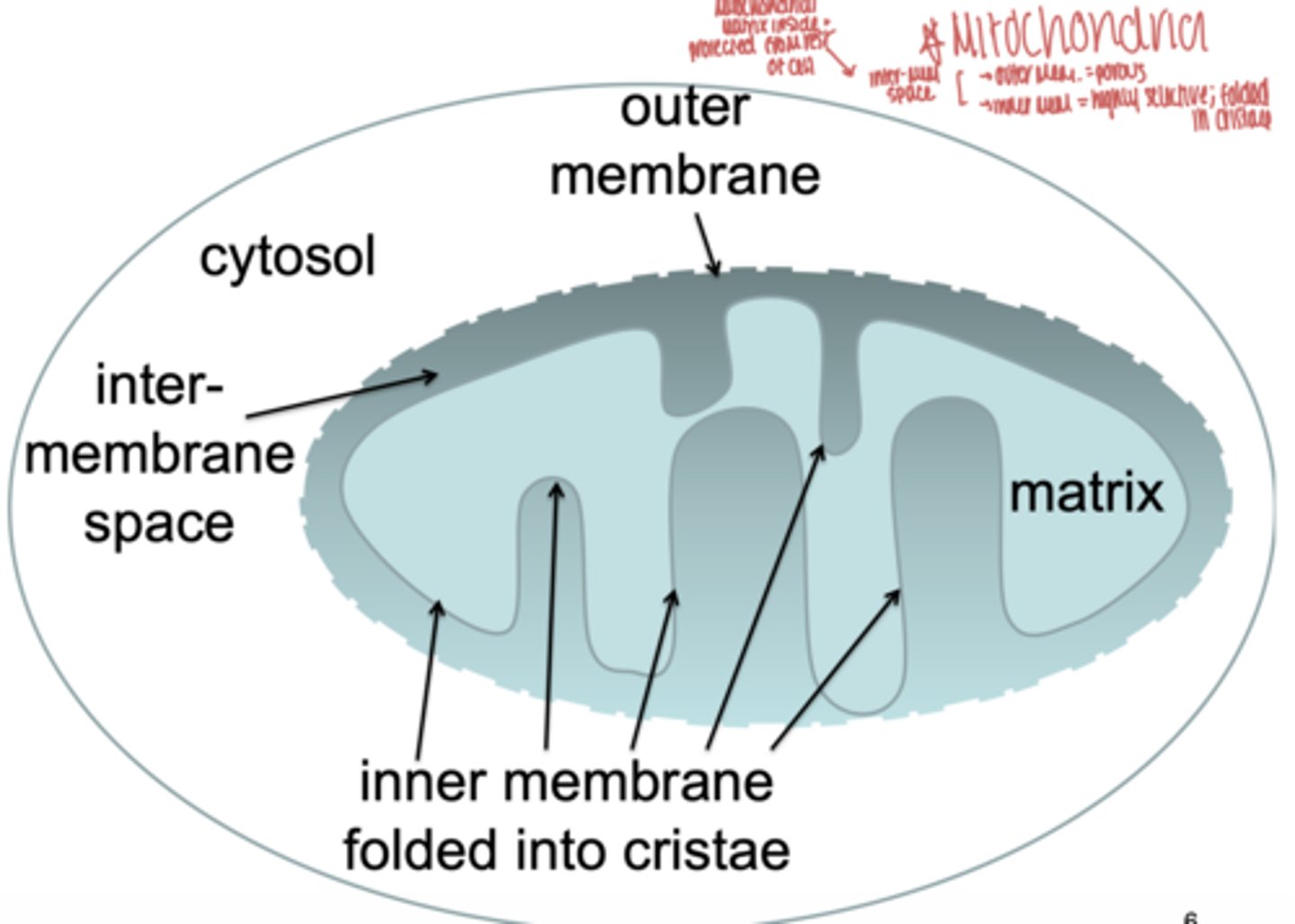
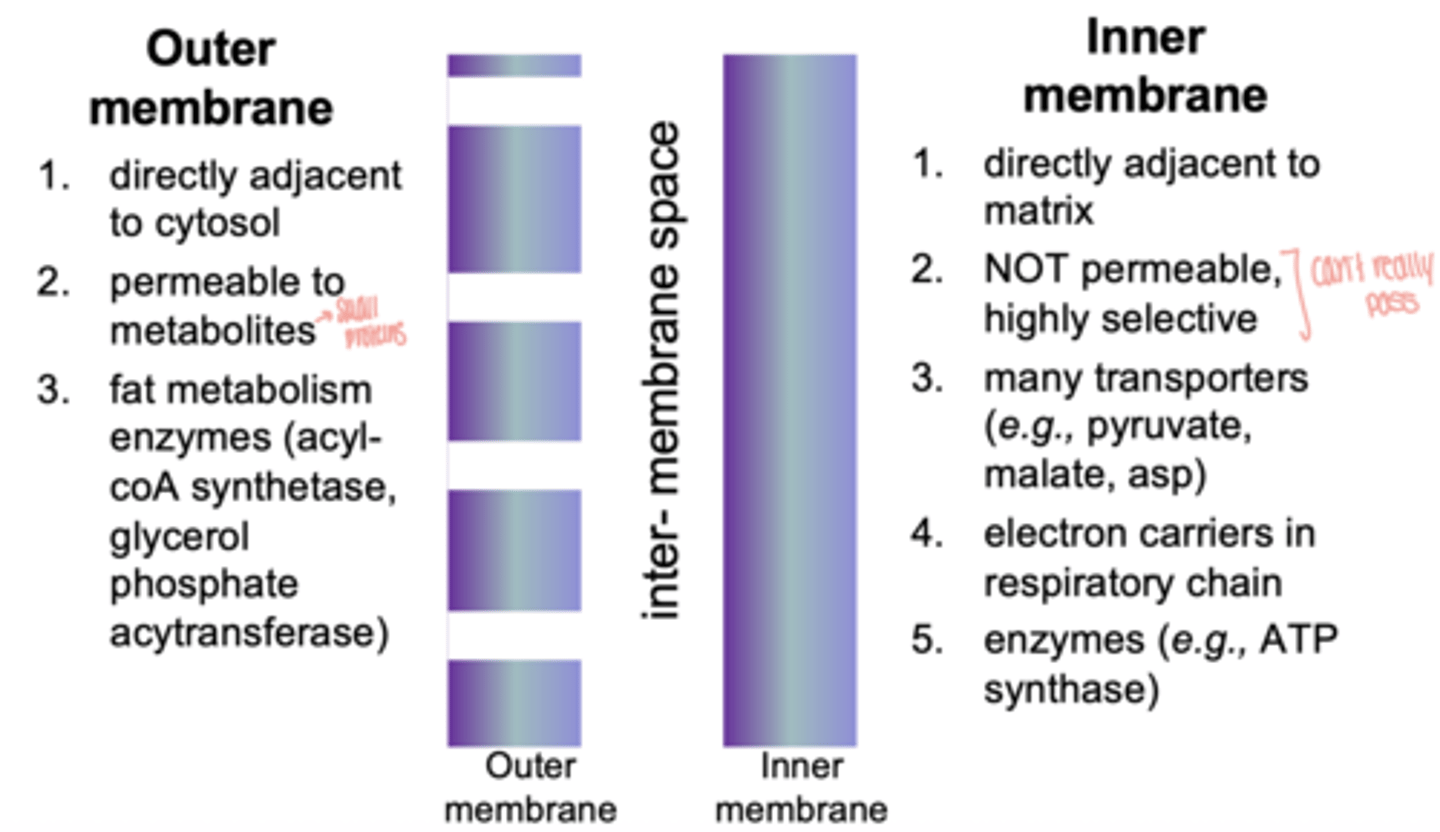
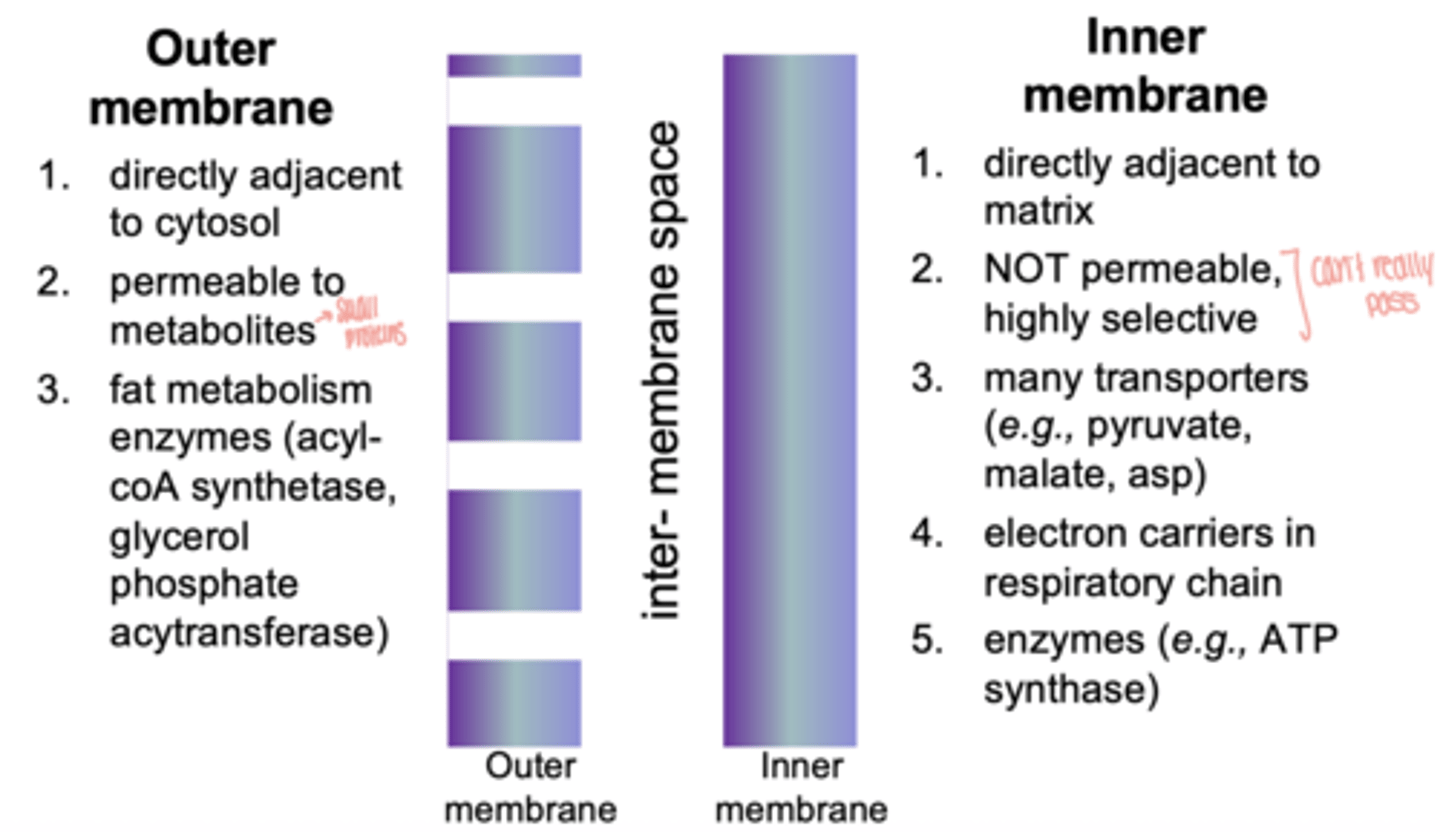
outer membrane
directly adjacent to cytosol
permeable to metabolites (proteins & small molecules)
fat metabolism enzymes (acyl-coA synthetase, glyceral phosphate acytransferase)
porous
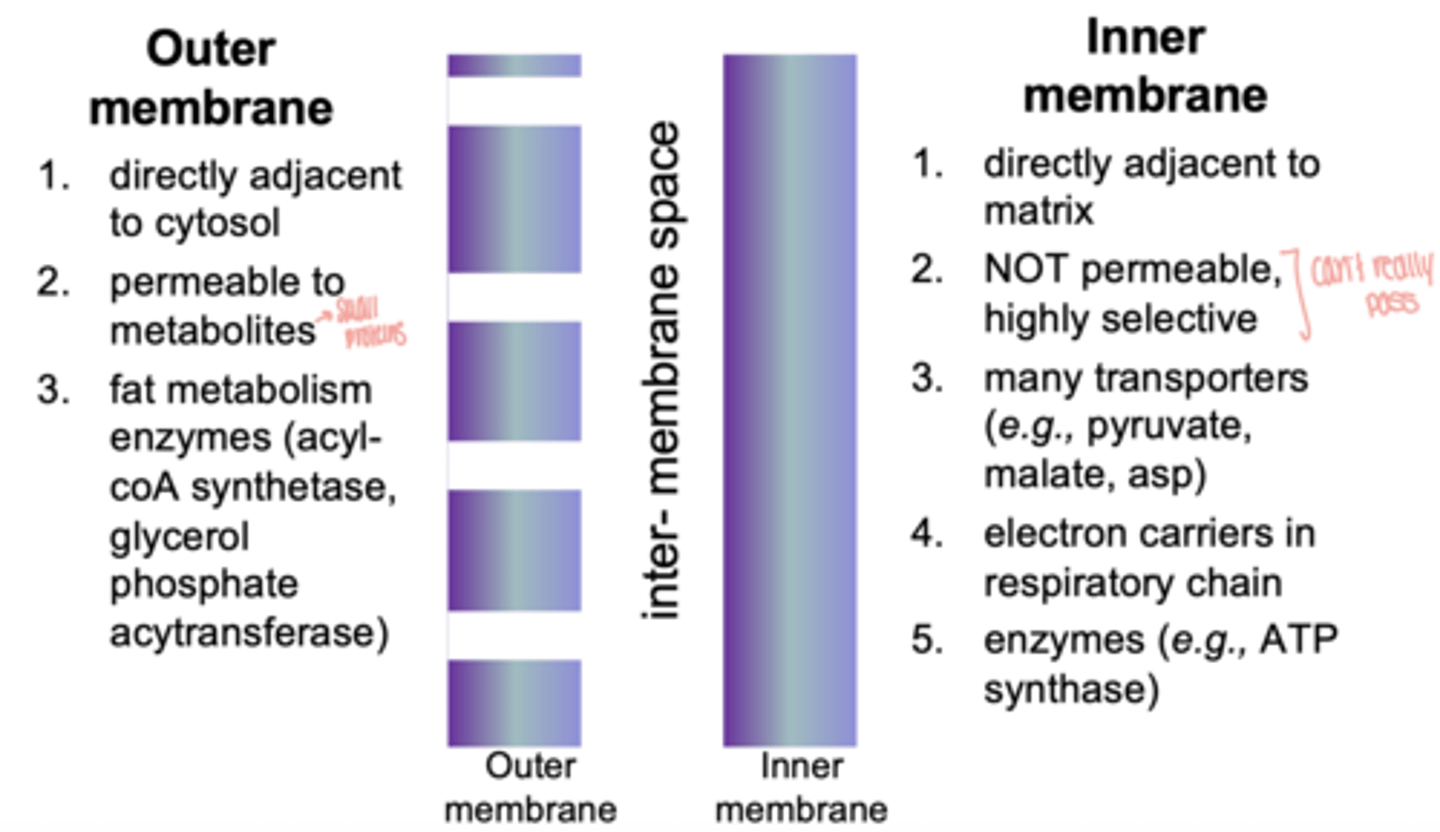
inner membrane
directly adjacent to matrix
NOT permeable, highly selective
many transporters (ex. pyruvate, malate, asp)
electron carriers in resp. chain
enzymes (ATP synthase)
what is special about the inner membrane
highly selective
contains:
- ETC
- ATP synthase
folded into cristae → ↑ SA
what processes occur in the mitochondrial matrix
TCA cycle
pyruvate dehydrogenase
beta- oxidation:
- fatty acids → acetyl CoA
name key mitochondrial diseases
- MERRF (Myoclonic Epilepsy associated with Ragged Red Fiber)
- MELAS ( Mitocohondrial Encephalopathy with Lactic Acidosis and Stroke-like episodes)
- LHON (Leber Hereditary Optic Neuropathy)
- GRACILE ( Growth Retardation, Aminoaciduria, Cholestasis, Iron overload, Lactic acidosis, Early death)
-Leigh syndrome
- CODAS (Cerebral, Ocular, Dental, Auricular, and Skeletal Anomalies Syndrome)
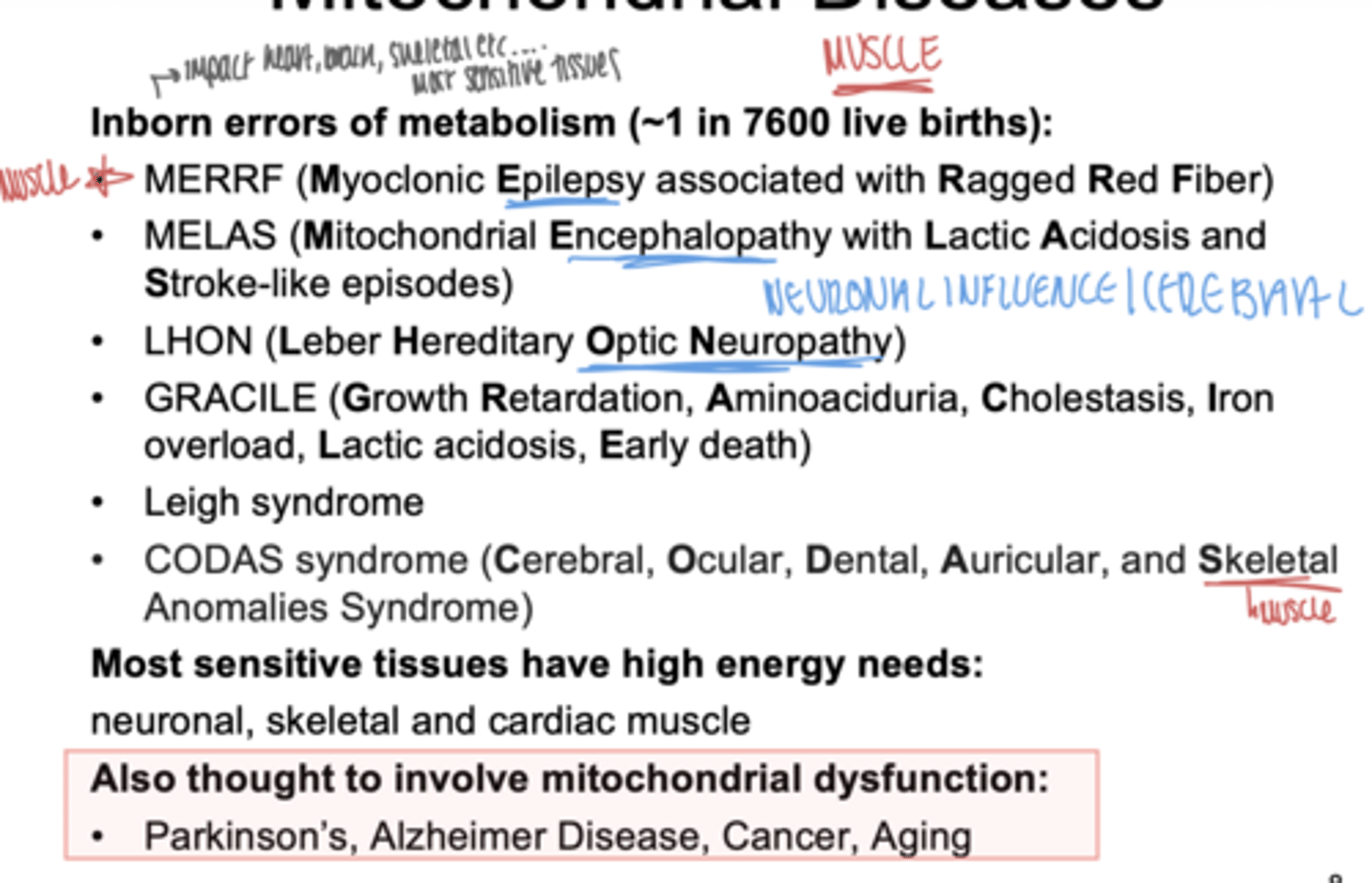
common symptoms of mitochondrial diseases
lactic acidosis due to reliance on glycolysis
neurological issues
muscle weakness/fatigue
what other conditions are thought to involve mitochondrial dysfunction
- Parkinsons
- alzheimer
- cancer
- aging
why is lactic acidosis a common symptom in mitochondrial diseases
without mitochondrial function, pyruvate must be directed to lactate to regenerate NAD+
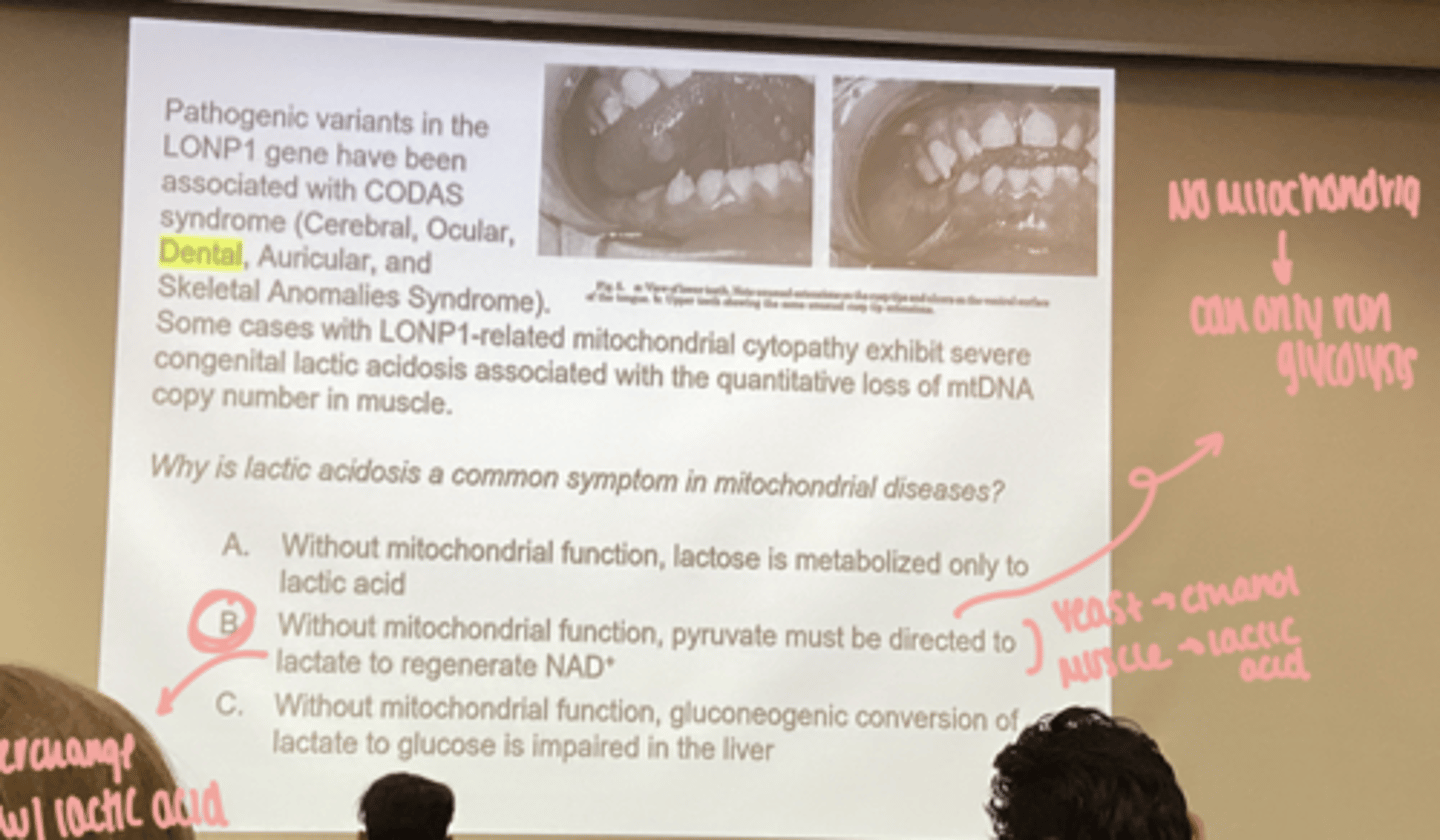
what happens if mitochondria don't work
-only glycolysis runs
- pyruvate → lactate
- needed to regenerate NAD+
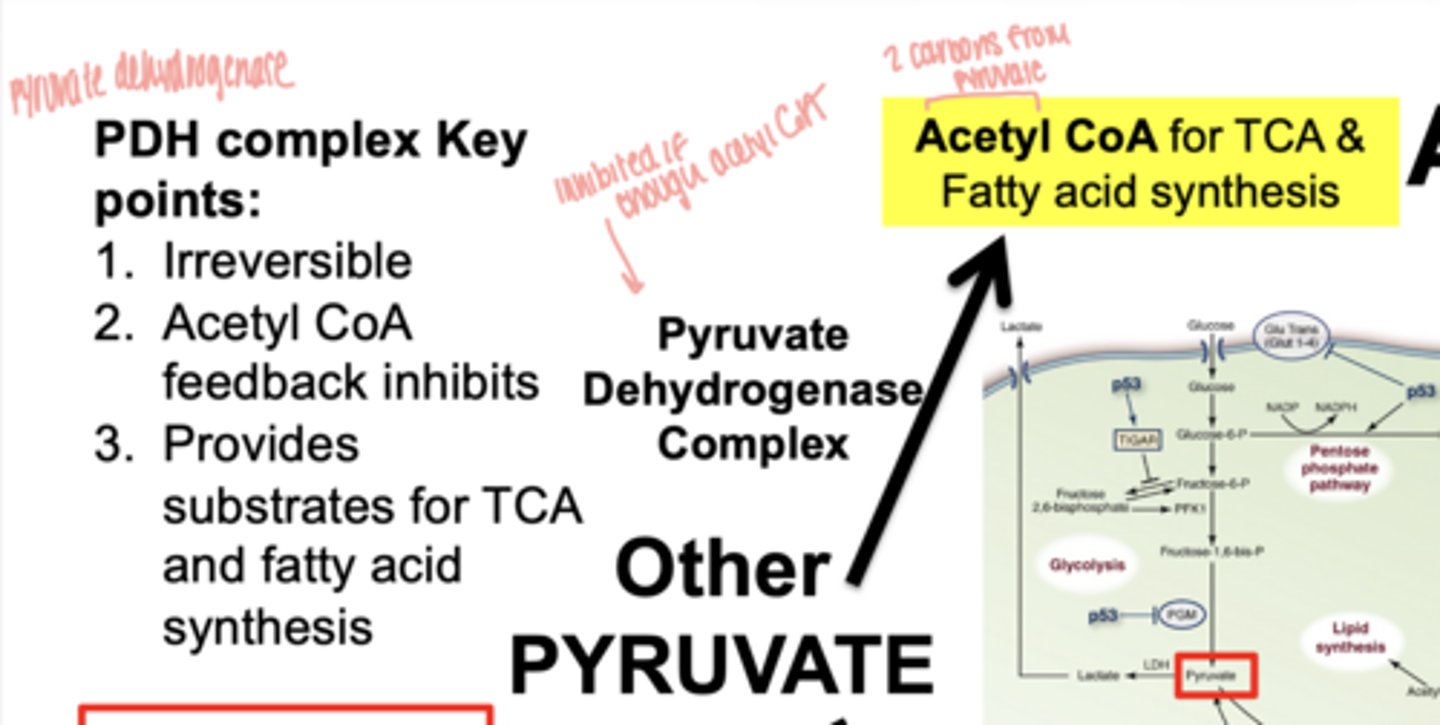
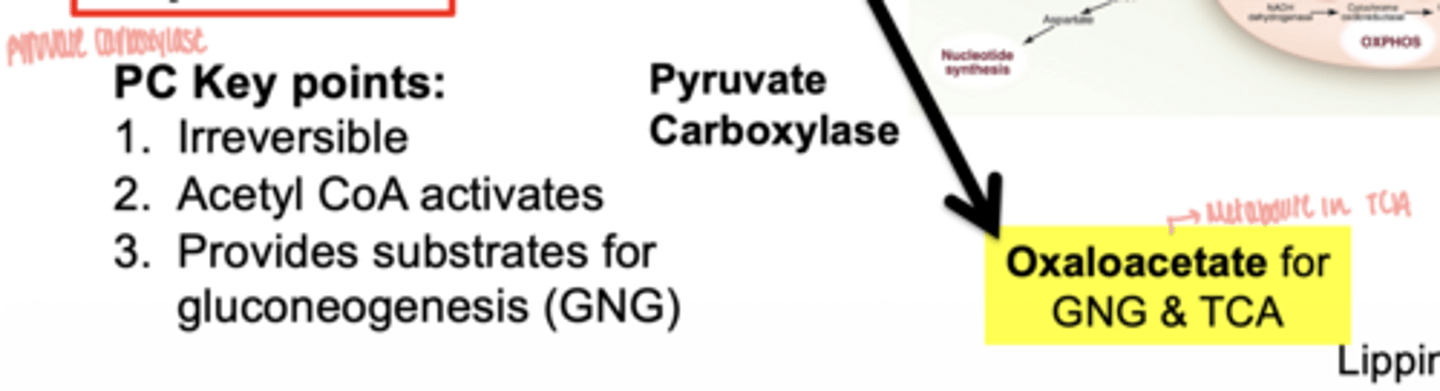
what are two major fates of pyruvate
- acetyl-CoA (via pyruvate dehydrogenase PDH) → TCA & fatty acid synthesis
- oxaloacetate via pyruvate carboxylase → gluconeogeneiss & TCA
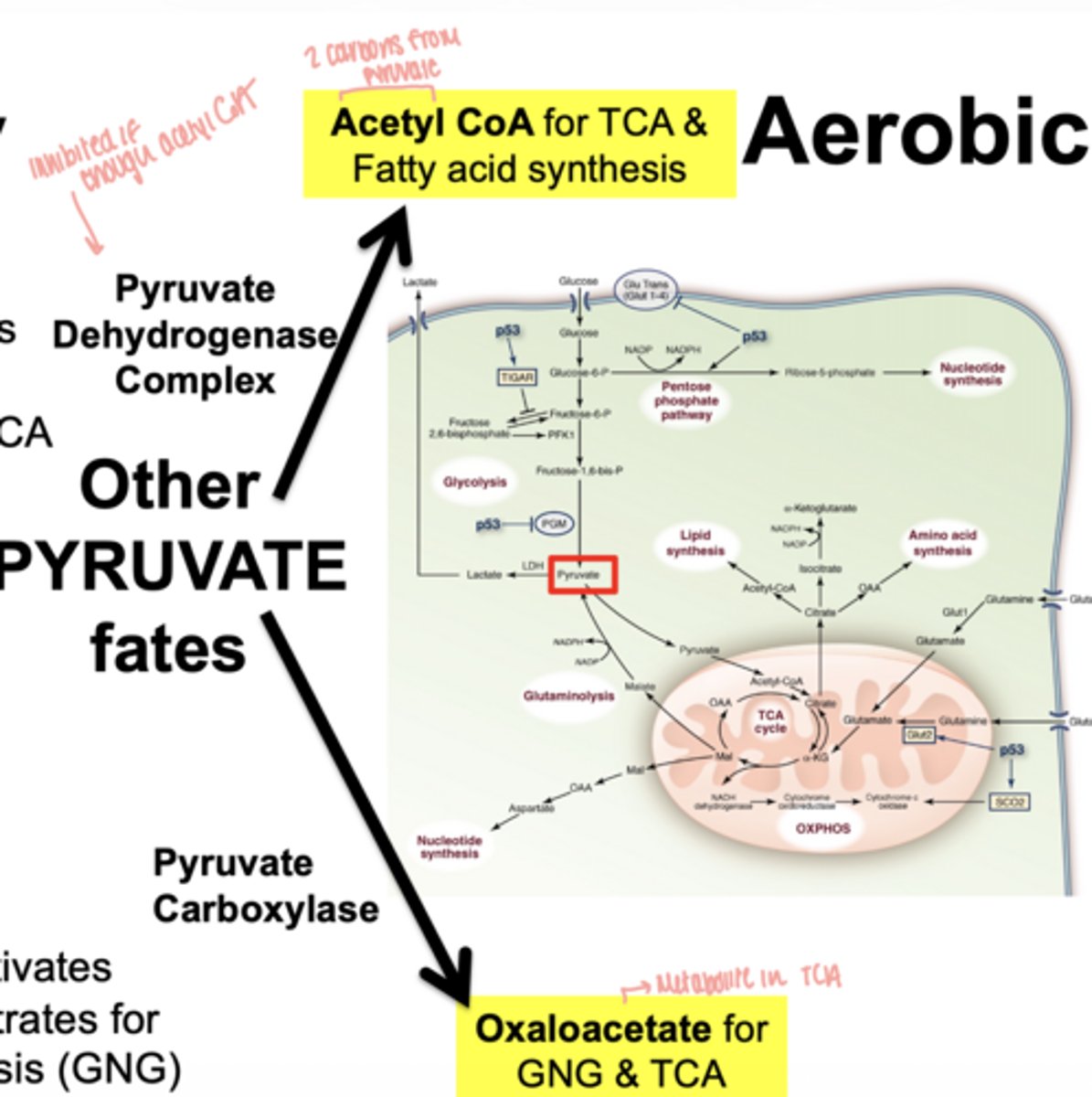
pyruvate dehydrogenase complex (PDH)
- irreversible
- acetyl CoA feedback inhibits
- provides substrate for TCA and fatty acid synthesis
pyruvate carboxylase
- irreversible
- acetyl CoA activates
- provides substrates for gluconeogenesis (GNG)
what does pyruvate dehydrogenase (PDH) do
converts pyruvate (3 C) → acetyl-CoA (2C)
releases:
- CO₂
- NADH
is PDH reversible
no
links glycolysis → TCA
major regulatory step
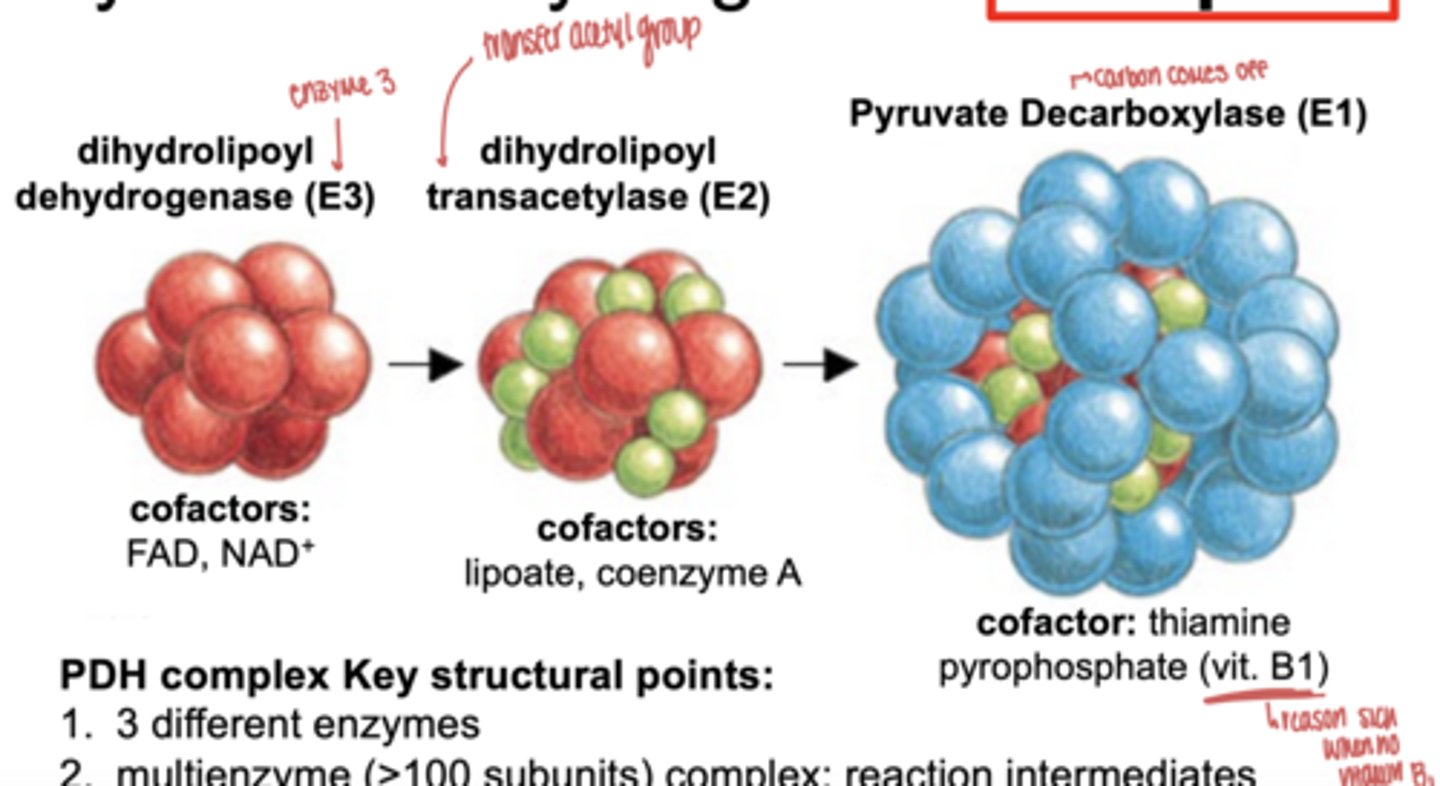
cofactors required for PDH
1. thiamine pyrophosphate (B1)
2. lipoate
3. CoA
4. FAD
5. NAD+
Tender Loving Care For Nancy
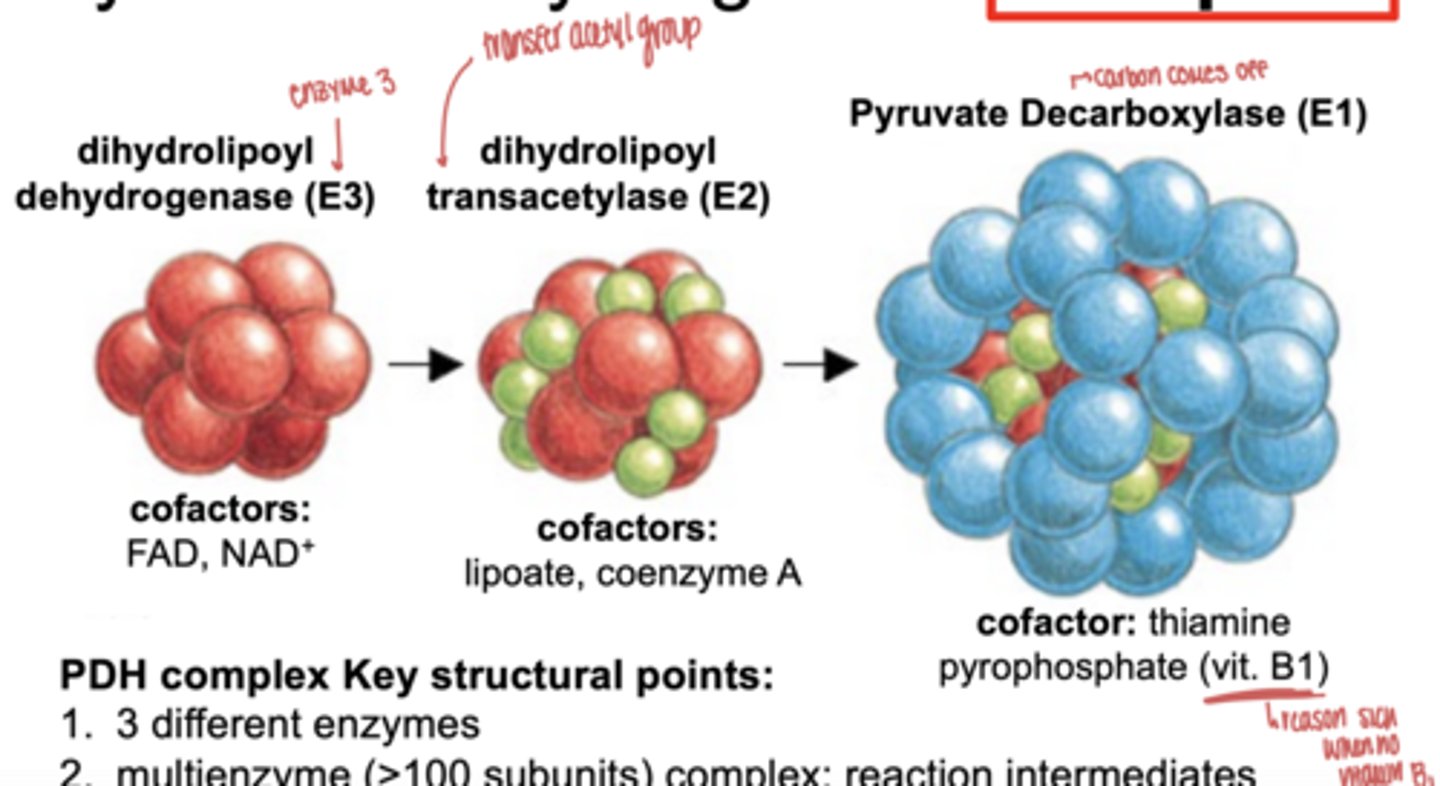
pyruvate decarboxylase E1 cofactor
thiamine pyrophosphate (vitamin B1)
dihydrolipoyl transacetylase E2 cofactor
lipoate, coenzyme A
dihydrolipoyl dehydrogenase E3 cofactor
FAD, NAD+
what are the 3 enzyme components of PDH
E1 : pyruvate dehydrogenase (Decarboxylase)
E2: dihydrolipoyl transacetylase
E3: dihydrolipoyl dehydrogenase
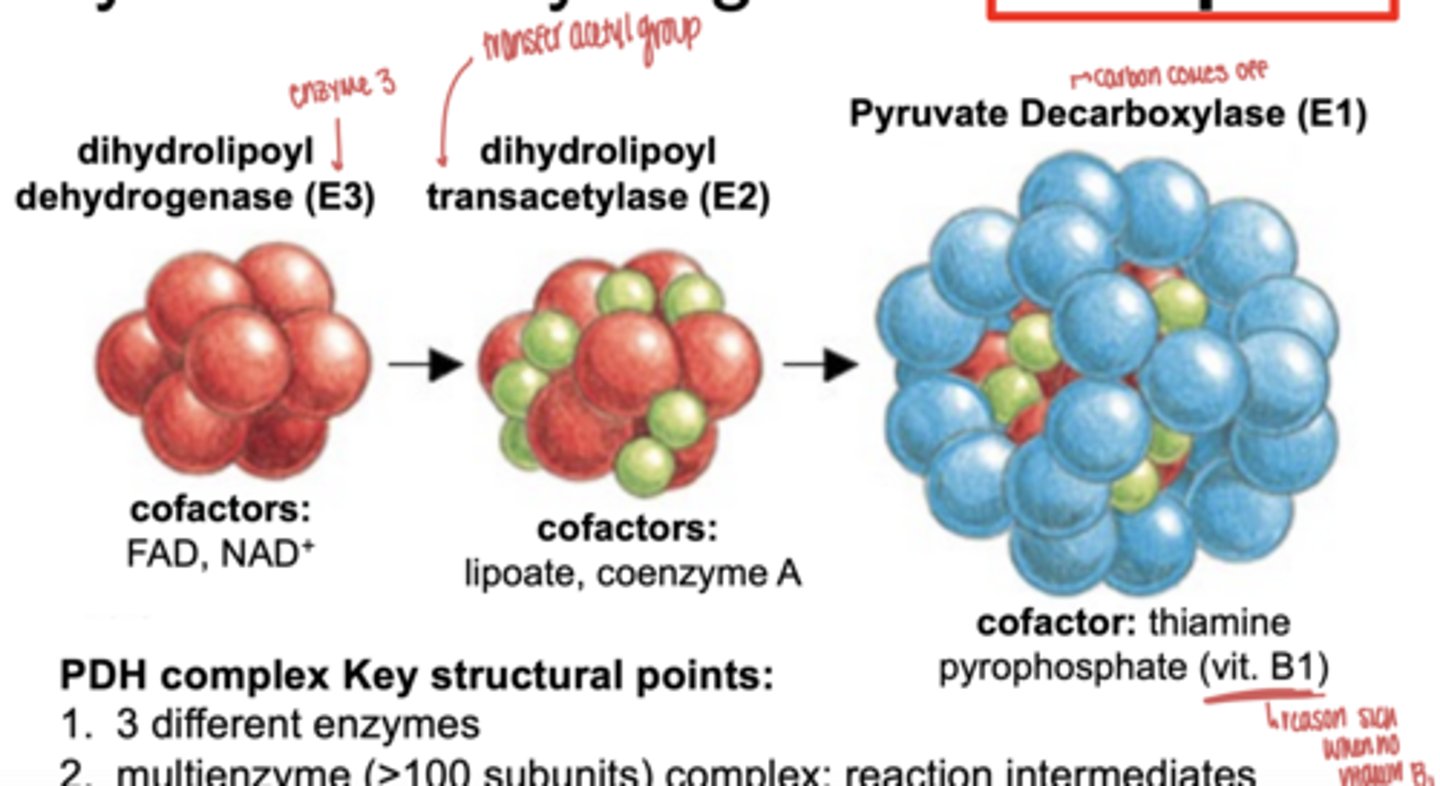
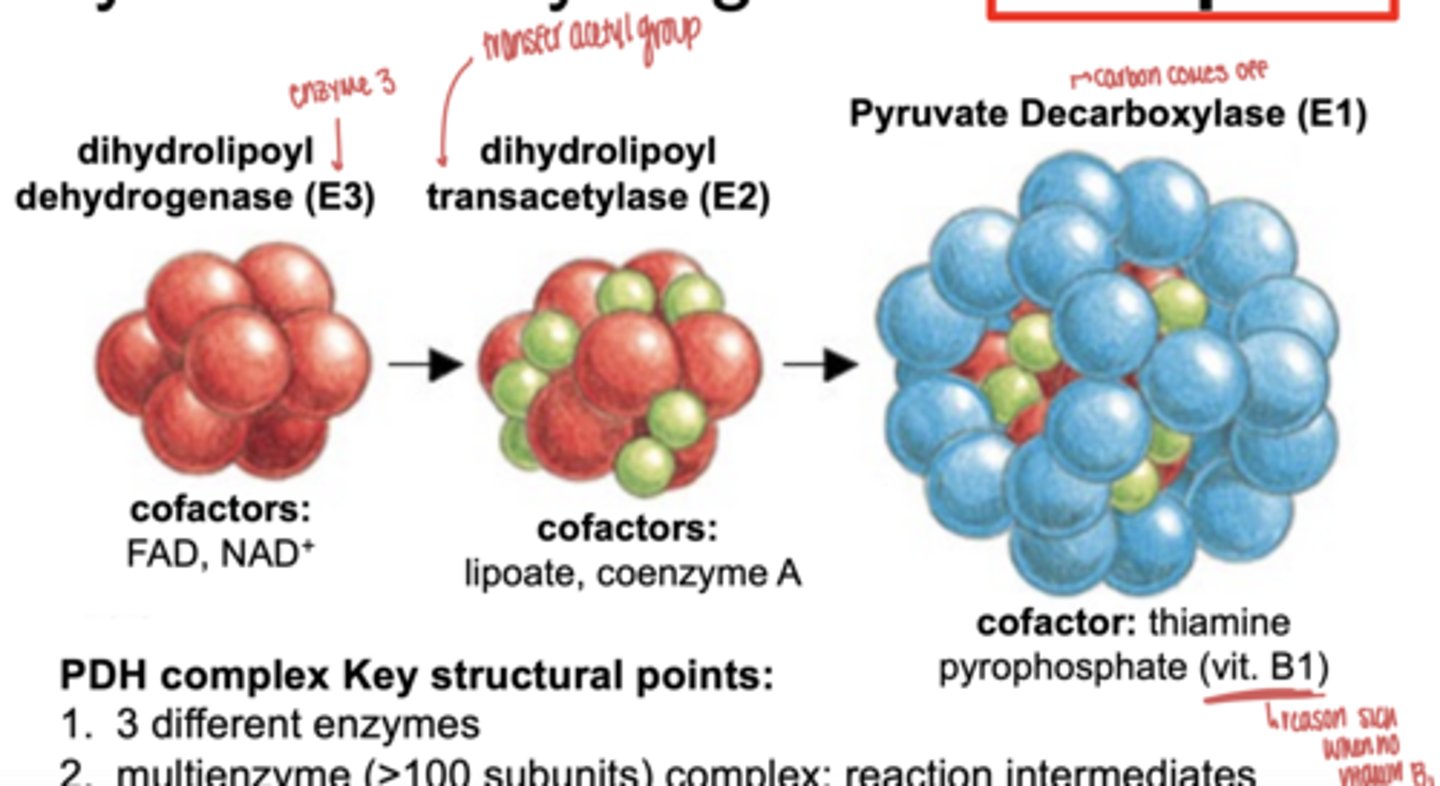
PDH complex structural points
- 3 diff. enzymes
- multienzyme ( >100 subunits) complex: reaction intermediates pass from enzyme to enzyme... assembly line
- essential cofactors participate in catalytic reactions
PDH mechanism summary
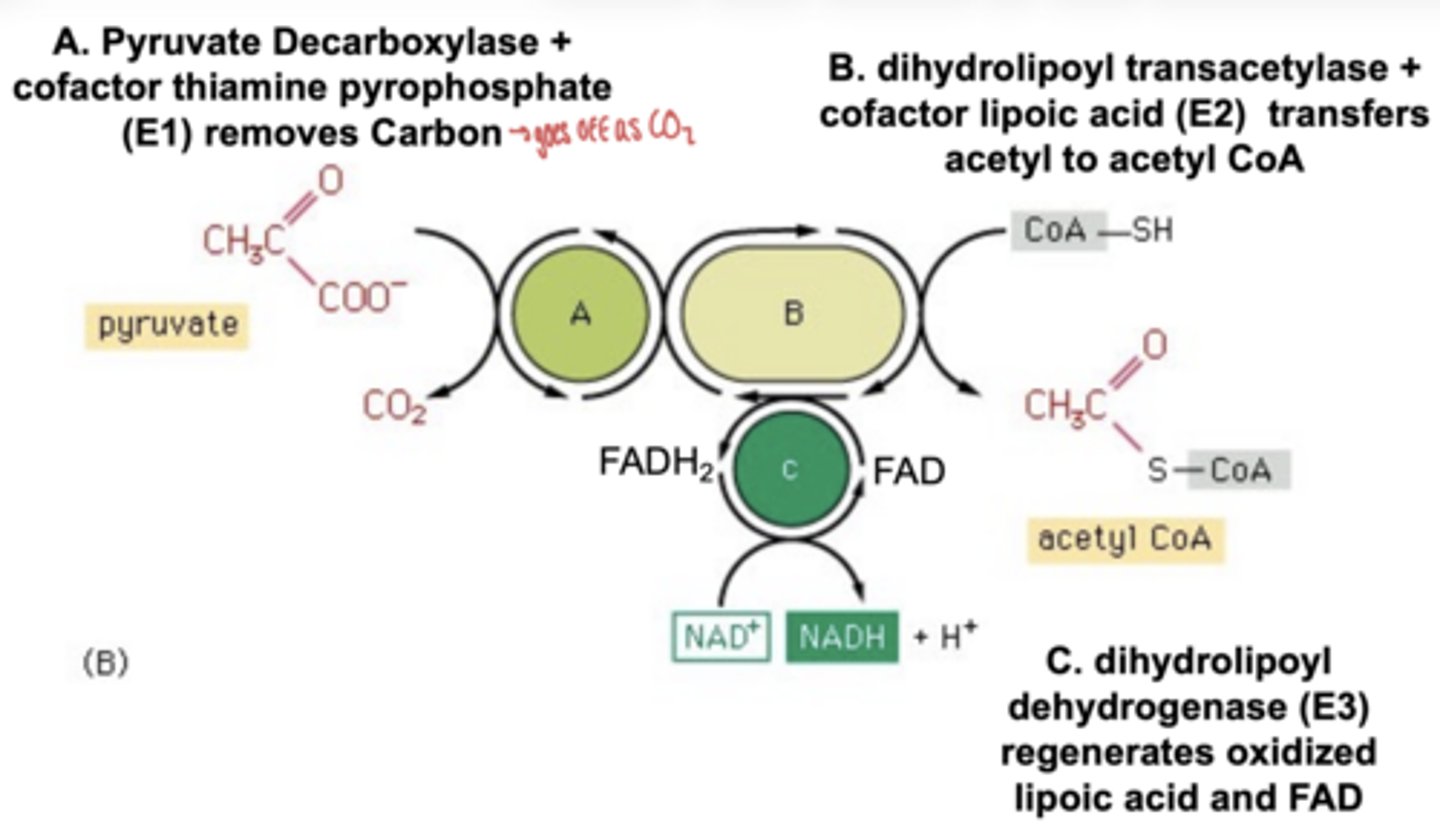
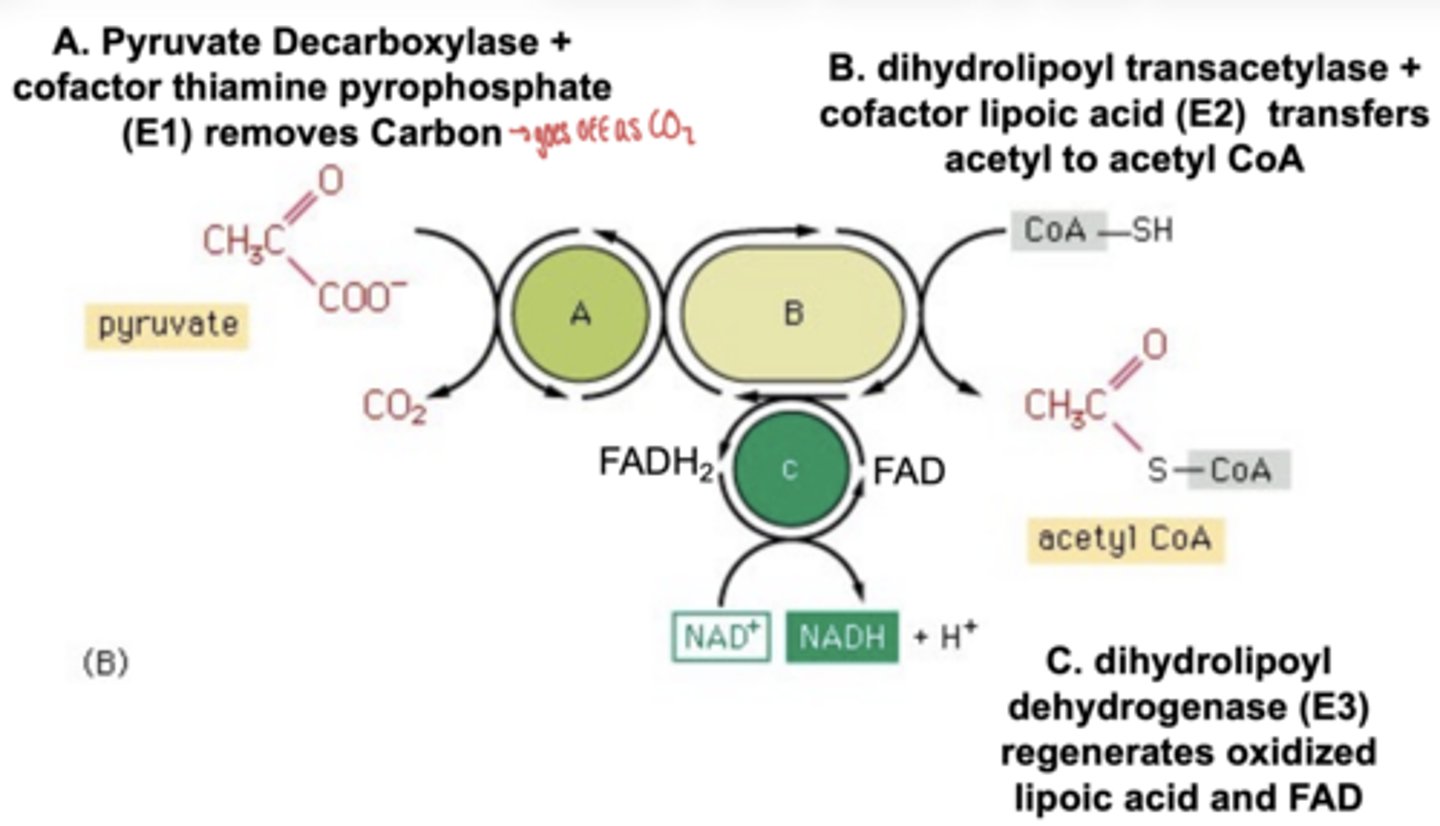
1. CO₂ removed
2. Acetyl transferred to CoA
3. NADH produced
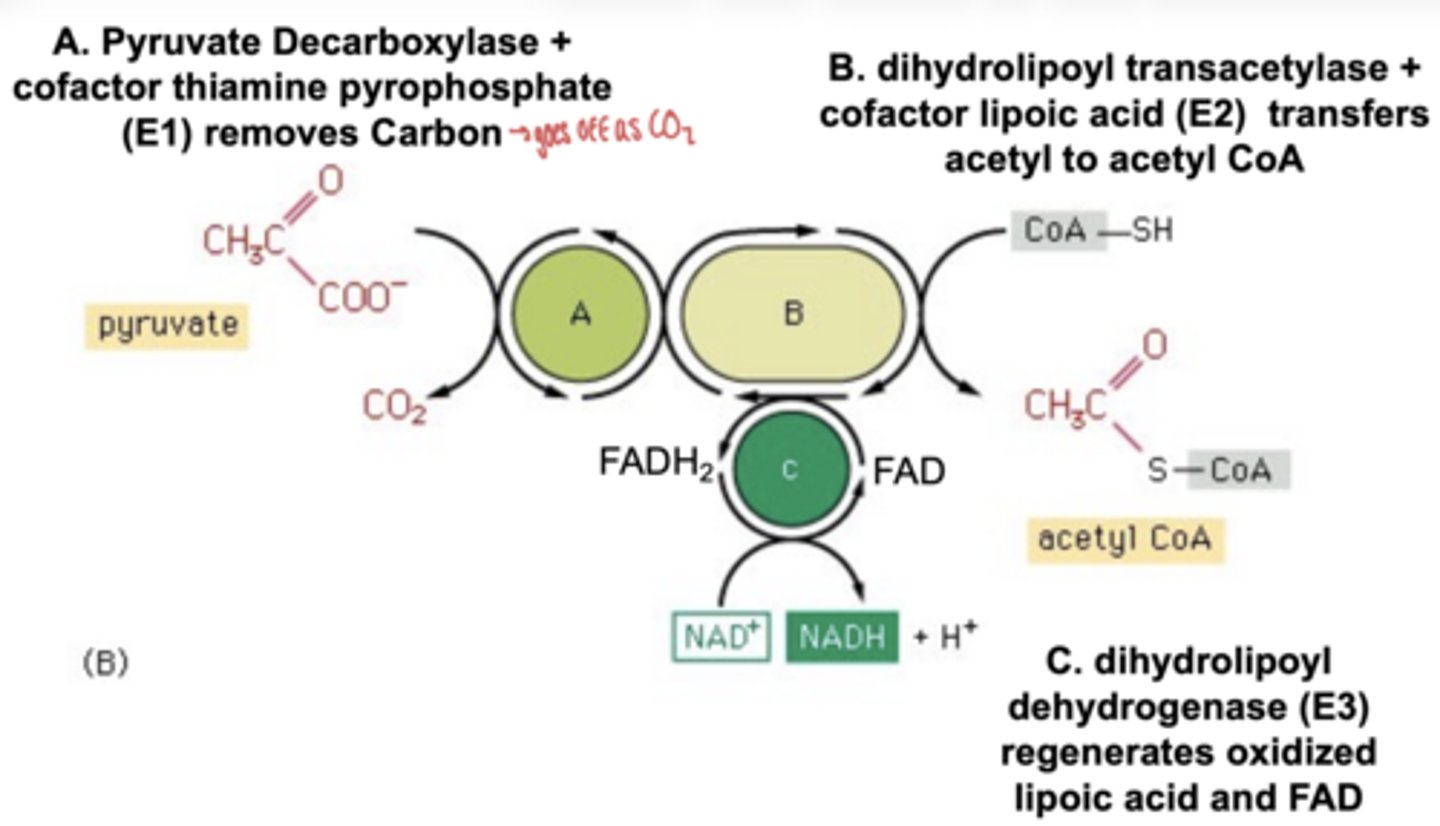
PDH mechanism- step 1
CO₂ removed
pyruvate decarboxylase + cofactor thiamine pyrophosphate (E1) removes carbon
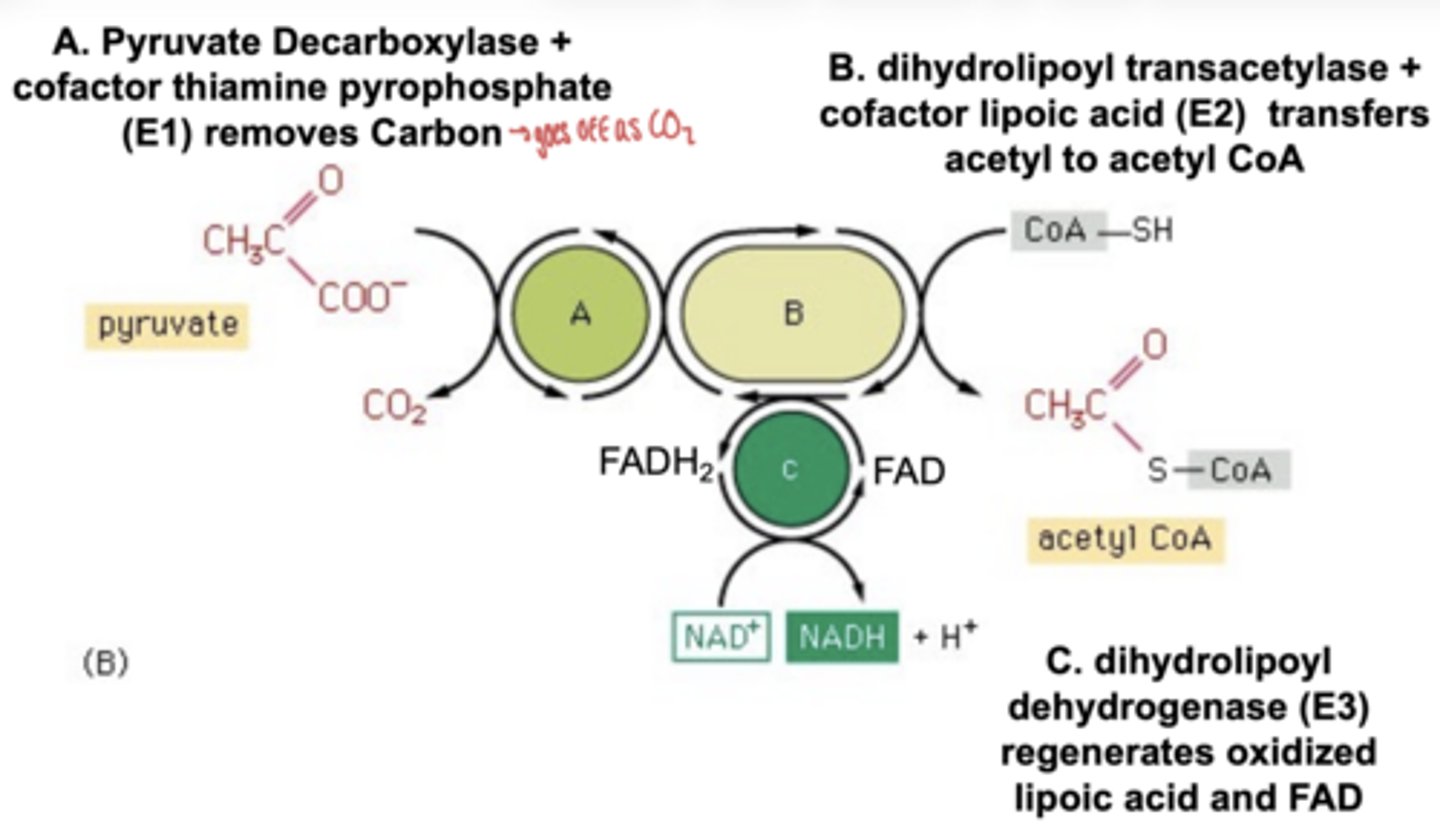
PDH mechanism- step 2
acetyl transferred to CoA
dihydrolipoyl transacetylase + cofactor lipoic acid (E2) transfers acetyl
PDH mechanism- step 3
NADH produced
dihydrolipoyl dehydrogenase (E3) regenerates oxidized lipoic acid and FAD
pyruvate fate if TCA is not required (ex. gluconeogenesis active)
high [acetyl CoA] activates pyruvate carboxylase
blocks pyruvate → TCA
pyruvate is diverted away from oxidation and instead carboxylated into intermediates that support glucose synthesis:
- conversion via pyruvate carboxylase into oxaloacetate (OAA) within the mitochondria
![<p>high [acetyl CoA] activates pyruvate carboxylase</p><p>blocks pyruvate → TCA</p><p>pyruvate is diverted away from oxidation and instead carboxylated into intermediates that support glucose synthesis:</p><p>- conversion via pyruvate carboxylase into oxaloacetate (OAA) within the mitochondria</p>](https://knowt-user-attachments.s3.amazonaws.com/f280139f-5b90-42e4-b47d-019ac88fb205.jpg)
pyruvate fate if TCA is required (ex. for fat synthesis)
low [acetyl CoA] activates PDH complex in matrix
CoA → acetyl CoA → helps synthesize fatty acids
![<p>low [acetyl CoA] activates PDH complex in matrix</p><p>CoA → acetyl CoA → helps synthesize fatty acids</p>](https://knowt-user-attachments.s3.amazonaws.com/2ed7c6d3-8f66-4d14-a702-bb0abca14712.jpg)
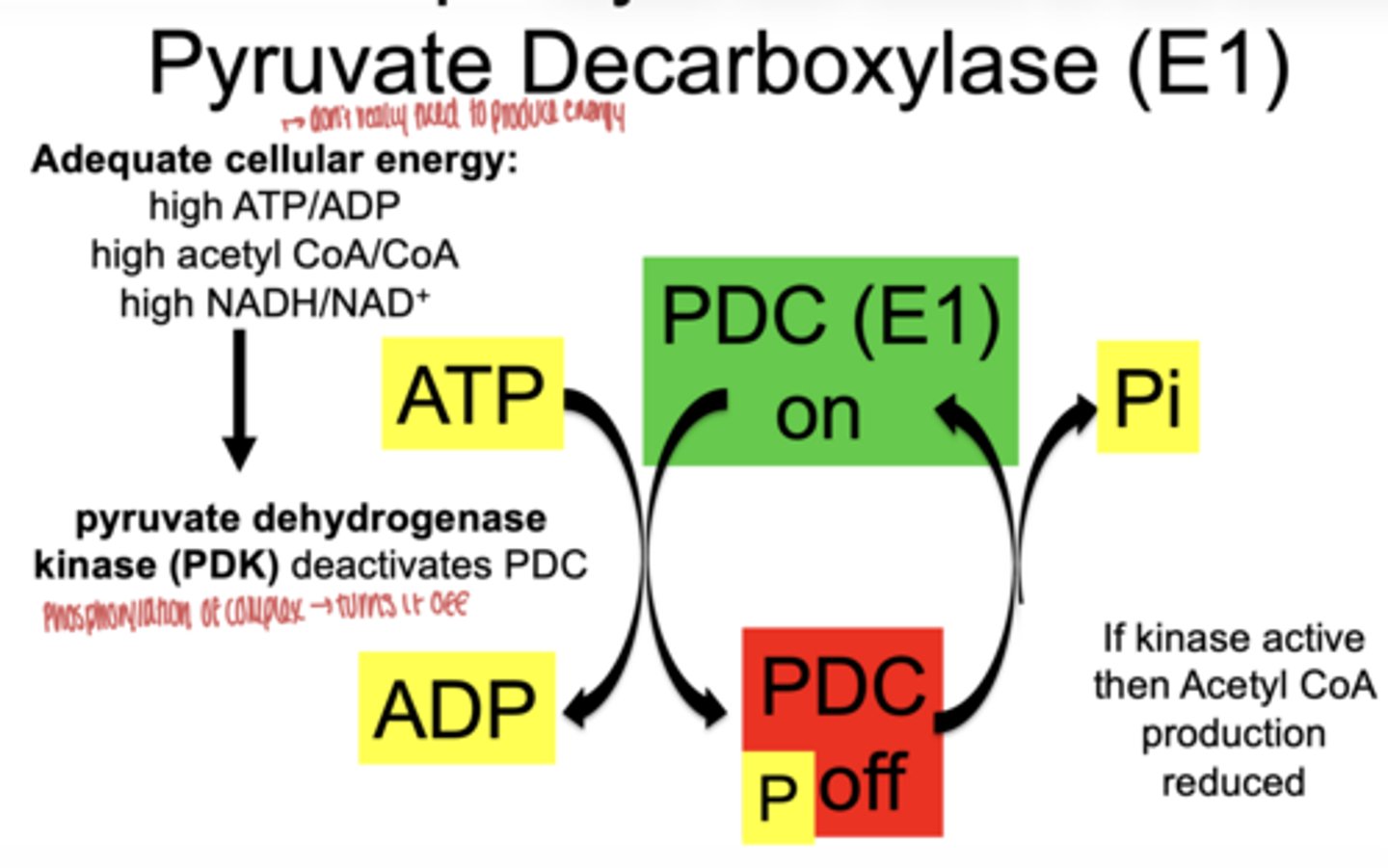
what happens to PDH regulation when energy is high/cell has adequate energy
adequate energy:
↑ ATP
↑ NADH
↑ acetyl-CoA
activates PDH kinase → phosphorylates PDH → deactivates PDH
what does pyruvate dehydrogenase kinase (PDK) do
phosphorylates pyruvate dehydrogenase/decarboxylase
if kinase is active → acetyl CoA production ↓
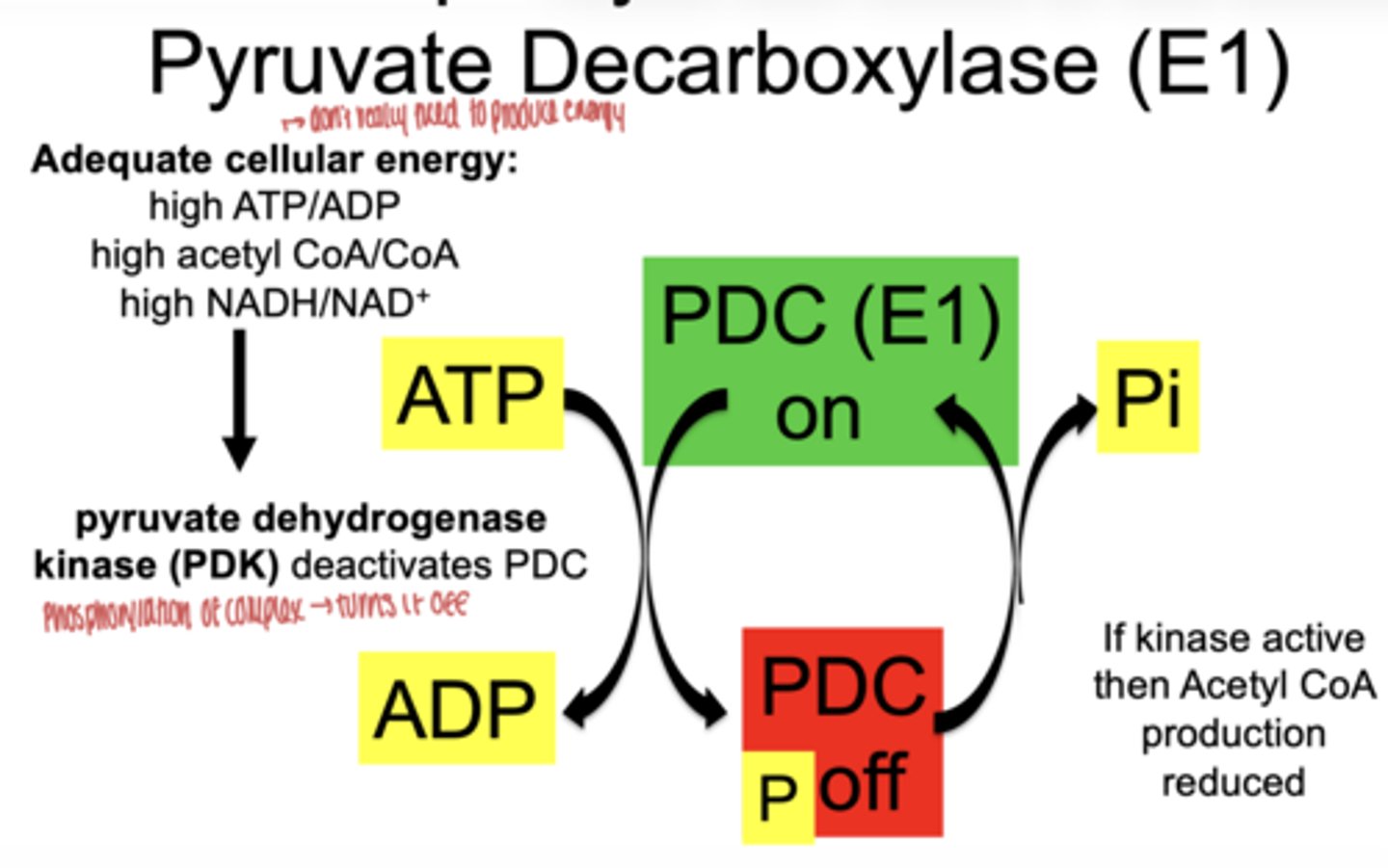
______ turns on pyruvate decarboxylase (E1)
dephosphorylation
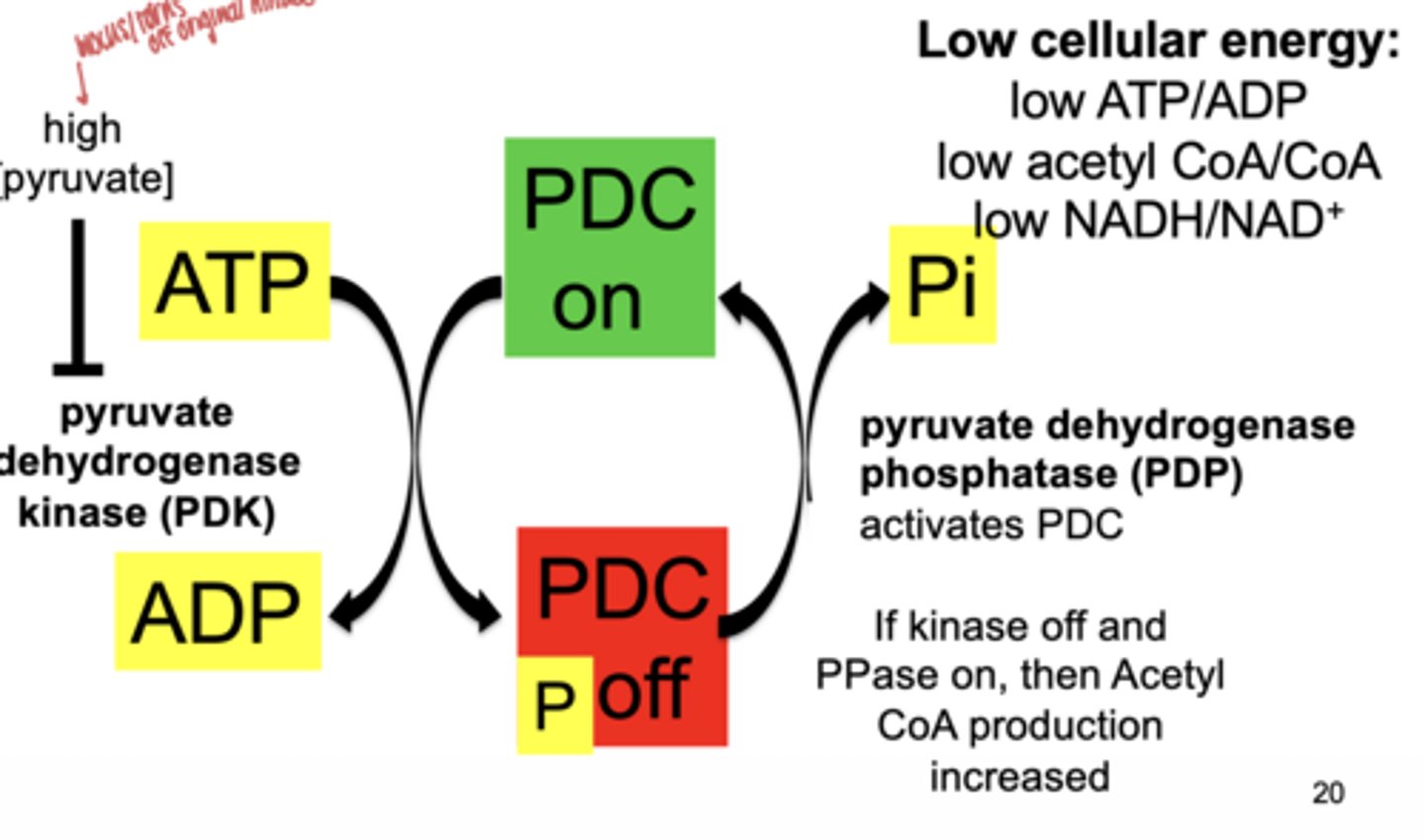
what happens when energy is low in cell
low energy:
- low ATP/ADP
- low acetyl CoA/CoA
- low NADH/NAD+
↑ pyruvate, ↑ ADP
activates PDH phosphatase → dephosphorylates → pryuvate dehyrogenase (E1) on
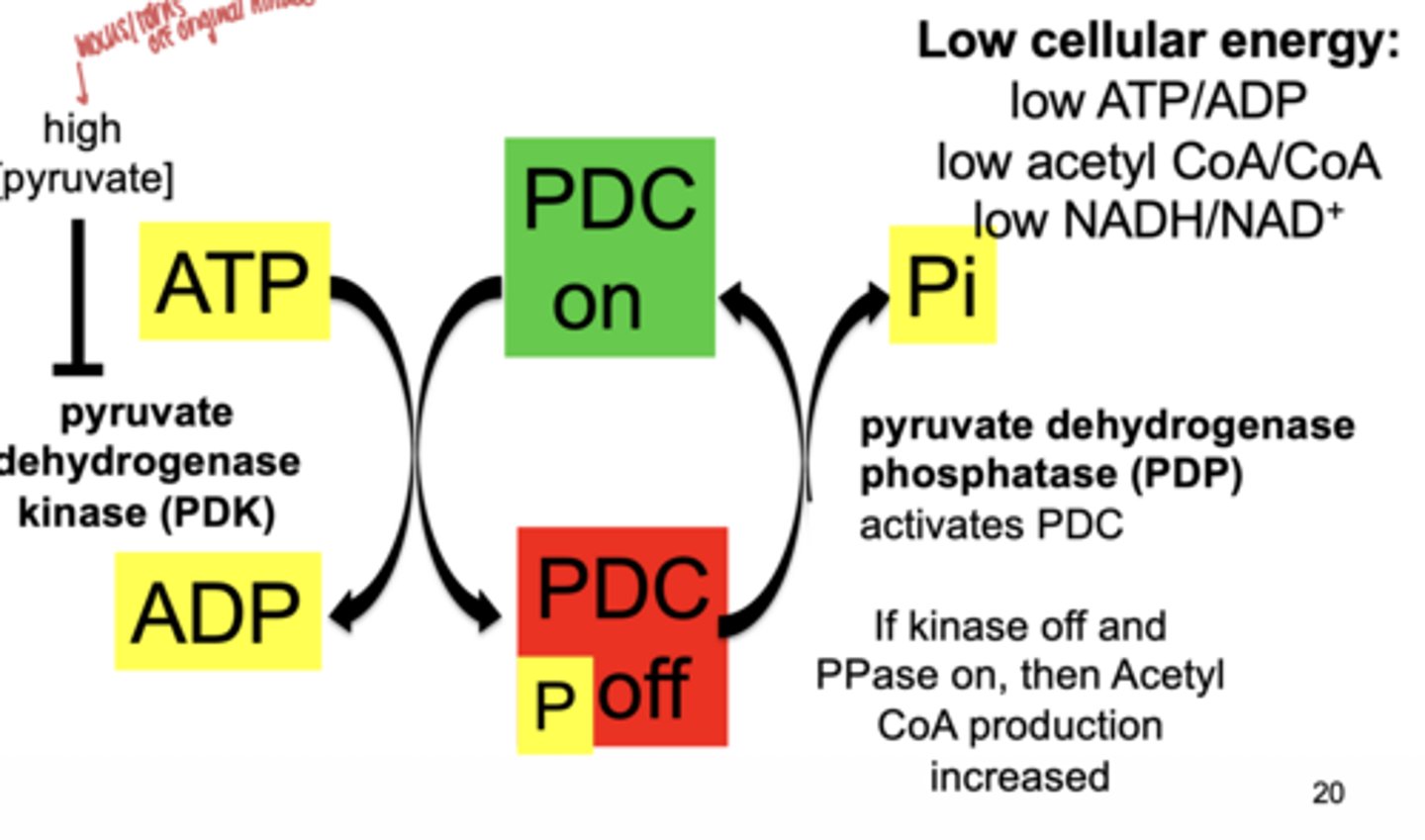
pyruvate dehydrogenase phosphatase (PDP)
activates pyruvate decarboxylase/ dehydrogenase (E1) in low energy
if kinase off and PPase on → acetyl CoA production increased
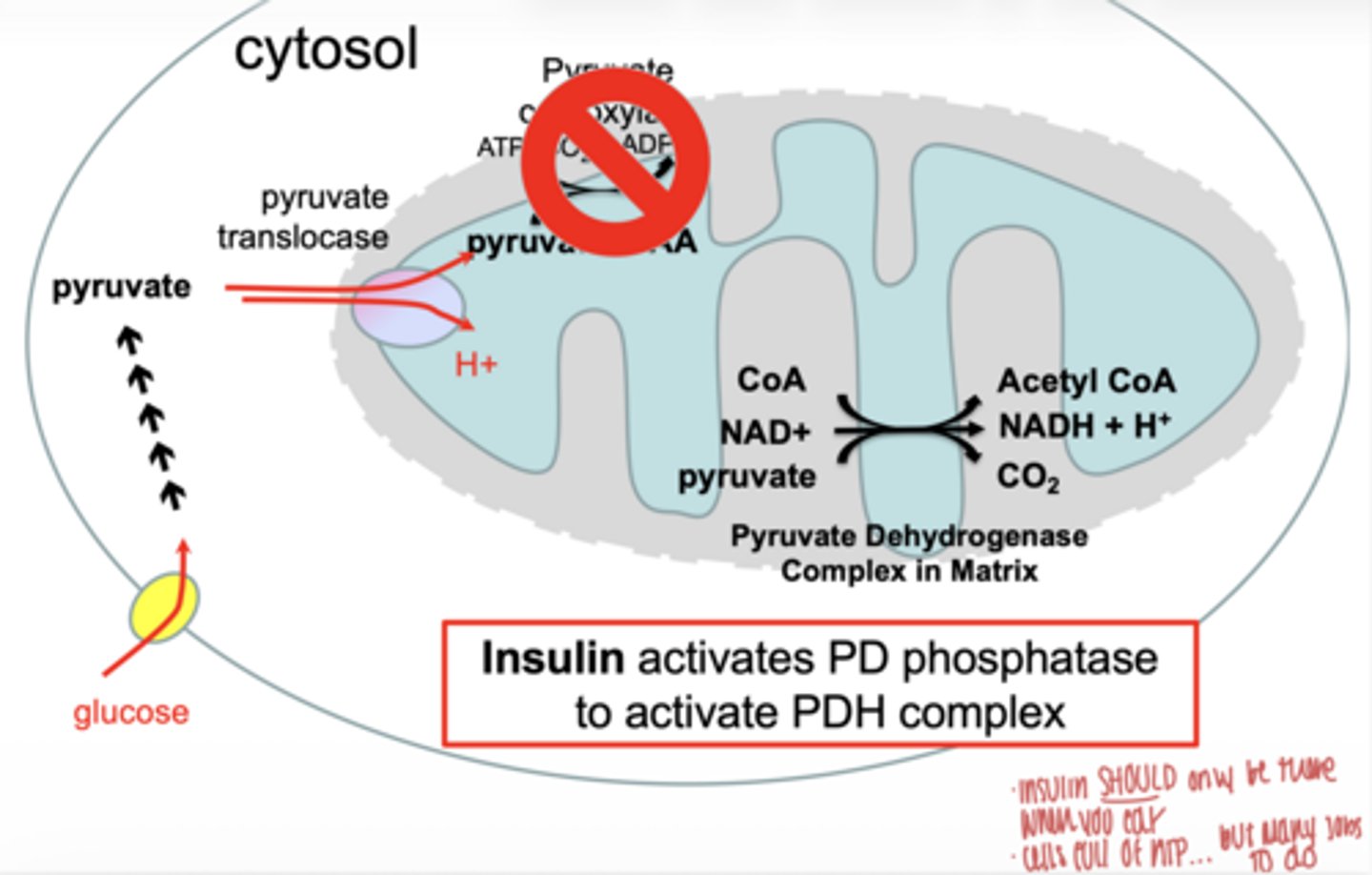
what does insulin do to PDH
activates pyruvate dehydrogenase phosphatase (PDP)
turns PDH on → promotes energy storage
**activates the pyruvate dehydrogenase (PDH) complex by removing inhibitory phosphate groups
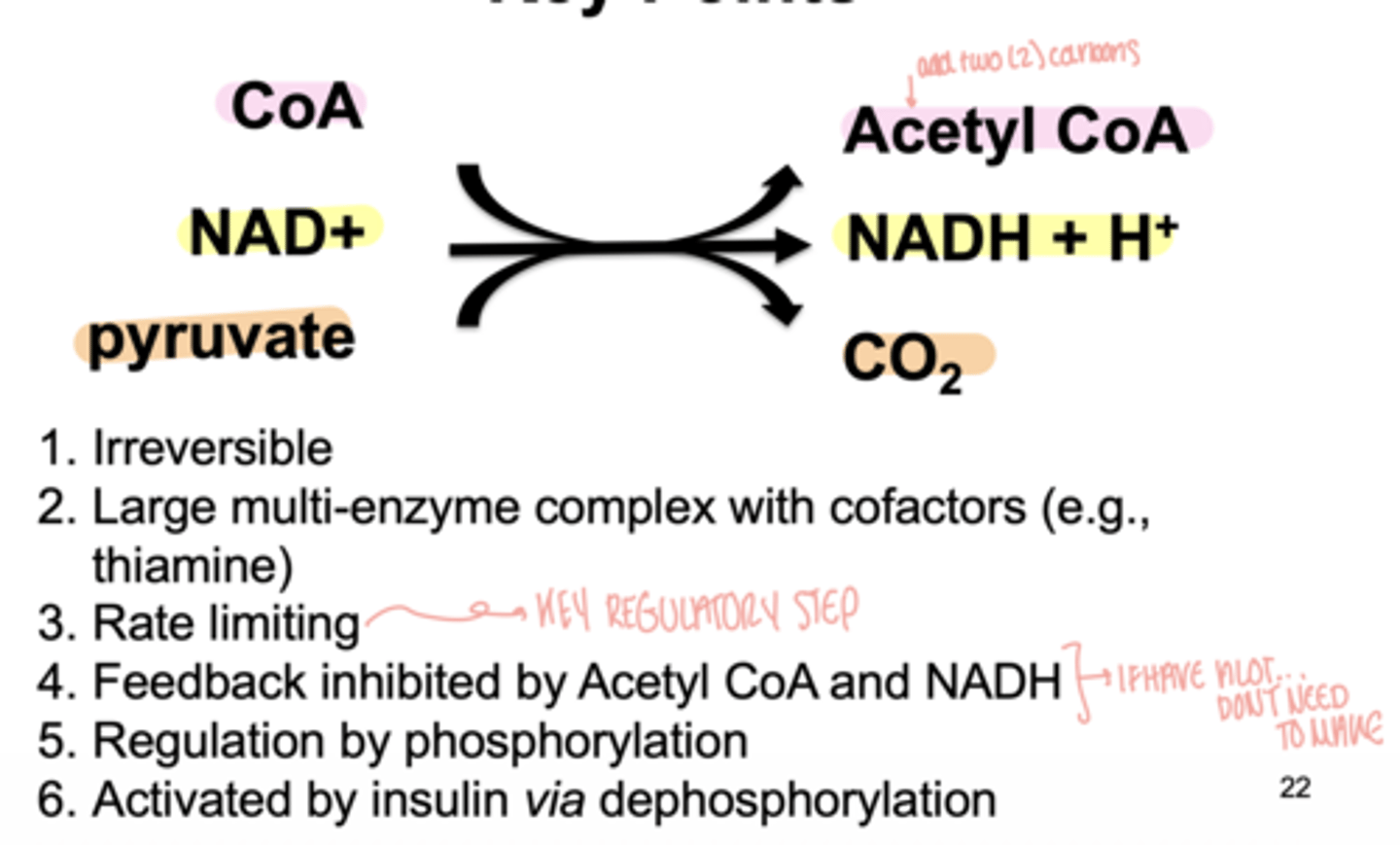
PDH summary
- irreversible
- large multi- enzyme complex w cofactors
- rate limiting/ key regulatory step
- feedback inhibited by NADH & acetyl- CoA
- regulated by phosphorylation
- activated by insulin via dephosphorylation
CoA → Acetyl-CoA
NAD+ → NADH + H⁺
pyruvate → CO₂
pyruvate carboxylase vs PDHC
pryuvate carboxylase:
- pyruvate + CO₂ + ATP → oxaloacetate + ADP + Pi
- activated by high energy state
pyruvate dehydrogenase complex:
- pyruvate + CoA + NAD → acetyl-CoA + CO₂ + NADH
- inhibited by ATP, acetyl-CoA, and NADH (high energy)
other names for tricarboxylic acid (TCA) cycle
- citric acid
- krebs
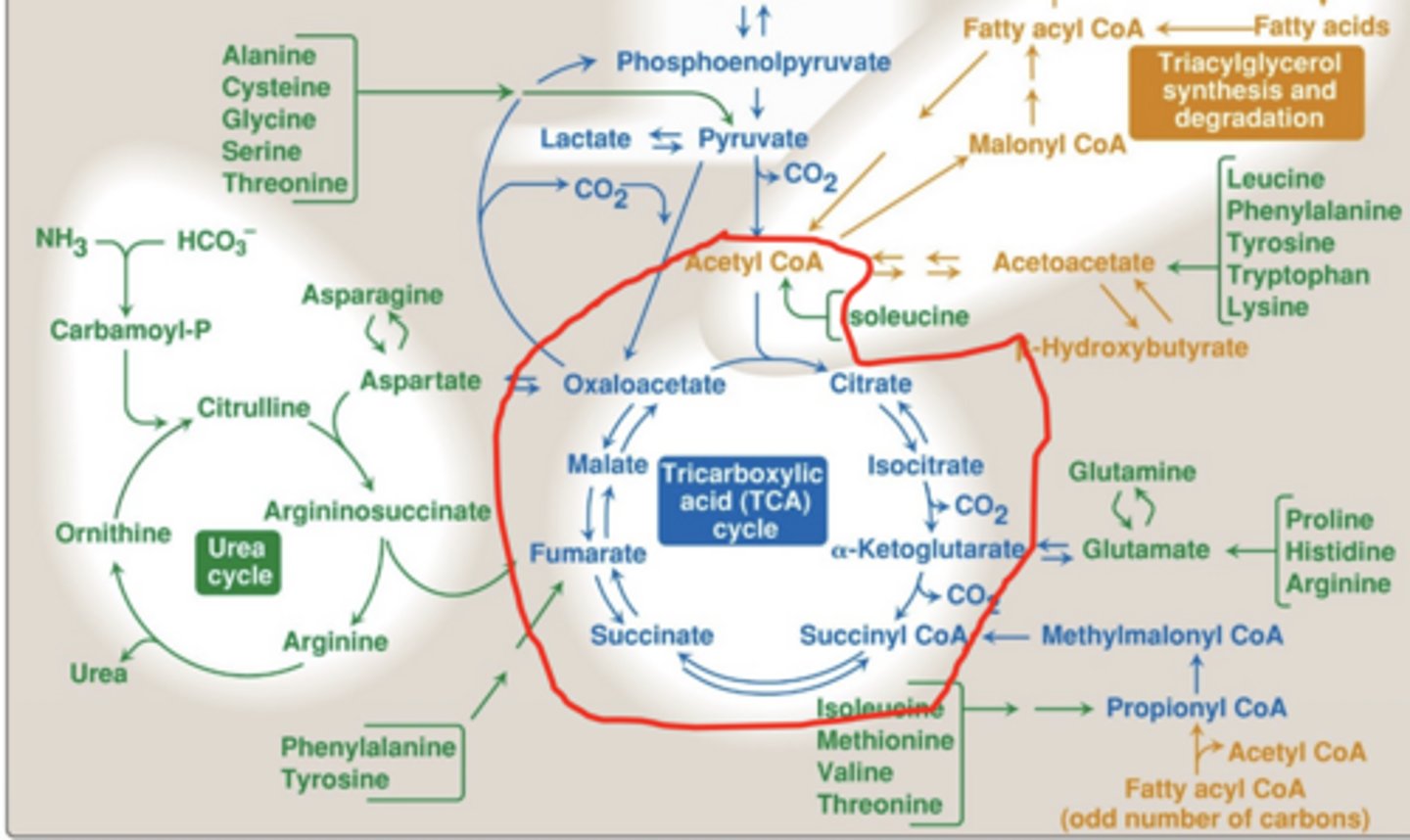
what is TCA
metabolic pathway in aerobic respiration that oxidizes acetyl-CoA to produce CO₂, ATP/GTP, and reduced cofactors (NADH, FADH₂)
in the mitochondrial matrix of eukaryotes
fueling the ETC to generate the majority of cellular energy
what enters the TCA
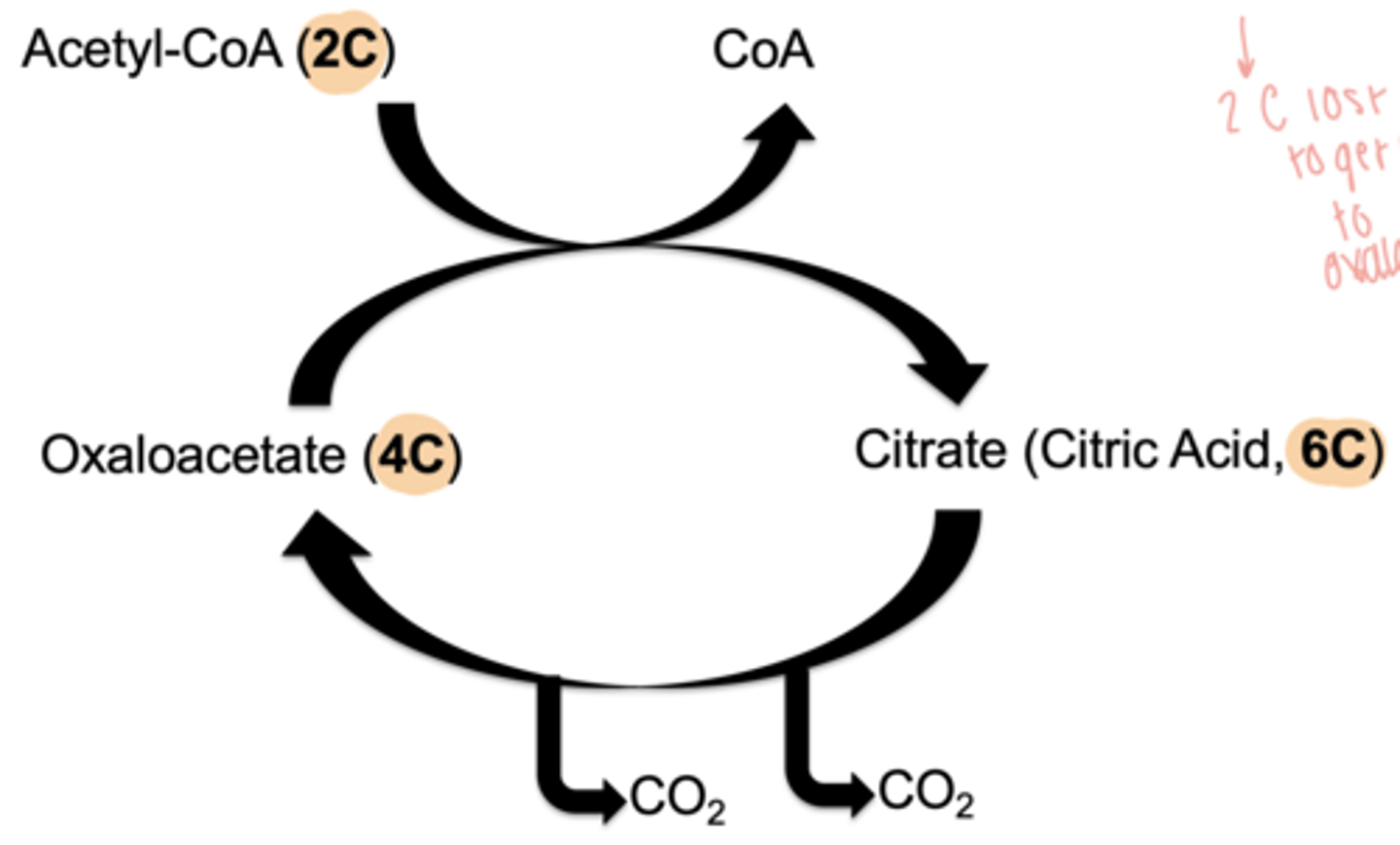
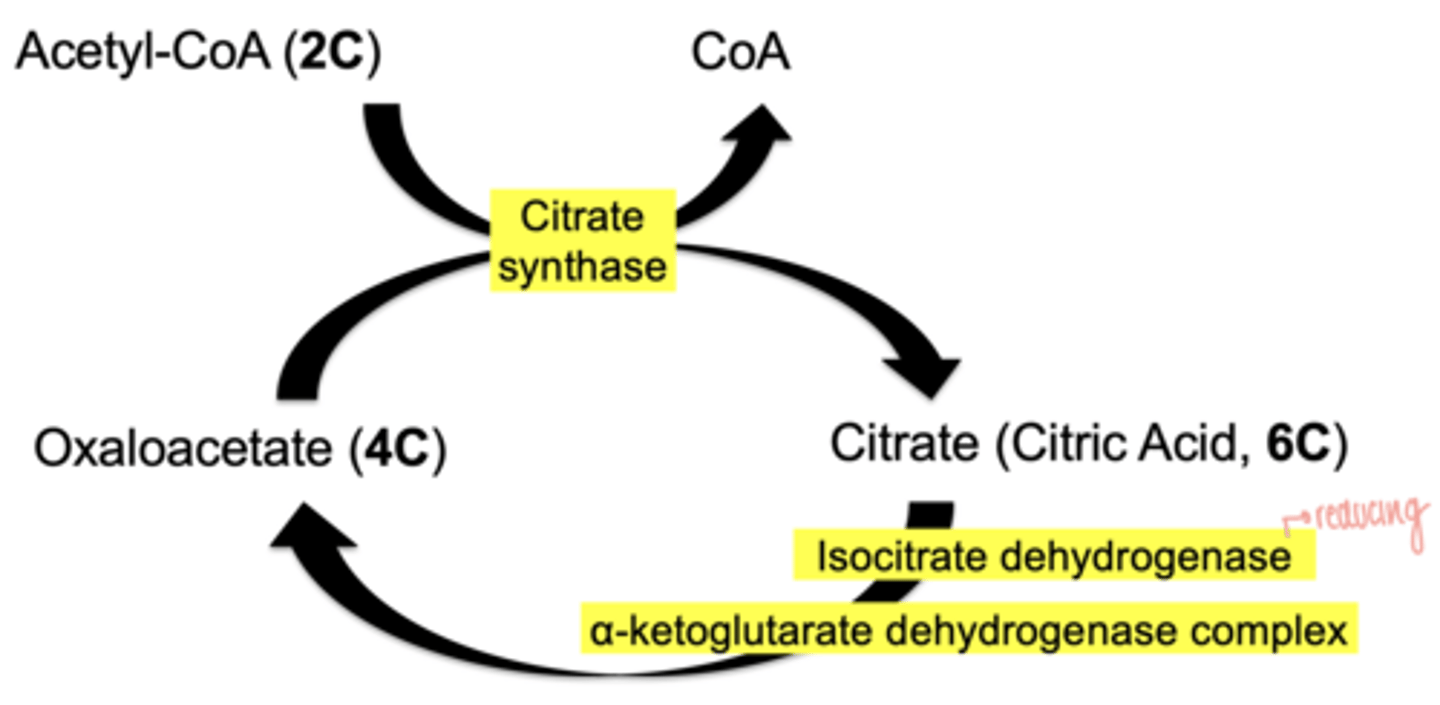
acetyl-CoA (2 C)
combines with oxaloacetate (4C) → citrate (6C)
what happens to carbons in TCA
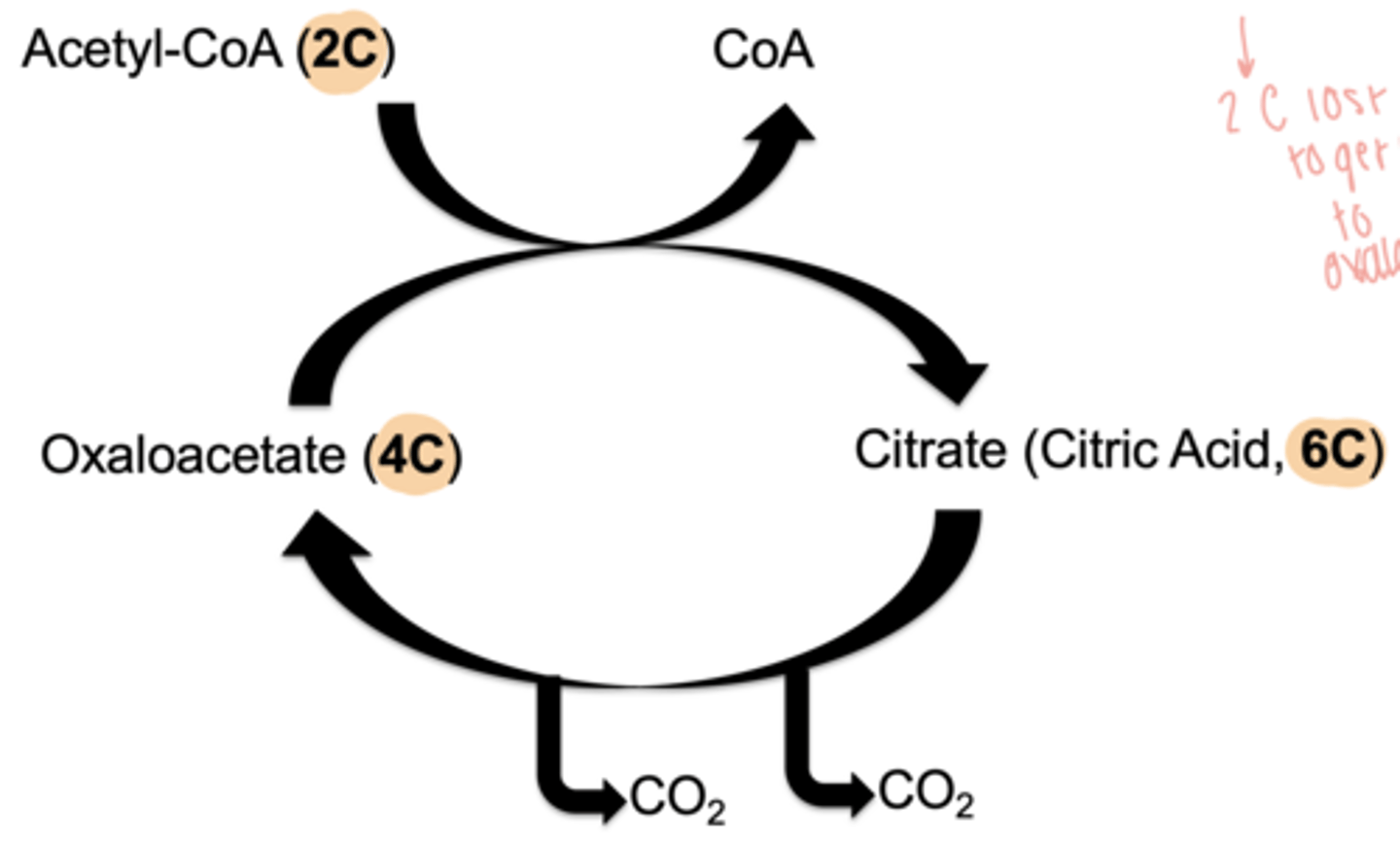
2 carbons enter
2 carbons leave as CO₂
energy yield per acetyl-CoA
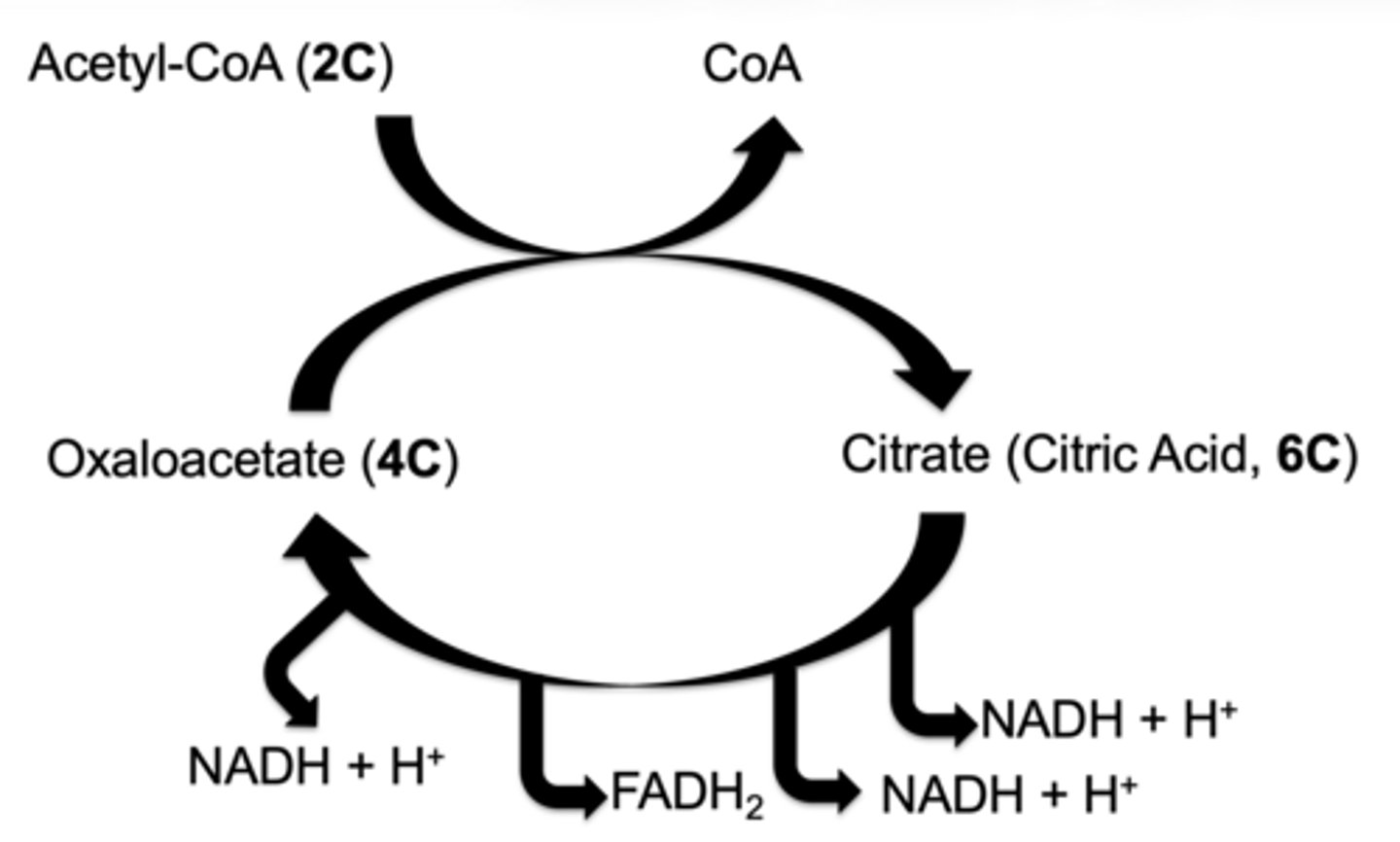
3 NADH
1 FADH₂
1 GTP (by substrate level phosphorylation... equivalent to ATP)
what are the 3 irreversible enzymes
1. citrate synthase
2. isocitrate dehydrogenase
3. α-ketoglutarate dehydrogenase
what inhibits TCA
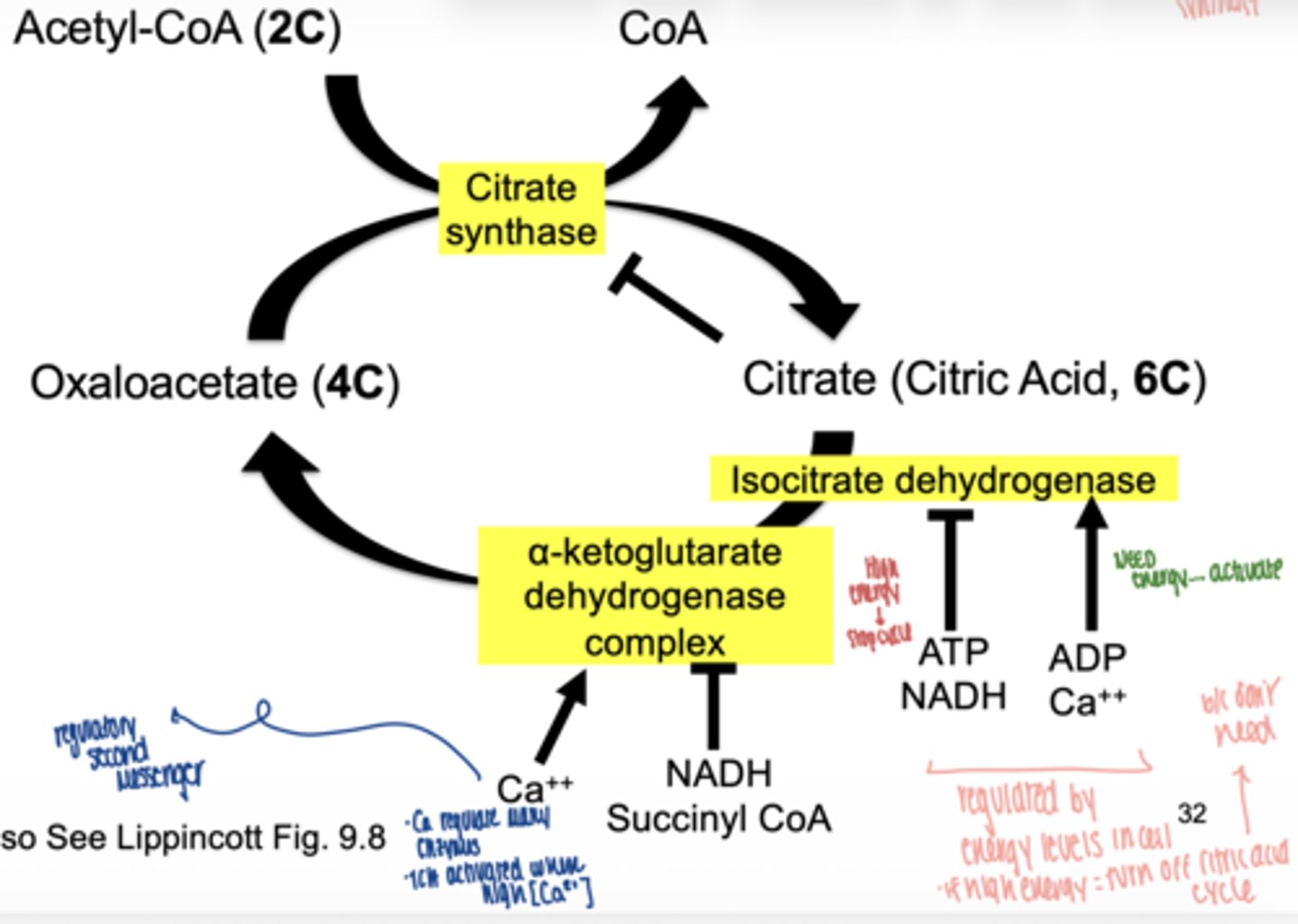
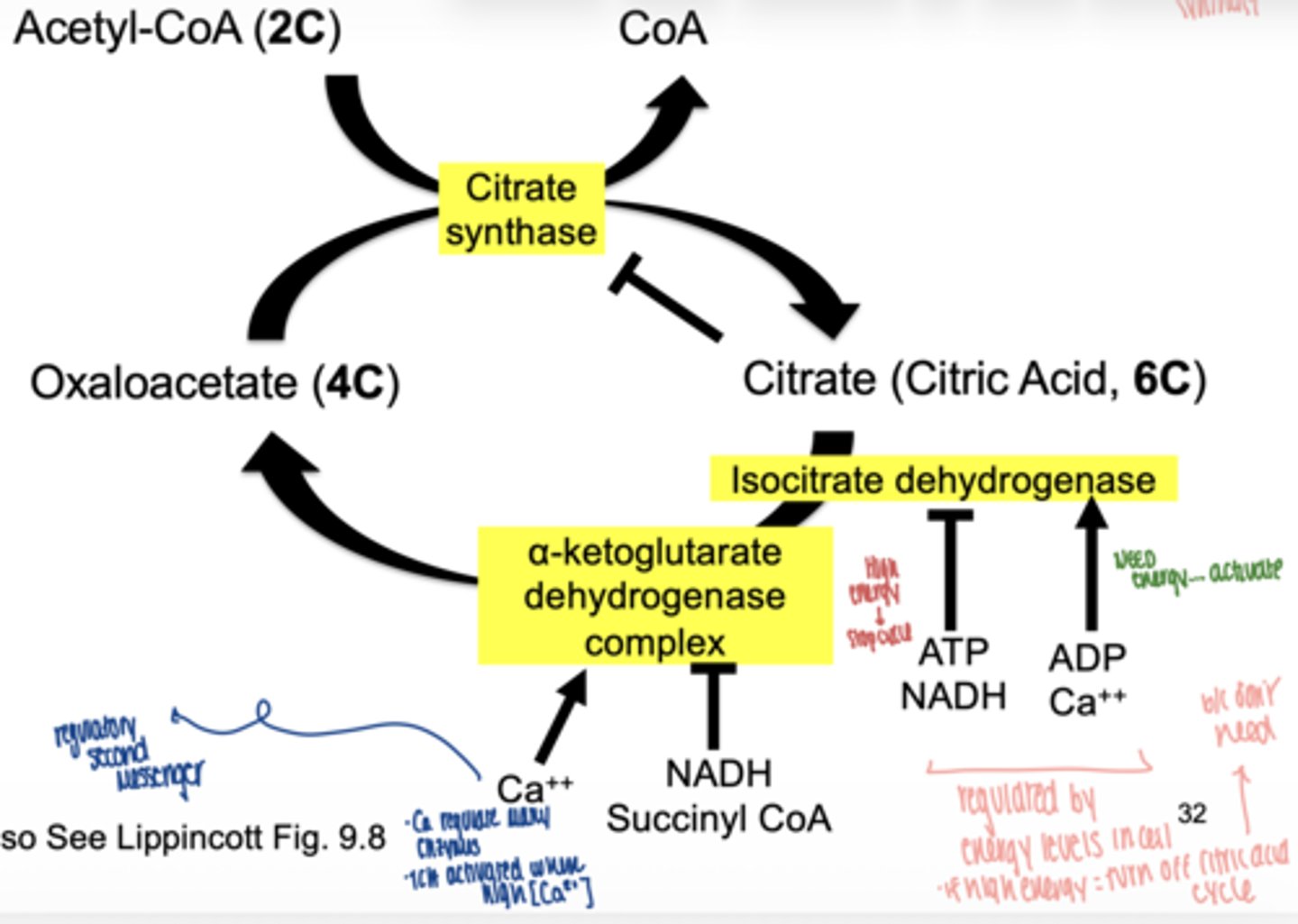
isocitrate dehydrogenase:
- ATP
- NADH
α-ketoglutarate dehydrogenase:
- succinyl-CoA
- NADH
what activates TCA
isocitrate dehydrogenase:
- ADP
- Ca²⁺
α-ketoglutarate dehydrogenase:
- Ca²⁺
if there is high energy (ATP and reducing power NADH), turn ____ citric acid cycle
off
**prevents unnecessary production of energy when the cell already has adequate supply**
enzymes that transfer potential to energy carriers
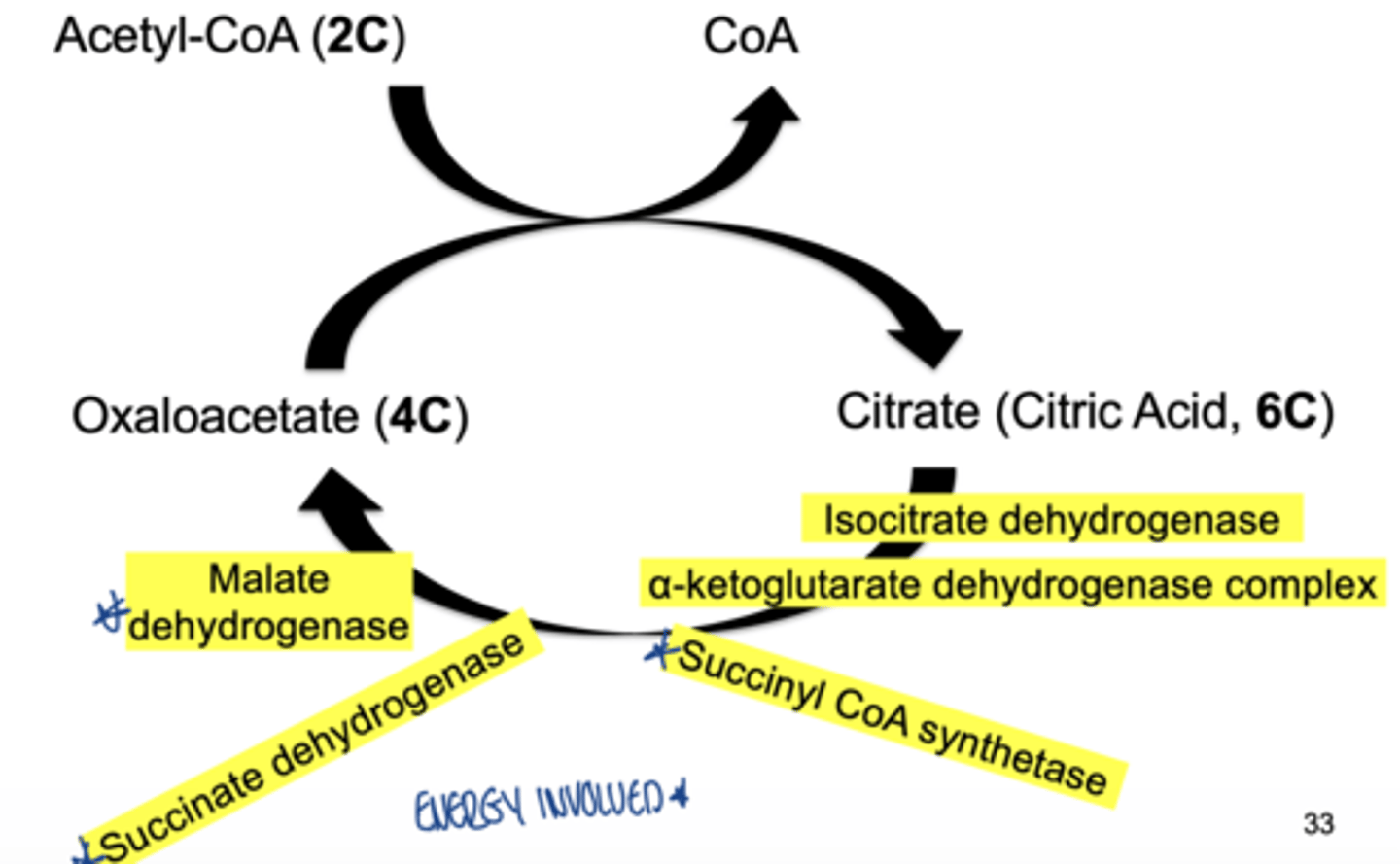
- isocitrate dehydrogenase
- α-ketoglutarate dehydrogenase:
- succinyl CoA synthetase
- succinate dehydrogenase
- malate dehydrogenase
how is α-ketoglutarate dehydrogenase similar to PDH
same cofactors:
- thiamine pyrophosphate (vit B1)
- lipoate
- coenzyme A
- FAD
- NAD+
produces NADH
releases CO₂
irreversible
rate limiting
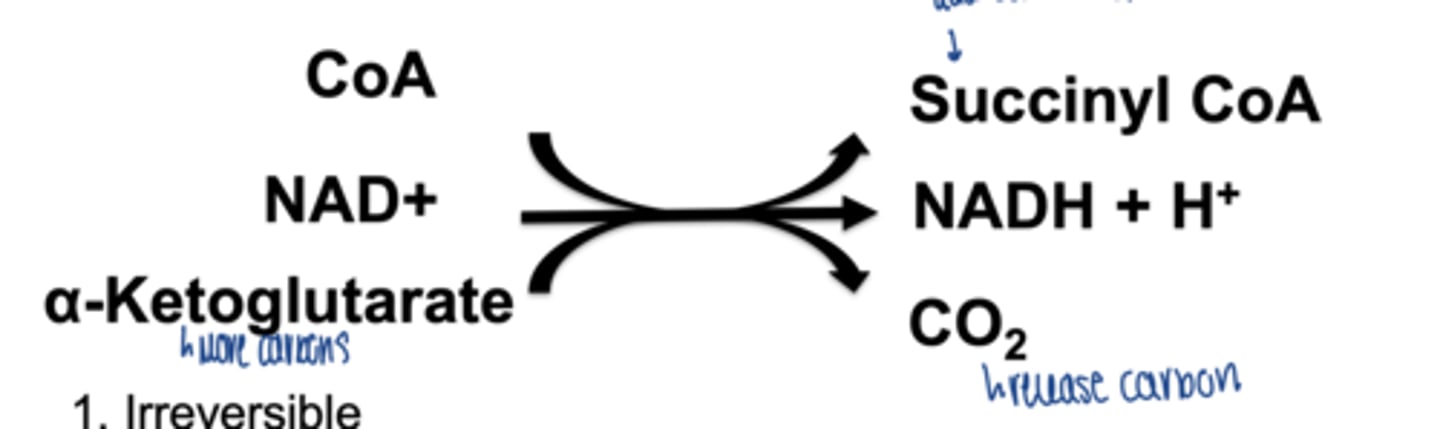
key differences between α-ketoglutarate dehydrogenase and PDH
α:
- not regulated by phosphorylation
- regulated by Ca²⁺ (secondary messenger)
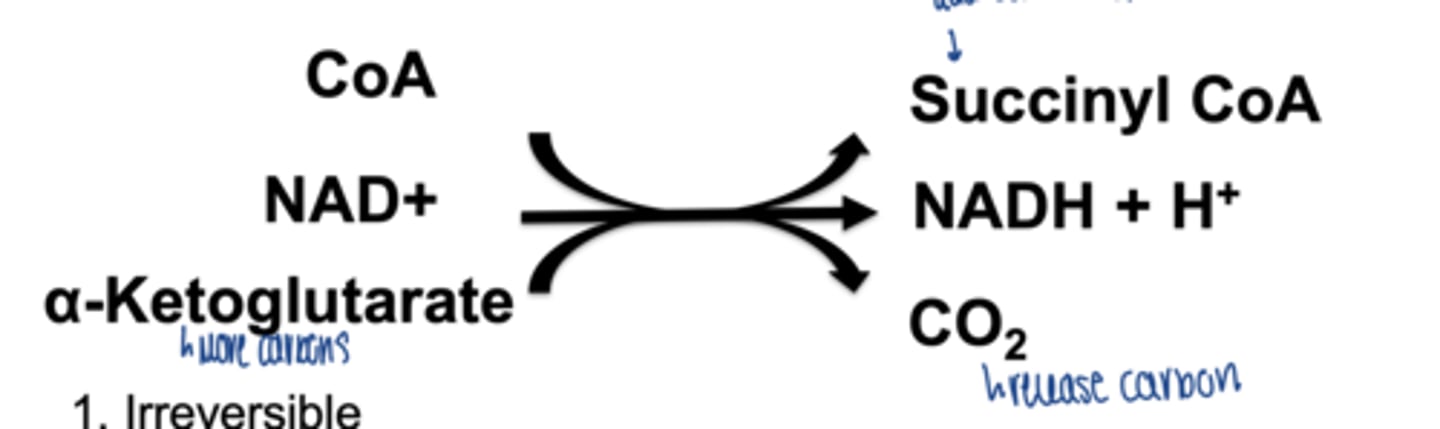
α-ketoglutarate dehydrogenase complex
1. irreversible
2. large multi enzyme complex with 5 cofactors
3. rate limiting
4. feedback inhibited by succinyl CoA and NADH
5. NOT regulated by phosphorylation
6. regulated by Ca2+
CoA → succinyl CoA
NAD+ → NADH + H⁺
α-ketoglutarate (more carbons) → CO₂
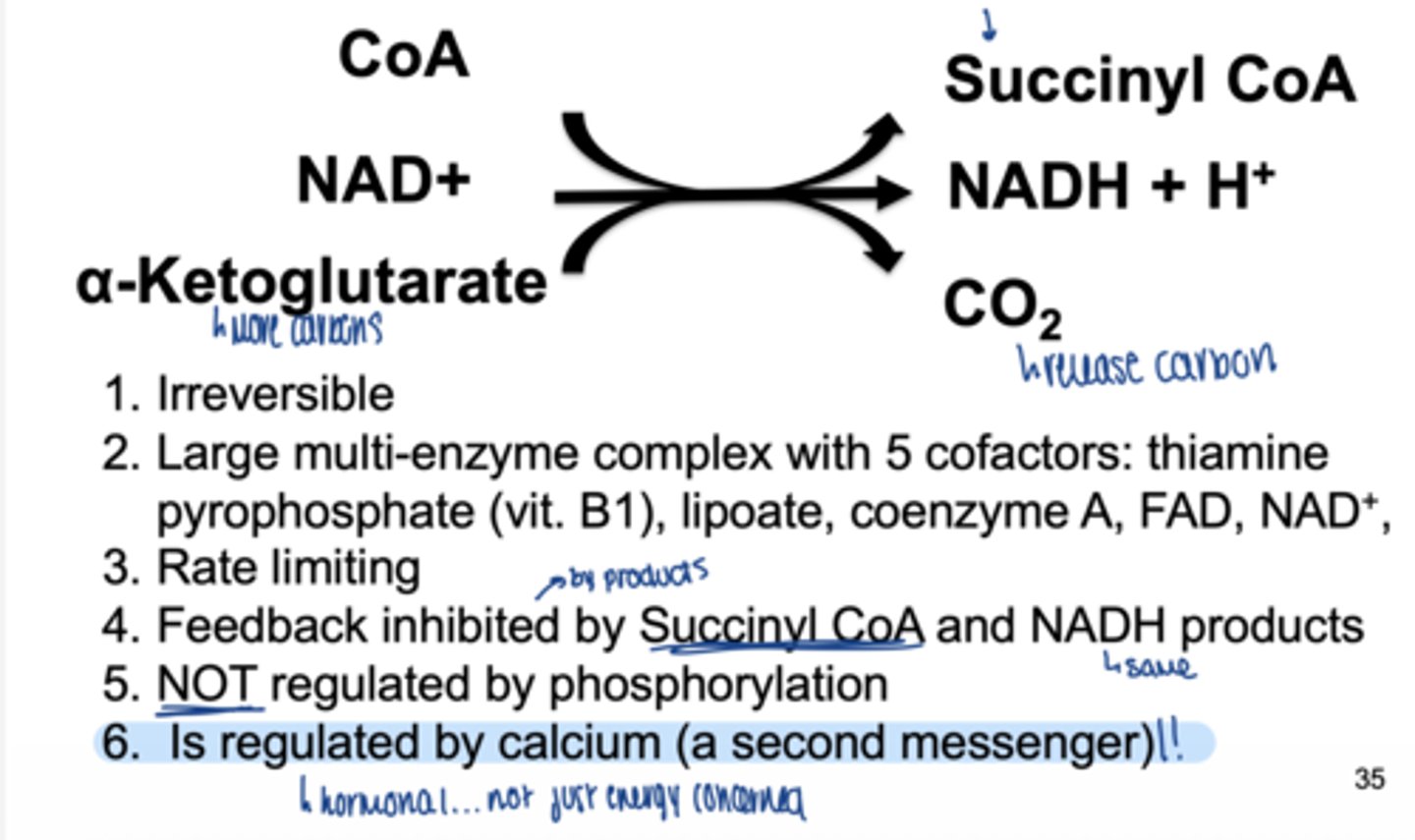
location of TCA
eukaryotes = matrix of mitochondria
prokaryotes = cytoplasm
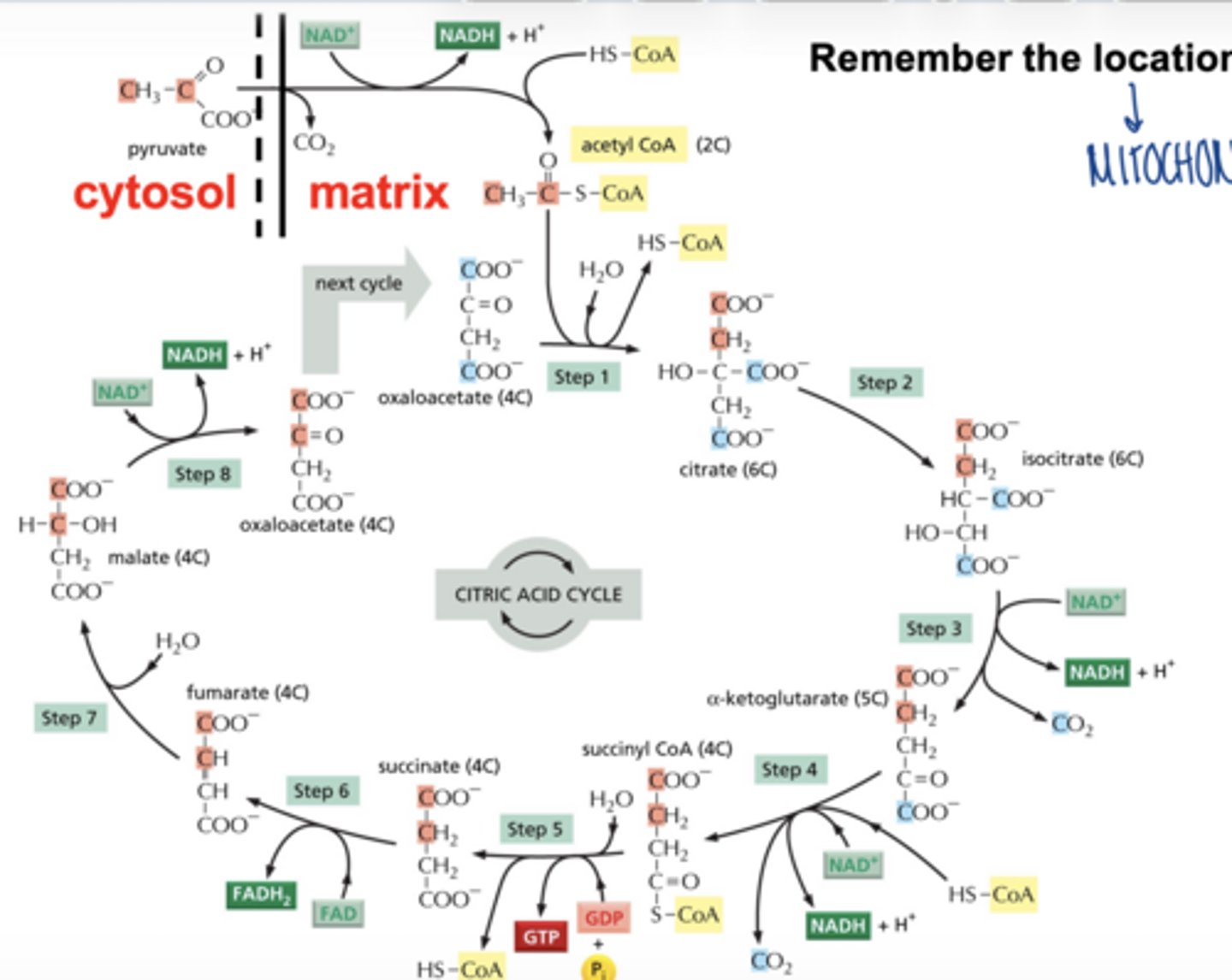
memory aids for intermediates
Citrate Is Krebs Starting Substrate For Making Ocaloacetate
Oh! Can I Keep Some Succinate For Myself
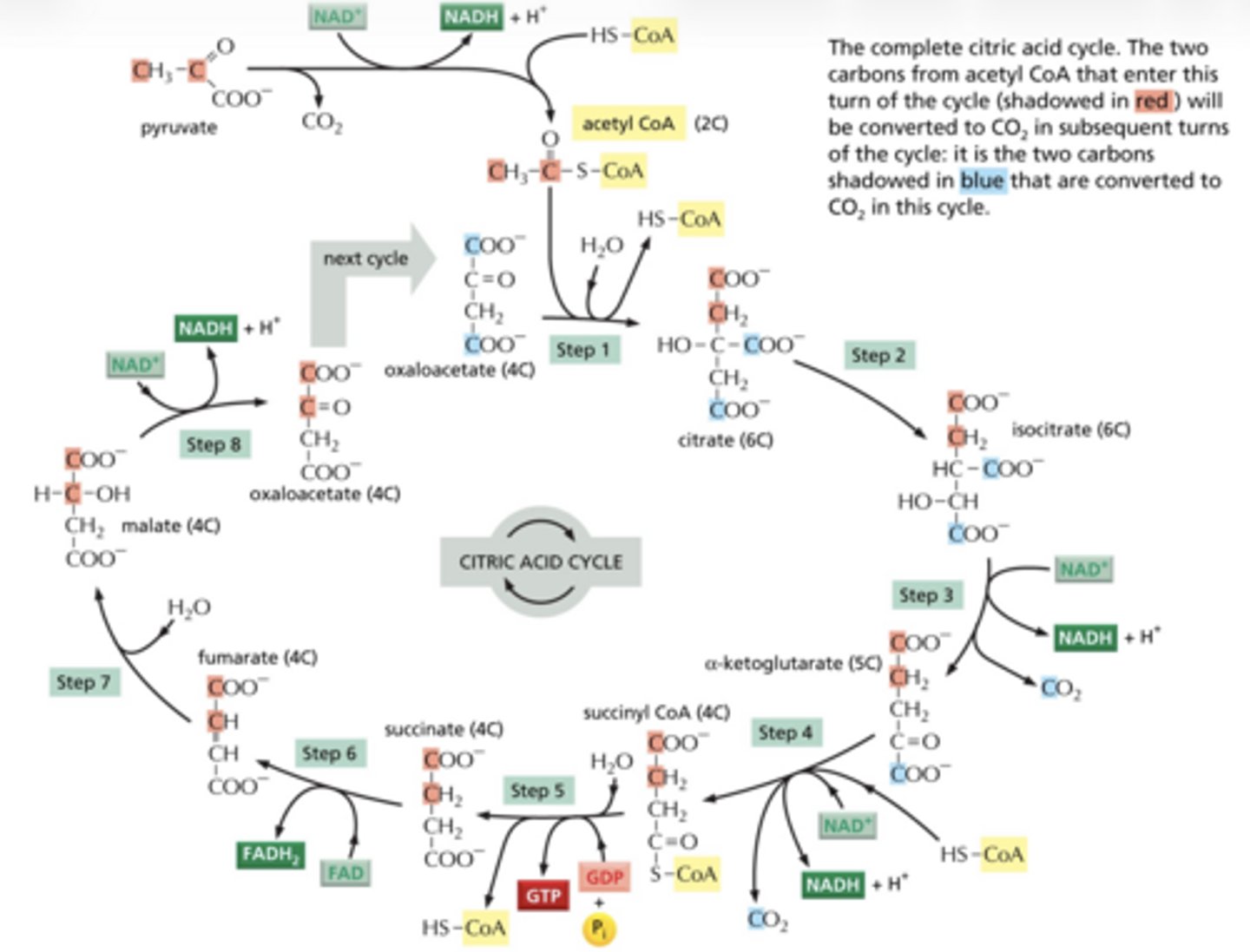
visual of irreversible steps
- pryuvate dehydrogenase (PDH) complex
- citrate synthase
- isocitrate dehydrogenase
- a-ketoglutarate dehydrogenase
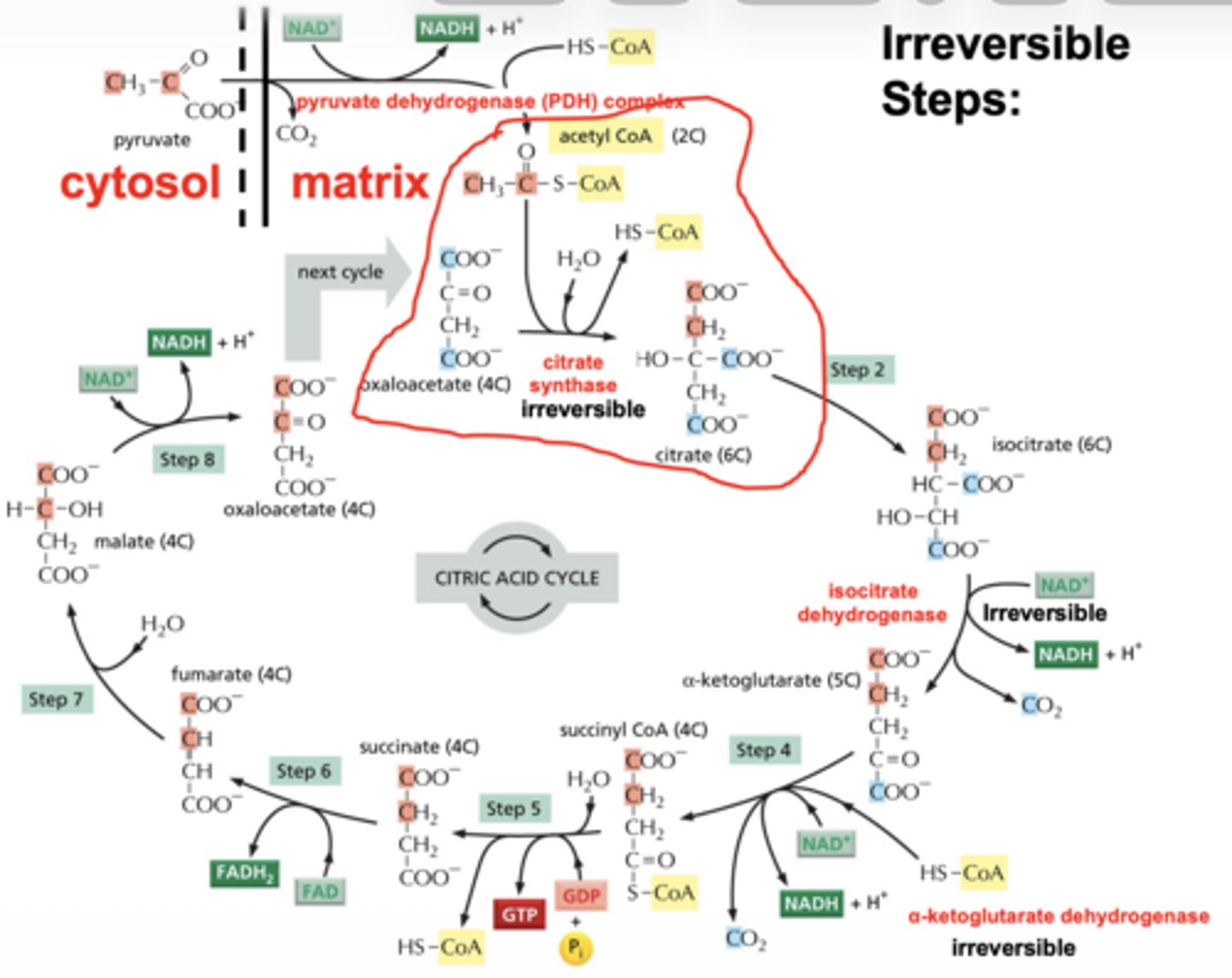
enzymes
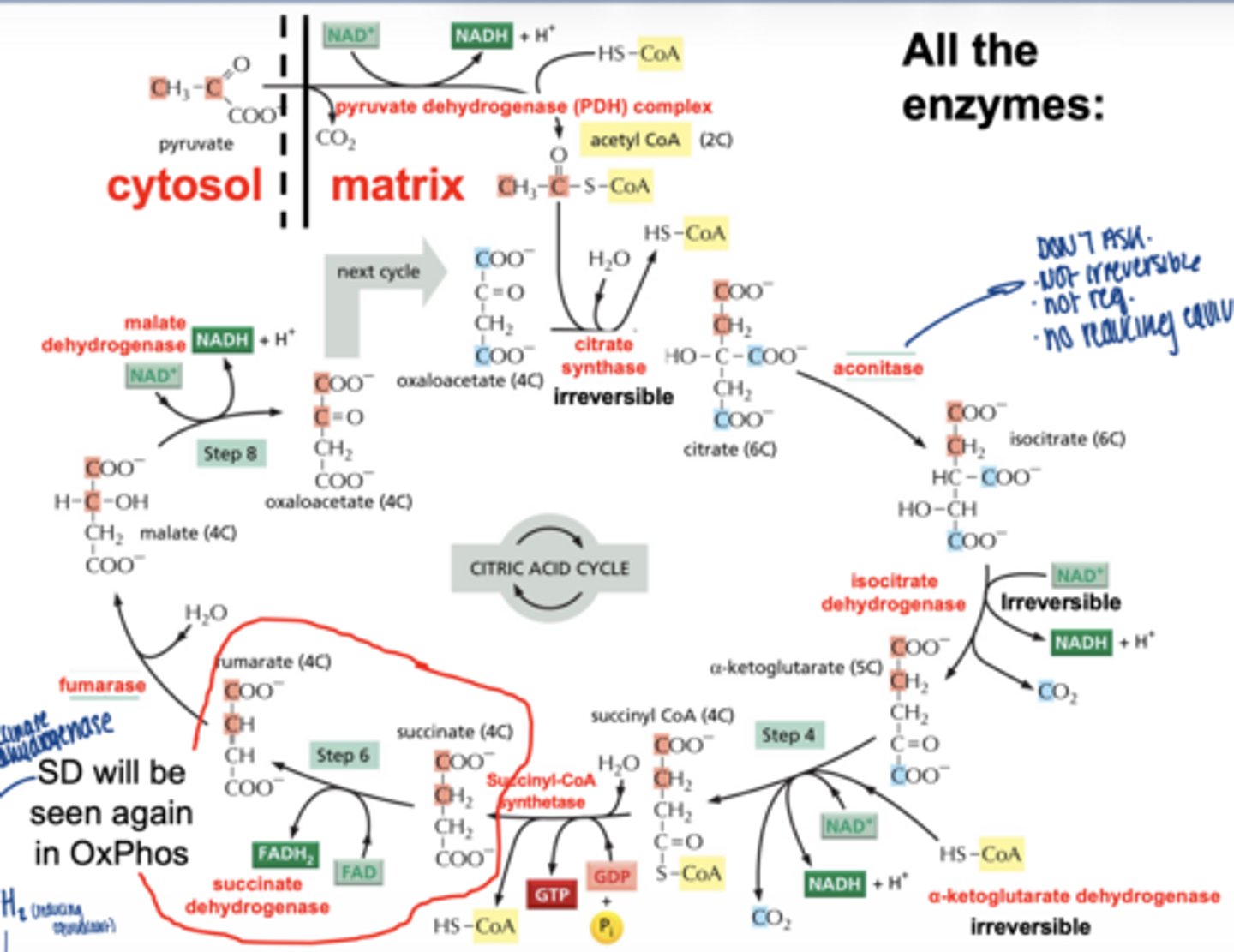
carrier molecules in TCA
acetyl-CoA
NADH
FADH₂
GTP
each turn of cycle → 3 NADH and 1 FADH₂
GTP = produced directly through substrate-level phosphorylation when succinyl-CoA is converted to succinate
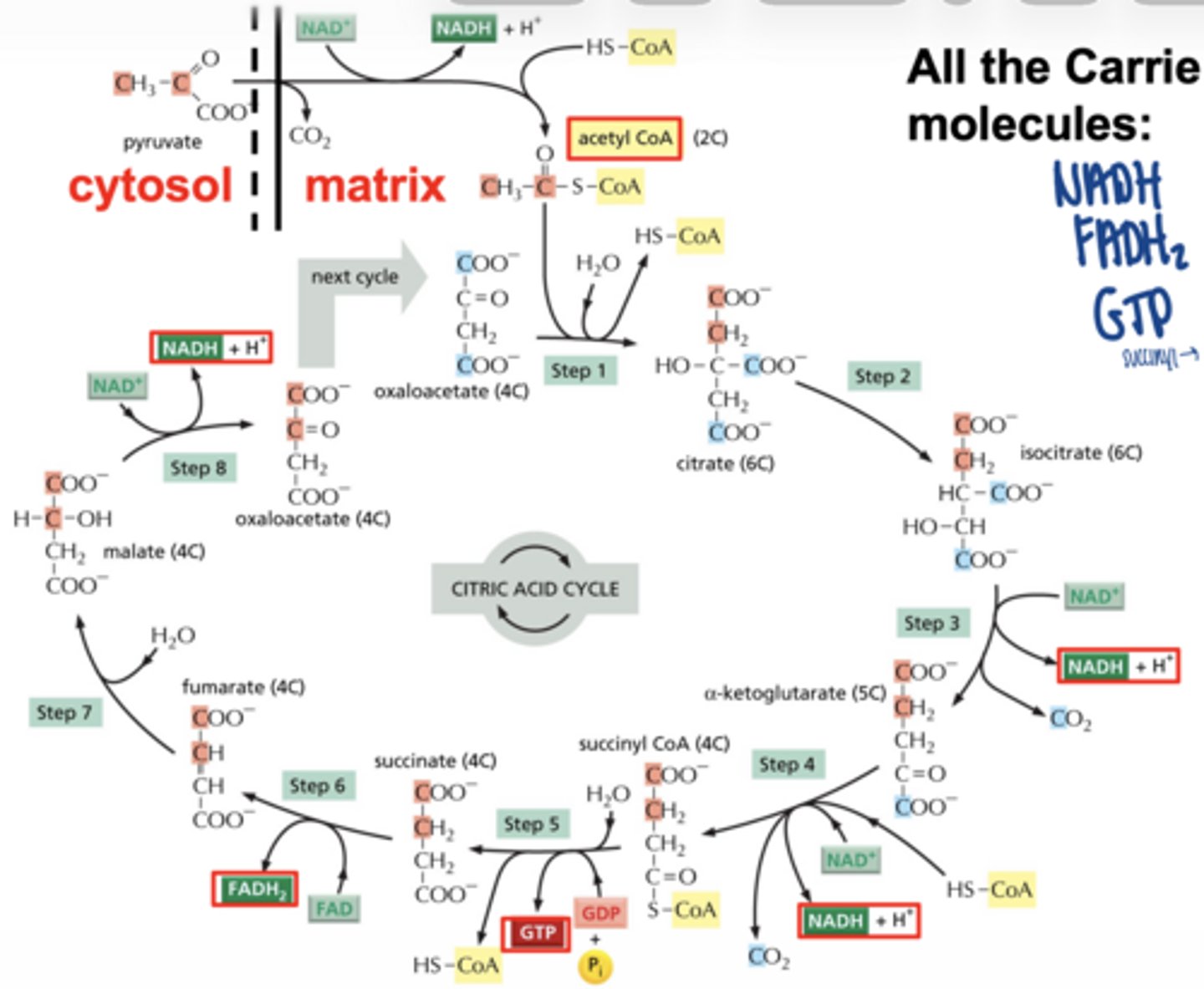
total yield from 1 glucose
glycolysis (cytosol: 2 pyruvate + 2 ATP + 2 NADPH
pryuvate to acetyl-CoA in mitochondria (PDH): 2 acetyl-CoA +2 NADH
TCA (mitochondria): 6 NADH + 2 FADH₂ + 2 GTP
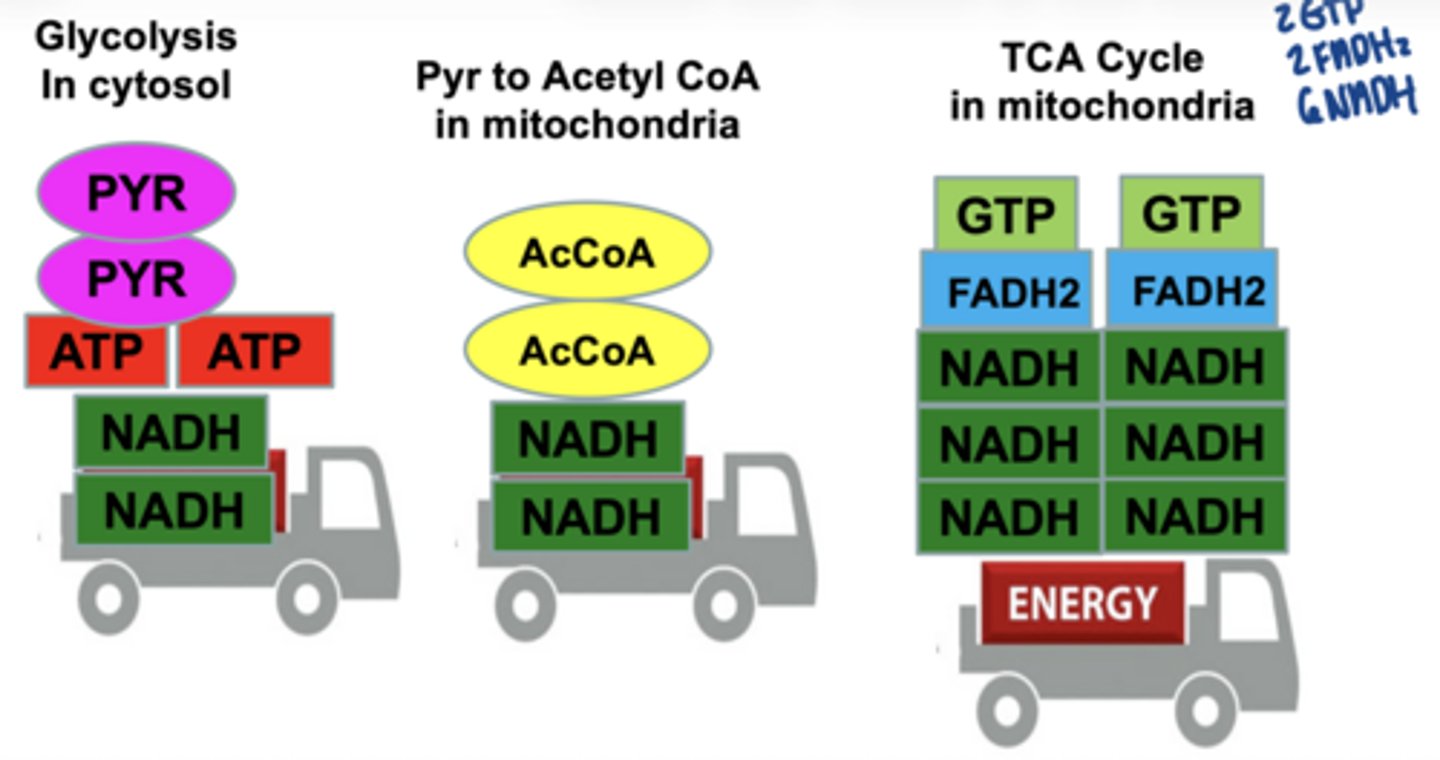
glycolysis and the TCA cycle produce energy ____ and ____ _____
carriers, building blocks
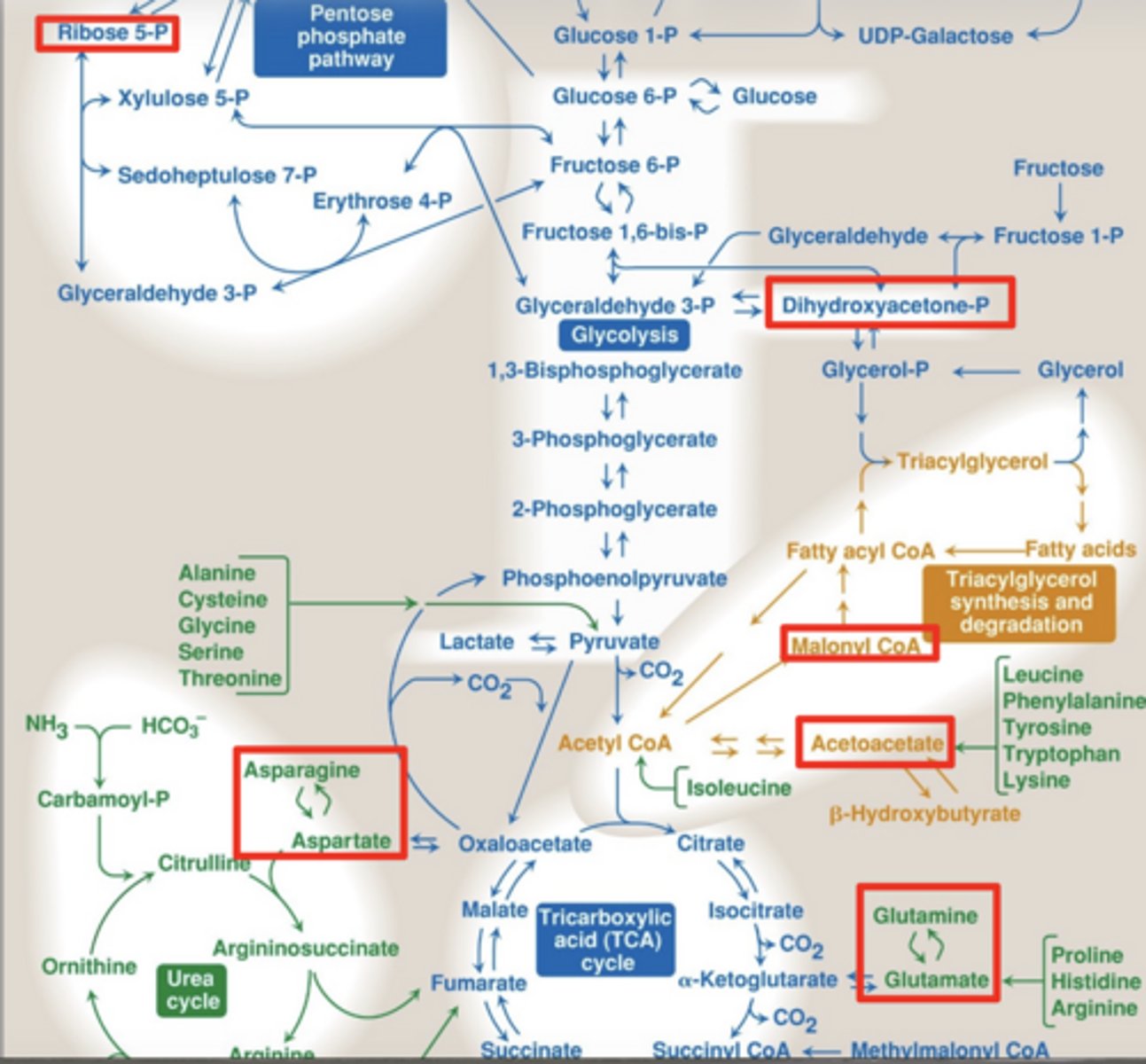
what is anaplerosis
replenishing TCA intermediates that have been extracted for biosynthesis
retain homeostasis of cellular metabolism
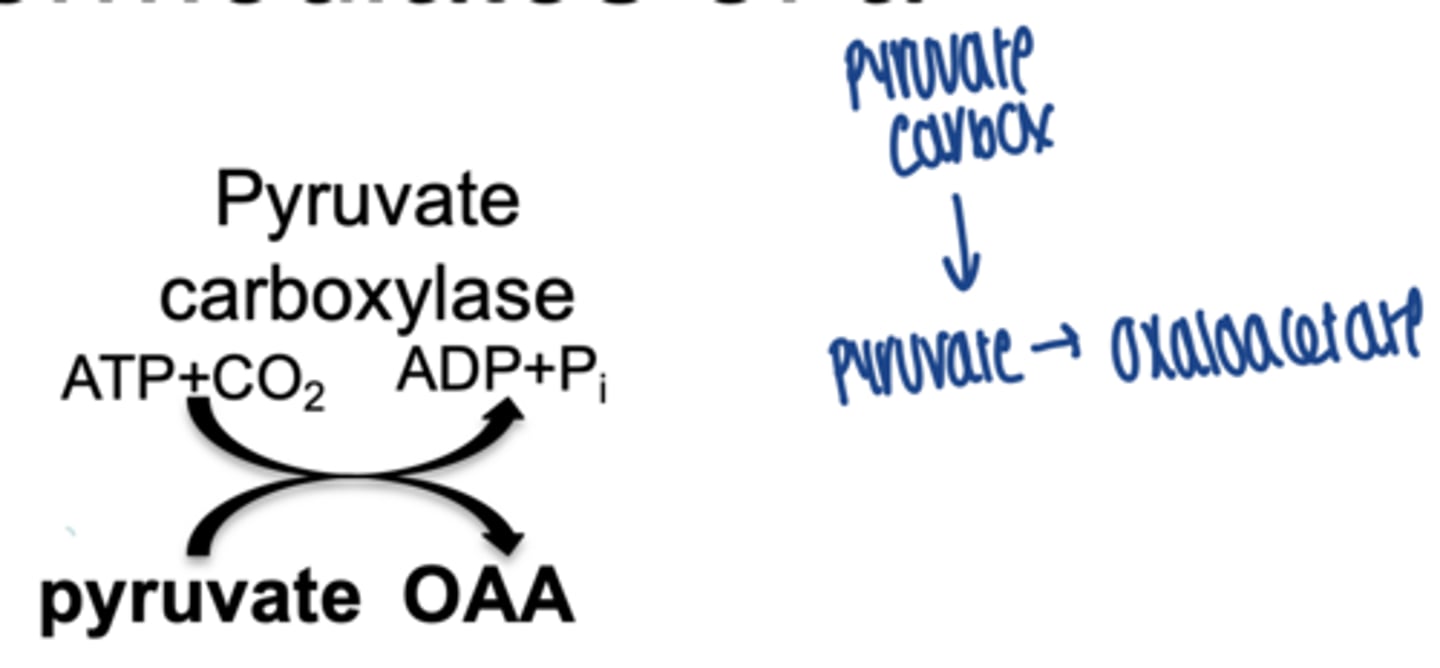
what are anaplerotic reactions
chemical reactions that form intermediates of a metabolic pathway
ex. pyruvate → oxaloacetate via pyruvate carboxylase
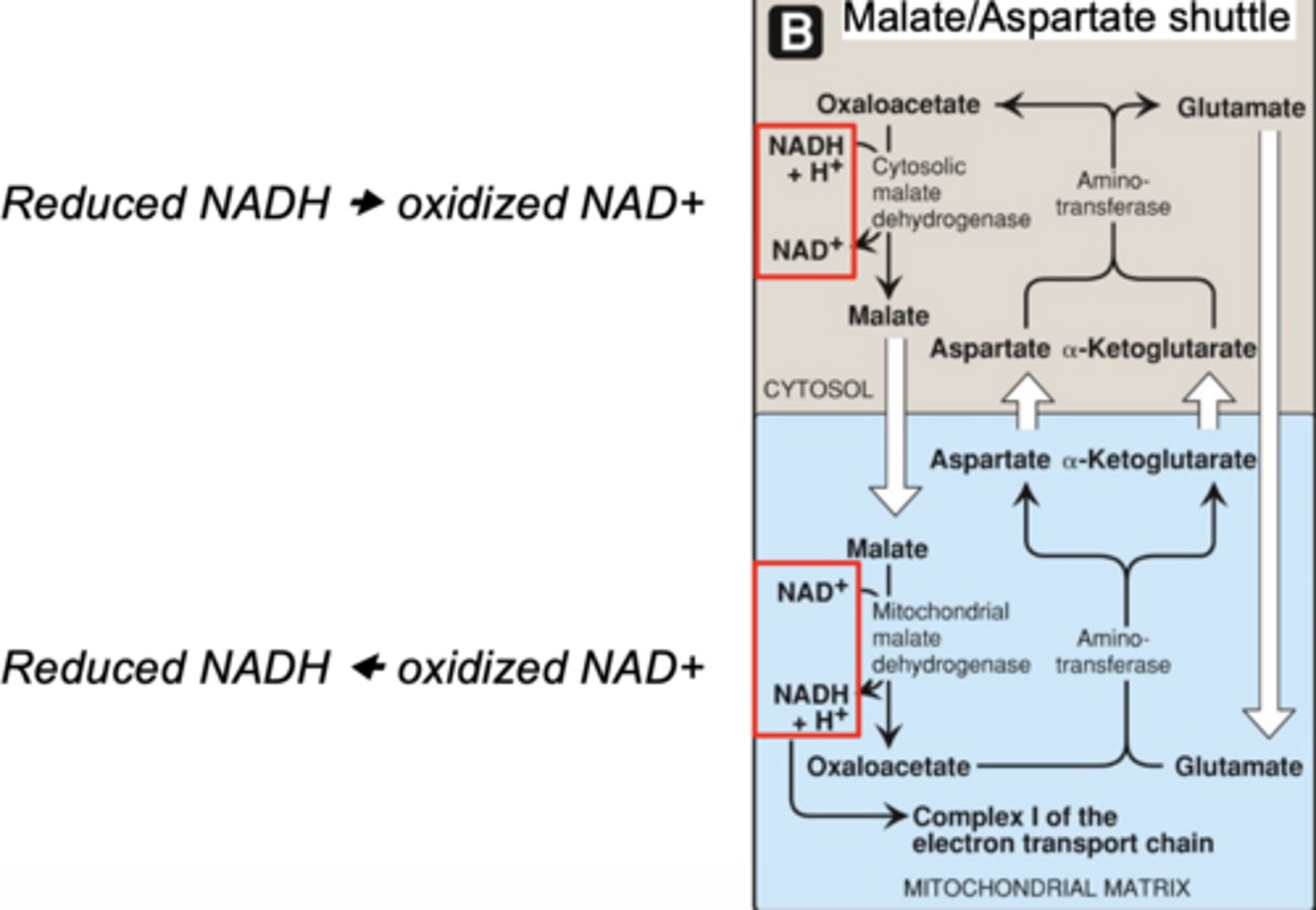
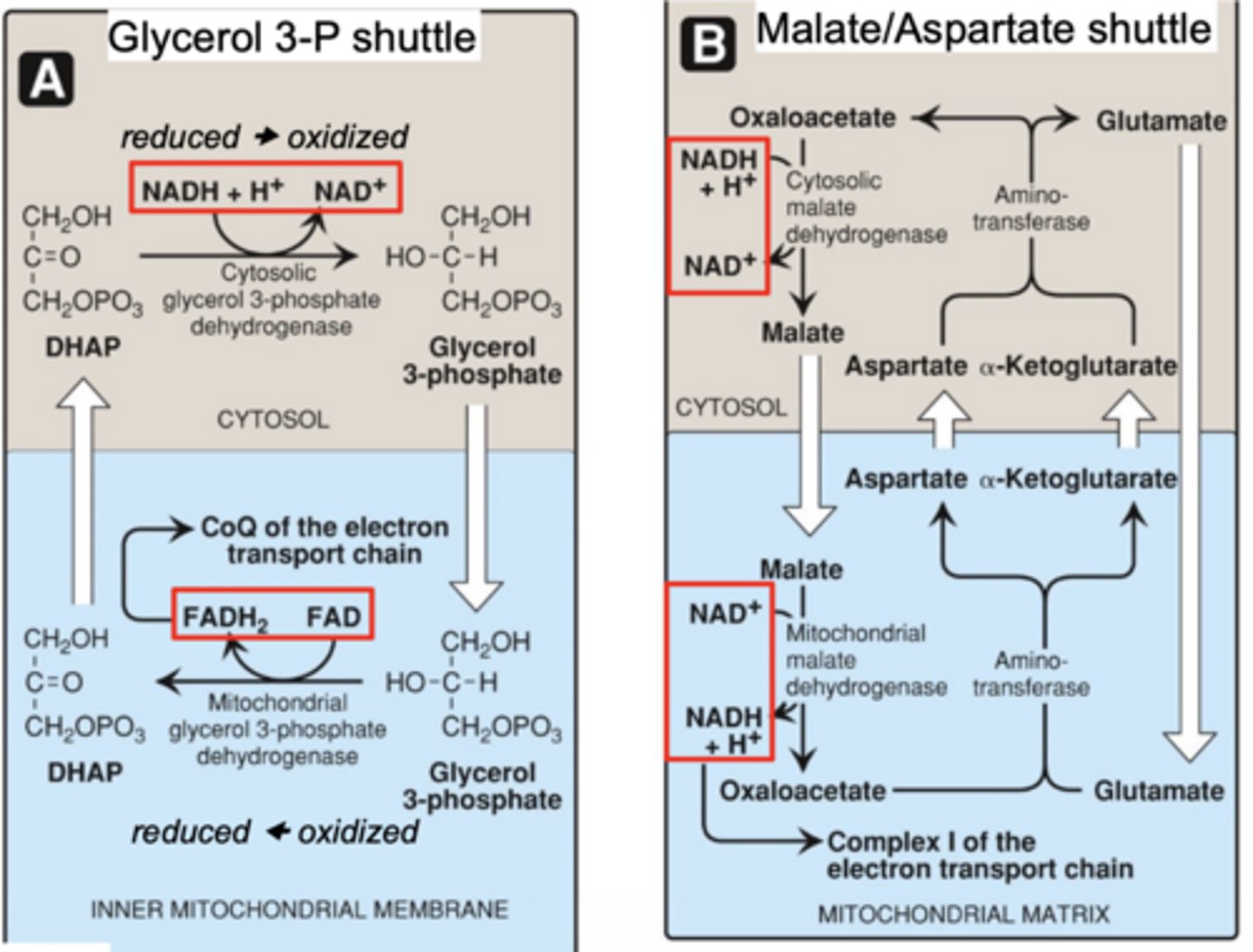
why are shuttles needed
NADH cannot cross inner membrane
malate/aspartate:
- reduced NADH → oxidized NAD+
-reduced NADH ← oxidized NAD+
shuttles transfer ____ equivalents from cytosol to mitochondria
reducing
two main shuttles
malate-aspartate shuttle:
- electrons from cytosolic NADH to oxaloacetate, forming malate, which crosses into the mitochondrial matrix, is re-oxidized back to oxaloacetate, and generates mitochondrial NADH
- high energy tissues (heart, liver)
- produces NADH
glycerol-3-phosphate shuttle
- muscle
- FADH₂
Malate-aspartate is active in high-energy tissues (liver/heart), while glycerol phosphate works efficiently in muscle.
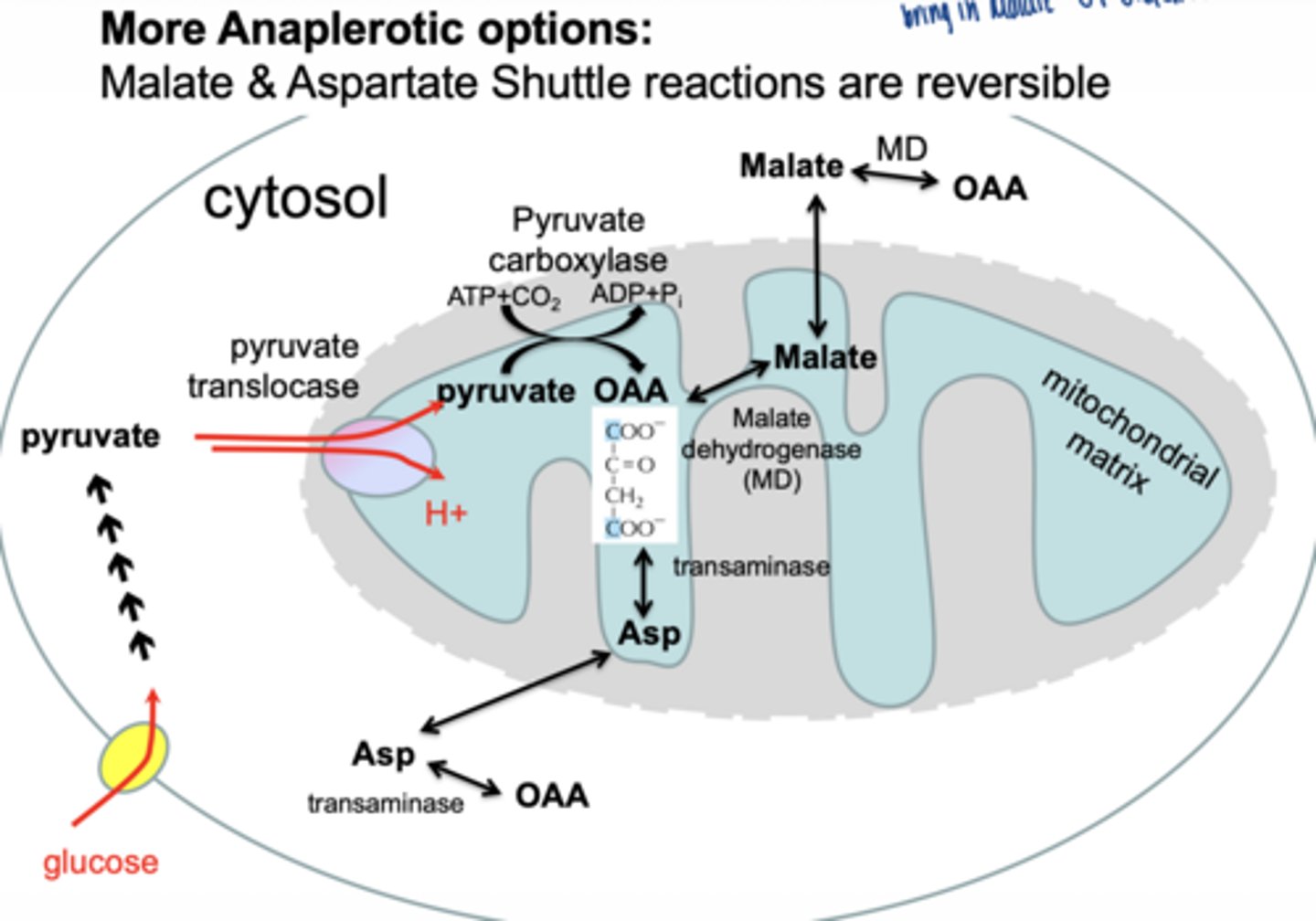
purpose of shuttles is to transfer _____ from NADH produced in the _____ (during glycolysis) across the impermeable mitochondrial membrane. This allows the electrons to enter the electron transport chain (ETC) to produce _____, while regenerating to keep glycolysis running... they are reversible
electrons, cytosol, ATP
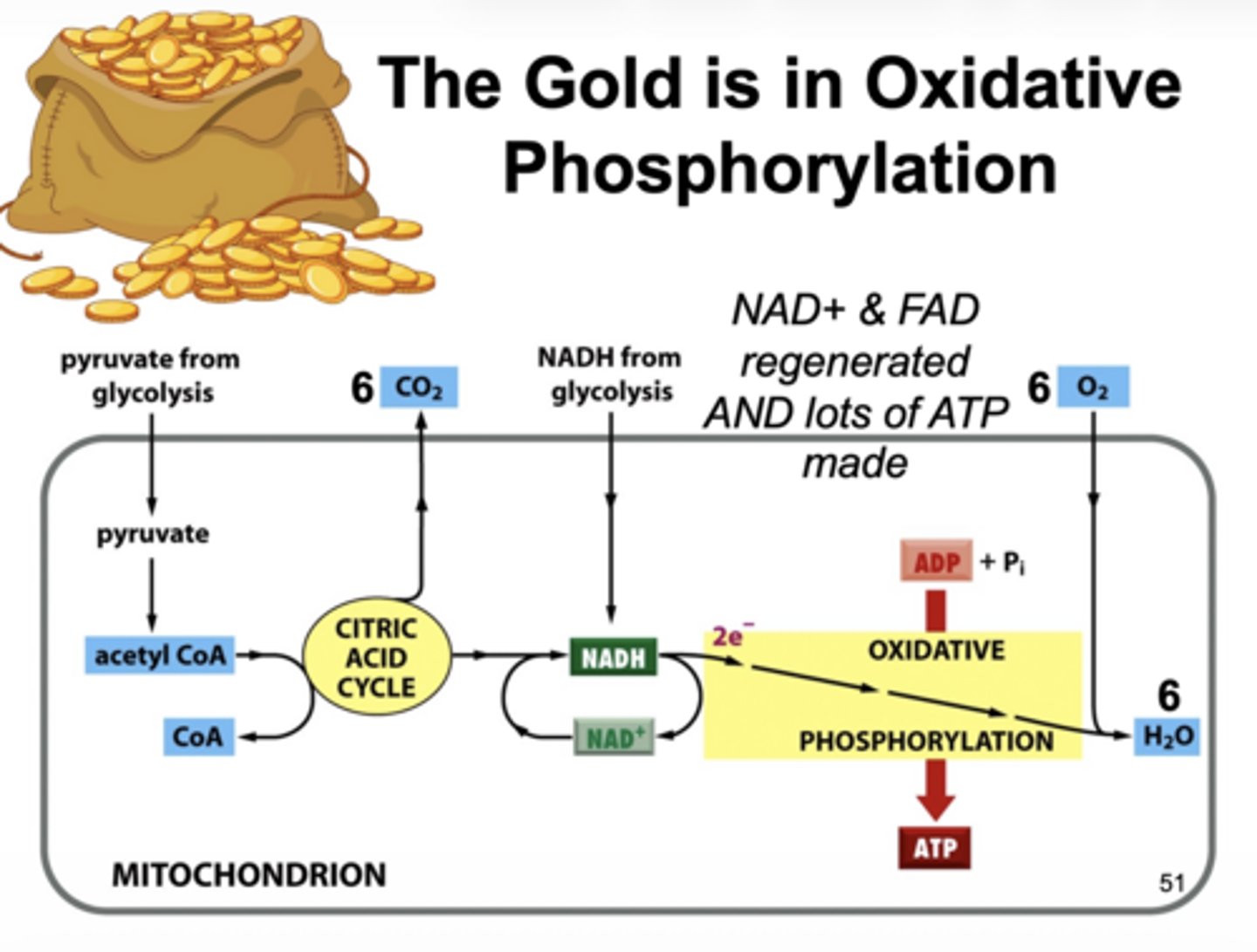
how is NAD+ and FAD regenerate
oxidative phosphorylation
main purpose of TCA
not ATP directly
producing NADH/FADH₂ for ETC
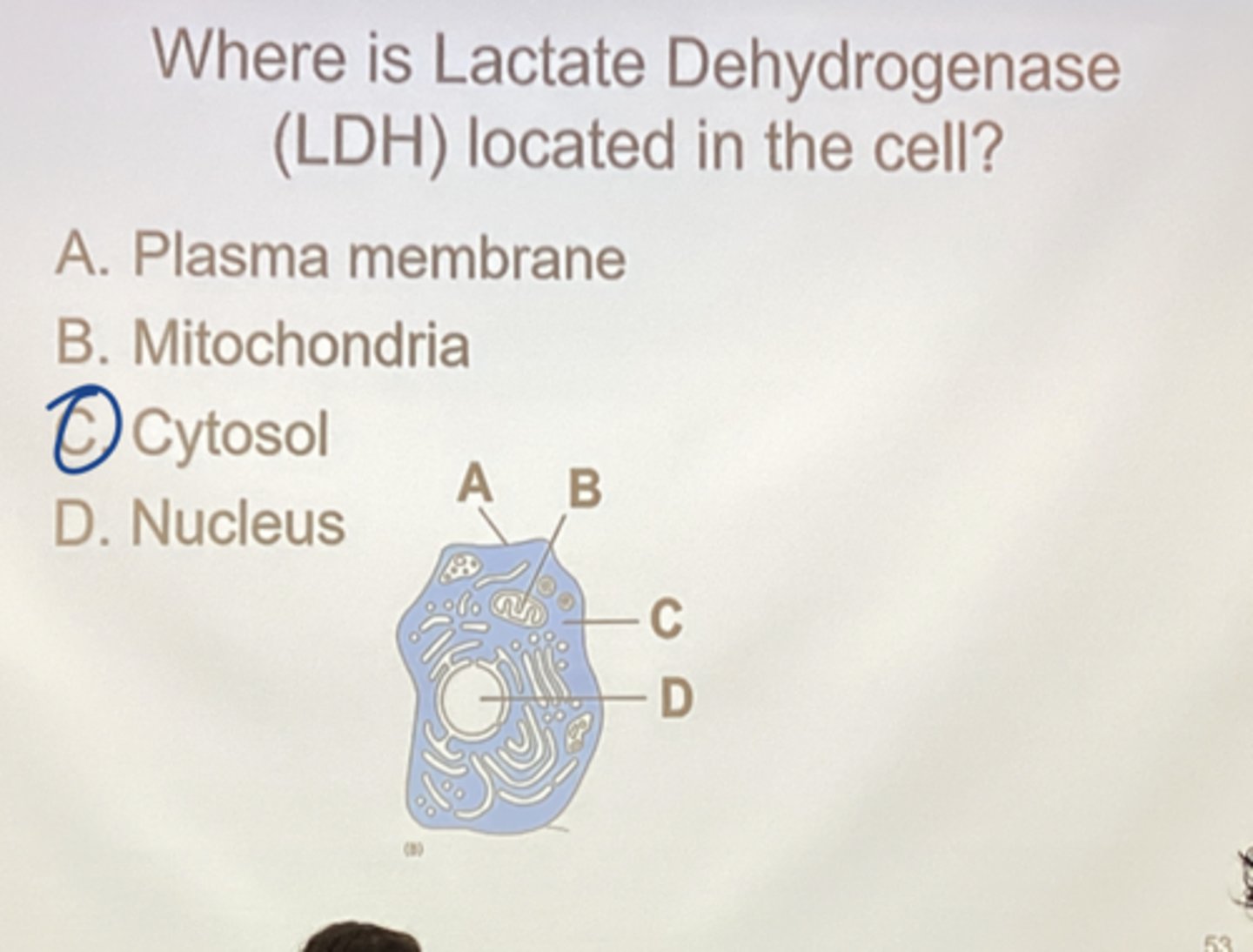
where is lactate dehydrogenase LDH located in cell
cytosol
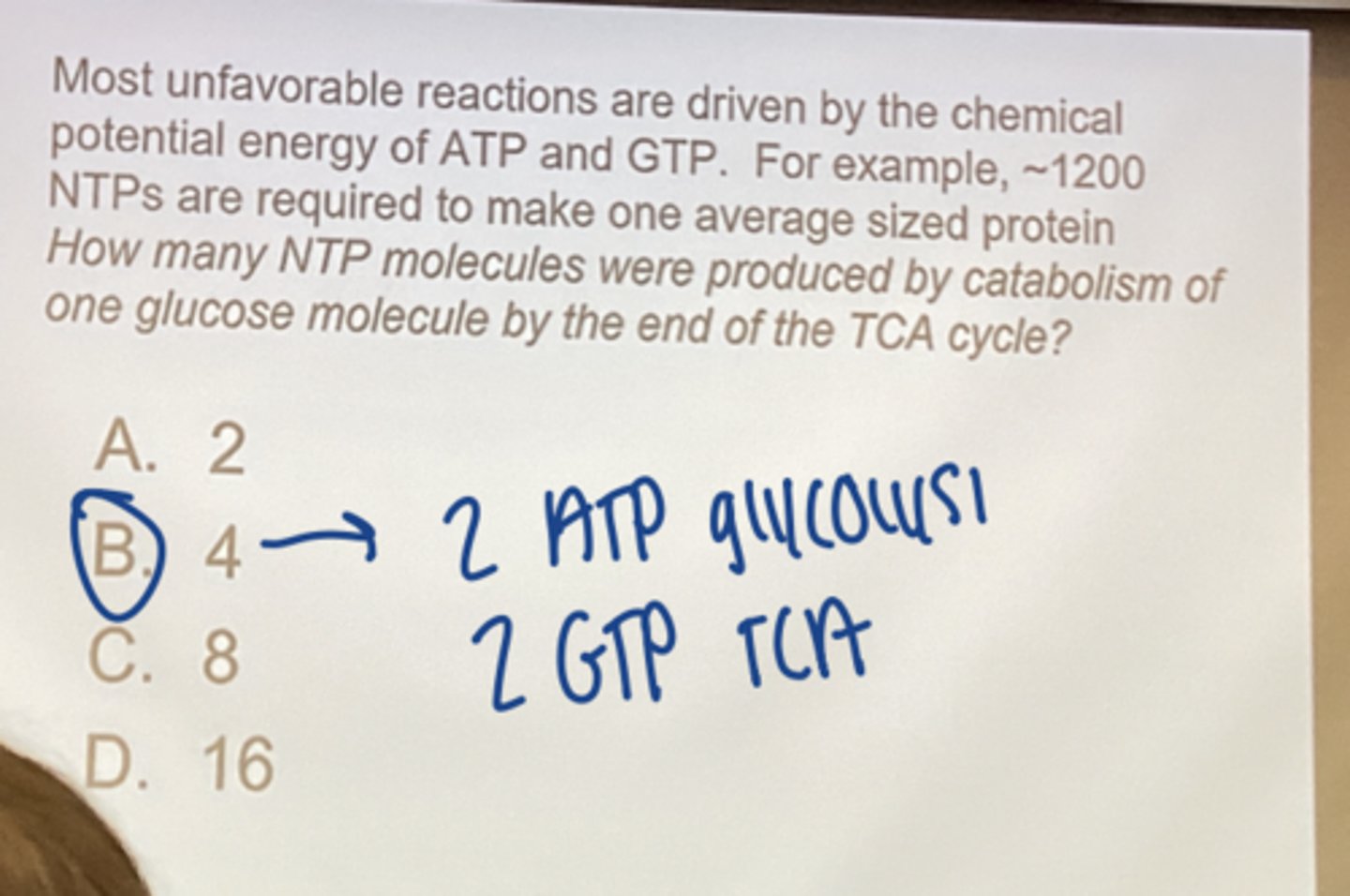
how many NTP molecules were produced by catabolism of one glucose molecules by the end of the TCA cycle
4 (2 ATP glycolyis, 2 GTP TCA)
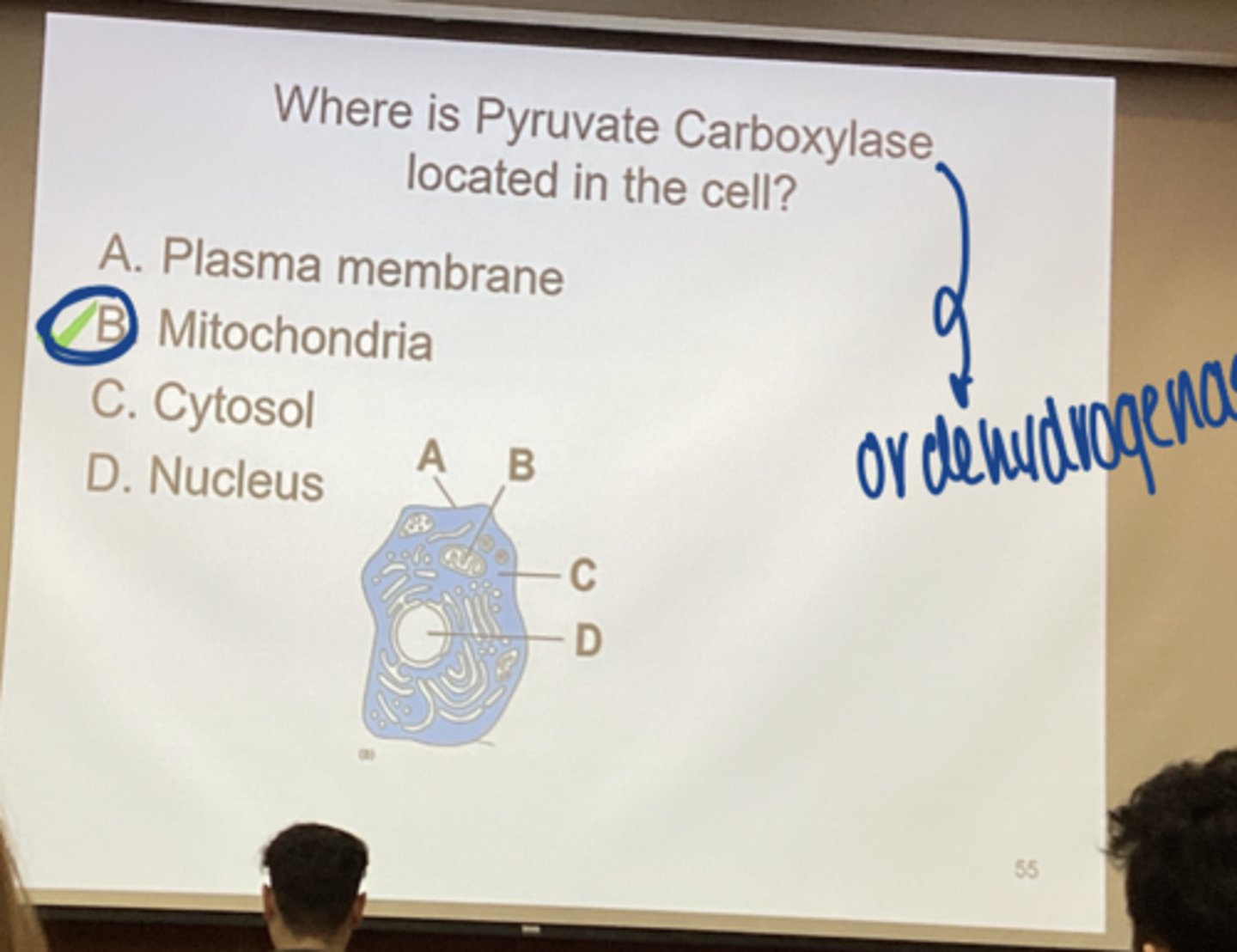
where is pyruvate carboxylase/dehydrogenase located in the cell
mitochondria
which TCA cycle step made GTP
conversion of succinyl CoA to succinate