Biological membranes
 Call Kai
 Learn
Learn Practice Test
 Spaced Repetition
 Match
Match Flashcards
 Knowt Play
1/10

There's no tags or description
Looks like no tags are added yet.
Name | Mastery | Learn | Test | Matching | Spaced | Call with Kai |
|---|
No analytics yet
Send a link to your students to track their progress
11 Terms
Biological membranes
Partially permeable barriers:
Control movement of substances in and out of cells and organelles
Separate cell from environment and organelles from cytoplasm
Help maintain internal conditions
Sites of chemical reactions:
Provide surfaces for enzymes and metabolic reactions
Increase efficiency by organising reactions (e.g. in mitochondria, chloroplasts)
Cell communication:
Contain receptor proteins for signalling molecules (e.g. hormones)
Allow cells to detect and respond to sign
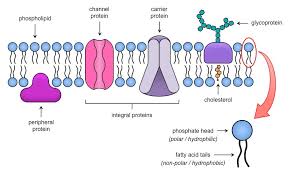
Components of fluid mosaic model
Phospholipids:
Form a bilayer with hydrophilic heads and hydrophobic tails
Create a partially permeable barrier controlling movement of substances
Cholesterol:
Fits between phospholipids
Regulates fluidity and stability of the membrane
Prevents membrane from becoming too rigid or too fluid
Proteins:
Include channels, carriers, enzymes, and receptors
Control transport and enable chemical reactions and signalling
Glycoproteins:
Proteins with carbohydrate chains
Act as cell recognition markers and receptors for signalling
Glycolipids:
Lipids with carbohydrate chains
Also involved in cell recognition and membrane stability
Fluid mosaic model
Temperature on membrane structure and permeabilty
Increasing temperature increases kinetic energy of phospholipids and proteins
Membrane becomes more fluid and more permeable
At high temperatures, proteins denature and the bilayer is disrupted, causing leakage of cell contents
Low temperatures make the membrane more rigid and less permeable
Solvents on membrane structure and permeabilty
Dissolve membrane lipids (phospholipids)
Disrupt the bilayer structure
Increase membrane permeability or completely destroy membrane integrity
Can also denature membrane proteins
Permeabiltiy:
Membrane permeability can be investigated using beetroot, where pigment leaks out if the cell membrane is damaged and is measured by colour intensity in solution. Increasing temperature or solvent concentration increases permeability by disrupting the phospholipid bilayer and denaturing membrane proteins.
Molecules movement:
A common practical is using agar blocks with indicator dye (e.g. phenolphthalein or universal indicator). The blocks are placed in acid or alkali, and the time taken for the colour change to spread is measured to show diffusion rate under different conditions (e.g. different sizes of blocks for surface area or different temperatures).
Passive movements across plasma membrane
Diffusion: movement of molecules from high to low concentration (no ATP required)
Facilitated diffusion: diffusion through channel/carrier proteins (no ATP required)
Osmosis: movement of water across a partially permeable membrane from a region of higher water potential to lower water potential (no ATP required)
Active movements to move across membranes
Active transport:
Moves substances against a concentration gradient (low → high)
Uses ATP and carrier proteins
Endocytosis:
Cell membrane engulfs substances to form vesicles
Requires ATP
Exocytosis:
Vesicles fuse with membrane to release substances outside the cell
Requires ATP
Osmosis on cells
Animal cells:
In hypotonic solution (higher water potential outside): water enters → cell may burst (lysis)
In hypertonic solution (lower water potential outside): water leaves → cell shrinks (crenation)
Plant cells:
In hypotonic solution: water enters → cell becomes turgid (healthy, firm)
In hypertonic solution: water leaves → cell becomes flaccid, and may undergo plasmolysis
Practical investigrations plant and animal cells
Plant cells (e.g. potato cylinders):
Place in solutions with different concentrations
Measure change in mass or length to show water gain/loss
Animal cells (e.g. red blood cells):
Observe under microscope in different solutions
Look for swelling, shrinking, or bursting