BIOS 301 - TCA
 Call Kai
 Learn
Learn Practice Test
 Spaced Repetition
 Match
Match Flashcards
 Knowt Play
1/27

There's no tags or description
Looks like no tags are added yet.
Name | Mastery | Learn | Test | Matching | Spaced | Call with Kai |
|---|
No analytics yet
Send a link to your students to track their progress
28 Terms
Stage 1 of Respiration
Acetyl-CoA production
Oxidation of fatty acids, glucose, and some amino acids generates NADH to yield acetyl-CoA
Carbohydrates release 1/3 of total potential CO2 during Stage 1
Stage 2 of Respiration
Acetyl-CoA oxidation
Generates 3 NADH, 1 FADH2, and 1 GTP
Remaining carbon atoms from carbohydrates, amino acids, and fatty acids are released during Stage 2
Stage 3 of Respiration
Oxidative phosphorylation
Electrons carried by NADH and FADH2 pass through ETC to generate the vast majority of ATP during catabolism, ultimately reducing O2 to H2O
The Citric Acid Cycle
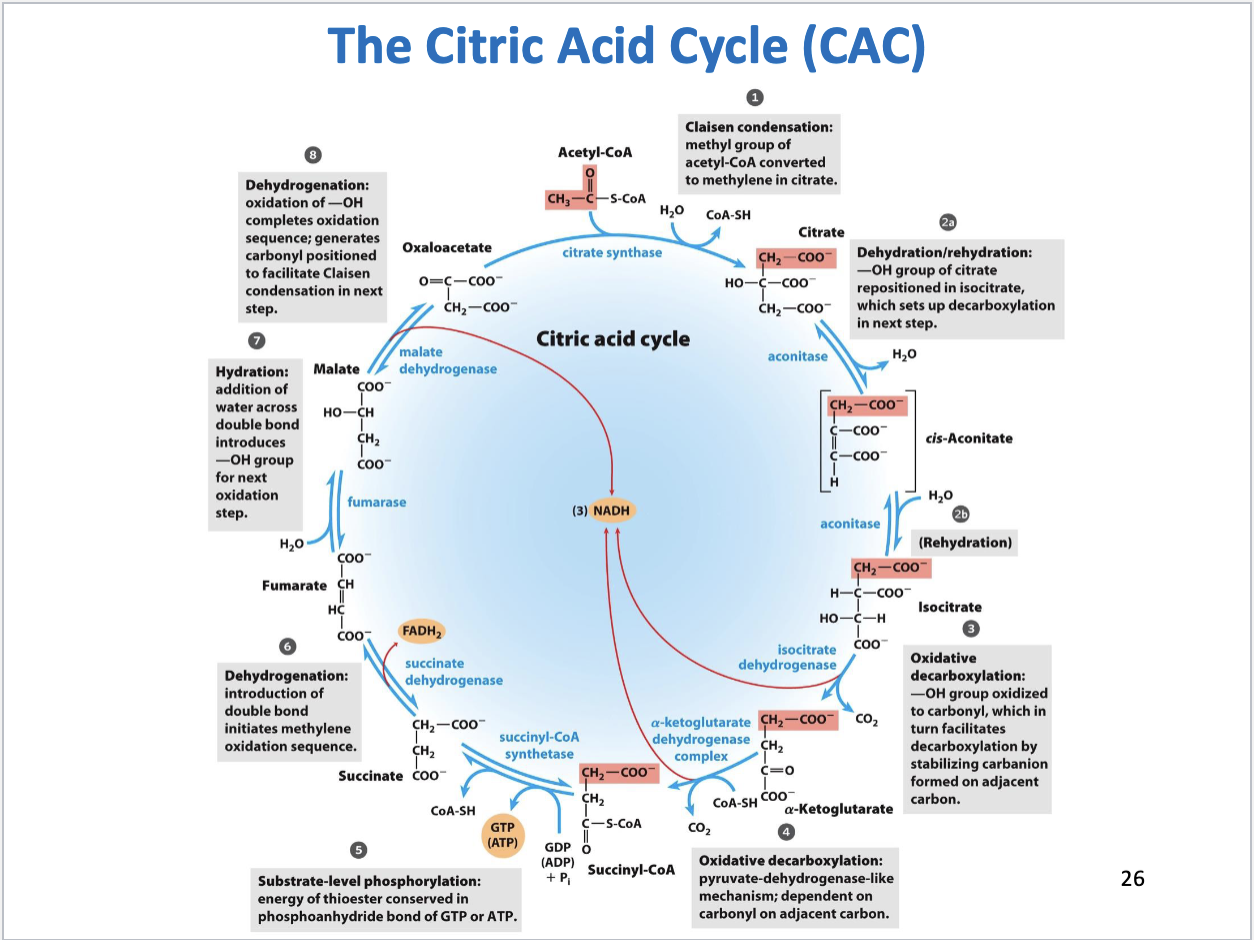
Synthase
No ATP/GTP involved
Synthetase
ATP/GTP involved
Induced fit in citrate synthase
OAA and acetyl-CoA bind sequentially
OAA binding causes conformational change that creates binding pocket for acetyl-CoA
Avoids unnecessary hydrolysis of thioester in acetyl-CoA
Describe function of aconitase as an iron response regulatory protein
Low [iron] causes loss of Fe-S cluster from aconitase
Aconitase then binds mRNA to regulate gene expression:
Suppresses translation of ferritin (stores iron)
Enhances translation of transferrin receptor (uptakes iron)
Origin of C-atoms in CO2
All CO2 released during the citric acid cycle is produced before succinyl-CoA is made
Both CO2 molecules lost were present on the oxaloacetate that entered the cycle (i.e. not directly from glucose)
Reaction series of succinyl-CoA synthetase
Phosphoryl oxygen of Pi attacks carbonyl of succinyl CoA, releasing CoA-SH
Histidine N3 attacks phospho-succinyl intermediate, forming P-N bond and releasing succinate
Pi group is transferred from His to GDP to form GTP
Succinyl-CoA Synthetase catalytic site
Partial positive charges of the helix dipoles (one each from the alpha and beta subunits) stabilize the phosphohistidyl group
The alpha subunit is specific for either GDP or ADP and distinguishes the two isozymes
Not stereospecific with respect to C2-C3 plane of symmetry (as in aconitase reaction)
Alternative function of succinyl dehydrogenase (outside TCA)
Functions as Complex II of the Electron Transport Chain
Serves as an integral membrane protein of the inner mitochondrial membrane
General sequence of events in citric acid cycle
Step 1: C-C bond formation to between acetate (2C) and oxaloacetate (4C) to make citrate (6C)
Step 2: Isomerization via dehydration/rehydration
Steps 3-4: Oxidative decarboxylations to give 2 NADH
Step 5: Substrate level phosphorylation to give 1 GTP
Step 6: Dehydrogenation to give 1 FADH2
Step 7: Hydration
Step 8: Dehydrogenation to give NADH
Points of regulation of Citric Acid Cycle
Regulated at highly thermodynamically favorable (irreversible) steps
Pyruvate dehydrogenase complex
Citrate synthase
Isocitrate dehydrogenase
Alpha-ketoglutarate dehydrogenase complex
TCA general regulatory mechanism
Activated by substrate availability, inhibited by product accumulation
Overall products of pathway are NADH and ATP
Inhibitors (NADH, ATP)
Activators (NAD+, AMP/ADP)
Regulation of pyruvate dehydrogenase complex
Regulated by reversible phosphorylation of E1
Phosphorylation: inactive
Dephosphorylation: active
PDH kinase and PDH phosphorylase are part of the mammalian PDH complex
Ca2+ enhances phosphatase activity (activates PDH)
Kinase is activated by ATP
High ATP → phosphorylated PDH → less acetyl CoA
Low ATP → dephosphorylated PDH → more acetyl CoA
Citrate synthase regulation
Inhibited by succinyl CoA
a-ketoglutarate is an important branch point for amino acid metabolism
Succinyl CoA communicates flow at this branch point to the start of the cycle
Control of citrate levels via isocitrate dehydrogenase
Inhibition of IDH leads to accumulation of isocitrate
Aconitase is reversible, leads to accumulation of citrate
Accumulated citrate leaves mitochondria and inhibits PFK-1 in glycolysis
Leucine
Ketogenic
Leucine → Acetyl CoA → Ketone bodies
Carbons in ketogenic path will not end up in glucose
Ketone bodies are produced by the liver and used by brain, heart, and muscle when glucose is scarce
Alanine
Glucogenic
Alanine → Pyruvate → Glucose
Pyruvate to glucose conversion is achieved via gluconeogenesis
Anaplerotic reactions
Intermediates in TCA can be used in alternative biosynthetic pathways
Must replenish the intermediates in order for TCA to continue
E.g. pyruvate + HCO3- + ATP → oxaloacetate + ADP (catalyzed by pyruvate carboxylase)
E.g. PEP + CO2 + GDP → oxaloacetate + GTP (catalyzed by PEP carboxykinase)
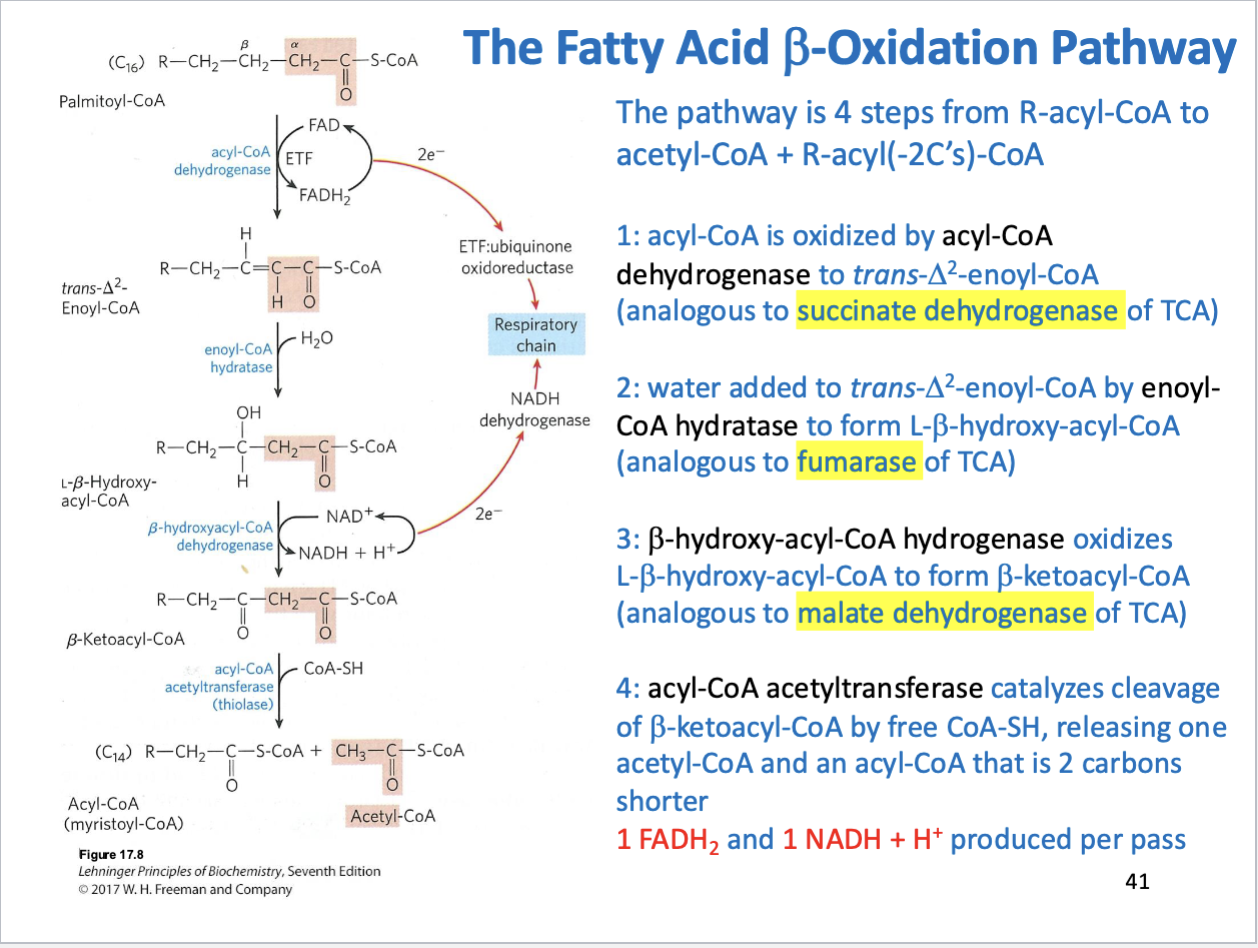
Fatty acid oxidation for energy (summary)
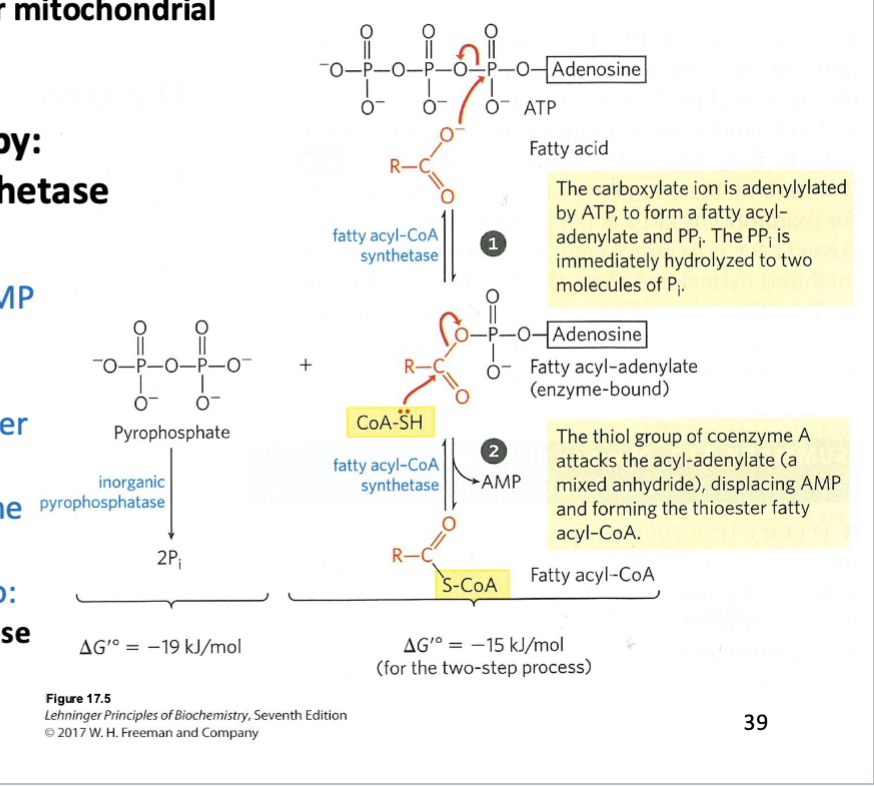
FA Activation
-2 ATP (for FA of any length)
FA oxidation: 1 FADH2 and 1 NADH per each oxidation
Number of oxidation cycles = (length of FA/2)-1
Acetyl CoA oxidation: 1 FADH2, 1 GTP and 3 NADH per TCA turn
Number of TCA turns = length of FA/2
Activation of FA before oxidation
Fatty Acid Beta Oxidation Pathway
Beta oxidation of monounsaturated fatty acids
Beta oxidation cycles are conducted as usual until double bond is present at C3-C4 carbon
Delta3, Delta 2 enoyl CoA isomerase catalyzes cis to trans conversion and migration of double bond to C2-C3
Enoyl-CoA hydratase is stereospecific and cannot add water across cis double bond
Beta oxidation of polyunsaturated fatty acids
Requires a reduction step (with cofactor NADPH and H+) in addition to isomerization
Beta oxidation of odd numbered fatty acids
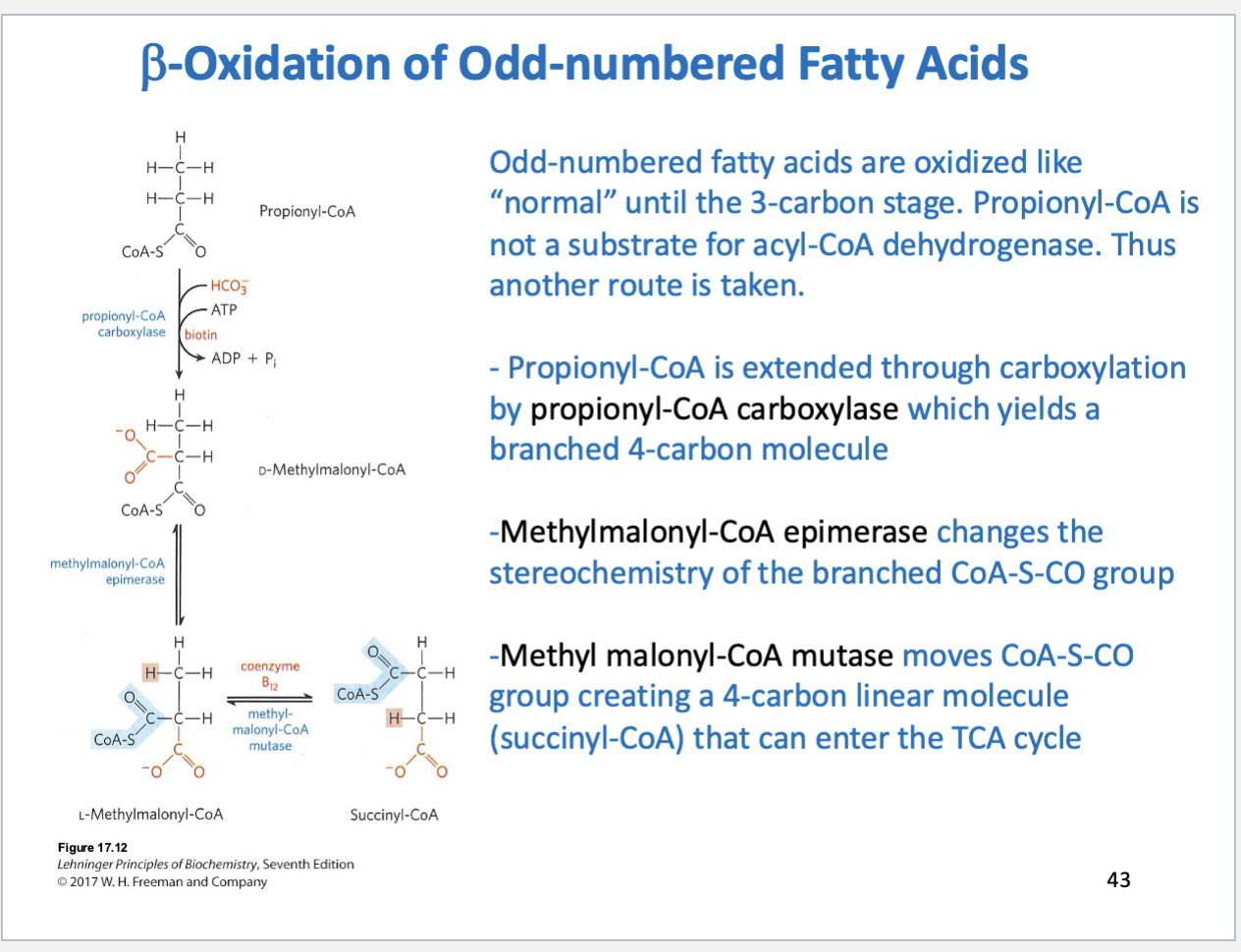
B12
Cobalt containing vitamin
Used in conversion of L-methylmalonyl-CoA to Succinyl-CoA in beta oxidation of odd numbered fatty acids