Torres Genetics Summer Session 1 Final Exam PRS
 Call Kai
 Learn
Learn Practice Test
 Spaced Repetition
 Match
Match Flashcards
 Knowt Play
1/268

There's no tags or description
Looks like no tags are added yet.
Name | Mastery | Learn | Test | Matching | Spaced | Call with Kai |
|---|
No analytics yet
Send a link to your students to track their progress
269 Terms
All organisms share a common coding system for their genomic information. The common
features of heredity imply all of the following EXCEPT
A. All life forms on Earth share a common ancestor.
B. The study of one organism's genes often reveals principles that apply to other organisms.
C. Genes from one organism will often function in another organism.
D. All organisms will have the same number of genes.
E. None of the above are implications of a shared coding system.
D. All organisms will have the same number of genes.
Recent discoveries in genetic engineering allowed humans to alter the genome of plants (crops) for the first time.
True or False
False
Gregor Mendel is generally recognized as the father of genetics because he
A. Generated new varieties of pea plants by random crosses of natural varieties.
B. Discovered the principles of heredity by crossing different varieties of pea plants and
analyzing their traits in subsequent generations.
C. Discovered which genes were responsible for the inheritance of specific traits.
D. Both B and C are correct
E. All A, B and C are correct
B. Discovered the principles of heredity by crossing different varieties of pea plants and analyzing their traits in subsequent generations.
Which of the following are features of heredity that would help explain these results?
1. Traits are transmitted to offspring via discrete units
2. The units are not lost, but their presence can be obscured or hidden
3. Each offspring receives units from the fittest parent
4. Each offspring receives one unit from each parent
A. 2 and 4
B. Only 4
C. 1, 2 and 3
D. 1, 2 and 4
A. 1, 2 and 4
How do you call a trait produced by a set of alleles?
A. Allelic variation
B. Gene map
C. Genotype
D. Phenotype
D. Phenotype
A research laboratory is searching for a new organism to use in genetic studies. Which of the following characteristics would make an organism MOST useful as a model organism for genetics research?
A. Long life cycle, many offspring, and highly specialized environmental requirements
B. Short generation time, many offspring, and easy maintenance in the laboratory
C. Large body size and complex behavioral traits
D. Slow development and limited genetic variation
B. Short generation time, many offspring, and easy maintenance in the laboratory
Which of the following best describes what the article found regarding zebrafish and human skin color?
A. Humans with mutations in the SLC25A5 gene are more closely related to zebrafish
B. The human genome contains zebrafish genes
C. Scientists discovered a gene that contributes to pigmentation in zebrafish and in humans
D. Mutations in a single gene determine zebrafish and human skin color
Scientists discovered a gene that contributes to pigmentation in zebrafish and in humans
I am aware that answering ANY PointSolutions questions while not being physically present in
the classroom is a violation of class policies
A. Yes I am aware
B. I was not aware but now I am
Yes I am aware
Each lecture will start with five individual, closed book questions based on _____
A. The material discussed the previous week
B. The material discussed the previous class
C. The Learning Outcomes assigned for that day
The Learning Outcomes assigned for that day
Bacteria and Archaea are interchangeable names to describe the same type of organisms.
True or False
False
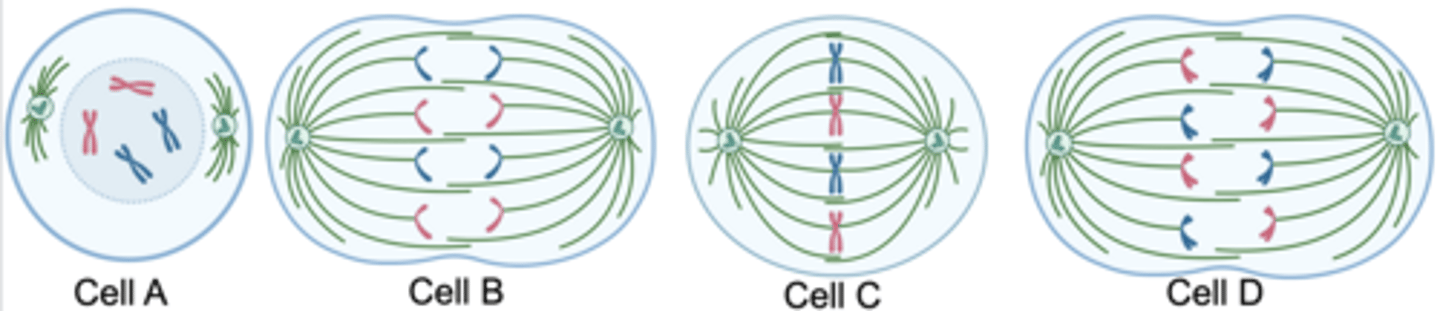
Which of these four cells is in anaphase of mitosis?
A. Cell A
B. Cell B
C. Cell C
D. Cell D
Cell B
A scientist is studying a cell and determines that it is diploid. Which of the following conclusions
can be made based on this information?
A. The cell contains two sets of each chromosome
B. The cell contains two homologous chromosomes
C. The cell contains two chromosomes
D. Each chromosome in the cell contains two sister chromatids
E. Each chromosome in the cell contains two copies of every gene
The cell contains two sets of each chromosome
Which of the following statements BEST distinguishes meiosis from mitosis?
A. Meiosis produces genetically identical daughter cells through a single division
B. Mitosis reduces chromosome number by half, whereas meiosis maintains chromosome
number
C. Mitosis and meiosis both produce haploid daughter cells
D. Meiosis occurs without DNA replication prior to division
E. Meiosis involves two divisions and produces genetically variable cells with half the
chromosome number
Meiosis involves two divisions and produces genetically variable cells with half the chromosome number
Which statement is characteristic of the bacteria and makes them different from both the
archaea and the eukaryotes?
A. Bacteria have no histones associated with their chromosomes and the other two groups do.
B. Bacteria do not have a nuclear envelope and the other two groups do.
C. Bacteria have multiple chromosomes whereas the other two groups have single
chromosomes.
D. Bacteria require mitosis for cell division whereas the other two groups use binary fission.
E. Bacteria have linear chromosomes whereas the other two groups have circular
chromosomes
Bacteria have no histones associated with their chromosomes and the other two groups do.
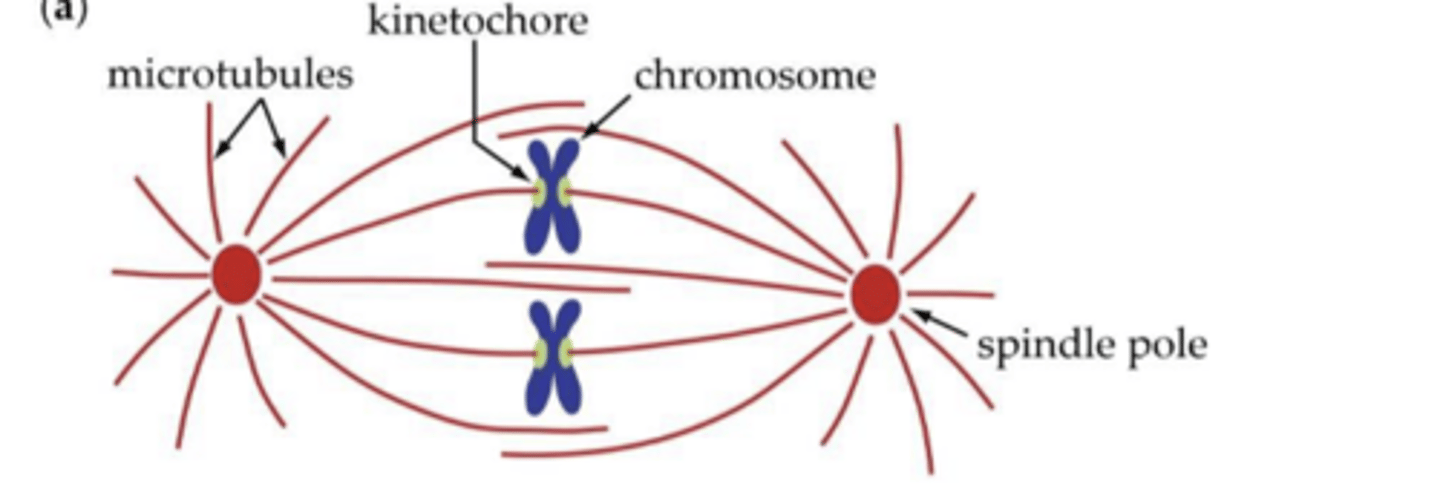
Which of the following statements best describes the cell below?
A. This cell has 2 chromosomes
B. This cell has 2 sister chromatids
C. This cell has 4 pairs of chromosomes
D. This cell is in prophase
This cell has 2 chromosomes
Which of the following is TRUE about homologous chromosomes?
A. Usually are identical.
B. Are present only after S-phase.
C. Are always composed of two sister chromatids
D. Are attached to a single centromere in Metaphase I.
E. Usually have the same genes in the same order as each other.
Usually have the same genes in the same order as each other.
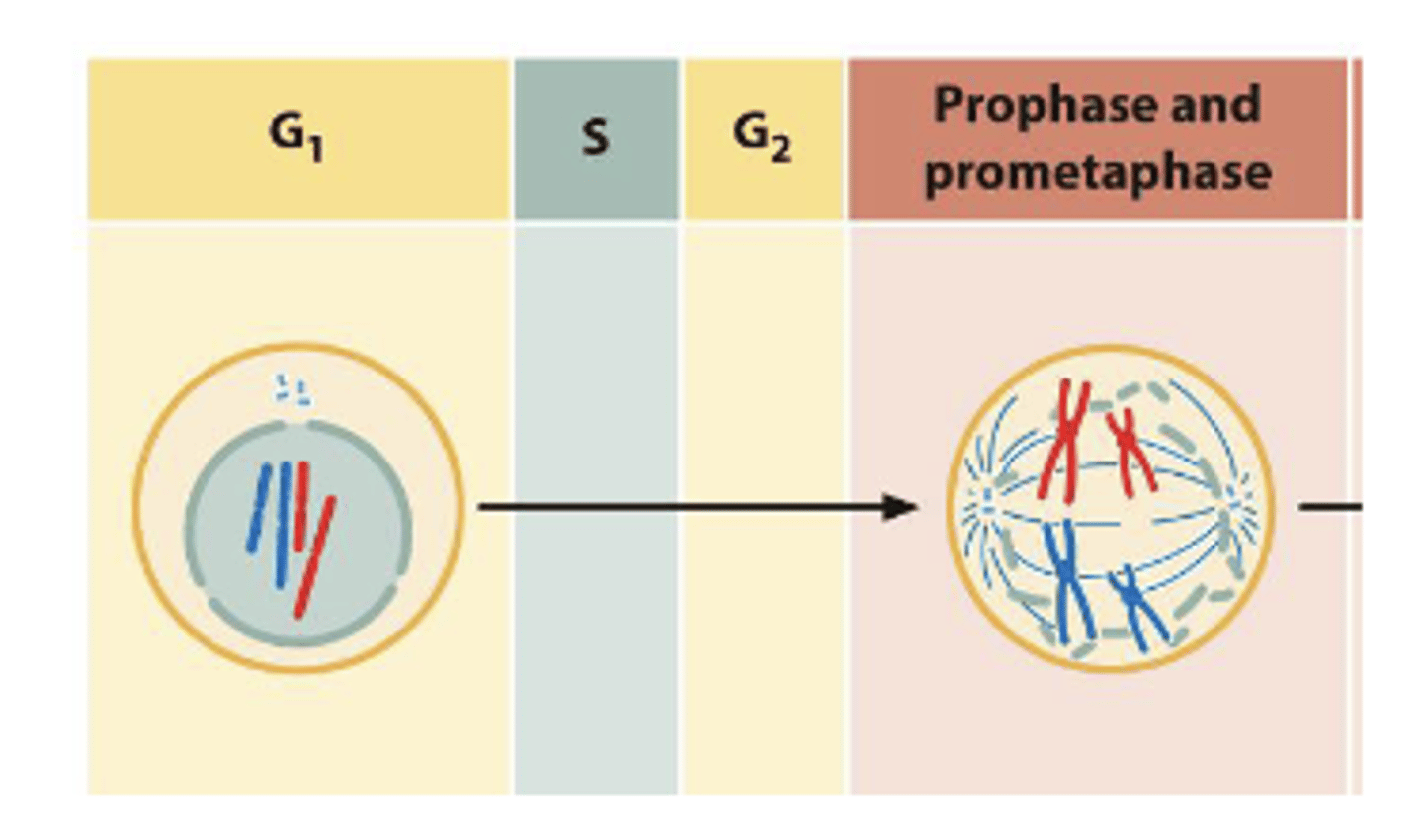
The diploid cell contains 4 chromosomes during G1 of interphase. Which of the following statements correctly describes the cell after S phase but before mitosis begins?
A. The cell contains 8 homologous chromosomes arranged into 4 pairs
B. The cell contains 4 DNA molecules because chromosome number and DNA amount remain
unchanged during S phase
C. The cell now contains 8 chromosomes because DNA replication doubles chromosome
number
D. The cell still contains 4 chromosomes, but each chromosome now consists of two sister
chromatids, for a total of 8 DNA molecules
The cell still contains 4 chromosomes, but each chromosome now consists of two sister chromatids, for a total of 8 DNA molecules
Meiosis produces ____, which contain ____ the genetic material of the original diploid parent cell.
A. Diploid somatic cells ; Twice
B. Haploid gametes ; Half
C. Sister chromatids ; Identical
D. Haploid somatic cells; Half
E. Diploid gametes ; Half
Haploid gametes ; Half
In summary, Meiosis I separates __ while Meiosis II separates __
A. Homologous chromosomes; Homologous chromosomes
B. Sister chromatids; Sister chromatids
C. Homologous chromosomes; Sister chromatids
D. Sister chromatids; Homologous chromosomes
Homologous chromosomes; Sister chromatids
The haploid amount of DNA in a human cell is 1.91 × 10¹² Daltons. How much DNA (in Daltons) do you expect to find after telophase and cytokinesis of Meiosis I?
A. 3.82 x 10¹³ Daltons
B. 7.64 x 10¹² Daltons
C. 3.82 x 10¹² Daltons
D. 1.91 x 1024 Daltons
E. 3.82 x 1024 Daltons
F. 0.95 x 10¹² Daltons
3.82 × 10¹² Daltons
What are the overall consequences of meiosis?
A. Four daughter cells are identical to the parental cell
B. The chromosome number is reduced
C. The daughter cells are genetically different from each other
D. Sister chromatids recombine
E. All of the above are correct
F. Only B and C are correct
F. Only B and C are correct
Which of the following processes unique to meiosis is NOT responsible for introduction of genetic variation?
A. Crossing over
B. Random separation of homologous chromosomes
C. Random separation of sister chromatid
Random separation of sister chromatids
A scientist crossed a stock melon plant that produced tan seeds with a plant that produced red seed. All 13 offspring produced tan seeds. What can you conclude from these data?
A. The tan seed phenotype is dominant
B. The red seed phenotype is dominant
C. Both parents were heterozygous for the seed color phenotype
D. This is a typical example of a dihybrid cross
The tan seed phenotype is dominant
If tan seed color (S) is dominant over cream (s), what is/are the possible genotype(s) that tan seeds could have?
A. SS
B. Ss
C. ss
D. A and B
E. A, B and C
D. A and B
During meiosis, which cell division stage is responsible for separating homologous chromosomes?
Meiosis I
During meiosis, which cell division stage is responsible for separating sister chromatids?
Meiosis II
The probability that a plant is tall is ¾. The probability that a plant has purple flowers is ¼. What is the probability that a plant is tall AND has purple flowers?
A. ¾
B. 1
C. ½
D. 3/16
E. 9/16
D. 3/16
What is the purpose of a test cross?
A. To determine if an individual is homozygous recessive
B. To determine the genotype of an individual
C. To determine the phenotype of an individual
D. To determine the genotype AND the phenotype of an individual
B. To determine the genotype of an individual
9:3:3:1 is the expected phenotype ratio for a ______ cross, assuming complete dominance
A.Monohybrid
B.Dihybrid
C.Trihybrid
B. Dihybrid
Which of the following is correctly referred to as an F2 individual?
A. Any offspring of a cross where the genotypes are Aa x Aa
B. Any offspring who has at least one F1 parent
C. Any offspring for whom both parents are F1 individuals
D. Any individual who is heterozygous at the two loci under consideration
C. Any offspring for whom both parents are F1 individuals
In guinea pigs, white coat color (w) is recessive to black (W). What is the probability that a heterozygous black guinea pig and a homozygous white guinea pig produce white offspring?
A. 0/4
B. ¼
C. 1/2
D. ¾
E. 4/4
C. 1/2
Alkaptonuria results from an allele (a) that is recessive to the allele for normal metabolism (A). Sally is healthy and so is her mom. Her father has alkaptonuria. What is Sally's genotype?
A. AA
B. Aa
C.aa
D.Homozygous recessive
B. Aa
In guinea pigs, black coat color (W) is dominant to white coat color (w), and short hair (H) is dominant to long hair (h). You identify a black guinea pig with long hair. Which of the following could represent the genotype(s) of this animal?
A. Wh or Wh
B. WWHH or WwHh
C. WWhh or Wwhh
D. Ww, WW or hh
C. WWhh or Wwhh
A guinea pig has the genotype WwHh. Which of the following represent possible gametes produced by this animal?
A. WwHh
B. Ww, Hh
C. W, w, H, h
D. WH, Wh, wH, wh
D. WH, Wh, wH, wh
What is the probability of getting a round and yellow seed from the RrYy x RrYy cross?
A. 6/8
B. 9/16
C. 3/16
D. 1/16
E. 6/4
B. 9/16
Which of the following genotypes could represent a dull, orange and nonbitter plant?
• Dull: D
• Glossy: d
• Orange: R
• Cream: r
• Bitter: B
• Nonbitter: b
A. DDRRBB
B. DdRrBb
C. DDRrBb
D. DdRRBb
E. DdRrbb
E. DdRrbb
What is the probability of getting a dull, orange and nonbitter seed from the F1 cross?
• Dull: D
• Glossy: d
• Orange: R
• Cream: r
• Bitter: B
• Nonbitter: b
A. 27/64
B. 9/64
C. 6/64
D. 3/64
E. 1/64
B. 9/64
Sex is determined __
A. Always by sex chromosomes.
B. Always by a small number of genes on the Y chromosome.
C. Always by the number of X chromosomes.
D. Always by the presence/absence of a Y chromosome
E. In many different ways in different organisms.
E. In many different ways in different organisms.
Some animals and plants do not have sex chromosomes but have genes that determine sex. This type of sex determination system is known as
A. Heterogametic sex determination
B. Homogametic sex determination
C. Chromosomal sex determination
D. Genic sex determination
E. Environmental sex determination
D. Genic sex determination
In mammals, how many X chromosomes are active in a single somatic (non-germline) cell?
A. 1
B. 2
C. 1 for males, 2 for females
D. Different somatic cell types will have different numbers of active X chromosomes
A. 1
The patchy distribution of color on tortoiseshell cats results from
A. Cats having a single X chromosome
B. Multiple X chromosomes (XXY)
C. A Y-linked color determining gene
D. Random X-inactivation
E. Cats having environmental sex determination
D. Random X-inactivation
The modification of the amount of protein produced by a sex chromosome is called __
A. Barr bodies
B. Dosage compensation
C. X-inactivation
D. X-linked expression
E. None of the above
B. Dosage compensation
You discover a new amphibian and name the sex chromosomes A and B. If the female is heterogametic and the male is homogametic, then what would be the chromosome arrangement of sex chromosomes in the adult?
A. Female AA and male BB
B. Female AB and male AB
C. Female AB and male BB
D. Female BB and male BB
E. Female XX and male XY
C. Female AB and male BB
Males are haploid with respect to X. Any allele on X is expressed in males
A. True
B. False
A. True
Crossing pure-breeding red eye females and white males produced
A. All progeny with white eyes
B. All progeny with red eyes
C. Only the females with white eyes
D. Only the males with white eyes
E. Half of the females and half of the males with white eyes
B. All progeny with red eyes
One form of red/green color blindness is inherited as an X-linked recessive trait. Are there any of the offspring from this cross colorblind?
A. Yes, all of the offspring is affected
B. Only the females are colorblind
C. Only the males are colorblind
D. Only half of the females and half of the males are colorblind
E. None of the offspring is colorblind
E. None of the offspring is colorblind
There is a form of metabolic vitamin D deficiency that is an X-linked dominant condition. What fraction of their daughters and sons will also have the disease?
A. All of the offspring will have the disease
B. Only the females will
C. Only the males will
D. Only half of the females and half of the males will
E. None of the offspring will
B. Only the females will
Which of the following options correctly represents the genotype of the fast-feathering male and slow-feathering female birds?
• + is the slow, dominant allele
• s is the recessive, fast allele
A. Females are Z+ W and males Zs Zs
B. Females are Z+ Z+ and males Zs W
C. Females are Zs W and males Z+ Z+
D. Females are Zs Z and males Z+ W
E. Females are X+ X+ and males Xs Y
A. Females are Z+ W and males Zs Zs
Fast-feathering is a Z-linked, recessive trait. The dominant trait is slow-feathering. A fast-feathering male is crossed to a slow-feathering female. What percentage of female chicks will be FAST feathering?
• + is the slow, dominant allele
• s is the recessive, fast allele
A. None of them
B. 25% of them
C. 50% % of them
D. 75% of them
E. All of them
E. All of them
How many Barr bodies are present in a Poly-X female (XXXX)? Hint: think about what Barr bodies do and how many active X chromosomes remain
A. None
B. 1
C. 2
D. 3
E. 4
D. 3
Which of the following is correct about X-chromosome inactivation?
A. X-inactivation is a process that systematically silences maternal or paternal genes, based on the chromosomal location of the trait
B. X-inactivation is a random process that happens separately in individual cells
C. Dosage compensation is achieved in animals by increasing the level of expression on the
male X-chromosome
D. Dosage compensation occurs in individual cells that inherit the paternal allele and
X-inactivation in individual cells that inherit the maternal allele
B. X-inactivation is a random process that happens separately in individual cells
In some cats, tail length is controlled by a single gene. You have observed a large number of families in these cats. In every single case where one parent was long-tailed and the other was tail-less, all of the offspring have short tails. This is best explained
A. If the tail-length alleles show incomplete dominance.
B. If long tails are dominant.
C. If tail length is X -linked.
D. If tail length is Y -linked.
E. As a particularly unlikely string of observations.
A. If the tail-length alleles show incomplete dominance.
A recessive allele (g) causes extra toes in cats. Several cats are known to be homozygous recessive (gg) for this allele, but some cats have extra toes while others have a normal number of toes.
A. Variable expressivity
B. Incomplete penetrance
C. Incomplete dominance
D. Codominance
E. Epistasis
B. Incomplete penetrance
Severity of symptoms of cystic fibrosis may vary from one patient to the next. The variation seen is representative of
A. Variable expressivity
B. Incomplete penetrance
C. Codominance
D. Dominant alleles
E. Recessive alleles
A. Variable expressivity
The term 'epistasis' refers to a situation in which
A. A single gene has more than two alleles.
B. Two genes share a single allele.
C. Two genes are found in different chromosomes
D. Two independent genes both have alleles with incomplete dominance.
E. The genotype at one locus affects the phenotype observed at a different locus
E. The genotype at one locus affects the phenotype observed at a different locus
In a species of fish, individuals with the genotype 𝑆𝐵𝑆𝐵 have blue scales, while individuals with the genotype 𝑆𝑌𝑆𝑌 have yellow scales. Heterozygous fish 𝑆𝐵𝑆𝑌 display both blue and yellow scales at the same time. Which inheritance pattern does this represent?
A. Complete dominance
B. Incomplete dominance
C. Codominance
D. Recessive epistasis
E. Dominant epistasis
C. Codominance
When you look at the phenotype by looking at the fruits themselves, you see that the fruits can be purple, violet or white. At this level, the relationship between the alleles is:
A. The purple allele is dominant
B. Incomplete dominance
C. The alleles are co-dominant
B. Incomplete dominance
When you sequence the mRNA of the enzyme, you find that violet plants have two different forms of the mRNA. The two forms are identical except for a single nucleotide difference, and they are both equally abundant in each cell. At this level, the relationship between the alleles is:
A. The purple allele is dominant
B. Incomplete dominance
C. The alleles are co-dominant
C. The alleles are co-dominant
Osteogenesis imperfecta (OI) is a disease associated with a mutation in COL1A1, a gene than synthesizes collagen. Scientists studying ____ of this disease, found that 70% of mice that carry the mutated gene exhibited symptoms of OI
A. Penetrance
B. Expressivity
C. Epistatic interaction
D. Incomplete dominance
A. Penetrance
A dominant allele causes patches of white fur in mice. Researchers examine several mice that all carry the same genotype for this allele. One mouse has a small white patch on belly, another has white patches on its back and legs, and another is almost completely white.
A. Complete dominance
B. Incomplete dominance
C. Variable expressivity
D. Incomplete penetrance
E. Codominance
C. Variable expressivity
The difference between dominance and epistasis is that __
A. Dominance masks genes at different loci
B. Epistasis mask genes at the same loci
C. Epistasis masks genes at different loci
D. All of the above
E. There is no difference
C. Epistasis masks genes at different loci
You cross a black Labrador (BB EE) with a yellow Labrador (bb ee). What are the genotypes and phenotypes of the expected progeny?
A. All of the progeny is Bb Ee, an intermediate between black and yellow = Brown
B. All progeny is Bb Ee (Black coat and color deposited) = Black
C. Half of the progeny is Bb Ee (Black coat and color deposited) = Black, and half is bb ee (brown color and color not deposited) = yellow
B. All progeny is Bb Ee (Black coat and color deposited) = Black
Which of the following genotypes will be associated with a yellow Labrador?
A. BB ee
B. bb Ee
C.Bb EE
D.BB EE
A. BB ee
What is the probability of obtaining a yellow Labrador when crossing Bb Ee x Bb Ee?
• BB ee
• Bb ee
• bb ee
A. 9/16
B. 3/16
C. 2/16 or 1/8
D. 4/16 or 1/4
E. 5/16
D. 4/16 or 1/4
The allele that masks the expression of the other allele is known as the epistatic allele. In the previous example, the epistatic allele is
A. E (more specifically e)
B. B (more specifically b)
A. E (more specifically e)
Assume 52 puppies are born at once after crossing two heterozygous dogs. How many dogs would you expect would be yellow?
A. 26
B. 18
C. 13
D. 8
E. 4
Bb Ee X Bb Ee
C. 13
This Punnet Square is for fruit color in squash. What do the white fruit (no color in the table) all have in common? (Not MCQ)
WY Wy wY wy
WY WWYY WWYy WwYY WwYy
Wy WWYy WWyy WwYy Wwyy
wY WwYY WwYy wwYY wwYy
wy WwYy Wwyy wwYy wwyy
All white fruit have at least one dominant W allele (W), which masks the color gene.
In animals, the mitochondrial DNA is ___the nuclear genome and is inherited ______.
A. Separate from; From both parents
B. Part of; From both parents
C. Separate from; Only from the mother
D. Part of; Only from the mother
E. Separate from; Only from the father
C. Separate from; Only from the mother
In humans, a common form of colorblindness is caused by mutations at a gene located on the X-chromosome. Consequently, males are much more likely to exhibit this form of colorblindness than are females. Which type of inheritance is this?
A. Genetic maternal effect
B. Sex-linked
C. Sex-limited
D. Sex-influenced
B. Sex-linked
In some snails, all offspring of a mother with the genotype LL or Ll will have shells that coil to the left - regardless of the offspring's genotype. Which type of inheritance is this?
A. Maternal effect
B. Cytoplasmic inheritance
C. Sex-linked
D. Sex-limited
E. Sex-influenced
A. Maternal effect
Precocious puberty behaves as a dominant trait in males, but has no effect (zero penetrance) on females. What kind of trait is it?
A. X-linked dominant
B. Sex-determined
C. Sex-influenced
D. Sex-limited
D. Sex-limited
In humans, pattern baldness is a sex-influenced trait. The allele B causes baldness and the allele b causes non-baldness. In males, B behaves as a dominant allele. In females, B behaves as a recessive allele. Which of the following individuals would most likely be bald?
A. A male with genotype Bb
B. A male with the genotype bb
C. A female with genotype Bb
D. A female with genotype bb
E. Both A and D
A. A male with genotype Bb
In domestic chickens, some males display a plumage pattern called cock feathering. Other males and all females display a pattern called hen feathering. Cock feathering is an autosomal recessive trait that is exhibited in males only. Two heterozygous birds are mated. What fraction of the total offspring is expected to exhibit cock feathering? (Not MCQ)
1/8 of the total offspring. Autosomal recessive = 1/4 cock-feather genotype, expressed only in males = 1/2 of those.
In some goats, the presence of horns is produced by an autosomal gene that is dominant in males and recessive in females. Which of the following represents a cross between a horned female is crossed with a hornless male?
• Presence of horns: H+
• Absence H+ horns: H-
A. H+ H+ male x H+ H+ female
B. H- H- male x H- H- female
C. H+ H- male x H+ H- female
D. H- H- male x H+ H+ female
E. H+ H+ male x H- H- female
D. H- H- male x H+ H+ female
When RNA or protein from the mother is loaded into the oocyte and they affect the development of the offspring independent of the offspring’s genotype, this referred to as __________.
A. Maternal inheritance
B. Maternal interference
C. Genetic maternal effect
D. Genomic imprinting
C. Genetic maternal effect
In a hypothetical organism, embryo color is determined by a maternal genetic effect. Allele G causes green embryos and is dominant over allele g, which causes yellow embryos. A female with genotype Gg is crossed with a male with genotype gg. Which of the following is the best prediction for the phenotype of their offspring?
A. 100% green embryos
B. 75% green embryos and 25% yellow embryos
C. 50% green embryos and 50% yellow embryos
D. 25% green embryos and 75% yellow embryos
E. 100% yellow embryos
A. 100% green embryos
The two following crosses produce offspring with the genotype Dd. Because D (dextral) is dominant over d (sinistral), offspring from both crosses will be dextral
A. True
B. False
B. False
Genetic maternal effect is another name for cytoplasmic inheritance
A. True
B. False
B. False
The color of leaves in these plants is determined by a gene in chloroplastic DNA. What would be the phenotype of the offspring in the following cross?
A. All plants would have green leaves
B. All plants would have white leaves
C. All plants would have variegated (white and green splotches)
D. Half plants would have green leaves and half would have white leaves
E. Some plants would have green leaves and some white leaves, in a 3:1 ratio
Green female x White male
A. All plants would have green leaves
Leber hereditary optic neuropathy (LHON) results from a mutation in mitochondrial DNA. For this disease, all of the following are expected EXCEPT that
A. The disease is passed from mother to all children.
B. A child who has the disease had a mother who had LHON.
C. The severity of the disease varies depending on how many copies of mutated mitochondrial genes are present.
D. None of the above; they are all true
D. None of the above; they are all true
The pedigree below could represent a Y-linked inherited trait
A. True
B. False
B. False
The pedigree below represents the inheritance of a trait in a family. If the mutation was recessive, what would individuals I-1, II-1 and II-3 have in common?
A. They are heterozygous
B. They are homozygous dominant
C. They are homozygous recessive
D. They carry the mutated allele in the Y-chromosome
A. They are heterozygous
The following pedigree could represent the mode of inheritance of an autosomal dominant trait
A. True
B. False
False
If the following pedigree represents the mode of inheritance of an autosomal recessive trait,
what could be the genotype of the parents?
A. Both parents are homozygous recessive
B. Both parents are homozygous dominant
C. One of the parents is homozygous dominant and the other one is homozygous recessive
D. At least one of the parents must be heterozygous
E. Both parents must be heterozygous
Both parents must be heterozygous
Which set of parents, by themselves, shows that a pedigree trait must be recessive?
A. II - 1+2
B. II - 6+7
C. III - 1+2
D. III - 10+11
E. More than one set of parents could support this
II - 1+2 (Unaffected parents producing an affected child)
The following pedigree could also represent the mode of inheritance of an autosomal recessive
trait
A. True
B. False
False
If the following pedigree represents the mode of inheritance of an autosomal dominant trait, what could you conclude about the genotype of the parents?
A. Both parents are homozygous recessive
B. Both parents are homozygous dominant
C. One of the parents is homozygous dominant and the other one is homozygous recessive
D. At least one of the parents must be heterozygous
E. Both parents must be heterozygous
At least one of the parents must be heterozygous
By focusing on the pedigree cross between III 1+2, what can you infer about the trait's dominance?
A. This trait definitely dominant
B. This trait is definitely recessive
C. Cannot tell precisely from this cross
Cannot tell precisely from this cross
Which of the following observations, by itself, cannot distinguish between autosomal dominant and autosomal recessive inheritance?
A. Two unaffected parents produce an affected child
B. The trait skips generations
C. The trait appears in every generation
D. Unaffected individuals transmit the trait
E. Two affected parents have an affected child
Two affected parents have an affected child
How is it possible that a daughter in the second generation is healthy in pedigree 1 but sick in pedigree 2? (Not MCQ)
Pedigree 1 is consistent with X-linked recessive (unaffected carrier daughter); Pedigree 2 is consistent with X-linked dominant.
Which observation would MOST strongly support X-linked recessive inheritance Which of the following observations would MOST strongly support X-linked recessive
inheritance over autosomal recessive inheritance?
A. The trait skips generations
B. Unaffected parents produce affected offspring
C. More males than females are affected
D. Two affected parents produce affected offspring
E. The trait appears among siblingsover autosomal recessive inheritance?
More males than females are affected
Assume the trait shown in the pedigree is X-linked recessive. Which of the following is the
MOST likely genotype combination for individuals III-1 and III-2?
A. III-1 = XᴬY ; III-2 = XᴬXᴬ
B. III-1 = XᵃY ; III-2 = XᴬXᴬ
C. III-1 = XᵃY ; III-2 = XᴬXᵃ
D. III-1 = XᴬY ; III-2 = XᴬXᵃ
E. Both B and C are possible, but B is more strongly supported by the pedigree. Assume A is an X-linked trait, and is dominant over a
E. Both B and C are possible, but B is more strongly supported by the pedigree. Assume A is an X-linked trait, and is dominant over a
A pregnant patient undergoes a procedure in which a small sample of placental tissue
containing fetal cells is removed and directly analyzed for chromosomal abnormalities early in
pregnancy. Which prenatal genetic testing method is this being described?
A. Amniocentesis
B. Maternal blood screening
C. Preimplantation genetic diagnosis (PGD)
D. Chorionic villus sampling (CVS)
E. Noninvasive prenatal screening (NIPS)
Chorionic villus sampling (CVS)
Noninvasive prenatal screening (NIPS) differs from traditional maternal blood screening because NIPS.
A. Can only be performed during the last trimester
B. Directly analyzes fetal DNA fragments found in maternal blood
C. Measures levels of pregnancy hormones in the maternal blood
D. Can definitively diagnose chromosomal abnormalities
E. Requires culturing fetal cells before analysis
Directly analyzes fetal DNA fragments found in maternal blood
A pregnant patient receives a positive NIPS result indicating increased risk for Trisomy 21.
Which of the following would MOST likely be recommended next to confirm the diagnosis?
A. Repeat ultrasound during the third trimester for confirmation
B. Additional maternal blood screening
C. Amniocentesis or Chorionic villus sampling (CVS)
D. Newborn screening after delivery
E. No further testing because NIPS is diagnostic
Amniocentesis or Chorionic villus sampling (CVS)
When performing a dihybrid cross, you expect to see a 9:3:3:1 ratio. What is a good explanation
if you do not see a 9:3:3:1 ratio in a dihybrid cross?
A. The two genes are found in different chromosomes
B. The two genes are close to each other and linked
C. One of the genes is dominant over the other
D. The two genes assort independently
E. This proves that Mendel's laws are incorrect
The two genes are close to each other and linked
An individual is homozygous dominant for genes A and B. If both genes are located on the
same chromosome, what would be the correct notation for the A and B loci?
A. Figure A
B. Figure B
C. Figure C
D. Figure D
Figure A (representing cis linkage on the same chromosome)
An individual is heterozygous for genes A and B and has the following genotype . Which
gametes are expected to be produced from that individual (assume genes A and B are
unlinked)?
A. A, a, B and b
B. AA, AB, BB and bb
C. AA, Aa, aa, BB, Bb and bb
D. AB, Ab, ab and aB
D. AB, Ab, ab and aB
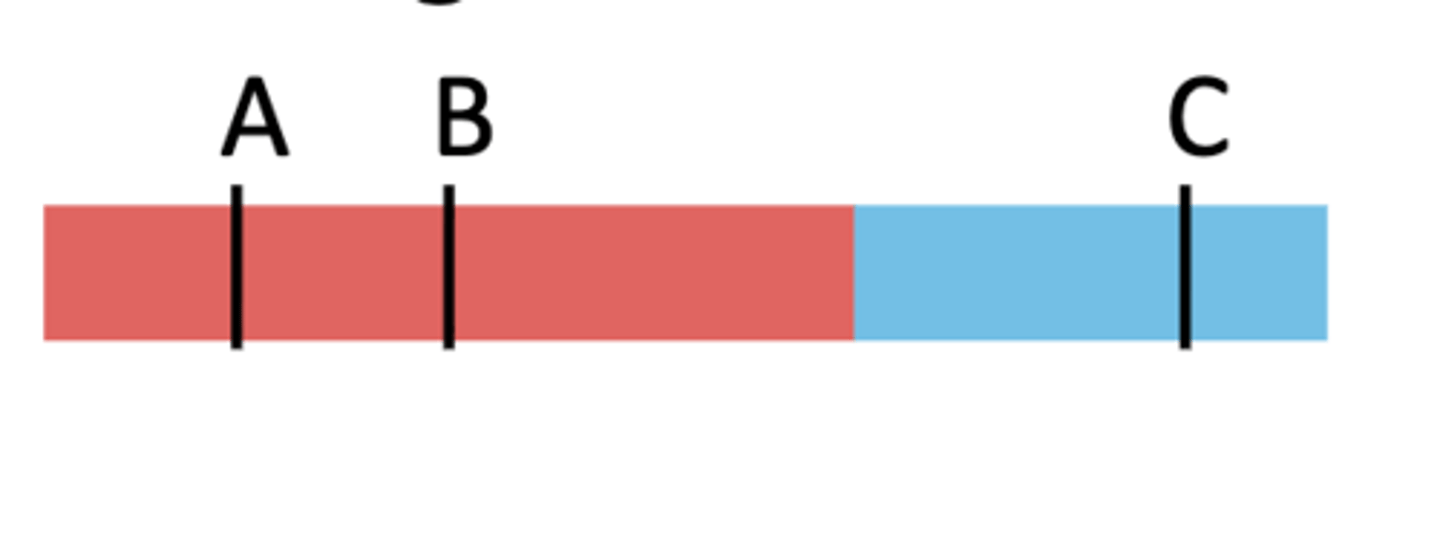
Two genes that lie far apart on the same chromosome are more likely to undergo crossing over than two close genes.
True or False
True
We testcross a tomato plant that is a dihybrid. Tall (D) is dominant over dwarf (d), and smooth
(P) is dominant over hairy (p). What is the cross?
A. DpDp x DpDp
B. DdPp x DdPp
C. ddpp x ddpp
D. DdPp x ddpp
DdPp x ddpp