HS 1002 FINAL flashcards
 Call Kai
 Learn
Learn Practice Test
 Spaced Repetition
 Match
Match Flashcards
 Knowt Play
1/184

Earn XP
Description and Tags
Week 1 to 11
Name | Mastery | Learn | Test | Matching | Spaced | Call with Kai |
|---|
No analytics yet
Send a link to your students to track their progress
185 Terms
What is a reductionist statement?
Not analytical
Represent complex phenomenon as if they are simple
Proposes they are impossible to change
What are the 2 most commonly discussed factors for health in our society?
Genetics
Behaviors
WHO def.
Non medical factors that influence health outcomes
conditions in which people are born, grow, work, live and age
What are the 2 types of social determinants
Attitudinal
personal beliefs, perspectives, and perceptions
Structural
policies, healthcare systems, infrastructure
A policy of excluding dental care from universal healthcare and defining it as an “individual responsibility” is a —-determinant of health that is rooted in —- determinants
Structural
Attitudinal
Basically, people who don’t have healthy teeth did it to themselves and must reap the consequences of their choices.
Health inequalities
Some people are healthier for a multitude of reasons
money
choices
access
Health Inequities
Some people have worse health due to not being given the same support/opportunities
The 14 determinants:
Aboriginal status
gender disability
housing early life
income and income distribution
education
race employment and
working conditions
social exclusion
food insecurity
social safety net health services
unemployment
job security
What ethnic group experiences higher prevalance of caries compared to any other group
Latino children
What causes difficulties in access to care (refering to latino oral health article)
Fluctuating eligibility for public health insurance
limited community infrastructure
lack of public transportation
What is a low income disease mechanism?
Explains how living in poverty leads to disease in the body
ex.:
Chronic stress
adoption of health threatening behaviors
material deprivation
Definition of health capital
The accumulation of health resources (physical and psychosocial) over the early stages of life
T or F: Canada is a powerhouse in SDH scholarship
True
T or F: In 1800s, many didn’t make it past 40
True
Avg life expectancy 1921, 1950, 2021
1921: 57.1 was avg life expectancy
1950: 70 was avg life expectancy
2021: 73.3 years global average
2021: 82.6 Canada avg
Basically, life expectancy increased
Top 3 causes of death in Canada - Recent
Cancer
Heart disease
Covid
Malawi life expectancy change
Malawi changed their avg life expectancy from 44 to 62 within 14 yrs
What did Madagascar rank on the multidimensional poverty rank
5th out of 110th
Who is the Father of Social Medicine and what does he state
Rudolf Virchow
“Disease is not something personal and special, but only a manifestation of life under modified (pathological) conditions”
Whitehall studies, what is it?
Principal investigator: Michael Marmot
10yr study pf 17500 male civil servants
Even though everyone had jobs,
social status still affected health
Whitehall 1 findings and Whitehall findings 2
higher civil ranking = longer life
Lowest grade (pay and status) civil servants had a 2.1x higher relative risk for cardiovascular disease mortality compared to highest grade civil servants
Clear relationship between social status, the behaviors and conditions of living typical of a particular status, and health
Causality def
Relationship between cause and effect
Prevalence def
Measure of disease that allows us to determine a person's likelihood of having a disease
Socialization def
process by which individuals learn the norms, values, and behaviours of their society.
Population health
A way to understand health of populations and develop interventions to improve/protect it
Dose Impact
The more exposure you have, the bigger the effect on your health.
Key drivers of health disparities is
1. Poverty
2. Access to healthcare
3. Education
Opportunity deficit
1. Limited support for and success in school
2. No good jobs in sight
3. Limited sense of purpose and meaning
How many young women experience postpartum depression in Canada and globally
20% in Canada
40% Globally
Children born into poverty are more likely to —- during first year of life
die
have learning difficulties
leave school before graduating
experience poor health
What do bigger income gaps lead to deteriorations in (3 things)
Social relations
Health
Human capital
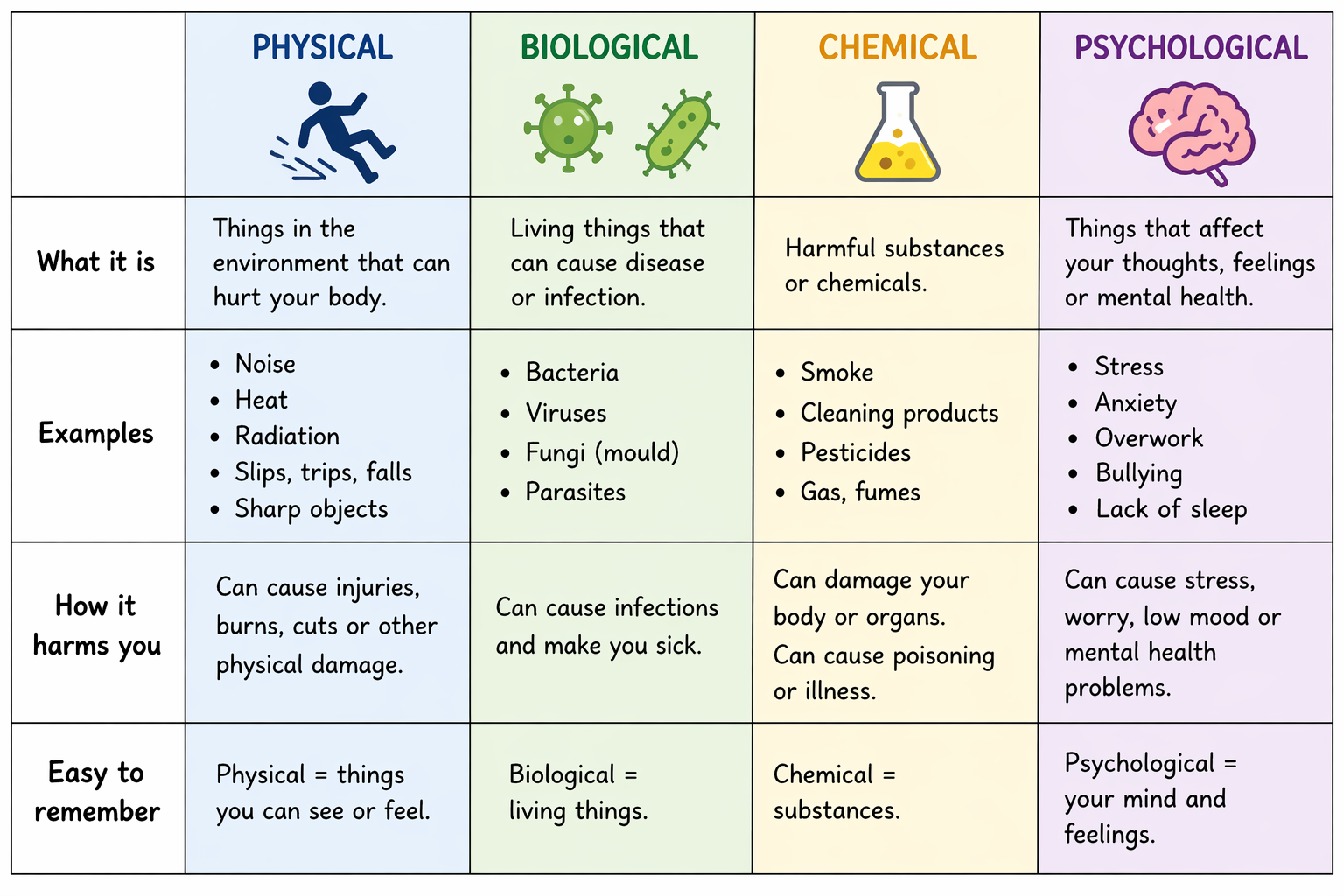
Advantages and Risks
Risks can be defined as the “potential of probability of harmful outcome through an exposure”
Physical
Biological
Chemical
Psychological
Vulnerability
how likely someone is to be harmed
Job security
A sense of well being, control, fulfillment, and self esteem
Mutual trust and respect between employer and employee
Environment feels safe
Job stability
What are characteristics of a precarious or non standard work
No job security
Often multiple employers
Lacks comprehensive benefits of standard work
non standard work: part time, contract work, freelancer
What is the Intensification of work
Increased expectation that work will be completed at greater speed with greater effort and better results on a tight deadline
About — of injuries require medical attention in Canada
1/6th
Stress profileration, how many workers in Canada reported feeling exhausted and burnt out?
A single problem can spread and create multiple new problems.
can lead to injury, burnout, and ALLOSTATIC overload
Almost ¼ of workers in Canada reported feeling exhausted and burnt out most of all of the time in spring 2023.
Burnout and symptoms
Psychological term
It is used in the employments health lit; refers to condition arising from chronic work related stress
Symptoms: Emotional exhaustion, disinterest in work, and lack of motivation
Allostatic Load def
Physiological wear and term on the body due to chronic stress and the repeated activation of the stress response system
Measurable through biomarkers such as cortisol levels, blood pressure, inflammation, and metabolic dysregulation
What defines a public health challenge?
The burden of disease in a population
The number people at risk for disease
Evidence: likelihood of harmful consequences from exposure to that risk
What does Work family conflict refer to
“Refers to the strains (times based strains and attention-based strains) that arise for parents when work and family demands are incompatible” (Greenhaus and Beutell, 1995)
Dinh and colleagues (what do they state):
Workplaces are one of the most important social institutions families engage with, supplying critical resources to families
The Long Arm of the Job
Q: “What impact does one's day to day experience at work have on what does and how one behaves when off work?”
A: “The results of this paper suggest that the extent to which a man is used, as a resource in the organization of work, is a burden– light or heavy– not easily dropped at the mill gates.”
This basically means that:
The impact of one's lived experience at work and how this relates to the ways in which people operate outside of work in the home sphere
Scarcity Hypothesis
We have limited resources of time and energy, and when these become taxed to the point of overload, this results in tiredness, emotional distancing, and absence from home
Dinh et al. 2017 – “Growing up in Australia" study
What is it
Goal
Findings
Studied 2496 dual earning couples and children
Goal of study: Study impact of various factors of children health and development by interviewing a national sample of parents twice a year, starting when their kids were in kindergarten.
Findings:
Negative impact on parent mental health
Increases irritability in interactions with kids
Impacts marital satisfaction
T or F: Mothers work-family conflict experiences impacted children differently than fathers WFC
T
Healthy childhood development depends on 3 factors:
Safe physical environment
Access to adequate nutrition
Quality supportive relationships
Gender norms
Standards and expectations to which those socially identified as belonging to a gender generally conform within a range that defines a particular society
What is the Fourth Industrial Revolution
a time when advanced technologies like AI and robotics are changing how we live, work, and communicate.
Gig work
unincorporated self employed workers whose future business activity is uncertain or expected to be minor or occasional
Gig economy stats
Growing internationally
8-10% of Canadians engage in gig work
871,000 Canadians reported gig work as main job
Gig workers in canada more likely to be
- women
- 15-24
-immigrant men
Worker vulnerability according to Jetha et al.
Vulnerable worker: Workers exposed to structural factors (ex. Racism, ableism, sexism) that may contribute to adverse work arrangements/environments
Fragmentation in the Future of Work Reading
Goal of study
Results
Conclusion
Goal of study: to understand how future of work could result in conditions which contribute to vulnerability for different groups of workers
Results: Nine trend categories were uncovered, which included digital transformation of economy, AI, climate change and the green economy.
Conclusion: Future of work represents an emerging public health concern
What are sources of risk to migrant workers’ health and well-being as they perform their daily tasks in the greenhouses?
They work 10 hrs a day or more, 7x a week
Cannot rest
Work on holidays, not paid extra or overtime
Not treated as humans (humiliated and abused)
Separation from family (stress)
What aspects of stress and gig worker vulnerability discussed in your required reading for week 3, the Fragmentation of Work, emerge in some form in the film?
Decline in union representation
Discrimination at work
Wage depression
Increased exposure to health and safety risks
How do specific structural conditions and factors (meaning economic, political, legal, and social norms, forces, policies, and systems) contribute to poor working and living conditions faced by the migrant workers?
Employers hire workers in desperate need for jobs and barely pay them (cheap labour)
They pay minimal for the labour and provide extremely cheap housing and utilities, causing the employees to be almost fully dependent on their job
Employers make it so that they have full power so that employees do not have a say - wage depression
This makes it difficult for an employee to have increase in pay or have any sort of power
Some immigrant workers are undocumented, so they fear reporting or speaking up
Employers have many ways of getting around certain labour laws as they are not enforced well enough (ex. Working overtime and crowded housing)
The long-arm of the job theory proposes that “the extent to which a man is used, as a resource in the organization of work, is a burden— light or heavy—not easily dropped at the mill gates. “ How is this theory illustrated or countered in the film?
The stress of not seeing family for 8 months (even more) while working in unsafe working condition and living conditions is extremely harmful
Working tiring, physical labour jobs can lead to body pain and cause mental stress
Constant fear of employers and their unstable future (one small mistake can lead to getting fired)
What did Joyce Echaquan experience
First nation
Complained about severe stomach pain, in return was insulted by healthcare workers
Canadian Charter of Rights and Freedoms Purpose
Protection from discrimination as a right of all Canadians
Equality rights
Is racism an SDH
yes
Acts of discrimination
Actions within systems of power
Socially structured
Normalized
Productive acts
Occurs at structural and individual levels
In Canada, —% of visible minority have experienced racial discrimination
81%
—- women in Canada have experienced racism when using the healthcare system
One in five
Poverty is racialized in Canada, —% of people living in poverty identify with a racial group in Toronto
62%
Evidence of direct impacts on health
Higher chronic disease
Reduced healthseeking
Higher levels of unhappiness
Higher levels of poverty
T or F: Every income bracket in Canada harbors slightly better health outcomes than the one below it
T
— racialized families live in poverty in Canada as opposed to — non racialized families
1 in 5
1 in 20
Intersectionality def
How different parts of someone's identity creates unique experiences
Structural discrimination vs Individual discrimination
SD:
macro level conditions that limit resources, opportunities, and the well being of less privileged groups
ID:
Negative interactions with another person (health care provider, salesperson, etc.) based on an individual's characteristics (race, gender, etc.)
In Ottawa and Toronto, in the middle of the pandemic, COVID-19 cases were——- higher within racialized communities as compared to nonracialized communities
1.5 to 5 times
within First Nations communities in February 2021 indicated that rates of infection were —-% higher as compared to non-First Nations communities
69%
The she session
Women are more likely to be negatively affected than men, esp. in jobs and income
recession triggered by COVID 19 disproportionately effects women
women of colour are more likely to be effected
T or F: COVID-19 is not the only pandemic, racism and inequity are also pandemics
T
Does equity equal equality?
No, treating someone equitably leads to better outcomes than treating everyone the same way.
T or F: The Chief Public Health Officer’s 2020 report highlighted that inequity in health outcomes was only a problem during the COVID-19 pandemic.
FALSE: Inequity has always been a problem
What are three ways that implicit racial bias affects healthcare?
Interpersonal Interactions
Internal Dynamics
Cost and Waste
Jetha and colleagues (2021) examine the changing nature of work on workers experiences of vulnerabilities. What are the trend categories reported in this required reading to impact vulnerability?
Focus- big, system-level trends shaping work, not individual outcomes
Precarious employment (unstable, insecure jobs)
Changing workforce composition (e.g., more gig workers, migrants)
Technological changes (automation, digital work)
Changing organization of work (outsourcing, subcontracting)
What is food insecurity, what does it mean to be food secure?
Not knowing if you will have enough food to eat today or in the future (if farmer, not knowing when food from harvest will run out)
If food secure: always have enough calories and right kinds of food for healthy life
What is the most extreme form of food insecurity
Famine
What are causes of food insecurity
Global + local economic forces
War and displacement
Environmental disaster
Poverty and non living wages
3 levels of food insecurity
Marginal: Worrying about running out of food or having limited selection
Moderate: Compromising in quality/quantity of food
Severe: Missing meals, reduced food intake, going without food
Approx. —% of households are facing food insecurity at mod + sev. level
16%
— children are experiencing food insecurity in Canada
1 in 5
— people who used food banks in 2023 used it for the first time
2 in 5
Food insecure stats
2017:
2020:
2022:
Food insecure households
2017-2018: 1.2 mill
2020: 2.1 mill
2022: 8.7 mill
Who groups are the highest food insecurity among
Low income/ on social assistance
Female single headed households with children
Racialized groups
Recent immigrants (20%)
33% First Nations living off reserve
Highest rates of food insecurity are in —— (-% to -% of households are food insecure)
Nunavut
57 to 76%
Uneven distribution of food insecurity among social groups:
-% seniors
-% have a disability
-% children
7.7% seniors
32% have a disability
33% children
—% of Canadian food bank users are on ——- as their MAIN source of income
42.4%
social assistance