Praxis II Middle School Social Studies 2
 Call Kai
 Learn
Learn Practice Test
 Spaced Repetition
 Match
Match Flashcards
 Knowt Play
1/99

There's no tags or description
Looks like no tags are added yet.
Name | Mastery | Learn | Test | Matching | Spaced | Call with Kai |
|---|
No analytics yet
Send a link to your students to track their progress
100 Terms
Charlemagne
King of the Franks (r. 768-814); Roman emperor (r. 800-814). Through a series of military conquests he established the Carolingian Empire, which encompassed all of Gaul and parts of Germany and Italy. Illiterate, though started an intellectual revival. Caused mass conversion to Christianity
Battle of Tours
European armies defeat Muslim armies and stop the spread of Islam in Europe, battle in 732 in which the Christian Franks led by Charles Martel defeated Muslim armies and stopped the Muslim advance into Europe
Charles Martel
Carolingian monarch of Franks; responsible for defeating Muslims in battle of Tours in 732; ended Muslim threat to western Europe.
William the Conquerer
Invaded England from Normandy in 1066 defeating Harold King of the Saxons; extended tight feudal system to England; established administrative system based on sheriffs; established centralized monarchy. This brought a blending of Latin (French) and German (Anglo-Saxon) based cultures
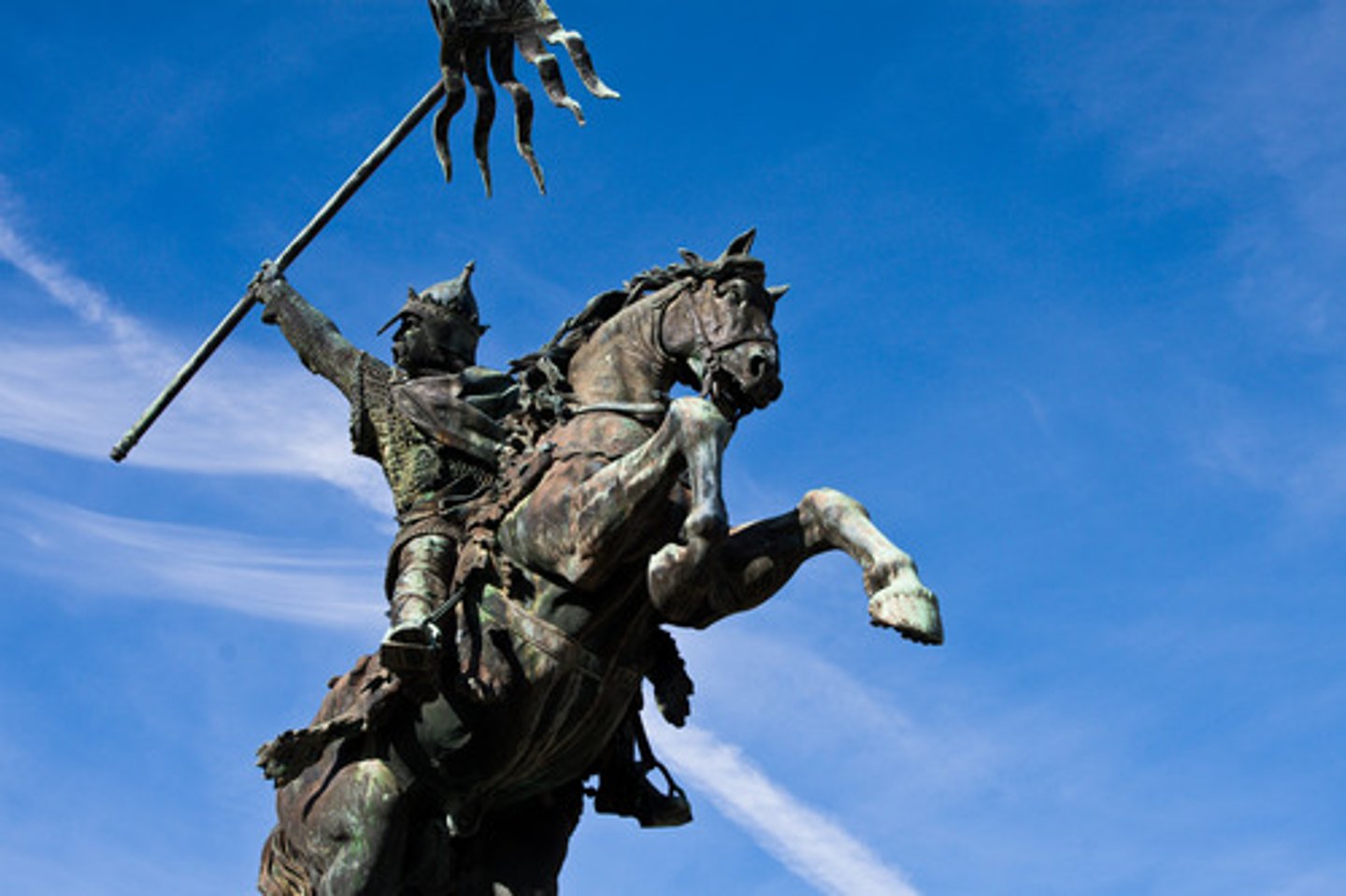
Otto the Great
Formed a close alliance with the Church. Built power by gaining support of clergy. Invaded Italy on pope's behalf. Rewarded by being crowned emperor 912-973. Created the Holy Roman Empire which was the strongest in Europe until the 12 century.
Great Schism
The separation of most of the Eastern churches from the Western Church in A.D. 1054 causing the establishment of Roman Catholic Church and the Eastern Orthodox.
Black Death
The epidemic form of bubonic plague experienced during the Middle Ages 1347-1351 when it killed nearly half the people of western Europe. Was caused by fleas on ship rats departing Asia but at the time was considered to be caused by magic or as punishment from God. Led in increased wages and taxes for the decimated workforce causing many revolts.
Crusades
A series of military expeditions in the 11th, 12th, and 13th centuries by Western European Christians to reclain control of the Holy Lands from the Muslims
Byzantine Empire
Historians' name for the eastern portion of the Roman Empire from the fourth century onward, taken from 'Byzantion,' an early name for Constantinople, the Byzantine capital city. The empire fell to the Ottomans in 1453. (250)
Albert Magnus
Also known as "the Great" and "Dr. Universalis", he was the first scholar to attempt to integrate Aristotle's philosophy into Christian theology. He used Aristotelian language to talk about God. Ex. God is the "prime mover" of all things. He was also the teacher of Thomas Aquinas.
Roger Bacon
Franciscan monk, English philosopher, and scientist in the 1200s who advocated for a system of scientific experimentation in seeking truth rather than accepting without question traditional Church and ancient beliefs. This led to the development of the scientific method.
Hundred Years War
The series of wars between England and France, 1337-1453, in which England lost all its possessions in France except Calais. Was discovered that foot soldiers with long bows were superior to armored knights thus ending medieval form of warfare.
War of the Roses
Struggle for the English throne (1455-1485) between the house of York (white rose) and the house of Lancaster (red rose) ending with the accession of the monarch Henry VII first of the Tudor dynasty
Joan of Arc
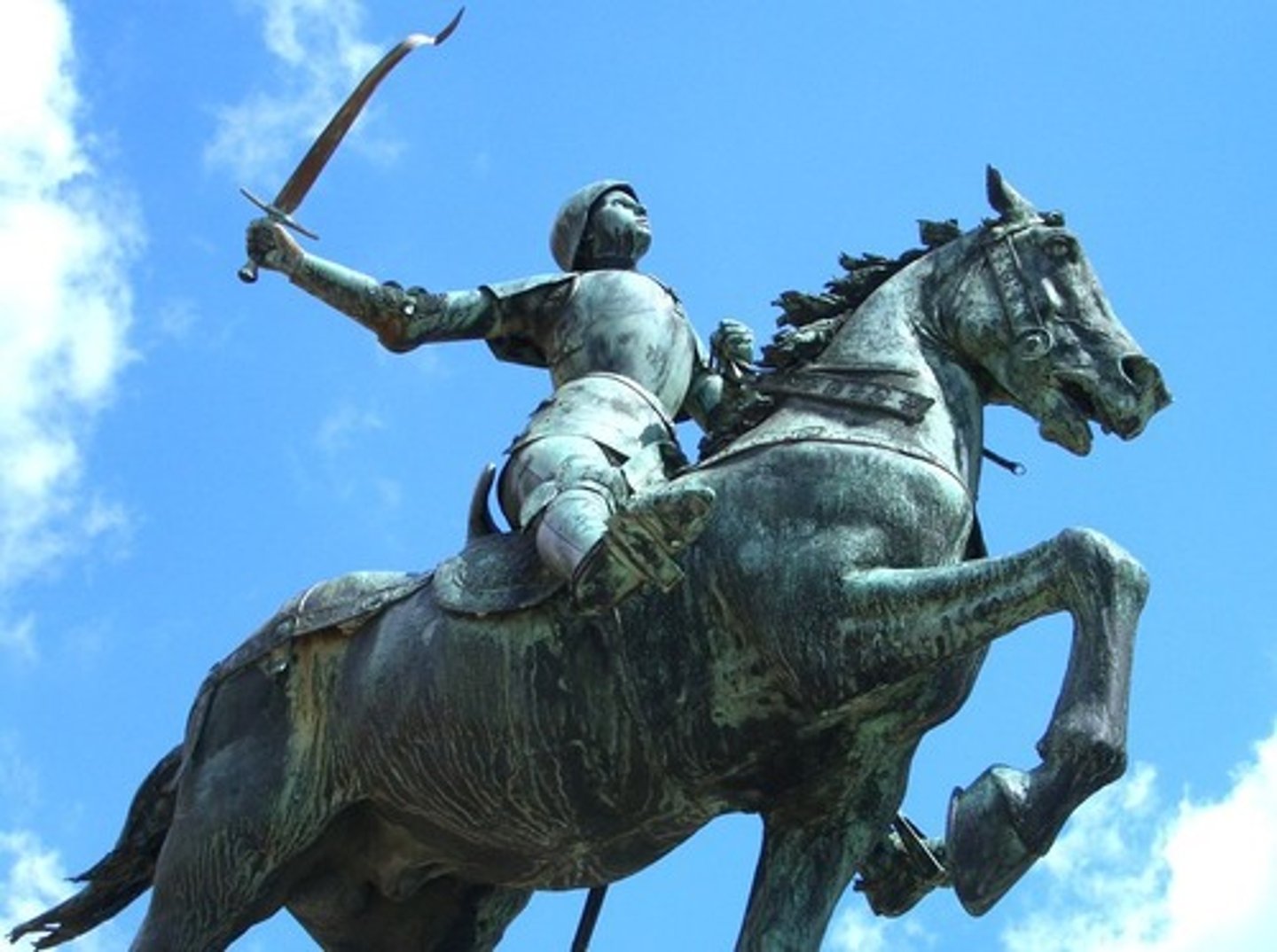
French heroine and military leader inspired by religious visions to organize French resistance to the English in the 100 Years War and to have Charles VII crowned king,
Johannes Gutenburg
German printer; in 1446 he invented a printing press that used movable type. This eventually led to written information including scripture being available to the general population causing a greater need for literacy.
William Shakespeare
(1564 - 1616) English poet and playwright considered one of the greatest writers of the English language; works include Julius Caesar, Macbeth, Romeo and Juliet, and Hamlet.
Thomas More
English statesman who opposed Henry VIII's divorce from Catherine of Aragon and was imprisoned and beheaded. Wrote the book "Utopia"
Erasmus
(1466?-1536) Dutch Humanist and friend of Sir Thomas More. Perhaps the most intellectual man in Europe and widely respected. Believed the problems in the Catholic Church could be fixed; did not suport the idea of a Reformation. Wrote Praise of Folly.
Niccolo Machiavelli
(1469-1527) Italian Renaissance writer, described government in the way it actually worked (ruthless). He wrote The Prince (the end justifies the mean).
Petrarch
(1304-1374)The father of humanism, he wrote that literature should not be subordinate to religion. He studied ancient texts like Cicero, and wrote his poetry in Italian vernacular, which unified the Italian language. He became a symbol of a new type of writer, he didn't use language merely as a practical tool but instead for expression.
William Wycliff
Condemned by Catholic church for translating Bible to English from Latin and Greek in late 1300s.
John Huss
Czechoslovakian religious reformer who anticipated the Reformation and attacked the corruption of clergy. Was excommunicated in 1409 and later was burned at the stake for heresy.
Martin Luther
German religious reformer who authored 95 Theses, posted in 1517 to church doors in Wittenburg, led to religious reform in Germany, denied papal power and absolutist rule. Claimed there were only 2 sacraments: baptism and communion.
95 Theses
The sheet of paper that Martin Luther put on a church door stating what he believed to be the abuses of the Catholic Church, which included the sale of indulgences. This act is regarded as the start or catalyst to the reformation.
John Calvin
French religious reformer who founded system of theology later known as Calvinism.
John Knox
This was the man who dominated the reform movement in Scotland and Switzerland. He established the Presbyterian Church of Scotland so that ministers ran the church, not bishops (1514-1572)
Calvinism
The theological system of John Calvin and his followers emphasizing omnipotence of God and salvation by grace alone
Counter Reformation
The reaction of the Roman Catholic Church to the Reformation reaffirming the veneration of saints and the authority of the Pope (to which Protestants objected) Most of southern Europe followed the counter reformation movement.
Inquisition
A Roman Catholic tribunal for investigating and prosecuting charges of heresy - especially the one active in Spain during the 1400s. The Inquisition was an element of the counter reformation.
Huegonots
Members of the Protestand Reformed church of France which were persecuted by French Catholics
St. Bartholomew Day Massacre
Six week nation wide slaughter of Huguenots. Occurred when Huguenot nobles were in Paris attending the marriage of Catherine's daughter to a Huguenot prince, Henry of Navarre in 1572. Resulted in over 10,000 deaths.
Edict of Nantes
1598 - Henry of Navarre's policy of religious tolerance to keep peace in France. Edict was revoked in 1685 by Louis XIV.
Henry of Navarre
Political leader of the Huguenots and a member of the Bourbon dynasty, succeeded to the throne as Henry IV. He realized that as a Protestant he would never be accepted by Catholic France, so he converted to Catholicism. When he became king in 1594, the fighting in France finally came to an end.
King Henry VIII
Founder of the church in England and ruled England from 1509-1547. He broke with the Catholic church because he couldn't get a divorce for wife not bearing male child.
Ferdinand Magellan
Portuguese navigator who led the Spanish expedition of 1519-1522 that was the first to sail around the world.
Spanish Armada
In 1588 the Spanish fleet attempted to invade England, ending in defeat, due to the raging storm in the English Channel as well as the smaller and better English navy led by Francis Drake. This is viewed as the decline of Spains Golden Age, and the rise of England as a world naval power.
Amerigo Vespucci
Italian cartographer commissioned by Portugal and sailed along the coast of South America concluding that it could not be Asia; his discoveries were published and the new continent was named after him
Enlightenment Period
18th century European movement in which thinkers attempted to apply the principles of reason and the scientific method to all aspects of life. Also known as Age of Reason.
William of Orange
King of England and Scotland and Ireland, he married the daughter of James II; was invited by opponents of James II to invade England; when James fled, William III and Mary II were declared joint monarchs (1650-1702) conditioned on signing the English Bill of Rights which limited the power of the monarchy.
Act of Settlement
Said no Catholic could be King of England thus insuring the Protestant line of succession. Succession switched from Stuarts to Hanovers because of this passing.
French Revolution
The revolution that began in 1789, overthrew the absolute monarchy of the Bourbons and the system of aristocratic privileges, and ended with Napoleon's overthrow of the Directory and seizure of power in 1799.
Reign of Terror
The historic period (1793-94) during the French Revolution when thousands were executed
Code Napolean
A set of laws made in 18th century that guaranteed certain freedoms for the males of France, French law is still based on this code. One of the main ways Napoleon was said to be the heir to the French Revolution.
Napolean Bonaparte
Overthrew French Directory in 1799 and became emperor of the French in 1804. Failed to defeat Great Britain and abdicated in 1814 and was exiled to the island of Elba. Returned to power briefly in 1815 but was defeated and died in exile on the island of St. Helena.
Battle of Nations
October 1813 at Leipzig in eastern Germany. The decisive defeat of the army of Napoleon by combined forces of Prussia, Austria, and Russia.
Robespierre
A French political leader of the eighteenth century. A Jacobin, he was one of the most radical leaders of the French Revolution. He was in charge of the government during the Reign of Terror, when thousands of persons were executed without trial including King Louis XVI and his wife Marie Antoinette. After a public reaction against his extreme policies, he was executed without trial in 1794.
Jacobins
Radical republicans during the French Revolution. They were led by Maximilian Robespierre from 1793 to 1794.
Ivan the Great
Prince of the duchy of Moscow who responsible for freeing Russia from the Mongols in the 1400s; took the title of Czar.
Ivan the Terrible
Ruled from 1533-1584; Was responsible for the death of thousands, including his own son; Created the Oprichnina in order to destroy the Boyars; Believed in a Strong Centralized Government; expanded mostly south.
Time of Troubles
Followed death of Ivan IV without heir early in 17th century; boyars attempted to use vacuum of power to reestablish their authority; ended with selection of Michael Romanov as Czar in 1613.
Boyars
Russian landholding aristocrats; possessed less political power than their western European counterparts
Oprichnina
The secret army/police created by Ivan IV or Ivan the Terrible that he used to kill anyone who got in his way (i.e. the Boyars)
Peter the Great
(1672-1725) Russian Czar (r. 1689-1725). He enthusiastically introduced Western languages and technologies to the Russian elite, moving the capital from Moscow to the new city of St. Petersburg which he founded.
Catherine the Great
Ruled Russia from 1762 to 1796, added new lands to Russia, encouraged science, art, lierature, Russia became one of Europe's most powerful nations
Austrian Empire
After the defeat of the Turks in 1687 Austria took control of all of Hungary, Transylvania, Croatia, and Slovenia, thus establishing the Austrian Empire in southeastern Europe. It remained a collection of territories held together by the Habsburg emperor, who was archduke of Austria, king of Bohemia, and king of Hungary.
Maria Theresa
Empress of Austria, 1740-1780, made sure all her children were educated, did away with forced labor for peasants of Austria, the reforms made-brought greater equality for Austrian society
Copernicus
Polish astronomer who produced a workable model of the solar system with the sun in the center (1473-1543)
Galileo
Italian astronomer and mathematician who was the first to use a telescope to study the stars; demonstrated that different weights descend at the same rate; perfected the refracting telescope that enabled him to make many discoveries (1564-1642) Promoted Copernicus's theory of heliocentric universe. Condemned by church and forced to recant.
Johannes Kepler
German astronomer; assistant to Tycho Brahe; used Brahe's data to prove that the earth moved in an elliptical, not circular, orbit; Wrote 3 laws of planetary motion based on mechanical relationships and accurately predicted movements of planets in a sun-centered universe; Demolished old systems of Aristotle and Ptolemy
Tycho Brahe
Influenced by Copernicus; Built observatory and collected data on the locations of stars and planets for over 20 years; His limited knowledge of mathematics prevented him from making much sense out of the data.
Isaac Newton
English mathematician and scientist who invented differential calculus and formulated the theory of universal gravitation, a theory about the nature of light, and three laws of motion. His treatise on gravitation, presented in Principia Mathematica (1687), was supposedly inspired by the sight of a falling apple.
Andreas Vesalius
a Flemish surgeon who is considered the father of modern anatomy (1514-1564)
William Harvey
English physician and scientist who described the circulation of the blood (1578-1657)
Francis Bacon
(1561-1626) English politician, writer. Formalized the empirical method. Novum Organum. Inductive reasoning.
Carolus Linnaeus
Swedish botanist who developed the first successful system for classifying living things into similar groups, a system that is still in use today: Kingdom, Phylum, Class, Order, Family, Genus, Species
Baroque
Style in art and architecture developed in Europe from about 1550 to 1700, emphasizing dramatic, curving forms, elaborate ornamentation, and overall balance of disparate parts. Associated with Catholicism.
Antonie van Leeuwenhoek
(1632-1723) a Dutch tradesman and scientist who is known as "the Father of Microbiology;" the first person to see bacteria through a microscope; best known for his work on the improvement of the microscope and his work which led to the creation of the field of study called microbiology
Johanne Sebastian Bach
(1685-1750) A famous German-Lutheran composer of organ fugues and church cantatas. Lived in Leipzig, and wrote St. Mathew Passion Coffee Cantata. Worked privately for the church and publicly.
Wolfgang Amadaeus Mozart
Prolific Austrian composer and child prodigy, master of all classical music of his time (1756-1791)
Ludwig van Beethoven
Ludwig van Beethoven (1770-1827) was the first master of romantic music. He was one of the greatest composers in German history. He composed 9 symphonies, 5 piano concerts, a violin concerto, 32 piano sonatas, 2 Masses, and an opera. Continued composing after becoming deaf. Beethoven never heard much of his later work including the finale to the Ninth Symphony.
Thomas Hobbes
English materialist and political philosopher who advocated absolute sovereignty as the only kind of government that could resolve problems caused by the selfishness of human beings (1588-1679), He wrote "Leviathan" and believed people were naturally cruel, greedy, and selfish; he also believed only a powerful governemnt could keep an orderly society
John Locke
English philosopher who advocated the idea of a "social contract" in which government powers are derived from the consent of the governed and in which the government serves the people; also said people have natural rights to life, liberty and property. Also, an English empiricist philosopher who believed that all knowledge is derived from sensory experience (1632-1704)
Industrial Revolution
The change from an agricultural to an industrial society and from home manufacturing to factory production, beginning in England from about 1750 to about 1850. Inventions such as steam engine, steam ships, locomotives, cotton gin, flying shuttle, spinning jenny, and power loom fueled the revolution as well as advances in steel production and the use of electricity. Later the internal combustion engine led to cars. At first there were no regulations regarding working and living conditions but later in the century there were many reforms.
Age of Revolution
Period of political upheaval beginning roughly with the American Revolution in 1775 and continuing through the French Revolution of 1789 and other movements for change up to 1848
1775-1783 American Revolution
1820's Revolutions: Greece, Spain, and the Italian and German States of Austrian Empire
1830's Revolutions: France, Italy, Belgium, and Poland
1848 Revolutions: France, Austria, Bohemia, Hungary, and small Italian and German states
1871 Revolution: France
Congress of Vienna
Meeting of representatives of European monarchs called to reestablish the old order and establish a plan for a new balance of power after the defeat of Napoleon in early 1800s.
Unified Italy
started in 1860s unofficial in 1870 because the Patrimony of St. Peter was not included; complete in 1871 included all Italian states and the Patrimony of St. Peter
Unified Germany
1860s-1870s Otto von Bismark unified Germany through or because a series of small strategic wars against Denmark, Austria, and France
Franco Prussian War
1870-71, war between France and Prussia; seen as German victory; seen as a struggle of Darwinism; led to Prussia being the most powerful European nation. Instigated by Bismarck; France seen as the aggressor eventually led to WWI due the changes in balance of power.
Romanticism
A movement in literature and art during the late 18th and early 19th centuries that celebrated nature and the past rather than civilization. Emotion was valued over reason. Mary Shelley's Frankenstein, Emily Bronte's Wuthering Heights, and poetry of William Wordsworth were notable pieces of literature while music was influenced by nationalism in the musical works of Frederic Chopin, Richard Wagner, and Giuseppe Verdi.
Ottoman Empire
A Turkish sultanate of southwestern Asia and northeastern Africa and southeastern Europe created by the Ottoman Turks in the 13th century and lasted until the end of World War I; although initially small it expanded until it superseded the Byzantine Empire around 1453. Became static because of the Muslim belief that all truth can be found in the Koran so did not participate in the Renaissance and Enlightenment with the western civilizations.
Ghengis Khan
The title of Temujin when he ruled the Mongols (1206-1227). It means the 'universal' leader. He was the founder of the Mongol Empire.
Kublai Khan
Mongolian emperor of China and grandson of Genghis Khan who completed his grandfather's conquest of China he establish the Yuan dynasty and built a great capital on the site of modern Beijing where he received Marco Polo (1216-1294)
Mongol Empire
An empire founded in the 12th century by Genghis Khan, which reached its greatest territorial extent in the 13th century, encompassing the larger part of Asia and extending westward to the Dnieper River in eastern Europe making it the largest land empire in the world.
Islam
The religion of Muslims collectively which governs their civilization and way of life; the predominant religion of northern Africa, the Middle East, Pakistan and Indonesia
Hinduism
A body of polytheistic religious and philosophical beliefs and cultural practices native to India and characterized by a belief in reincarnation and a supreme beings of many forms and natures, by the view that opposing theories are aspects of one eternal truth
Buddhism
A world religion or philosophy based on the teaching of the Buddha and holding that a state of enlightenment can be attained by suppressing worldly desire, religion founded by Siddhartha Gautama, the Buddha
WWI
1914-1918; Began after the assassination of Austrian Archduke Franz Ferdinand by a group of Serbian radicals; Germany, Austria-Hungary (aka central powers) v. Britain, France, Russia (aka allied powers); America is neutral. Over 10,000,000 people died mostly in battle.
League of Nations
An international organization formed in 1920 to promote cooperation and peace among nations; although suggested by Woodrow Wilson, the United States never joined and it remained powerless; it was dissolved in 1946 after the United Nations was formed.
Post WWI Middle East
As mandated by the League of Nations, Britain administered or influenced the governance of: Iraq, Palestine, Egypt, and Arabia while France administered: Syria and Lebanon
Turkey became the first secular state in Middle East under "Ataturk" Mustafa Kemal. Iran (aka Persia until 1935) and Iraq became independent nations as did Egypt and all the others except Palestine eventually.
Franz Ferdinand
Archduke of Austria and Hungary who was assassinated at Sarajevo by a Serbian terrorist group called the Black Hand in 1914; his death was a main cause for World War I.
Balfour Declaration
Statement issued by Britain's Foreign Secretary Arthur Balfour in 1917 favoring the establishment of a Jewish national homeland in Palestine.
United Nations
International organization founded in 1945 to promote world peace and cooperation. It replaced the League of Nations.
Holocaust
A methodical plan orchestrated by Hitler to ensure German supremacy. It called for the elimination of Jews, non-conformists, homosexuals, non-Aryans, and mentally and physically disabled. Related to WWII.
WWII
Began when Germany invaded Poland in 1934; US became in WWII when Pearl Harbor was bombed by Japan in 1941 and ended in 1945
Israel
An ancient kingdom of the Hebrew tribes at the southeastern end of the Mediterranean Sea, In antiquity, the land between the eastern shore of the Mediterranean and the Jordan River, occupied by the Israelites from the early second millennium B.C.E. The modern state of Israel was founded in 1948 by the United Nations as a result of the Holocaust. Conflict between the Jews and Arabs persists over the land which had been part of Palestine.
Six Day War
(1967) Short conflict between Egypt and her allies against Israel won by Israel; Israel took over the Golan Heights , The West Bank of the Jordan River; and the Sinai Peninsula.
October War
Known as Yom Kippur War, 6-25 Oct, 1973. Suprise attack instigated by Egypt and Syria to push Israel out of Sinai. (Arab-Israeli conflict).
OPEC
An organization of countries formed in 1961 to agree on a common policy for the production and sale of petroleum; Organization of Petroleum Exporting Countries; international cartel that determines price of oil by regulating supply; Venezuela, Saudi Arabia and UAE are prominent members
Middle East
Geo-Political designation of the area stretching from the eastern Mediterranean Sea to the western side of the Indian subcontinent. Consists of countries such as Israel, Iran, Iraq, Saudi Arabia, and Egypt.
Near East
The region between the Eastern coast of the Mediterranean Sea and the Tigris and Euphrates Rivers