animal/plant genetics
 Call Kai
 Learn
Learn Practice Test
 Spaced Repetition
 Match
Match Flashcards
 Knowt Play
1/40

There's no tags or description
Looks like no tags are added yet.
Name | Mastery | Learn | Test | Matching | Spaced | Call with Kai |
|---|
No analytics yet
Send a link to your students to track their progress
41 Terms
DNA
contains thymine
RNA
contains uracil
what is DNA packed tightly around in a condensed eukaryotic chromatin
histones
DNA replication
DNA is used as a template to direct synthesis of new DNA
function of promoter elements during transcription
attract RNA polymerase to initiate expression of genes
If a bacterial strain’s DNA is 27% guanine, then the percentage adenine must be:
23%
An isolated human population is found that practices cannibalism. Individuals eat the brains of deceased, believing it passes on wisdom of the dead. These individuals typically die in their early thirties. Autopsy reveals patients have severely necrotic cerebellums. A brain extract from affected humans fed to mice causes similar symptoms in the mice. The extract was individually treated with DNAase, RNAase, protease or lipase. Both protease and lipase destroy the agent causing necrosis.
The causative agent is likely to be comprised of:
only protein and lipid
Given the chromosome with strands a AND b, which of the following is true of genes found in eukaryotic cells
a* ————————-5’
b* ————————-3’
genes can be encoded on either of the two DNA strands found in a chromosome, but any individual gene is only encoded on one strand of DNA
how many telomeres do individual eukaryotic chromosomes contain
2
in cells lacking telomerase
chromosomes will shorten with each cell division
During transcription, the promoter element must transit from a closed to an open form. This means:
The DNA of the promoter must unwind a small portion of the double helix
to admit RNA polymerase.
Given the following portion of a template strand sequence:
3’ GGATCTCAATCGA 5’
The RNA transcribed from this region will be:
5’ CCUAGAGUUAGCU 3’
Chromosomal DNA in bacteria
circular and stored in a nucleoid body
The transforming principle was demonstrated by:
Heat treating virulent Streptococcus pneumonia and using the extracted material to convert non-virulent S.pneumonia to a virulent strain.
During replication
primase must provide RNA primers on the leading and lagging strand.
What enzymatic activity destroys the transforming principle?
DNAase
The major and minor grooves of DNA
allow proteins to read the sequence of the bases
An E. coli mutant is identified that grows poorly at 32oC but normally at 37oC. RNAs synthesized at 32oC are much longer than those synthesized when the cells are grow at 37oC. The most likely gene mutated in this strain encodes:
Rho factor
The typical function of micro RNAs (miRNAs) is to
nhibit the translation of messenger RNAs
The proofreading activity of DNA polymerase
Removes incorrectly incorporated nucleotides during replication
given this segment of the human genome with the sequence:
5′ CTGAATCGGGTTGGG 3′
3′ GACTTAGCCCAACCC 5′
In order for the top strand (bold) to be replicated, which of the following items is needed?
primer with the sequence 5′ CCCAAC 3’
Which of the following components of telomerase is primarily responsible for accurate and faithful extension of the telomere ends of DNA?
RNA
which of the following proteins has, as its primary function, unwinding the double- stranded DNA at the replication fork?
helicase
The following highlighted sequence (the dots mean any nucleotide sequence of unspecified length), which is transcribed but is not present in mature mRNA, likely corresponds to:
5’ …AGGUAAGU……………………A…………UUUCCCAGG…
an intron
Replication of the region of the top DNA strand labeled “A” would entail:
Replication of the region of the top DNA strand labeled “A*” would entail:
Continuous synthesis – of the leading strand
Discontinuous synthesis – of the lagging strand
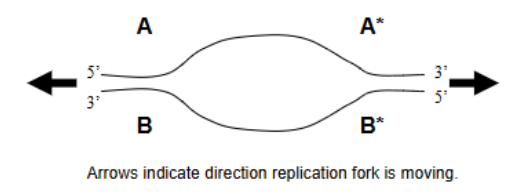
Which of the following is used as a parental template strand at some point during replication?
all of the above
When the replication fork reaches the end of the linear chromosome in eukaryotes, which newly synthesized strand is expected to NOT experience the “end-replication problem” that is overcome by telomerase function?
the leading strand
A primary function of the 3’ poly(A) “tail” put on eukaryotic transcripts is to:
increase stability of the transcript
which of the following distinguishes transcription from replication? Unlike DNA polymerase during replication:
RNA polymerase can initiate synthesis without a primer.
during protein synthesis on the ribosome, new amino acids are always
added:
o the C-terminus of the growing polypeptide chain
When the translation machinery encounters a “stop” codon:
translation is terminated by release factors (proteins) that are recruited in
response to the stop codon.
n eukaryotic cells, DNA is:
packaged into nucleosomes
during splicing
he introns are removed from the primary transcript
You discover a sequence of DNA that increases expression of a gene located 25,000 base pairs away from the sequence. The segment of DNA you identified is likely to be:
an enhancer
during the production of mature mRNAs
Splice donors pair with splice acceptors resulting in intron removal.
In Transcription, the function of promoter elements is to:
Attract RNA polymerase to initiate expression of genes.
To demonstrate the transforming principle, Frederick Griffith made use of strains of Streptococcus pneumoniae bacteria. In his experiment:
Something in the heat killed Smooth S. pneumoniae transformed the non- virulent Rough S. pneumoniae to a virulent Smooth S. pneumoniae.
During translation, the correct amino acid encoded by the mRNA is
incorporated into the growing peptide chain because
he anticodon of a correctly charged tRNA basepairs with the codon in the
mRNA.
The following mRNA is translated in a cell. Identify the encoded protein
sequence.
5’ ACAGAUGACUGCUAUCUGAAUUGUA 3’
MET-THR-ALA-ILE
Chargaff’s rules state that
all of the above
The amount of purines = amount of pyrimidines.
The amount of thymine = amount of adenine
The amount of guanine = amount of cytidine
Amount of A+T does not equal the amount of G+C