8- child extractions
 Call Kai
 Learn
Learn Practice Test
 Spaced Repetition
 Match
Match Flashcards
 Knowt Play
1/22

There's no tags or description
Looks like no tags are added yet.
Name | Mastery | Learn | Test | Matching | Spaced | Call with Kai |
|---|
No analytics yet
Send a link to your students to track their progress
23 Terms
What does the success of a pediatric extraction depend on?
Procedure itself- loose tooth or surgical extraction
Child’s psychological conditions
Behaviour management techniques- motivation and anxiety control
LA or sedation techniques- pain control
As a general rule…
Surgical extraction is not necessary in temporary dentition
Must have informed consent and preop x rays
Indications for extractions in temp dentition
Large non restorable caries lesions
Traumatic lesions- dentoalveolar fracture, vertical fracture
Orthodontic reasons (serial extractions)
Periapical or inter-radicular infection- no other alternative
Medical reasons (lack of cooperation, disabled patient)
Acute dento-alveolar abscess with cellulitis
Temporary teeth which interfere with the normal eruption of the permanent successor (ectopic eruption, ankylosis)
Persistence of temporary roots
Serious delay of eruption of the permanent teeth
Temporary teeth related or close to cysts, tumors
Periodontal problems
Economic problem
What are some systemic contraindications of extractions?
Medical issues may delay- consult with paediatrician or specialist
Rheumatic fever in childhood
Congenital cardio disease
Renal disorder
Immunodeficiency
Blood dyscrasia, Hemophilia or other platelet disorders
Diabetes (if uncontrolled- affects healing process, due to weak immune system)
Patients on steroids.
Malignant disease is an absolute contraindication- Leukaemia, Lymphoma- Increased risk of infection and bleeding. Only indicated if maxillary bones need radiation because of a tumor
Local contraindications in dental extractions
Previous/ present radiation treatment in that area- ORN of the jaws is likely to develop (absolute contraindication).
Severe acute infection abscess, pericoronitis (relative contraindication, extraction is delayed)
Angioma
Other contraindications to consider?
Psychological and physical immaturity of child- assess social, emotional status and cognitive level
Nutritional facts
If no informed consent
What must you evaluate preop extraction?
Medical history, intraoral exam, radiogarph
Behaviour
Signed informed consent
Explain procedure to child and parent
Premedication if necessary (endocarditis)
Give post op recommendations and prescribe meds in advance
Instruments- forceps
Pediatric forceps- smaller and easier to hide in hand
Conventional forceps- bigger but easier to handle- more efficient for force
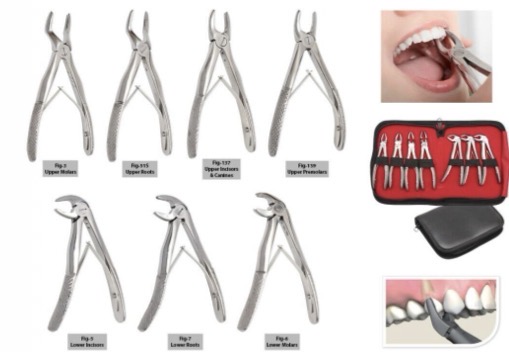
Instruments- elevators or luxators
Use if- retained roots, ankylosed teeth, very destroyed teeth
Caution if sharp
Control tip by placing finger close to it, hold handle with hand
Instruments- peristome, curette
Peristome- retracts mucoperiosteum
Sharp spooned curette- to remove connective and granulation tissue from bone- NOT FOR TEMP- damages perm tooth
Suture not freq
Anaesthesia technique for extractions?
Local
Start with topical- spray/gel- benzocaine gel 5 mins
1- Infiltration injection
2- Mandibular block- but may be uncomfy
Upper anteriors extraction technique
Easy and simple- good visibility
1 conical root
Cause- trauma or huge caries
Rotation with forceps
Roots require elevator then forceps
Respect permanent germ- in palatal apical area
Luxation movements of crown ALWAYS LINGUAL never buccal
When shouldn’t you extract upper anteriors?
If non visible radicular crest
Usually after horizontal fracture
Leave them to resorption
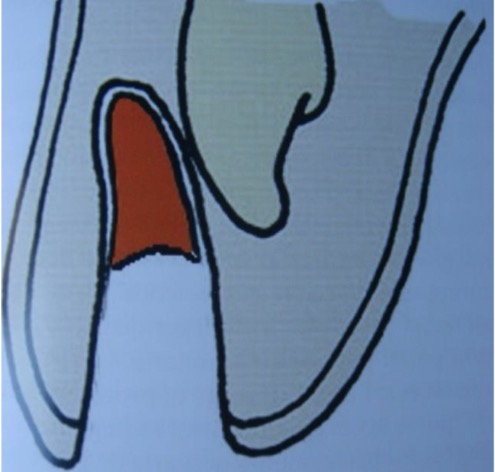
How to extract lower anterior teeth?
Due to lingual eruption of permanent
Careful luxation movements if atypical root resorption as the root will be long but extremely thin
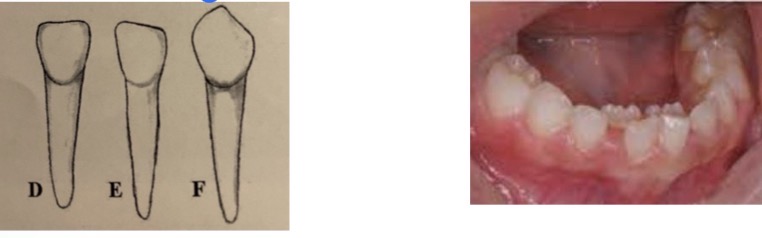
How to extract upper posterior molars? (Why difficult to use forceps, first, what movements)
Crown convexity + cervical outline height + root convexity
Use the elevator to remove insertion
Start with palatal movements, and after buccal movements
Soft circular movements can be performed after that
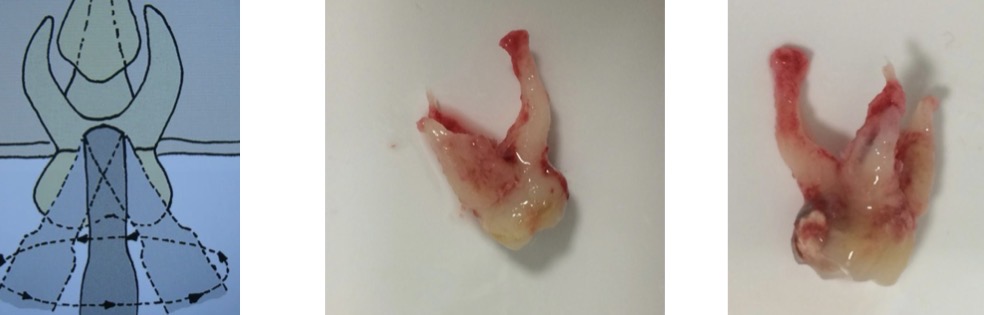
What instruments to use/not for lower posterior molars, consider…?
Avoid cow horn forceps- damage perm germ
Use straight elevator
If difficult- odontosection- in L2M extract m and d roots separately
Support mandible to protect TMJ joints from injury
Maxillary and mandibular molars important points
Roots are shorter, thiner and much more divergent than permanent
Eruption of the successor weaken the roots
Root fracture common
Before extraction, assess with X-Ray of the relation between temporary roots and the permanent successor (how close)
Pressure should be avoided in the furcation area. maybe odontosection to protect the developing permanent tooth
Force has to be continuous palatal-lingual to buccal, allows for the expansion of the alveolar bone to reduce the risk of root fracture
What to remember if the primary tooth root is fractured?
If root tip can be removed easily- remove it
If small root deep in socket close to perm successor- leave to be resorbed- inform parents and monitor
Extraction of immature PD…
Usually premolars for orthodontic indication, or first molars (caries, MIH)
Less probability of root fracture
Bone is more spongy than the one in an adult
What must you do during the extraction?
Prevent swallowing extracted tooth by placing intraoral gauze behind it
If extracting after a resto- keep rubber dam on
Avoid periapical curettage
Post operative consideration
Show cleaned extracted tooth
Hold gauze for 15-30mins- change if bleeding continues to 60mins
Don’t eat until after anaesthesia effect gone
Don’t rinse or spit first day
Ice in wet cloth can be placed after 2-3 hrs- 10mins on, 20mins off
Soft cold diet , careful brushing
Rinse with serum + take painkiller
What is the most frequent complication after child extractions?
Mainly after inferior alveolar block (mandible)
Swelling as child suctions their lip- cerstaes edema- mistaken for abscess
Mild pain and discomfort
May scratch injury of chin
What are some complications averted child extractions?
Pain
Difficulty eating and drinking
Abscess
Temperature
Cellulitis
Septicaemia