NSCI1001 Introduction to the Brain Part III: Chemical Signaling
0.0(0)
Studied by 4 people Call Kai
 Learn
Learn Practice Test
 Spaced Repetition
 Match
Match Flashcards
 Knowt Play
Card Sorting
1/31

Earn XP
Description and Tags
Last updated 4:49 PM on 1/31/23
Name | Mastery | Learn | Test | Matching | Spaced | Call with Kai |
|---|
No analytics yet
Send a link to your students to track their progress
32 Terms
1
New cards
Ligand-gated channels
receptors for neurotransmitters
2
New cards
When a neuron responds to hyper/depolarization stimuli with a graded potential, where in the neuron does this take place?
dendrites
3
New cards
When a neuron responds to hyper/depolarization stimuli with an action potential, where in the neuron does this take place?
axon
4
New cards
synapse
transmit chemical signals from one cell to the next
5
New cards
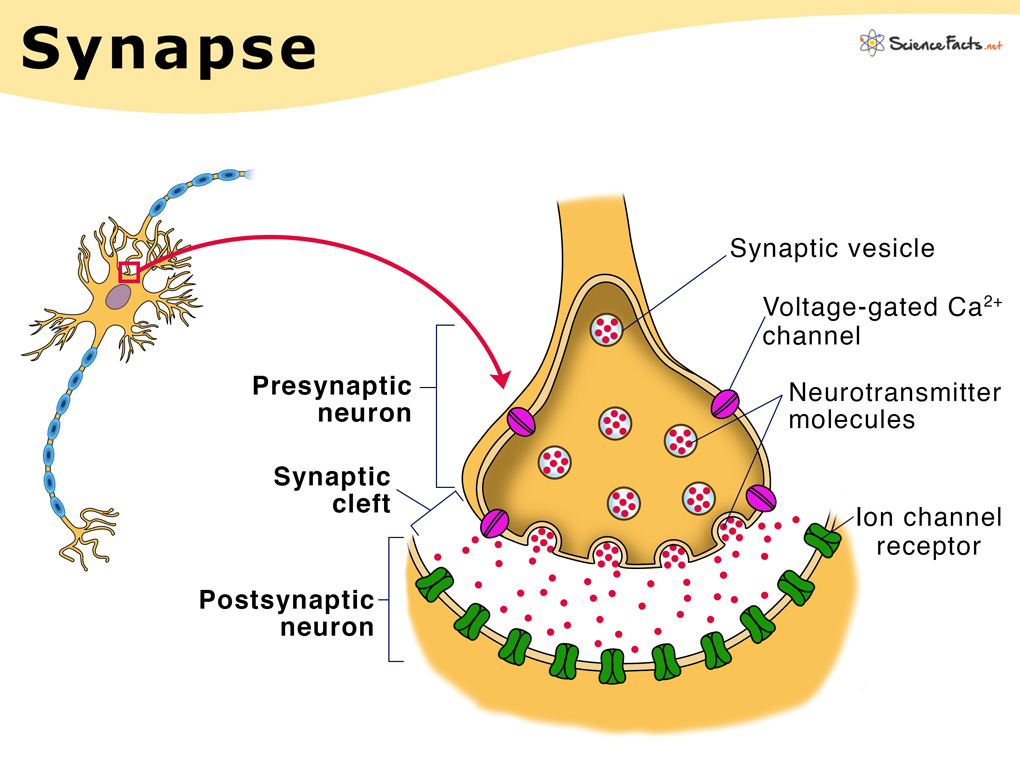
where on the neuron is the presynaptic terminal? how much space is between neurons in the synaptic cleft? where on the neuron is the postsynaptic membrane?
axon terminal; \~50 nm; dendrite
6
New cards
What are the seven steps in synaptic transmission?
1. action potential arrives at axon terminal
2. Ca +2 channels open allowing Ca +2 to flow into the cell
3. synaptic vesicles fuse with the cell membrane
4. synaptic vesicles release neurotransmitters into the synapse
5. receptor activation
6. post-synaptic cell decides if it will fire an action potential
1. inactivation
7
New cards
step 1 of synaptic transmission
action potential: a depolarizing action potential arrives at the axon terminal
8
New cards
step 2 of synaptic transmission
Ca 2+ influx: voltage-gated Ca 2+ channels open allowing Ca +2 to flow into presynaptic cell
9
New cards
step 3 of synaptic transmission
movement of synaptic vesicles: Ca +2 causes the synaptic vesicles to move to the membrane and fuse with the membrane
10
New cards
step 4 of synaptic transmission
release: neurotransmitters are released into the synapse
11
New cards
step 5 of synaptic transmission
receptor activation: neurotransmitters in the synapse can freely move about; if they interact with a receptor (bind to it) they activate the receptor to stimulate electrical changes in the postsynaptic neuron post-synaptic electrical response; glutamate opens ligand-gated channels
12
New cards
step 6 of synaptic transmission
signal new action potential: cell body adds the graded inhibitory and excitatory potentials and decides whether to produce a new action potential
13
New cards
step 7 of synaptic transmission
neurotransmitter inactivation: neurotransmitters in synapse are either (a) altered into inactive substances or (b) recycled (reuptake) back into presynaptic vesicles
14
New cards
which glial cells have uptake mechanisms to inactivate glutamate?
astrocytes
15
New cards
how do neurotransmitters engage with the postsynaptic terminal?
they bind to receptors but do not enter
16
New cards
synaptic plasticity
synaptic transmission can be changed by experience
17
New cards
synaptic transmission
communication between neurons
18
New cards
What do long-term changes in synaptic transmission represent?
cellular basic of learning and memory
19
New cards
glutamate
most abundant excitatory neurotransmitter in CNS; learning and memory, neuronal death, seizure disorders (epilepsy)
20
New cards
GABA
most abundant inhibitory neurotransmitter in CNS; seizure disorders (epilepsy); mainly in brain
21
New cards
glycine
inhibitory neurotransmitter; mainly in spinal cord
22
New cards
acetylcholine
neuromuscular synapse (constructs muscles); learning and memory, Alzheimer’s disease
23
New cards
dopamine
reward, Parkinson’s disease, schizophrenia, drug addiction, happy signals
24
New cards
serotonin
sleep-wake cycle, depression
25
New cards
noradrenaline
sleep-wake cycle, alterness
26
New cards
neuropeptides
opioids (encephalin, endorphin, etc.), substance P, etc. (e.g. analgesics → painkillers)
27
New cards
pharmacological therapy
use of molecules to replace deficiencies in neurotransmitters (e.g. L-Dopa treats Parkinson’s)
28
New cards
how can we target the steps in chemical neurotransmission for drug therapies?
synthesis, chemical inactivation, reuptake, receptor activation
29
New cards
synthesis
L-Dopa used to treat Parkinson’s disease
30
New cards
chemical inactivation
MAOI’s (antidepressant drugs) block chemical inactivation, meaning there is more dopamine (and other neurotransmitters) in the synapse
31
New cards
reuptake
amphetamine blocks reuptake of dopamine into the presynaptic cell, which means there is more dopamine remaining in the synapse (used to treat ADD)
32
New cards
receptor activation
dopamine binds to two different receptors, D1 receptors which stimulate postsynaptic neurons (make them more positively charged) and D2 receptors which inhibit postsynaptic neurons (make them more negatively charged); anti-schizophrenic drugs like haldol (haloperidol) block these dopamine receptors and alleviate schizophrenic symptoms