B. PRODUCTS AND CONSTITUENTS
 Call Kai
 Learn
Learn Practice Test
 Spaced Repetition
 Match
Match Flashcards
 Knowt Play
1/28

There's no tags or description
Looks like no tags are added yet.
Name | Mastery | Learn | Test | Matching | Spaced | Call with Kai |
|---|
No analytics yet
Send a link to your students to track their progress
29 Terms
a) Health foods
b) Crude drug
Products of pharmacognostic origin can be: (2)
c. Health foods
Products of natural origin which without therapeutic effect are used in self-treatment of diseases
a. Crude drugs
b. Constituents
c. Health foods
d. Galenicals
d. Crude drugs
Vegetable or animal drugs that consist of natural substances only undergoing collection and drying
a. Health foods
b. Constituents
c. Galenicals
d. Crude drugs
d. Vegetable and animal
The two sources of crude drugs
a. Synthetic and semisynthetic
b. Marine and terrestrial
c. Fungal and bacterial
d. Vegetable and animal
a. Constituent
A compound that is pharmaceutically or pharmacologically active
a. Constituent
b. Crude drug
c. Health food
d. Biogenesis
c. Biogenesis
The synthesis of constituents also known as anabolism
a. Catabolism
b. Metabolism
c. Biogenesis
d. Biotransformation
c. Synthetic production
The application of biogenesis in the pharmaceutical industry
a. Drug distribution
b. Drug elimination
c. Synthetic production
d. Drug absorption
a) Primary
b) Secondary
Constituents are mainly classified based on the organism's need for it: (2)
c. Organism's need for the constituent
The basis for the main classification of constituents in pharmacognosy
a. Chemical structure of the compound
b. Therapeutic use of the compound
c. Organism's need for the constituent
d. Source of the natural product
b. Primary constituents
-yung biomolecules (carbs, lipids, proteins, nucleic acid)
The classification of constituents that are needed by the organism to survive
a. Tertiary constituents
b. Primary constituents
c. Accessory constituents
d. Secondary constituents
b. Secondary constituents
The classification of constituents that are not needed to survive but have special purposes
a. Tertiary constituents
b. Secondary constituents
c. Accessory constituents
d. Primary constituents
a. Reproduction, protection, and defense
The special purposes served by secondary constituents in organisms
a. Reproduction, protection, and defense
b. Digestion, defense and absorption
c. Cell division, protection and repair
d. Energy production, cell division and growth
d. Alkaloids
The secondary constituent that deters herbivores through a bitter defense mechanism
a. Volatile oils
b. Carbohydrates
c. Lipids
d. Alkaloids
a. Volatile oils
The secondary constituent that attracts pollinators
a. Volatile oils
b. Carbohydrates
c. Lipids
d. Alkaloids
c. Thylakoids
called a granum when stacked
The structure where light-dependent reactions occur
a. Stroma
b. Chloroplast matrix
c. Thylakoids
d. Cell membrane
ATP, NADPH, and oxygen
The products of the light-dependent reaction of photosynthesis
Calvin cycle/ Carbon fixation
Light-independent reaction is aka
c. Stroma
The location in the plant cell where the light-independent reaction or Calvin cycle occurs
a. Thylakoids
b. Mitochondria
c. Stroma
d. Nucleus
Glucose
The product of the light-independent reaction or Calvin cycle
c. It can happen even when there is light
The light-independent reaction is often misunderstood when called dark reactions because
a. It only occurs in the absence of light
b. It produces dark-colored pigments
c. It can happen even when there is light
d. It requires darkness to produce glucose
c. C₄ carbon fixation
low H2O absorption = CAM
high Co2 absorption = C4 fixation
The specialized type of carbon fixation used by plants to deal with high CO₂ levels
a. C₃ carbon fixation
b. CAM
c. C₄ carbon fixation
d. C₂ carbon fixation
b. CAM (Crassulacean acid metabolism)
low H2O absorption = CAM
high Co2 absorption = C4 fixation
The specialized metabolic pathway used by plants to deal with low water contents
a. C₃ carbon fixation
b. CAM
c. C₄ carbon fixation
d. C₂ carbon fixation
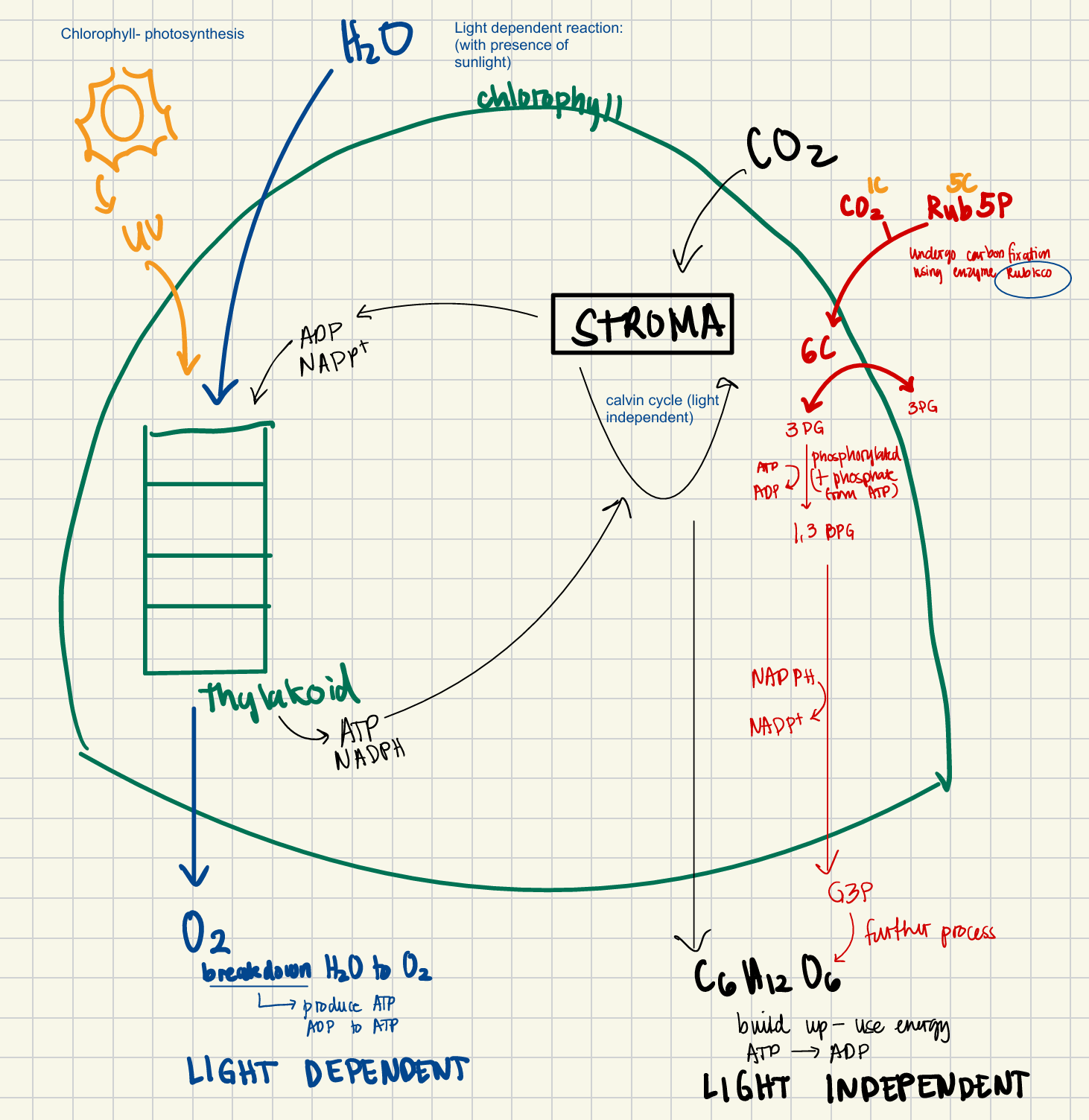
draw light-independent and light-dependent reactions
d. Natural
A product that did not undergo molecular modifications
a. Total synthesis
b. Semi-synthetic
c. Biosynthetic
d. Natural
c. Semi-synthetic
A product that uses a natural product as starting material then underwent molecular modification
a. Natural
b. Total synthesis
c. Semi-synthetic
d. Biosynthetic
d. Total synthesis
A product that did not involve any natural starting material at all
a. Natural
b. Semi-synthetic
c. Biosynthetic
d. Total synthesis
d. Pinene from pine
pine → pinene —( modification) → camphor
The natural starting material used in the semi-synthetic production of camphor
a. Vinyl chloride
b. Cycloheptadine
c. Camphor plant
d. Pinene from pine
b. Vinyl chloride and cycloheptadine
vinyl chloride + cycloheptadine → synthetic camphor
The reactants used in the total synthesis of camphor that do not involve any natural starting material
a. Pinene and camphor plant
b. Vinyl chloride and cycloheptadine
c. Pine extract and cycloheptadine
d. Camphor and pinene
d. 3
a) Natural
b) Semi-synthetic
c) Total synthesis
The total number of classifications of products based on origin
a. 4
b. 5
c. 2
d. 3