MCAT Organic Chemistry
 Call Kai
 Learn
Learn Practice Test
 Spaced Repetition
 Match
Match Flashcards
 Knowt Play
1/115

There's no tags or description
Looks like no tags are added yet.
Name | Mastery | Learn | Test | Matching | Spaced | Call with Kai |
|---|
No analytics yet
Send a link to your students to track their progress
116 Terms
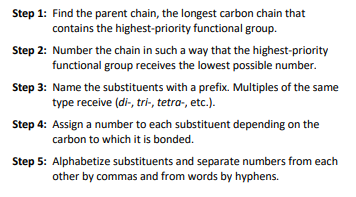
IUPAC Naming Steps
Alkane
Hydrocarbon with only single bonds -ane
Alkene
Hydrocarbon with double bond -ene
Alkyne
Hydrocarbon with triple bond -yne
Alcohol
-OH with -ol suffix and hydroxy- prefix
Diol
Contains 2 hydroxyl groups.
Geminal: If on same carbon
Vicinal: If on adjacent carbons
Carbonyl
C=O
Aldehyde
Carbonyl group on the end of carbon chain
Ketone
Carbonyl group in the middle of carbon chain
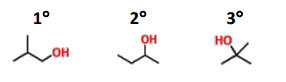
1,2,3, Alcohols
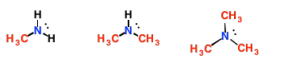
1,2,3, Amide
Carboxylic Acid
Highest priority functional group since it contains 3 bonds to oxygen. -oic
Ester
Derivative of carboxylic acid with -OH replaced with -O-
Amide
Replace -OH in carboxylic acid with an amino group
Chiral center
4 different groups attached to a central carbon
2n rule
n = number of chiral centers # of stereoisomers = 2^n
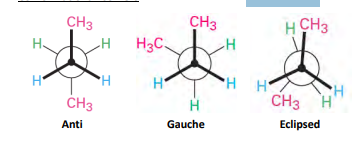
Types of isomers
Cyclohexane substituents
Equatorial: In the plane of the molecule.
Axial: Sticking up/down from the molecule’s plane.
Enantiomers
Nonsuperimposable mirror images. Opposite stereochemistry at every chiral carbon. Same chemical and physical properties, except for rotation of plane polarized light.
Optical activity
The ability of a molecule to rotate plane-polarized light: d- or (+) = RIGHT, l- or (-) = LEFT.
Racemic Mixture
50:50 mixture of 2 enantiomers. Not optically active
Meso compounds
Have an internal plane of symmetry, will also be optically inactive because the two sides of the molecule cancel each other out.
Diasteromers
Not mirror image but are stereoisomers
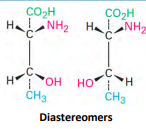
Cis-Trans
A subtype of diastereomers. They differ at some, but not all, chiral centers. Different chemical and physical properties.
Relative configuration
Gives stereochemistry of a compound in comparison to another
Absolute configuration
Gives the stereochemistry of a compound without having to compare to other compounds
Cahn-ingold-prelog priority rules
Priority is given by looking at atoms connected to the chiral carbon or double-bonded carbons; whichever has the highest atomic # gets highest priority
ZE for akenes
Z is highest on same while E is highest on opposite
RS for stereoisomers
R is clockwise and S is counterclockwise
Fisher projection
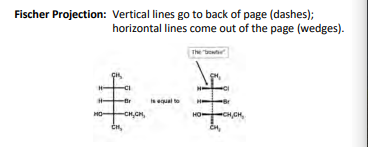
Alternating fischer projection
Switching 1 pair of substituents inverts the stereochemistry; switching 2 pairs retains stereochemistry. Rotating entire diagram 90° inverts the stereochemistry; rotating 180° retains stereochemistry
Bonding orbitals
Created by head-to-head or tail-to-tail overlap of atomic orbitals of the same sign. Lower energy more stable
Antibonding orbitals
Created by head-to-head or tail-to-tail overlap of atomic orbitals of opposite signs. More energy less stable
Resonance
Describes the delocalization of electrons in molecules that have conjugated bonds
Conjugation
Occurs when single and multiple bonds alternate, creating a system of unhybridized p orbitals down the backbone of the molecule through which p electrons can delocalize
Alpha-carbon
Carbon adjacent to a carbonyl
Alpha-hydrogen
Hydrogen connected to an alpha carbon
Nucleophiles
“Nucleus-loving”. Contain lone pairs or p bonds. They have increasing EN and often carry a NEG charge. Amino groups are common organic nucleophiles.
Nucleophilicity
A kinetic property. The nucleophile’s strength. Factors that affect nucleophilicity include charge, EN, steric hindrance, and the solvent.
Electrophiles
“Electron-loving”. Contain a + charge or are positively polarized. More positive compounds are more electrophilic
Leaving group
Molecular fragments that retain the electrons after heterolysis. The best LG can stabilize additional charge through resonance or induction. Weak bases make good LG.
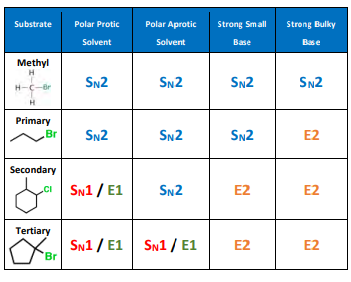
Sn1
Unimolecular nucleophilic substitution. 2 steps. In the 1st step, the LG leaves, forming a carbocation. In the 2nd step, the nucleophile attacks the planar carbocation from either side, leading to a racemic mixture of products. Rate = 𝑘 [substrate]
Sn2
Bimolecular nucleophilic substitution. 1 concerted step. The nucleophile attacks at the same time as the LG leaves. The nucleophile must perform a backside attack, which leads to inversion of stereochemistry. (R) and (S) is also changed if the nucleophile and LG have the same priority level. SN2 prefers less-substituted carbons because steric hindrance inhibits the nucleophile from accessing the electrophilic substrate carbon. Rate = 𝑘 [nucleophile] [substrate]
Polar protic
Acetic Acid, H2O, ROH, NH3
Polar aprotic
DMF, DMSO, Acetone, Ethyl Acetate
Leaving groups chart
Alcohols
Have the general form ROH and are named with the suffix –ol. If they are NOT the highest priority, they are given the prefix hydroxy
Phenols and types
Benzene ring with –OH groups attached. Named for the relative position of the –OH groups
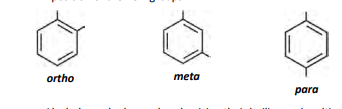
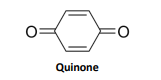
Quinones
Synthesized through oxidation of phenols. Quinones are resonance-stabilized electrophiles. Vitamin K1 (phylloquinone) and Vitamin K2 (the menaquinones) are examples of biochemically relevant quinones
Hydroxyquinones
Produced by oxidation of quinones, adding a variable number of hydroxyl gruops
Ubiquinone
Also called coenzyme Q. Another biologically active quinone that acts as an electron acceptor in Complexes I, II, and III of the electron transport chain. It is reduced to ubiquinol
Primary Alcohol
Can be oxidized to aldehydes only by PCC; oxidized all the way to carboxylic acids by any stronger oxidizing agents
Secondary Alcohol
Can be oxidized to ketones by any common oxidizing agent
Mesylates
Contains -SO3CH3
Tosylates
Contains -SO3C6H4CH3
Acetal
Primary carbon with -OR and H atom
Ketal
Secondary carbon with 2 -OR groups
Deprotection
Acetal or ketal back to a carbonyl by acid
Oxydation in aldehydes and ketones
Are produced in primary and secondary alcoholds. PCC must be used for aldehydes or it will end up being a carboxylic acid
Keto/enol
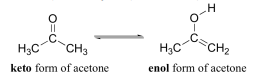
Aldehydes and ketones exist in both keto and enol form
Tautomers
Isomers that can be interconverted by moving a hydrogen and a double bond
Michael Addition
Enolate attacks an a,b-unsaturated carbonyl, creating a bond
Kinetic Enolate
Favored by fast, irreversible reactions at LOW TEMP, with strong, sterically hindered bases.
Thermodynamic enolate
Favored by fast, reversible reactions at HIGH TEMP with weaker, smaller bases
Enamines
Tautomers of imines. Less common
Aldol
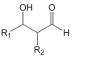
Contains aldehyde and alcohol
Aldol Nucleophile
The nucleophile is the enolate formed from the deprotonation of the a-carbon
Aldol Electrophile
The electrophile is the aldehyde or ketone in the form of the keto tautomer
Dehydration
After the aldol is formed, a dehydration reaction (loss of water molecule) occurs. This results in an a,bunsaturated carbonyl.
Retro-Aldol Reactions
Reverse of aldol reactions. Catalyzed by heat and base. Bond between a- and b-carbon is cleaved.
Carboxylic acid nomenclature
Suffix –oic acid. Salts are named with the suffix –oate, and dicarboxylic acids are –dioic acids
Carboxylic acid properties
Carboxylic acids are polar and hydrogen bond well, resulting in high BP. They often exist as dimers in solution.
Carboxylic acid acidity
The acidity of a carb acid is enhanced by the resonance between its oxygen atoms. The acidity can be further enhanced by substituents that are electron-withdrawing, and decreased by substituents that are electron-donating
Beta-dicarboxylic acids
Like other 1,3-dicarbonyl compounds, they have an ahydrogen that is also highly acidic
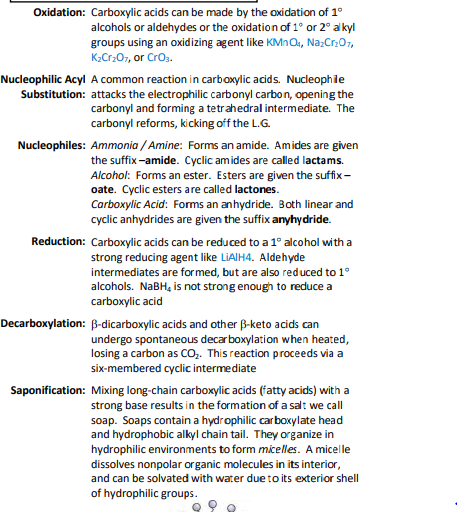
Reactions of carboxylic acids
Anhydrides
-O- connecting 2 carbonyls. 5 or 6 membered rings are stable
Steric hinderance
When a reaction cannot proceed because of crowding
Induction
Uneven distribution of charge across a sigma bond due to differences in electronegativity. More electronegativity = greater reactivity
Conjugation
Alternating single and multiple bonds, which create delocalized pi electron clouds. More reactive
Ring strain
More reactive. Torsional strain from eclipsing interactions and angle strain from compression bond angles below 109.5
Cleavage
Anhydrides can be cleaved by the addition of a nucleophile. Addition of ammonia or an amine results in an amide and a carboxylic acid. Addition of an alcohol results in an ester and a carboxylic acid. Addition of water results in two carboxylic acids.
Transesterification
The exchange of one esterifying group for another on an ester. The attacking nucleophile is an alcohol.
Amino acid structure
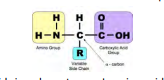
Aliphatic
Non-aromatic. Side chains contains only C and H
Peptide bonds
C-N bond and formed by condensation reactions. Need strong acid/base to cleave peptide bond
Polypeptides
Made up of multiple amino acids linked by peptide bonds. Proteins are large, folded, functional polypeptides.
Strecker Synthesis
Generates an amino acid from an aldehyde
Gabriel synthesis
Generates an amino acid from potassium phthalimide, diethyl bromomalonate, and an alkyl halide.
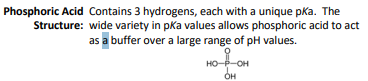
Phosphoric acid
Sometimes referred to as a phosphate group or inorganic phosphate, denoted Pi. At physiological pH, inorganic phosphate includes molecules of both hydrogen phosphate (HPO4 2-) and dihydrogen phosphate (H2PO4 - ).
Phosphoric acid structure
Phosphodiester bonds
Phosphorus is found in the backbone of DNA, which uses phosphodiester bonds. In forming these bonds, a pyrophosphate (PPi, P2O7 4-) is released.
Organic phosphates
Carbon containing compounds that also have phosphate groups. The most notable examples are nucleotide triphosphates (such as ATP or GTP) and DNA.
Important peaks for IR
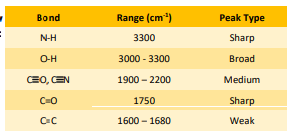
UV spec
Good for double bonds or heteroions.
HOMO and LUMO
To appear on a UV spectrum, a molecule must have a small enough energy difference between its HOMO and LUMO to permit an electron to move from one orbital to the other. The smaller the difference between HOMO and LUMO, the longer the wavelengths a molecule can absorb.
TMS
NMR spectra are calibrated using tetramethylsilane (TMS), which has a chemical shift of 0 ppm
Integration
Area under the curve that is proportional to the number of protons under the peak
Deshielding
Occurs when electron-withdrawing groups pull electron density away from the proton’s nucleus, allowing it to be more easily affected by the magnetic field. Deshielding moves a peak further downfield
Downfield
Left and deshielded
Upfield
Right and more shielded