Health Chapter 7
 Call Kai
 Learn
Learn Practice Test
 Spaced Repetition
 Match
Match Flashcards
 Knowt Play
1/154

There's no tags or description
Looks like no tags are added yet.
Name | Mastery | Learn | Test | Matching | Spaced | Call with Kai |
|---|
No analytics yet
Send a link to your students to track their progress
155 Terms
What do people assume obesity says about who someone is?
“They are lazy and gluttonous and have chosen to gain excess fat. This idea is not only false but also harmful.”
Is obesity a choice?
No
What contributes to weight gain?
Sleep deprivation, psychological stress, endocrine disrupters, medications, and insufficient medical attention due to weight bias can contribute to weight gain.
Studies show that genetics, epigenetics, and our environment play a significant role
What are the effects of the “voluntary obesity” idea?
Weight discrimination has been shown to do the opposite: increase overeating and bingeing.
Obesity is linked with a higher risk of what?
Cardiovascular diseases: coronary heart disease, cerebrovascular disease, and heart failure, among others.
What does evidence say one’s level of health may depend on?
Your level of health may depend on how high your body mass index is and how much physical activity you do
The paradox of being “___________” is controversial
Fat and Fit
The key to the paradox of being “fat and fit” is to focus on _________________
focus on how much fat we have or where the fat is located, rather than how much we weigh.
What do do the benefits of fitness on metronomic heath look like for someone with high levels of obesity?
The benefits of fitness on metabolic health appear similar if not even more significant for those with higher levels of obesity.
Why do critics argue against calling obesity a “disease?”
•We could say that accumulating fat is a naturally evolved way to be.
•A designation of disease might keep people from being proactive about changing their weight status.
•The label disease might carry with it weight stigma.
What are the arguments of calling obesity a disease?
Many individuals with obesity do present criteria for having a disease.
A disease identity improves research into treatment and prevention.
Weight stigma can be reduced by emphasizing genetic and environmental factors that contribute to obesity.
The label can refer more broadly to a “socially communicable” disease.
What approaches to health can work to the opposite effect than intended: a healthier you?
Weight-centric approaches to health
What are ways to measure health?
Weight remains essential, but it is one of many factors, including fat content, fat distribution, diets, levels of physical activity, hormonal balance, blood pressure, stress, and satisfaction with ourselves
What is thought to be linked to obesity?
Insulin and the hormones leptin and ghrelin
The environment in which many Americans live and work can be “obesogenic.” What does this mean?
It encourages overconsumption of calories and discourages physical activity.
What does the food industry promote at every turn?
The sale of high-calorie processed foods
Who is targeted by the food industry at a young age age and why?
Because they have a stronger preference for sweets than adults do, children are targeted from a young age and encouraged to make unhealthy choices.
Many experts observe that U.S. agricultural policy encourages farmers to produce what?
Corn and its by-product, high fructose corn syrup, at the expense of fruits and vegetables
What is the result of the encouraged corn production over fruits and vegetables over the past decades?
Over the past decades, the price of fruits and vegetables has risen much faster than the prices of other consumer goods, while the price of sugar, sweets, and carbonated drinks declined.
How can public policies have a good influence?
The updated food labels and new regulations requiring chain restaurants and vending machine operators to post calorie information should help consumers make more informed choices.
What are public health experts encouraging people to do?
Rather than leaving all discussion to policymakers, public health experts are encouraging people to mobilize grassroots campaigns against the way food is currently distributed and marketed.
When do we learn our healthy and unhealthy eating behaviors?
Early on
What is food often a symbol of?
Love and caring
Food’s integral part of social gatherings and celebrations can what?
Make changes to eating patterns difficult.
What have many people used food for?
A means of coping with stress and negative emotions
What happens when eating becomes the primary means of regulating emotions?
Binge eating or other unhealthy eating patterns can develop.
How has food choices can become a source of power?
•The domain of food may represent one of few that people perceive to be under individual control.
•Groups can make collective decisions about how to gain power through food.
Within some populations, the prevalence of what goes down as family income level goes up, especially among women and children?
The prevalence of obesity goes down as family income level goes up
What percentage of children and adolescents have obesity?
20%
What percentage of children and adolescents have severe obesity?
6%
All U.S. ethnic/racial groups are affected by unhealthy weight. Are there differences among them?
Yes
All U.S. ethnic/racial groups are affected by unhealthy weight. What are the differences between them?
Black Americans have significantly higher rates of obesity compared to other groups
Black women have significantly higher rates than Black men.
Severe obesity occurs at significantly higher rates among women, people aged 40–59, and non-Hispanic Blacks.
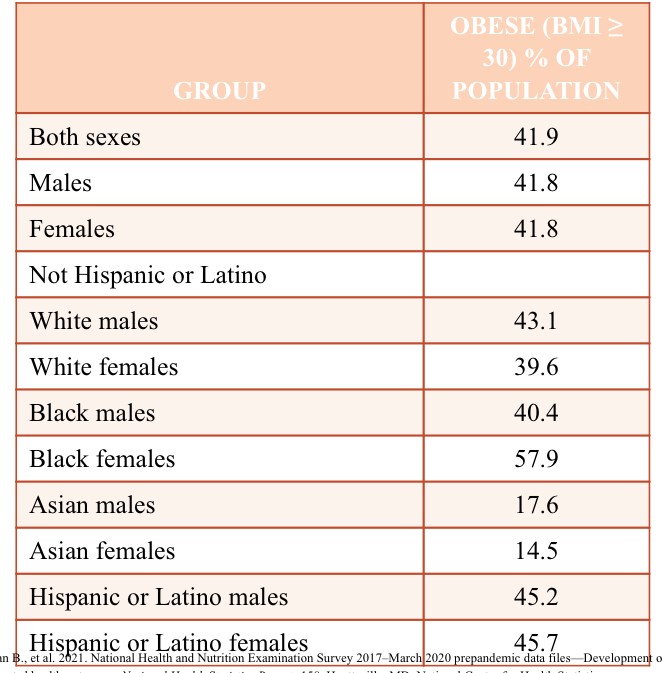
Study this picture. Who is affected by obesity the most? Who is affected by obesity the least?
Most: Hispanic or Latino females (45.7%)
Least: Asian females (14.5%)
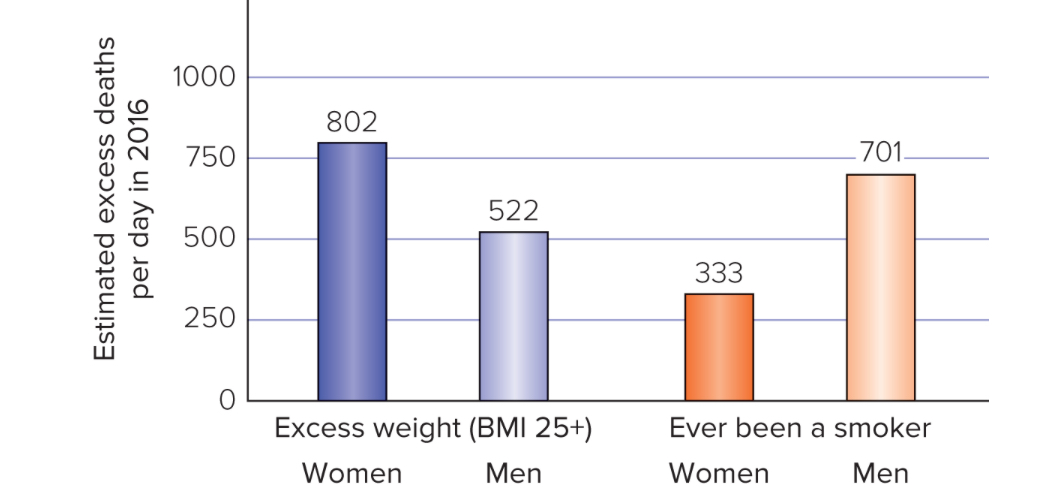
Study this graph
More women than men die from obesity than men
More men die from smoking than women
More people die from obesity than smoking
Obesity is 1 of __ major controllable risk factors for heart disease.
6
What risks do obesity increase?
Heart disease, cardiovascular disease (CVD), hypertension, certain forms of cancer, gallbladder disease, kidney disease, respiratory problems, joint diseases, skin problems, impaired immune function, and sleep disorders.
How much weight loss in individuals with obesity can reduce the risk of weight-related health conditions and increase life expectancy.
5-10%
Overweight
Abnormal fat accumulation above the recommended range for good health
Obesity
Severely overweight, characterized by an excessive accumulation of body fat
What is the most important thing to consider for health?
The proportion of the body’s total weight that is fat—the percent body fat.
Body Mass Index (BMI)
A measure of body weight that is useful for estimating a person’s weight status and for classifying the health risks of body weight
How is BMI calculated
BMI is calculated by dividing body weight (in kilograms) by the square of height (in meters).
Mass/height
BMI is combined with waist measurement in order to do what?
to more accurately assess health risks
Waist measurement and waist-to-hip ratio help provide what?
assessment of body fat distribution
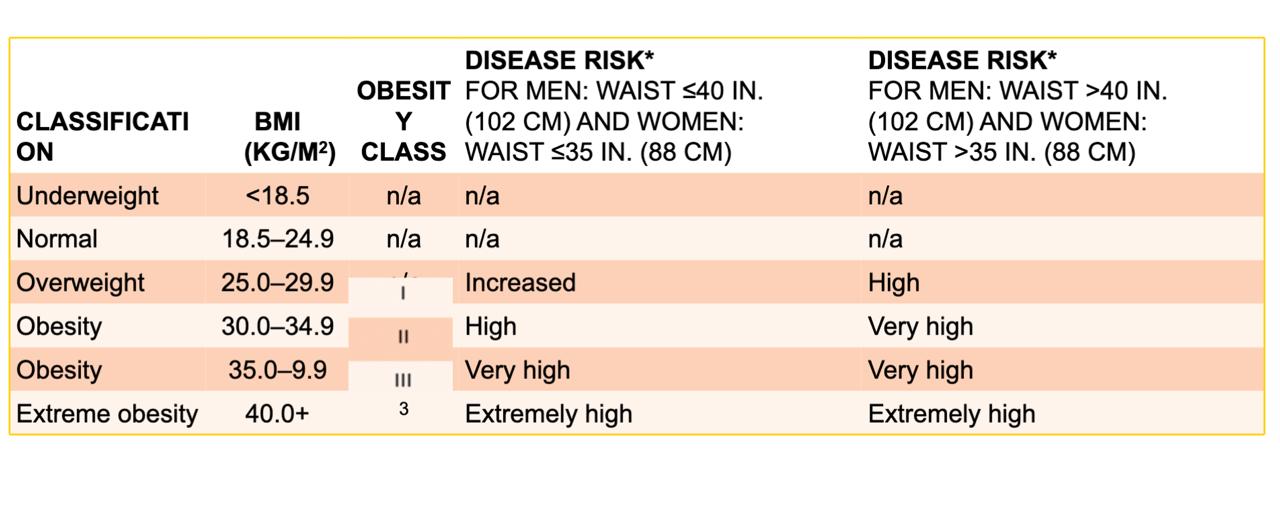
Study this
*Disease risk for type 2 diabetes, hypertension, and cardiovascular disease.
Note: Increased waist circumference also can be a marker for increased risk, even in people with BMI classified as normal.
Body image
the mental representation we hold about our bodies
Body image is the cultural picture of the body as seen through the mind’s eye and consists of __________________
Perceptions, images, thoughts, attitudes, behaviors, and emotions.
What is the result like of discrimination and negative attitudes that result from weight bias?
Devastating
Developing a positive body image is an important aspect of ___________________
psychological wellness and successful weight management
What can poor body image can cause?
psychological distress
What does weight stigma do?
Weight stigma damages health, undermines human and social rights, and is unacceptable in modern societies
How does body dysmorphic disorder (BDD) affect people?
Individuals with body dysmorphic disorder (BDD) are overly concerned with physical appearance, often focusing on perceived flaws not apparent to others
How many people are affected by body dysmorphic disorder (BDD)?
BDD affects about 2% of Americans, males and females in equal numbers.
Does body image bear resemblance to fact always?
No
What is also a hallmark of muscle dysmorphia, in which people see themselves as small and out of shape despite being very muscular?
Distorted body image
Exercise is a healthy practice, but people with ___________ sometimes exercise excessively.
eating disorders or body image problems
Are there there are limits to the changes that can be made to body weight and body shape? Is so, why?
Yes, because body weight and body shape are influenced by heredity.
Knowing ______________ is crucial for overall wellness.
when the limits to healthy change have been reached and learning to accept those limits
Weight management is most successful in what kind of atmosphere?
a positive and realistic atmosphere
The hazards of excessive dieting and overconcern about body weight need to be countered by what?
A change in attitude
What movement reframes the paradigm of weight loss to disease prevention,
The Health at Every Size (HAES) movement
HAES sees weight as a marker of what?
HAES sees weight as a marker of size, not health.
Not using weight as a marker for size causes individuals to be what?
By not using weight changes as a marker for health, individuals may be less discouraged by weight stabilization or gain and may be more likely to continue in behaviors that have an independent benefit on health.
Eating disorders
a serious disturbance in eating patterns or eating-related behavior, characterized by a negative body image and concerns about body weight or body fat.
Eating disorders are classified as _________
mental disorders
Anorexia nervosa
an eating disorder characterized by a refusal to maintain body weight at a minimally healthy level and intense fear of gaining weight or becoming fat; self-starvation.
How many people suffer from anorexia nervous in their lifetimes?
Up to 4% of women and 0.3% of men
Anorexia nervosa has been linked to a variety of medical complications including what?
disorders of the cardiovascular, gastrointestinal, and endocrine systems.
Bulimia nervosa
an eating disorder characterized by recurrent episodes of binge eating and purging to prevent weight gain.
Purging
the use of vomiting, laxatives, excessive exercise, restrictive dieting, enemas, diuretics, or diet pills to compensate for food that has been eaten and that the person fears will produce weight gain.
Binge eating and purging may become a way of dealing with what?
difficult feelings such as anger and disappointment
The binge–purge cycle of bulimia places a tremendous strain on the body and can have what serious health effects?
tooth decay, esophageal damage and chronic hoarseness, menstrual irregularities, depression, liver and kidney damage, and cardiac arrhythmia.
Binge eating disorder (BED)
an eating disorder characterized by repeated episodes of eating large amounts of food in a short period of time; episodes are marked by feelings of lack of control.
Does binge eating disorder involve purging behaviors?
No
Binge eating disorders can often cause what?
Obesity
Other specified feeding or eating disorders (OSFED)
Other specified feeding or eating disorders (OSFED): a category describing a feeding or eating disorder that does not meet the full diagnostic criteria for anorexia, bulimia, or binge eating disorder.
Examples of OSFED include what?
atypical anorexia nervosa, a condition in which weight is not below normal; bulimia nervosa with less frequent bulimic episodes; purging disorder, a condition without binge eating; and night eating syndrome, in which the individual engages in excessive nighttime food consumption.
What should our relationship to food be?
Happy
What relationship with food do people with eating disorders have?
In the lives of affected individuals, eating results in feelings of guilt and self-loathing rather than satisfaction, causing tremendous disruption.
Do everyone who have abnormal habits have an eating disorder?
No. Many people have abnormal eating habits and attitudes about food that disrupt their lives, even though these habits do not meet the criteria for a major eating disorder.
What behaviors are considered disordered eating?
Behaviors such as food restriction, binge eating, or purging that are done less often or less severely might be considered disordered eating.
What are the health risks of disordered eating?
Disordered eating can have serious health risks, including a greater risk or obesity and eating disorders, bone loss, gastrointestinal disturbances, electrolyte and fluid imbalances, low heart rate and blood pressure, increased anxiety, depression, and social isolation.
Does social media cause eating disorders?
No, but social media can contribute to eating disorders
What industries contribute to the promotion of eating disorders?
Fashion, beauty, and fitness
Excessive time on social media has been associated with symptoms of what?
anxiety, depression, decreased psychological well-being, lower self-esteem, psychological distress, and loneliness.
The sharing of positive _____________ also happens over social media.
role models and healthy behaviors
When is a good time to develop a lifestyle for successful weight management?
During early adulthood, when healthy behavior patterns have a better chance of taking hold
What are healthy behaviors to adopt that can be maintained throughout life?
•good dietary patterns and eating habits;
•regular physical activity and exercise;
•strategies for positive thinking and managing emotions; and
•coping strategies for the stresses and challenges in life.
What does dieting involve?
Food restrictions
What does diet refer to?
Daily food choices
What suggests approximate daily energy (calorie) needs based on age, sex, height, weight, and physical activity level?
MyPlate
What is a more important consideration for weight management than total calories consumed?
Individual energy balance
What to do if weight loss is your goal?
If weight loss is your goal, increase your physical activity and include strength training to build muscle mass and aerobic-type exercises to burn calories.
Is losing weight of maintaining weight easier?
Maintaining weight loss may be more difficult than losing the weight
What is an effective approach to long-term weight maintenance without the need for counting calories?
intuitive eating
Are portion sizes are important?
Yes
How many people significantly underestimate the amount of food we eat?
Most people
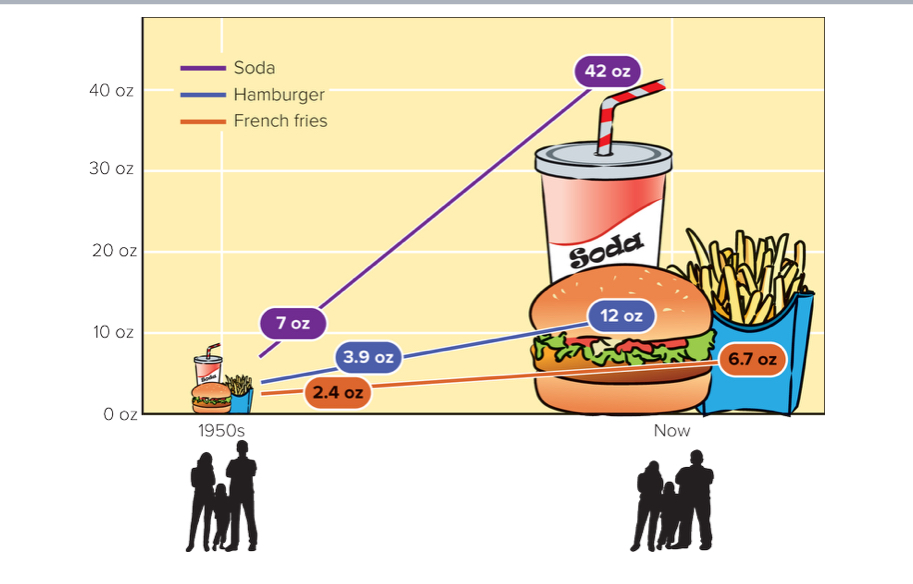
Study this
Portion sizes have been growing. So have we. The average restaurant meal today is more than four times larger than in the 1950s. Adults today are, on average, 26 lbs heavier. To eat healthy, there are things we can do for ourselves and our community. Order the smaller meals on the menu, split a meal with a friend, or eat half and take the rest home. Ask the managers at favorite restaurants to offer smaller meals.
Energy density
number of calories per ounce or gram of food
What reduces hunger and leads to feelings of fullness and satisfaction?
Studies suggest that it isn’t consumption of a certain amount of fat or calories in food that reduces hunger and leads to feelings of fullness and satisfaction; rather, it is consumption of a certain weight of food.