2.11 (2) Profit Maximisation
 Call Kai
 Learn
Learn Practice Test
 Spaced Repetition
 Match
Match Flashcards
 Knowt Play
1/10

There's no tags or description
Looks like no tags are added yet.
Name | Mastery | Learn | Test | Matching | Spaced | Call with Kai |
|---|
No analytics yet
Send a link to your students to track their progress
11 Terms
Explicit costs
Explicit costs are business costs that firms incur in their operations.
→ into factors of production
Implicit costs
An implicit cost is the opportunity cost that exists in every business decision-making situation.
Opportunity costs of using your own resources in one way instead of the next best alternative.
→ what you sacrifice by NOT choosing the next best alternative.
PROFIT
= total revenue (TR) - total costs (TC)
Total costs include explicit and implicit costs
NORMAL PROFIT
Occurs when TR = TC
Called breakeven
ABNORMAL PROFIT
Occurs when TR > TC
→ firm earns more revenue than all its costs
→ extra profit remains after paying all costs
A loss occurs when TR < TC
→ firms revenue not enough to cover costs
Why do firms aim to maximise profit?
Most firms aim to maximise profit as a rational business objective
Higher profits benefit shareholders through:
dividends
higher share prices
Rising share prices increase shareholder wealth
The Profit Maximisation Rule
MC = MR
→ no additional profit can be gained by producing another unit of output
→ here should stop producing more
MC < MR
→ producing one extra unit costs LESS than the revenue earned from selling it.
→ firms still gains extra profit from producing more
MC > MR
→ Cost of producing one extra unit is GREATER than the revenue gained from selling it.
→ producing more REDUCES profit
→ the firm has gone beyond profit maximisation.
Why may firms struggle to produce at the profit maximisation level of output?
1. Firms may not know exact MC and MR
costs and revenues constantly change
difficult to calculate exact profit-maximising output
Firms do not constantly change prices
customers dislike constant price changes
it may confuse or annoy consumers
3. Changing prices changes MR
consumers buy different quantities
revenue changes
4. Government regulators may intervene
very high prices
abuse market power
→ price changes forced
How do firms adjust toward profit maximisation in the long run?
Firms aim to maximise profit in the long run
They adjust price, output and costs to produce where:
MC=MR
If profits are high, firms may expand production and new firms may enter the market
If firms make losses, they reduce costs/output or leave the industry
In the long run, firms seek greater efficiency and sustainable profit levels
Diagram Profit Maximisation
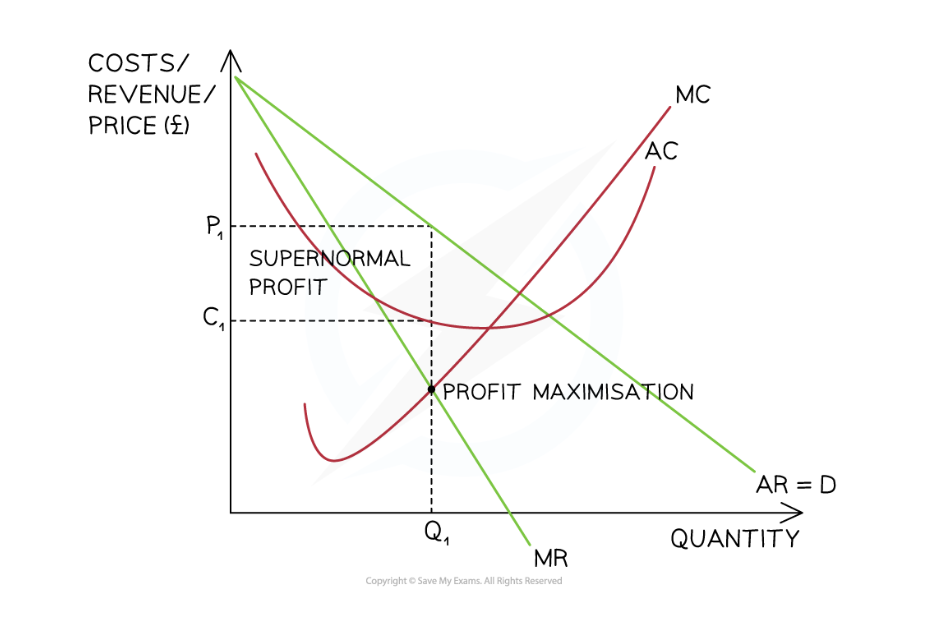
Digaram Analysis
Firm has market power as the MR and average revenue (AR) curve are downward sloping
Profit maximisation level of output (MC = MR)
The selling price is P1
The average cost is C1 and AC
The supernormal profit = ( P1 - C1) X Q1
SUPERNORMAL PROFIT P > AC