polymer, wood and metal enhancements
 Call Kai
 Learn
Learn Practice Test
 Spaced Repetition
 Match
Match Flashcards
 Knowt Play
1/27

Earn XP
Description and Tags
Name | Mastery | Learn | Test | Matching | Spaced | Call with Kai | Chat |
|---|
No analytics yet
Send a link to your students to track their progress
28 Terms
Polymer Enhancements
Lubricants
Thermal antioxidants
Pigments
Antistatics
Flame retardants
Plasticisers
Fillers
Antioxidants
Bio-batch materials
Biodegradable plascicisers
Bio-batch additives
UV stabilisers
Lubricants
Polymer Enhancement - adding wax or calcium stearate reduced the viscosity of the molten polymer, making it less sticky and allowing more intricate shapes to be formed
Thermal antioxidants
Polymer Enhancement - prevent the polymer oxidising or discolouring due to excessive heat during processing
Anti-statics
Polymer Enhancement - reduce the likelihood of the polymer building up static charge
Flame / fire retardants
Polymer Enhancement - reduces the likelihood of combustion, spread of fire or potential electrical fires
Wood Enhancement - resin can be impregnated with fire retardant cladding (e.g. for indoor flooring) or the fire retardants can be used to pressure treat the wood, making it more resistant to wear
Plasticisers
Polymer Enhancement - allows plastics to become less hard and brittle at normal temp use (e.g. LDPE food wrap), they also help in processing as they allow polymers to be easily formed at higher temperatures
Fillers
Polymer Enhancement - sawdust and wood flour provide bulk to the product, meaning less polymer is required, and mineral fillers (chalk & clay) help increase the thermal conductivity ∴ the material heats up and cools down quicker
Biodegradable plascicisers
Polymer Enhancement - these make the polymer more flexible, softer and easier to break down → faster degradation time
Bio-batch additives
Polymer Enhancement - oxy-degradable, photodegradable and hydro-degradable additives help reduce the degradation time from hundreds of years to a few months
UV stabilisers
Polymer Enhancement - prolongs the life by preventing the polymer chains being broken down by sunlight, used for outdoor products like patio furniture, vehicle parts, roofing materials
Advantages
Prolong the lifespan of polymers by preventing degradation from UV light exposure
Maintain strength, colour, and integrity, especially for outdoor applications
Disadvantages
Can be expensive, affecting the overall cost of polymer products
Effectiveness may degrade over time with prolonged exposure to UV light
Bio-batch materials
Polymer Enhancement - encourage biodegradability, used for food packaging, carrier bags, biodegradable plastics
Advantages
Encourage biodegradability of plastics, reducing their environmental impact
Can be used in products like food packaging and carrier bags for more sustainable disposal
Contribute to the development of compostable plastics that break down in natural environments
Disadvantages
May require specific conditions for complete biodegradation (e.g. industrial composting facilities)
Potentially more expensive than traditional polymers without additives
Can affect mechanical properties of the polymer (e.g. flexibility or strength)
Antioxidants
Polymer Enhancement - help reduce the environmental deterioration of the polymer from exposure to oxygen
Wood Enhancements
Resins and laminations
Resins w/ fire retards
Laminations
Preservatives
Pigments / paints
Fire retardant preservatives
Modified natural polysaccharide
Structural composite lumber (SCL) and lamination veneer lumber (LVL)
Varnishes
The combination of natural timber with resins and lamination can enhance properties, e.g. increased strength and stability
Enhancing timber products with preservatives, finishes and coatings
Resins and laminations
Wood Enhancement - used in engineered woods to enhance the properties of the useable parts of trees, such as sawdust, wood chips and fibres e.g. chipboard
Modified natural polysaccharide
Wood Enhancement - wood is impregnated to cure within the wood cell structure, increasing hardness, toughness and stability
Air seasoning
Wood Enhancement - Traditional and inexpensive, used for outdoor products
Wood is stacked in a shelter outside, protected from the rain
Air circulates between the planks to remove excess moisture
It’s a slow process, taking up to one year
Kiln seasoning
Wood Enhancement - Expensive, used for indoor products
Wood is stacked on trolleys
It is initially steamy in the kiln then becomes hotter and drier
It is a quick process, taking up to a few weeks
Both temperature and humidity are controlled
What does seasoning prevent?
Wood Enhancement
Warpage - The distortion or bending of timber due to changes in moisture content, temperature, or drying methods. Warped wood may be difficult to work with and may not maintain its shape in certain applications
Shrinkage - The reduction in size of timber as it dries out and loses moisture. Shrinkage can cause timber to change shape, which must be considered in design and construction
Splitting - The separation of the wood along its grain, typically caused by excessive dryness or stress. Splitting can affect the structural integrity of the wood and its appearance
Gives a greater immunity from decay and increased resistant to rot
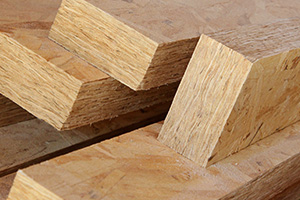
Structural composite lumber (SCL) and lamination veneer lumber (LVL)
Wood Enhancement - made by layering SCL strands or veneers (LVL) of wood with resins, pressing and heat curing them to produces a stable wood billet → they’re less prone to warping, splitting and shrinking, while also having greater load bearing properties
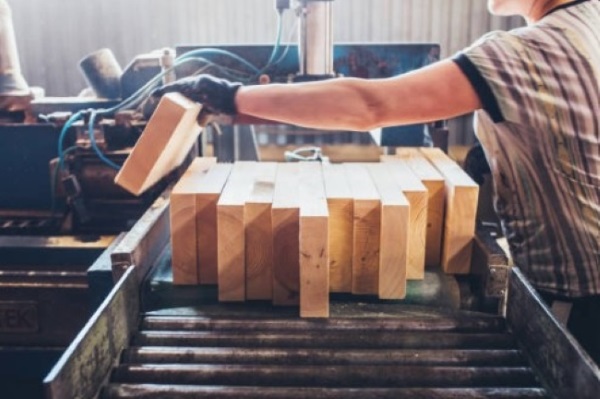
Lamination
Wood Enhancement - bonding layers of wood together for complex shapes or added strength, used for bridges and kitchen tables
Process
Thin layers of wood are cut out and stuck together using adhesive inbetween each layer (usually PVA)
A former is used to achieve the desired shape
Clamps/vaccuum bag apply pressure whilst the adhesive sets
Once formed the laminated timber can be trimmed and sized
Advantages
Economic to use (uses whole tree)
Can be shaped into a curve/complex shapes
Comes in large sheets
Strong material
Lighter than solid wood
Disadvantages
Poor surface finish
Layers of material are visable and not very aesthetically pleasing
Can be damaged by water/moisture which leads to delamination
Difficult to be recycled
Can release formaldehyde which is toxic
Preservatives
Wood Enhancement - used for wood products exposed to water and corrosion
Advantages
Improves lifespan of timber
Reduce biological corrosion
Improves aesthetics of wood
Disadvantages
Toxic
More effective if used to pressure treat wood
Paints
Wood Enhancement - used for bridges, wooden decking
Advantages
Stops rusting/corrosion
Aesthetically pleasing
Range of colours
Saves time/money
Disadvantages
Chips/flakes away
Not environmentally friendly
Varnishes
Wood Enhancement - used to enhance and protect the woods
Advantages
Protects from dirt/sunlight/water
Enhances look of wood
Easy to apply
Can't see brush strokes
Disadvantages
Can be dull colour
Bubbles can ruin finished look
Some varnishes are bad for the environment (brushes cleaned result in varnish into water system)
Metal enhancements
Heat treatment can enhance metal properties
Work hardening
Annealing
Case hardening
Hardening
Tempering
Work hardening
Metal enhancement - when the metal is ‘cold worked’ by bending, rolling or hammering
the crystals within the metal are distorted and changed, leading to improved tensile strength and hardness in the worked area
when the metal crystals are distorted, they cannot more freely within the metal structure ∴ less ductility, more cracking and more damage in worked area
undesirable affects can be removed by annealing
Annealing
Metal enhancement - make the work-hardened metal easier to work by making it less brittle and more ductile
the metal is heated and then cooled very slowly
this allows the metal crystals to grow and slowly move into place
Case hardening
Metal enhancement - used to harden the surface of steels with less than 0.4% carbon content, producing an outer casing of greater hardness with the inner core of the metal retaining the original ‘softer’ properties
Process (two stages)
Carburising: this changes the chemical composition of the surface of the steel so that is can absorb more carbon to increase hardness
the metal is placed in a ceramic box packed with powdered carbon and heated to 930C for a period of time
carbon is then absorbed by the metal, the depth of absorption is determined by the length of time if carbursing (the longer the time, the thicker the carbon layer)
the product is then heated to about 760C and quenched
Quenching: the hot metal is quenched in water to fast-cool it and seal the hard surface while not affecting the properties of the inner core
This stops the carbon escaping the surface of the metal
Advantages
Greater hardness for outside surface
Improved wear resistance
Resistance to surface indentations
Low coefficient of friction
Internal properties of metal remain unchanged
Disadvantages
Depth of hardness is not fully known
Difficult to machine metal after process
Hardening and tempering
Metal enhancement - used for screwdrivers, wrenches, hardened steel
Hardening: steels are heated to alter their crystalline structure, increasing hardness and brittleness (step 1, 2 and 3)
Tempering: reduces some of the excess hardness and brittleness of a hardened metal, while also increasing the toughness and ductility (step 4)
Process
Medium/High carbon steel is heated to a given temperature (below critical temperature) and held there for a period of time
It is then quenched in water/oil
The metal has now been hardened which improves certain properties but makes the metal very brittle
As a result the metal is reheated to a given temperature (below critical temperature) and allowed to cool slowly
Advantages
Improved tensile strength
Very hard
Reversible process (via annealing)
Disadvantages
Metal becomes less ductile
Metal is more likely to crack/damage in worked area
Metal becomes more brittle