Lecture 5.2: Cluster B Diagnoses
 Call Kai
 Learn
Learn Practice Test
 Spaced Repetition
 Match
Match Flashcards
 Knowt Play
1/28

There's no tags or description
Looks like no tags are added yet.
Name | Mastery | Learn | Test | Matching | Spaced | Call with Kai |
|---|
No analytics yet
Send a link to your students to track their progress
29 Terms
Cluster B Phrase
Emotional, dramatic, or erratic
Cluster B disorders
Characterized by overly dramatic, flamboyant, emotional, and/or erratic behavior
Antisocial PD
Borderline PD
Histrionic PD
Narcissistic PD
Antisocial Personality Disorder
A pervasive pattern of disregard for and violation of the rights of others
Repeatedly performing acts that are ground for arrest
Deceitfulness
Impulsivity
Consistent irresponsibility
Lack of remorse
Requires:
Age 18 or older
Evidence of Conduct Disorder by age 15
Anti-social personality prevalence
Prevalence
General Population: 4.1%
Forensic Populations: 60%
About 3x more common among men
Life course for anti-social personality
Course
Tends to have a chronic course: delinquent behavior in childhood (e.g., conduct disorder) continues into adulthood
Middle age (around their 40s), they “burn out”
Psychopathy
emphasizes both (1) personality traits (e.g., emotional deficits) and (2) behaviors (e.g., socially deviant behaviors)
May or may not engage in criminal behavior
The diagnosis of antisocial PD focuses more on observable behaviors
38% of people with Antisocial PD also have psychopathy.
Understanding psychopathy image
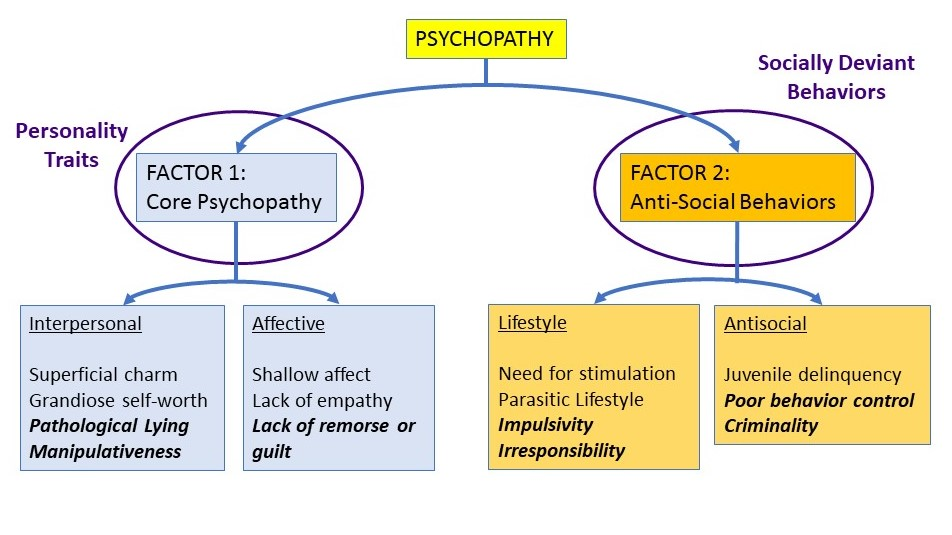
Antisocial PD vs. Psychopathy
Earlier conceptualizations of Antisocial personality disorder had a greater overlap with psychopathy
However, due to DSM-5’s focus on observable behaviors, Antisocial personality disorder is a distinct concept from psychopathy (there is still some overlap)
Psychopathy is a better predictor of recidivism than ASPD
38% of people with Antisocial PD also have psychopathy.
(Recidivism is the rate at which an incarcerated person is released and later returns to prison)
Overlap between ASPD, Psychopathy, & Criminality
Individuals with psychopathy may or may not show criminal behavior.
38% of people with Antisocial PD also have psychopathy.
50-85% of criminals have anti-social personality disorder
15% of criminals are psychopaths
Does Psychopathy look the same in women as it does in men?
The gender difference in psychopathy (and Antisocial PD) may be partly due to limitations of assessments
Two Issues Created by Socialization
Socialization of Clinicians
Socialization of Clients
Physical aggression might be more common in men
Women may be more likely to engage in relational aggression
Antisocial PD & Psychopathy: Etiology Psychological Factors
Learning Deficits:
Hypothesis 1: Emotional deficits
They lack fear & anxiety, so they can ignore the effects of punishment
Hypothesis 2: Impulsivity
They have trouble shifting their attention to consider the negative consequences of their behavior
These etiological factors apply to people with psychopathic traits (with or without ASPD)
Antisocial PD & Psychopathy: Etiology Neurological Factors
Abnormal brain structure & function
Evidence of smaller and hypoactive frontal lobes (i.e., the area which governs EF processes)
Deficits in EF: deficits in inhibition, planning
Genetically predisposed temperament
High reward dependence: being highly motivated by the possibility of reward
Low harm avoidance: not being strongly motivated by the possibility of punishment
Low persistence: low frustration tolerance
Candoret et al study on criminal behavior of male adoptees
criminal behavior increased dramatically if the adoptee had BOTH a genetic predisposition to Antisocial PD and were being raised by a parent with antisocial PD. (interaction effect)
Antisocial PD & Psychopathy: Etiology Social Factors
Inconsistent discipline (or complete lack of discipline) often seen in the prior family history of ASPD men
Kids with a "difficult temperament" are especially irritating to parents
Parents respond inappropriately by giving up or becoming severe in punishment
Person selects friends who share antisocial interests and problems (‘skinheads’, gangs)
Antisocial PD & Psychopathy: Treatment
Little research on treatments
Effectiveness depends on whether or not the individual has psychopathy
Psychopathy has poor prognosis
Personality traits interfere with therapeutic alliance
Feasibility of managing behavior vs. treating personality traits
Treatments for individuals with antisocial PD who are not psychopathic are more successful
Most likely to respond if they have a comorbid anxiety disorder (which indicates that they are not psychopathic)
Treatment that targets behavior change and behavior control (through CBT) is more effective than treatment that targets empathy training
Borderline Personality Disorder Symptoms
A pervasive pattern of chaotic interpersonal relationships, unstable self-image, affective instability, and marked impulsivity
Frantic efforts to avoid abandonment
Recurrent suicidal behavior or self-mutilation
Marked reactivity of mood
Inappropriate, intense anger
Chronic feelings of emptiness
Impulsivity (e.g., binge eating, spending, seggs)
Chaotic interpersonal relationships that waver between extreme idealization and devaluation
Requires 5 of the 9 possible criteria
Borderline prevalence
Prevalence
General population: 5.9%
Treatment-seeking populations:
Inpatient: 20%
Outpatient: 10%
According to the DSM, 75% of those diagnosed are women
Link to antisocial personality disorder: clinicians more likely to diagnose men with ASPD and women with BPD
Why? What are the similarities between the disorders?
Share symptoms of impulsivity, instability in relationships, and manipulation of others.
High rate of suicide: 10% die by suicide
Borderline PD: Etiology Psychological Factors
Core feature of the disorder is emotion dysregulation, meaning that they:
Have a lower threshold for emotional activation (i.e., their emotions shift quickly)
Experience emotions intensely
Experience slow return to emotional baseline (i.e., it takes them longer to self-soothe and come back down)

Borderline PD: Etiology Neurological Factors
Differences in brain activity
Hyperactivity of the amygdala
Brain structure that generates strong emotions
Hypoactivity of the frontal lobes
Brain structure that allows for self-control of emotional expression, as well as focusing attention and problem-solving
Low serotonin levels
Associated with depression & impulsivity
Abnormal serotonin levels found more often
among women with the disorder
Borderline PD: Etiology Social Factors
Invalidating Environments
In childhood, family members and friends invalidated the child’s emotional experience (e.g., “You’re too sensitive)
Generates a learning history wherein the person views themselves as bad and punishable
Childhood abuse
Especially sexual trauma
Treatment for Borderline Personality Disorder
Among the most challenging personality disorder to treat
Medications
Used to treat comorbid Axis I disorders
May help with symptoms of emotional instability and impulsivity
Dialectical Behavior Therapy (DBT)
Most well-validated treatment for BPD
Dialectical Behavior Therapy (Linehan, 1993)
DBT falls under the umbrella of CBT, with an added emphasis on Zen- and meditation-related components
Developed for use with clients with BPD, particularly those with parasuicidal behavior
What is “dialectics?”
Refers to synthesizing opposing elements. For example, accepting your current situation while at the same time recognizing that in order to feel better, change must occur
Involves both individual therapy, as well as a skills training group
Skills training group involves 4 basic modules:
Core Mindfulness
Interpersonal Effectiveness
Emotion Dysregulation
Distress Tolerance
Histrionic Personality Disorder
A pervasive pattern of excessive emotionality and attention seeking
Inappropriately seductive or provocative behavior
Uncomfortable in situations in which s/he is not the center of attention
Theatrical style of speech
Suggestible, easily influenced by others
Rapidly shifting and shallow expression of emotions
Considers relationships more intimate than they really are
Requires 5 of the 8 possible criteria
Histrionic Personality Disorder Prevalence
General Population: ~1.84%
Treatment-Seeking Population: 10-15%
Histrionic PD Etiology
Retrospective reports suggests they feel they did not get enough attention from parents
High in reward dependence: sensitive to negative evaluation
Histrionic PD Treatment
CBT or psychodynamic therapy
Get bored easily and continue to see other people as the primary problem
What do Histrionic PD vs. Borderline PD vs. Antisocial PD all have in common?
Cluster B is about manipulating others.
For Histrionic, it is manipulating to gain attention
For borderline personality, it is about gaining care/nurturance
For Antisocial PD, it is about gaining money, power, or sex
Narcissistic Personality disorder Symptoms
A pervasive pattern of grandiosity, need for admiration, and lack of empathy
Preoccupied with fantasies
Associates only with high-status others
Has a strong sense of entitlement
Is interpersonally exploitative
Is envious and thinks others are envious of him/her
Requires 5 out of 9 possible criteria
Narcissistic Personality disorder Prevalence
Prevalence: 7.7% men, 4.8% women but hard to determine
According to the DSM, between 50-75% of those diagnosed are male
Hypothesized to have the same psychological and social factors that contribute to histrionic PD