topic 4 - the annoying bs
 Call Kai
 Learn
Learn Practice Test
 Spaced Repetition
 Match
Match Flashcards
 Knowt Play
1/19

There's no tags or description
Looks like no tags are added yet.
Name | Mastery | Learn | Test | Matching | Spaced | Call with Kai |
|---|
No analytics yet
Send a link to your students to track their progress
20 Terms
why use biomass instead of counting number of individuals
Less time consuming
Individual organisms could not be identified/separated
Too small to count
How to standardise sampling
Same sample size area
Same day/time of day samples are taken
Same sampling time
investigating diversity w DNA
Compare DNA base sequences/banding on computerised systems
More similar genes/DNA = more closely related species
what do we aim for in investigating
Aim to have representative sample
Avoid sampling bias
Account for chance anomalies
sd
spread of the data values about the mean - higher spread of data around the mean = more variability
what is species richness and what is index of diversity
species richness - number of different species in a community (particular area at given time)
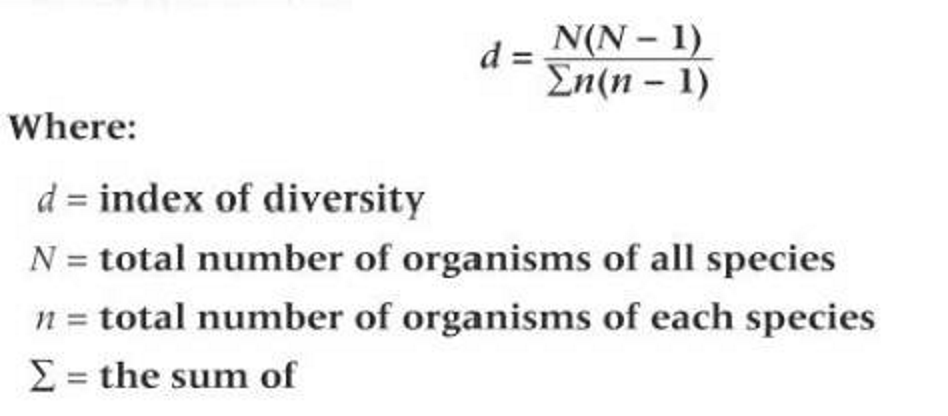
index of diversity - relationship between number of diff species and number of individuals within each species in a community
index of diversity equation
how does farming reduce biodiversity
Remove habitats
Use monocultures which reduce species richness
Use pesticides and herbicides
Overuse of fertilisers which can lead to eutrophication and damage aquatic ecosystems
what happens if less plant species present
fewer habitats and fewer food sources
balancing conservation and farming
Better conservation = higher species richness, biomass and more carbon stored
Higher species richness and biomass = more organisms for food webs
More carbon stored = less CO2 in atmosphere
Lower yield so less food profit
what is hierarchy/phylogeny
smaller groups within bigger groups with no overlap btw groups at same taxonomic level
what causes smaller population
Inbreeding
Population may have started with very few individuals/one pregnant female/founder effect
Population might have been small/genetic bottleneck
why is courtship behaviour done
Recognise members of their own species of the opposite sex
Identify a mate that is capable of breeding because both partners need to be sexually mature, fertile and receptive to mating
Ensure successful reproduction
Form a pair bond that will lead to successful mating and raising of offspring
Synchronise mating so it takes place when there is the maximum probability of the sperm and egg meeting
what is genetic diversity
number of different alleles of genes in population
for selection
Directional/stabilising selection
Change in environmental conditions/constant conditions
Random mutation
Result in new allele of gene
Selective advantage
More likely to survive and reproduce
Pass on advantageous alleles
Frequency of allele increases
One extreme selected for/Standard deviation decreases
what is gene mutation
change in the base sequence of DNA in chromosomes
how meiosis works
DNA replication occurs in late interphase
Two divisions
In first - homologous chromosomes are separated
In second - sister chromatids are separated from centromere splitting
Produces 4 haploid cells
what are the two ways of variation in meiosis
independent segregation of homologous chromosomes - during metaphase, lining up on equator is random
crossing over during prophase - form bivalent, chiasmata form, equal portions of alleles are swapped, new combination of alleles
what is gene
sequence of DNA bases that codes for amino acid sequence of polypeptide or functional RNA (rRNA or tRNA) - occupies specific locus
what is genome and what is proteome
genome - complete set of genes in cell
proteome - full range of proteins that cell is able to produce