Biochem 3461 Exam 1
 Call Kai
 Learn
Learn Practice Test
 Spaced Repetition
 Match
Match Flashcards
 Knowt Play
1/248

There's no tags or description
Looks like no tags are added yet.
Name | Mastery | Learn | Test | Matching | Spaced | Call with Kai | Chat |
|---|
No analytics yet
Send a link to your students to track their progress
249 Terms
Phylogenetic trees
- show evolutionary relationships
- nodes represent a common ancestor
- branch length represents time (longer branch = more time passed)
Prokaryotic cells
size
number of membrane layer
whats in it
small
unicellular
single membrane
no nucleus or organelles
eukaryotic cells
size
multi single or both
how many layer membrane
what are present
1000-10000 times larger
single or multi-celled
bi-layer membrane
nucleus and organelles present
what are the 3 domains?
eukarya, archaea, and bacteria
what is special about archaea
they live in extreme conditions
what are the 2 types of archaea?
thermoacidophiles (heat and acid)
halophiles (salt)
what atoms make up 99% of the human body?
Hydrogen, oxygen, carbon, and nitrogen
what are the trace elements?
- Elements necessary for life in small amounts
- manganese, iron, cobalt, nickel, copper, zinc, iodine, and selenium
Why do C, H, O and N make such good atoms in making up the human body?
they form covalent bonds that are very strong
how many covalent bonds in hydrogen?
1
how many covalent bonds in oxygen?
2
how many covalent bonds in nitrogen?
3
how many covalent bonds in carbon?
4
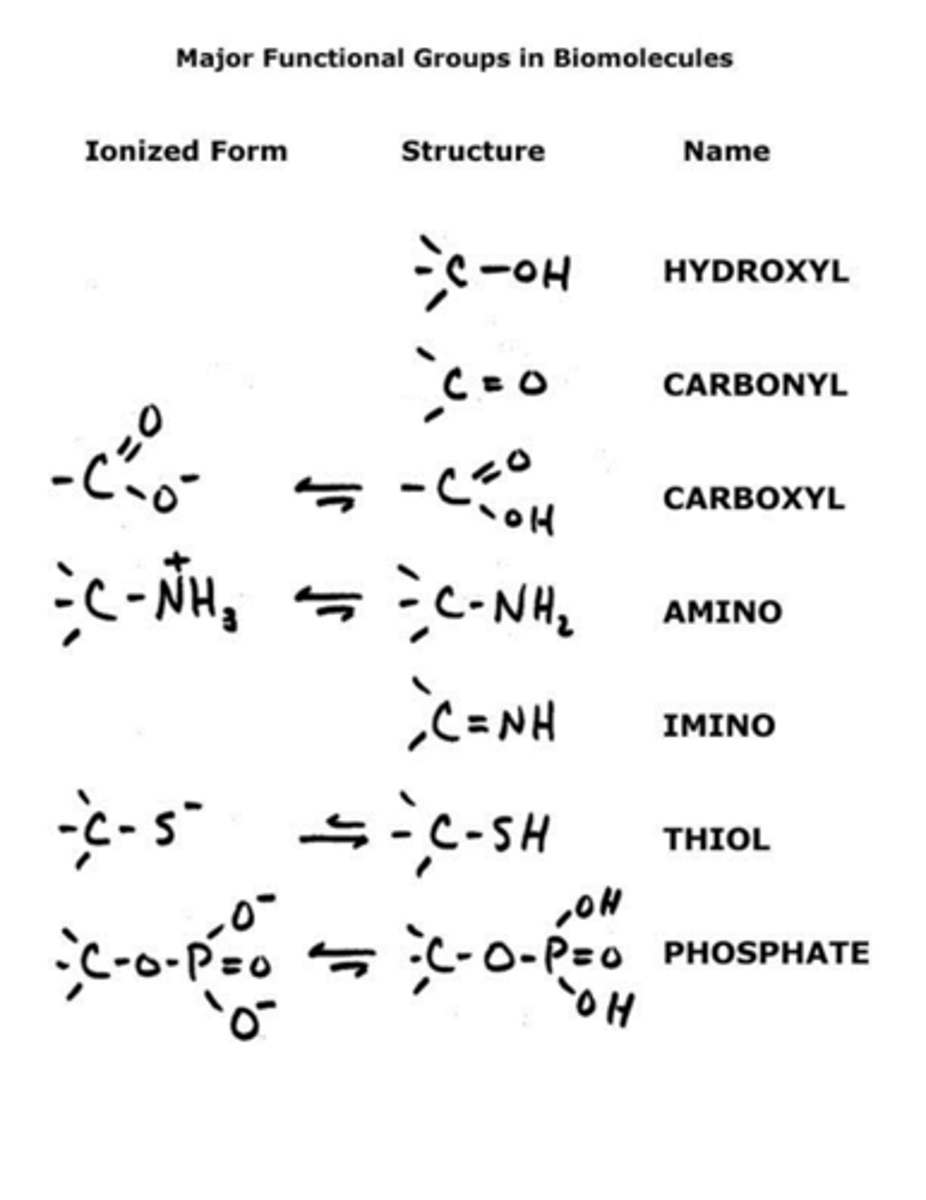
what are the major functional groups in biomolecules?
hydroxyl
carbonyl
carboxyl
amino
imino
thiol
phosphate
thioether
hierarchy of life
inorganic precursors -> metabolites -> building blocks -> macromolecules -> supra molecule complexes -> organelles
what do amino acids build?
proteins
what do sugars build?
polysaccarides
what do nucleotides build?
nucleic acids
properties of biomolecules
- directionality (N terminus to C terminus)
- informational
- 3-D architecture
- weak forces
- condensation reaction (dehydration)
what kind of bonds do macromolecules have?
weak bonds which allow for movement
when at the same distance, which type of bond has the weakest interaction?
hydrogen bonds
ionic interactions
- forces between oppositely charged ions
- charges may depend on pH
- strength depends on charge and distance
van der Waals interactions
- induced interactions between transient positively charged nuclei and the electron shell of a nearby atom
- strength increases as the distance between them decreases
if the energy is positive, it's in or out of system
being put into the system
if energy is negative, it's
being released, more spontaneous and favorable
hydrogen bonds
what do they occur between?
what kind of bonds
what is strength dependent on
-occur between a hydrogen atom that is covalently bonded to an electronegative atom (donor) and a second electronegative atom (acceptor)
- strength depends on polarity donor and acceptor atoms
properties of water
- high boiling point
- melting and freezing point are both 32 degrees
- low density at solid state
- bent structure = polar
- non-tetrahedral bond angles (not 109 degrees)
- H-bond donor and acceptor
cooperative H-bonding
bind of 1 hydrogen atom leads to the binding of others
What's the density of the 3 states of matter for water? (least to most)
gas < solid <liquid
what does an open lattice cause?
low density at a solid state due to open space
hydrogen bonds in ice
how many? whats the speed?
what is the h-bond lifetime
4 (slow)
H-bond lifetime is about 10 microseconds
hydrogen bonds in water
2.3 (constantly moving)
H-bond lifetime is about 10 picoseconds
water is a universal solvent because
-it forms H bonds with polar solutes (salt)
- forms a hydration shell around ionic solutes
dielectric constant
- how well something can dissolve
- ability to separate charges
what water ionizes it forms what?
H+ and OH-
when H+ hydrates it forms
H3O+
eq means
rate of forward reaction
Keq means
ratio of products to reactants (equal reverse and forward rxn)
in equilibrium
forward rxn = reverse rxn
pH increases when
H+ decreases or OH- increases
dissociation of strong acids and bases
completely dissociate to form ions like NaCl and HCl
what are the 4 properties to determine what acid is more favorable?
atom electronegativity/size
resonance
induction
orbital types
what are the trends seen in the periodic table in relation to size and electronegativity?
- electronegativity increases going from the left to the right of the table
- size increases from up to down
if Ka is large, this means
it dissociates very well
if Keq is moderate or small, this means
it doesn't dissociate very well
Ka equals
[H+][A-]/[HA]. Use this when dissociation is lower than 5%
Concentration of M
- High M means it's highly dissociated and therefore is probably a strong acid
- low M means it's lowly dissociated and therefore is a weak acid (more protonated)
- equal to moles/L
if dissociation is higher than 5%, what must you use to solve?
quadratic equation
If Ka is higher, this means
dissociation is higher, so the acid is stronger
pKa
concentration of acid and conjugate base
pKa is the pH at which acid = conjugate base
important formulas for calculating pH
- pH = -log10[H+]
- pKw = pH + pOH = 14
- Ka = [H+][A-]/[HA]
- pH = pKa + log10[A-]/[HA]
titration curves
used to determine the total amount of acid in a solution
when OH- neutralizes an equal amount of H+,
this shifts the equilibrium to the right
what is the inflection point in a titration curve?
the equivalence point of the titration (pKa)
Polyprotic acids
when multiple protons are being given off
system
portion of the universe
isolated system
cannot exchange matter or energy
closed system
can exchange only energy
open system
can exchange both matter and energy
first law of thermodynamics
Energy cannot be created or destroyed
total energy of an isolated system is
conserved
how is energy exchanged?
heat and work
E2-E1=q-w
if q is positive, this means
heat is absorbed (endothermic)
if q is negative, this means
heat is released (exothermic)
if work is positive, this means
work BY a system
if work is negative, this means
work ON a system
when volume is constant
work is 0
when pressure is constant
work will be very high
what is ∆H?
enthalpy change
heat transferred in constant pressure
what is ∆E?
heat transferred in constant volume
why is ∆H usually equivalent to ∆E?
most biochemical systems have small V changes and constant P
second law of thermodynamics
entropy (S)
systems tend toward disorder and randomness
order is low S
disorder is high S
S= klnW
Boltzmann's constant
k = 1.38 x 10^-23 J/K
what is W in the entropy formula?
number of equal energy arrangements in a system
Entropy per mole (what are the formulas and gas constant)
S=2.303RlogW (S=RlnW) or (S=kNlnW)
R=8.314 J/(Kmol) (8.134)
entropy-driven process
a reaction that cannot be reversed
(mixing mio into water)
Gibbs free energy
what does it let us know
what is the formula
quantity that allows us to asses whether reactions will occur or not
G= H-TS
what's true regarding pressure in biological and biochemical processes?
pressure is constant
if ∆G is 0
reaction is at equilibrium
if ∆G is negative then the reaction is
reaction is favorable (exergonic)
if ∆G is positive
reaction is unfavorable (endergonic)
what is enthalpy?
The heat content of a system at constant pressure
what's an example of a reaction that favors both enthalpy and entropy?
fermentation of glucose to ethanol (both values are negative)
what's an example of a reaction that favors only enthalpy?
combustion of ethanol (only enthalpy value is negative)
what's an example of a reaction that favors only entropy?
decomposition of nitrogen pentoxide (only entropy value is negative)
chemical potential
substance's contribution to free energy of the system
(refer to slide 13 of lecture 4)
temperature is always in
Kelvin
what is the equation for Keq?
Keq= e^(∆G/RT)
what happens when concentration is NOT 1 M?
∆G changes
what is the pH at the standard state in biochemical systems?
pH=7
what is the one exception where 1 M isn't the standard state?
protons
what does a superscript signify?
standard state
when H+ is produced
∆G + RTln[H+]
when H+ is consumed
∆G - RTln[H+]
when pressure and temperature are constant
∆G = ∆H - T∆S
(refer to slide 21 of lecture 4)
when plotting lnKeq v. 1/T, what is the formula?
lnKeq= - (∆H/R)(1/T) + (∆S/R)
coupling
how reactions with negative ∆G' can occur
high energy phosphate compounds
- phosphoenolpyruvate (PEP)
- 1,3-bisphosphoglycerate (CP)
- phosphocreatine (ATP)
reduced coenzymes
NADH and FADH2
(NADH gives more energy)
overall ∆G' is the
sum of the two ∆G' values of individual reactions