Lecture 17: Audition - how do we hear
 Call Kai
 Learn
Learn Practice Test
 Spaced Repetition
 Match
Match Flashcards
 Knowt Play
1/6

There's no tags or description
Looks like no tags are added yet.
Name | Mastery | Learn | Test | Matching | Spaced | Call with Kai |
|---|
No analytics yet
Send a link to your students to track their progress
7 Terms
Describe how sound is created/behaves
changes in sound/air pressure experienced perceptually as sound
sound moves forward (compression) and backwards (rareification)
compression represents high air pressure - peaks
rarefication represents low pressure - troughs
What are the three features that account for the perception of sound
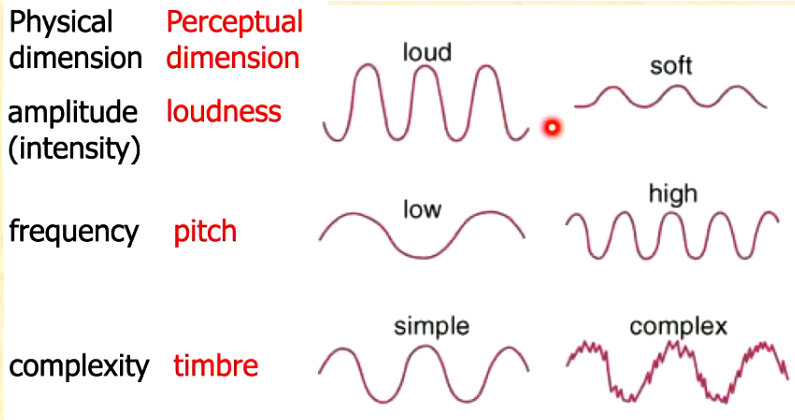
Amplitude - extent of rareifcation + compressions
accounts for loudness
greater difference in rarefication + compression means more loud sound
frequency - number of cycles of rarefication + compression per second
accounts for pitch - high (high frequency) or low (slow)
complexity/timbre - complex sounds have more combinations
The perceptual dimensions due to processing in brain however originates due to differences in physical properities of sound waves
What constitutes the outer, middle and inner ear.
outer ear:
ear +pinna + ear cannal
sound travels and hits pinna
Sound travels through ear canal - End of ear cannal is the eardrum (tympaic membrane) - behind eardrum is middle ear
middle ear
ossicles
stapes/stirrups
inner ear
cochlea (has oval window and round window) - contains fluid
loops things - critical for vestibular (balance) response - contains fluid
Describe how sound reaches the inner ear.
The forwards and backwards motion of sound, causes the eardrum to resonate (also move backwards and forward in the same way the sound was produced)
Eardrum moving causes bones (ossicles) to lever backwards anf forwards
stapes or stirrups
connected to ossicles - moves backwards and forwards in response against the oval window
As oval window is soft (as compared to rest of cochlea), can cause the membrane to move inward
Inside cochlea there is fluid - so when stapes moves forward, the fluid moves along the cochlea (around the basilar membrane from the base to the apex) and come back down to the round window (at the base)
Round membrane is soft - so allows fluid to move backwards (back toward base) as well
thus through windows- fluid moving backwards + forwards
Describe the basiliar membrane and how it responds differently to a particular physical characterisitc of sound.
spiraling membrane (membrane follows spiral of cochlea)
fluid moves along here from base to apex
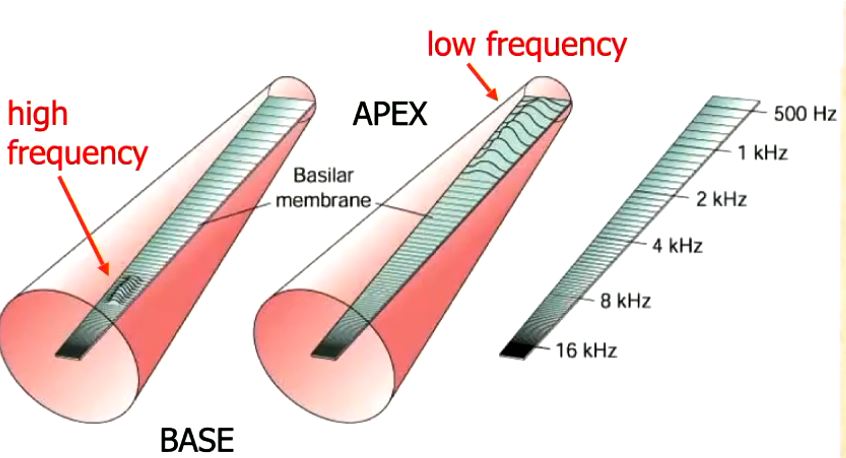
higher frequency causes more vibration at base (near oval window) vs low frequency at the apex
more vibration = more hair cell stimulation = more spiral ganglion stim. at this location
each spiral ganglion can resond to a range of frequencies, they will respond most to their preffered frequency at the specific location
known as place coding
Describe place coding
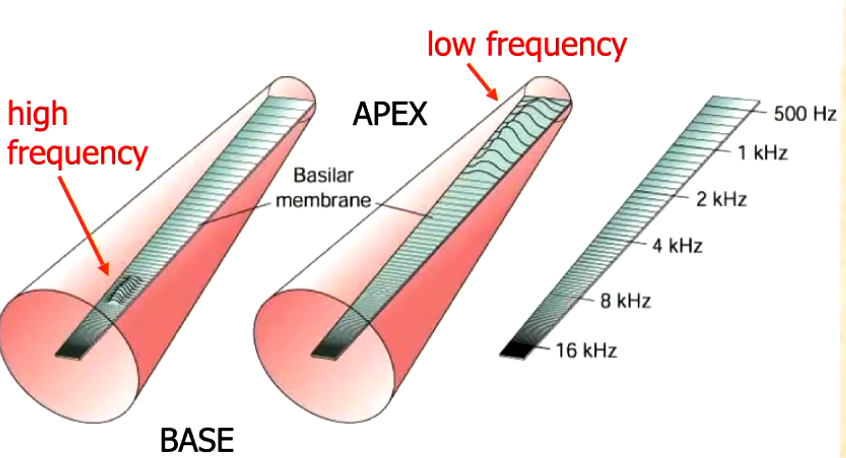
High frequency causes more vibration at the base whereas low frequency causes more vibration at the apex
More vibration -> more response from spiral ganglion cells at this location
the brain can use the location of the spiral ganglion cell (with most activity) to determine the frequency of the sound
Each spiral ganglion cell will respond to a range of frequenices, but has a preffered
Increasing intensity of sound, has a higher response at all frequencies, BUT the peak/preffered frequency does NOT change
Relative output -> how much of each frequency there is
Total activity across all cells -> tells us how intense the sound is
i.e. basiliar membrane INFORMS frequency of the sound to the brain!