Minko exam 3 - Lecture 8 Controlled Release & Targeted Drug Delivery
 Call Kai
 Learn
Learn Practice Test
 Spaced Repetition
 Match
Match Flashcards
 Knowt Play
1/17

There's no tags or description
Looks like no tags are added yet.
Name | Mastery | Learn | Test | Matching | Spaced | Call with Kai |
|---|
No analytics yet
Send a link to your students to track their progress
18 Terms
Controlled Drug Release
Release of a drug or other active agent in a predesigned manner
The release of the active agent may be:
Constant over a long period
Cyclic over a long period
triggered by the environment or other external events
Advantages of controlled drug delivery
more effective therapies
Eliminating the potential for both under- and overdosing
the maintenance of drug levels within a desired range
the need for fewer administrations
optimal use of the drug in question
increases patient compliance
Disadvantages of controlled drug release
1.The possible toxicity or nonbiochompatibillity of the materials used
undesirable by-products of degradation
Any surgery required to implant or remove the system
the chance of pt. discomfort from the delivery device
the higher cost of controlled-release systems compared with traditional pharmaceutical formulations
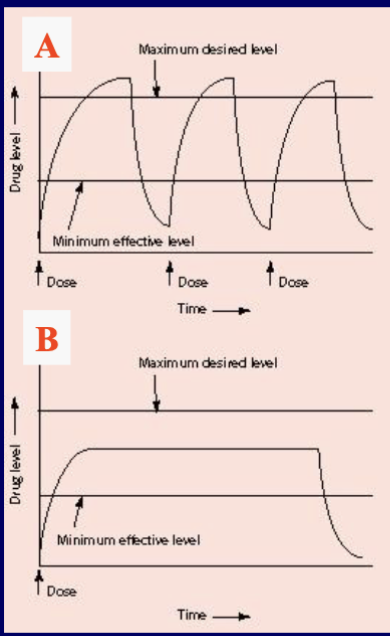
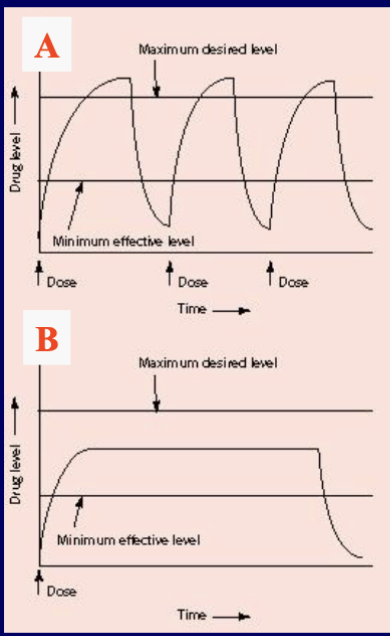
Controlled release versus traditional therapy - Goal
The goal of many of the original controlled release systems was to achieve a delivery profile that would yield a high blood level of the drug over a long period of time.
Controlled release versus traditional therapy - Key point
The key point with traditional drug administration (A) is that the blood level of the agent should remain between a maximum value, which may represent a toxic level, and a minimum value, below which the drug is no longer effective
Mechanisms of controlled release - Four primary mechanisms
diffusion
degradation
swelling followed by diffusion
active efflux
Any or all of these mechanisms may occur in a given release system
Diffusion - Overview
Diffusion occurs when a drug or other active agent passes through the controlled-release device
The diffusion can occur:
on a macroscopic scale - as through pores in the device matrix
on a molecular level, by passing between matrix molecules
Constant Delivery Rate devices
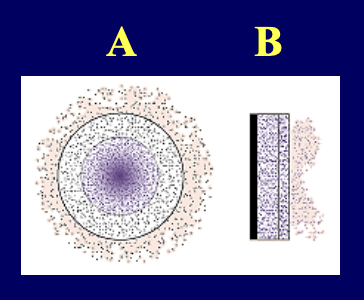
For the reservoir systems shown the drug delivery rate can remain fairly constant. In this design, a reservoir - whether solid drug, dilute solution, or highly concentrated drug solution within a polymer matrix — is surrounded by a film or membrane of a rate-controlling material
Constant Delivery Rate devices - A vs B
The only structure effectively limiting the release of the drug is the layer surrounding the reservoir. The system shown in figure A is representative of an implantable or oral reservoir delivery system, whereas the system shown in figure B illustrates a transdermal drug delivery system, in which only one side of the device will actually be delivering the drug
Environmental responsive systems
It is also possible for a drug delivery system to be designed so that it is incapable of releasing its agent or agents until it is placed in an appropriate biological environment.
Environmental responsive systems - swelling
Swelling-controlled release systems are initially dry and when placed in the body, will absorb water or other body fluids and swell. the swelling increases the aqueous solvent content within the formulation as well as the polymer mesh size, enabling the drug to diffuse through the swollen network into the external environment
most of the material used in swelling-controlled release systems are based on hydrogels, which are polymers that will swell without dissolving when placed in water or other biological fluids.
Environmental responsive systems - Hydrogels
These hydrogels can absorb a great deal of fluid and, at equilibrium, typically comprise 60-90% fluid and only 10-30% polymer.
The Enhanced Permeability and Retention (EPR) Effect
The enhanced permeability and retention (EPR) effect was first described by Dr. Hiroshima Maeda and coworkers
The EPR Effect is the result of the increases permeability of the tumor vascular endothelium to circulating macromolecules combined with limited lymphatic drainage from the interstitium. Low molecular weight drugs coupled with high molecular weight carriers are inefficiently removed by lymphatic drainage and therefore accumulate in tumors
Enhanced Permeability and Retention Effect - Phenomenon
The EPR effect is a phenomenon that explains the ability of macromolecules to preferentially accumulate in solid tumors. The EPR effect results from the increases permeability of vascular tumor endothelium to circulating macromolecules combined with limited lymphatic drainage from the tumor interstitium.
Linear Polymer - Linear Spacer DDs: HPMA-DOX conjugate
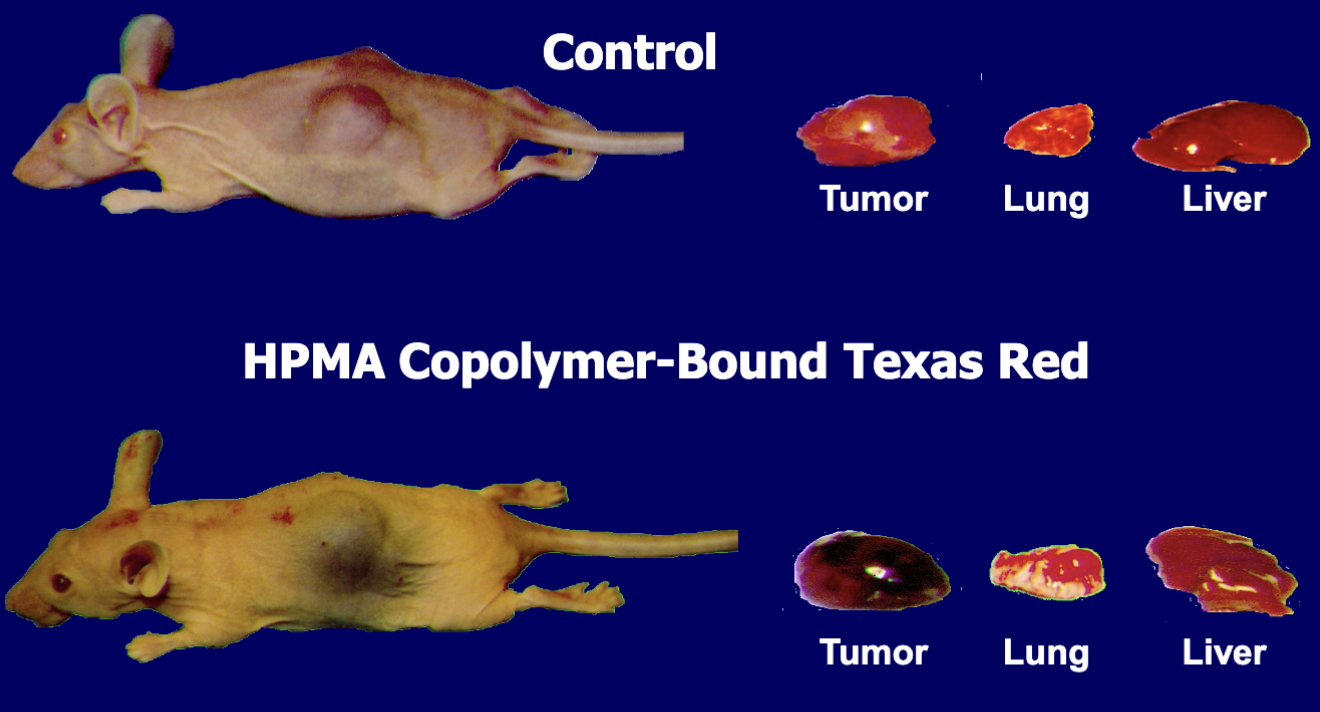
Passive Tumor Targeting (EPR Effect)
just an example
color means if drug made it to the tumor it needs to affect
Passive Tumor Targeting by the EPR effect - Advantage
conjugation of low molecular weight drug to high molecular weight polymer enhances its anti-tumor activity and decreases adverse side effects of chemotherapy
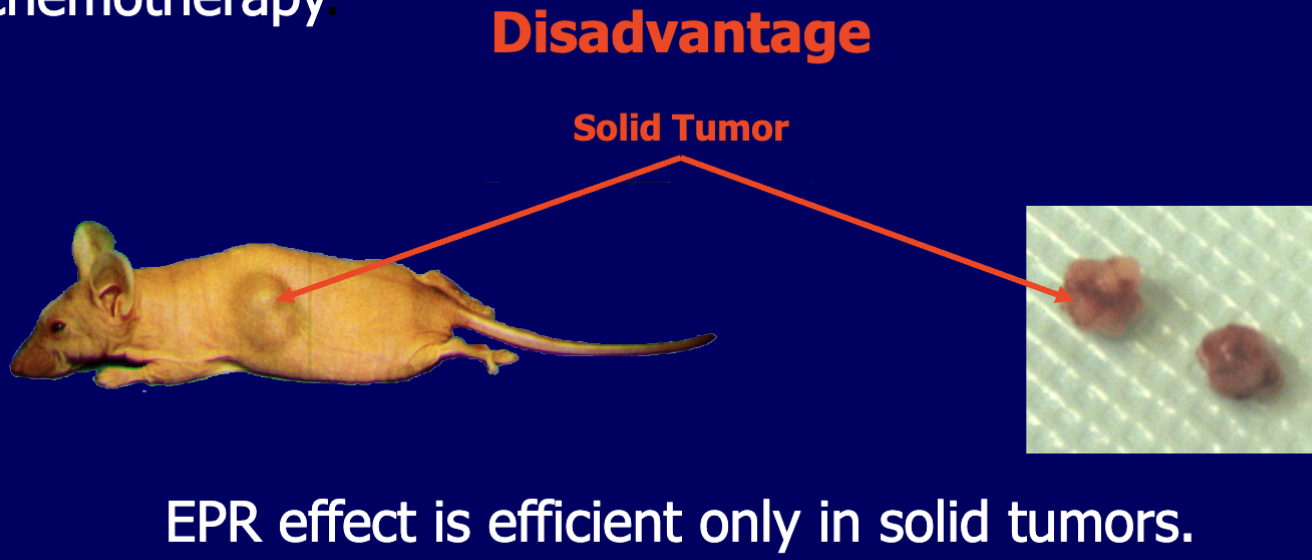
Passive Tumor Targeting by the EPR effect - Disadvantage
EPR effect is efficient only in solid tumors
Controlled release versus traditional therapy - Controlled drug delivery system
In controlled drug delivery systems (B) designed for long-term administration and sustained drug release, the drug level in the blood remains constant, between the desired maximum and minimum, for an extended period of time. Depending on the formulation and the application, this time may be anywhere from 24 hours (procardia XL) to 1 month (Lupron Depot) to 5 years (Norplant)