domestic and static electric (paper 1)
 Call Kai
 Learn
 Practice Test
 Spaced Repetition
 Match
 Flashcards
 Knowt Play
1/58

Earn XP
Description and Tags
59 Terms
DC direct current
Direct current flows around a circuit in one direction. It is supplied by battery. A direct current always stays the same. Alot of devices in our home use direct current.
AC alternating current
alternating current is supplied by our mains electricity supply (anything that is plugged in). The current repeatedly changes direction. Ac looks like a wave.
how do we change AC into DC?
a diode
what is the difference between direct and alternating pd
Direct PD means the electrical fault happens in one place with a steady pattern. Alternating PD means the fault moves or changes location, switching back and forth. Direct PD is usually easier to find because it stays in one spot. Alternating PD can be harder to detect because it changes.
Potential difference leads to a current. Whether the potential difference is alternating or direct, it will lead to a current. An alternating potential difference will lead to an alternating current, whilst a direct potential difference leads to a direct current.
Alternating current changes direction. An alternating current (ac) changes direction all the time. By this, we mean that the current will flow in one direction, then reverse and flow in the other direction instead. The direction of current is constantly alternating between positive and negative.
Direct current does not change direction. A direct current (dc) does not change direction. By this, we mean that the current flows in one direction only, never reversing.
UK frequency
50Hz
UK voltage
230V
cathode ray oscillope (CRO)
used to measure the voltage and frequency of an electrical supply
how to find the time period
count - count the number of squares that make one complete wave horizontally/peak to peak e.g. 4 squares
look at the scale - e.g. one square is equal to 0.02 seconds
multiply - multiply the number of squares by the time for one square to find the time period for the wave
e.g. time period = 0.02 × 4 = 0.08
how to find the frequency
1
—-
time period
plugs
live wire - brown
earth wire colour - green and yellow stripes
neutral wire - blue
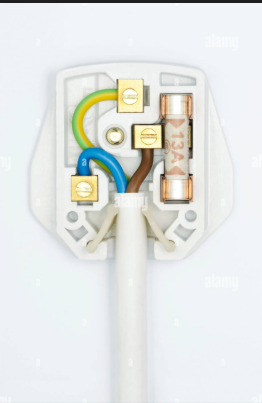
most appliances connect to the mains with a three core cable - what are the names of these three core cables?
live, neutral, earth
what are most wires made of
copper
what are wires covered in
plastic or rubber insulation
why are wires given different colours
to clearly identify the function for safety
why are the pins a diferent material to wires
pins need strength and wear resistance and good contact while wires prioritize flexibility and efficient current flow
why should we replace a broken or faulty plug
risk of electrocution and electrical fire
function of live wire
to carry high voltage electrical current from power source
what must the live wire be connected to
the power source
why might the live wire still be dangerous even if the switch was open
High Voltage Remains: The wire is still energized at 230V, and a, path to ground (like a person) will cause a fatal shock
Faulty Wiring: Insulation could be damaged, exposing the live wire.
Residual Charge: Some components (like capacitors) can store charge even after the switch is opened
function of neutral wire
to provide a return path for electrical current, completing the circuit back to the power source
function of the earth wire
providing alow resistance path for fault currents to flow to the ground, prevents electric shock and fire
what pd is the earth wire held at
0
the potential difference between the live wire and earth.
230v
what is the function of the fuse
to protect electrical circits and devices from damage by acting as a sacrificial saftey device
energy stores
thermal
kinetic
nuclear
gravitional potential
elastic potential
chemical
energy transfers
electrical
waves
heat
work
explain how the power transfer in a circuit device is related to the potential difference across it and the current through it.
Power transfer in a circuit device is the rate at which electrical energy is converted into other forms (like heat or light), calculated as the product of potential difference and current. A higher voltage (energy per charge) or higher current (charge flow rate) results in greater power. it is directly proportional
explain how the power transfer in a circuit device is related to the energy transferred over a given time.
Higher power means more energy is transferred over a given duration. Directly proportional again
energy rule
energy is always conserved. Cannot be destroyed or created. Only stored or transferred.
energy is conserved always!!!!!
key rule
WHEN CHARGE FLOWS IN A CIRCUIT< WORK IS DONE AND ENERGY IS TRANSFERRED
energy transferred (J) = charge (C) x p.d (V)
E=QXV
so in a circuit if ……
more current flows then more charge will pass and more energy will be transferred
I leave the circuit on for more time, then more charge will pass and more energy will be transferred
there is more pd across a device then more energy will be transferred
electrical power
power (watts)
POWER IS THE RATE AT WHICH ENERGY IS TRANSFERRED OR POWER IS THE ENERGY TRANSFERRED PER SECOND
power (W) = energy tranferred (J) // time (s)
describe what affects the amount of energy an appliance transfers.
power rating and length of time
all the equations
energy = power x time
power = current x pd
power = (current)² x resistance
energy = charge x pd
charge = current x time
pd = current x resistance
THIS IS ALL GIVEN IN A FORMULA SHEET
fuses
they melt if too larger a current flows through
they stop appliances from overheating/catching fire
standard = 3A, 5A, 13A in plugs
use the smallest fuse that has a value greater than the working current
lamp uses 2.5A →3A fuse
describe how different domestic appliances transfer energy from batteries or ac mains to electric motors or heating devices.
Domestic appliances transfer energy from AC mains or batteries by converting electrical energy into kinetic energy (via motors) or thermal energy (via heating elements)
Motors use electromagnetic fields to spin, while heating elements use electrical resistance to generate heat, with the total energy transferred determined by power rating and time.
how does charge cause work to be done in a circuit
because a potential difference (voltage) drives the movement of charge (electrons) through components, transferring energy
power lost in a resistor
the power lost in a resistor is given by - p=i²xr
where i is the current flowing through the cable and r is the resistance of the cable
the efficiency of the device is given by - efficiency = useful output // total power output
what is the national grid and what does it do
The National Grid is the high-voltage electricity transmission network for Great Britain, transporting power from generators (wind farms, power stations) to local distribution networks,, homes, and businesses. (defenition from google)
The national grid is a network of cables and transformers that covers the uk and connects power stations to consumers. The national grid transfers electrical power from power stations anywhere on the grid to anywhere else on the grid where it is needed e.g. homes, industrys.
why is the national grid an efficient way to transfer energy
Reduced Energy Loss: By lowering the current, less energy is dissipated as heat to the surroundings through transmission cables.
High Voltage Transmission: Stepping up the voltage allows for the transmission of high power with low current.
Optimized Infrastructure:
The use of thick cables with low resistance, combined with transformers, maximizes transmission efficiency
.
Grid Resilience: The interconnected network allows for a reliable, continuous supply, as power can be rerouted if one station fails
the national grid
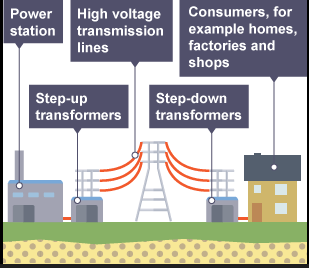
what is a power station
where electricity comes from e.g. shoreham power station
transformers
P = I X V
A transformer is a device used in the national grid to change potential difference of an electrical supply
step up transformer
increase voltage to reduce energy loss
decrease current to obey the law of conservation of energy
step down transformers
increase current to conserve energy, the decrease in voltage requires an increase in current. For example, if the voltage is halved, the current is roughly doubled.
decrease voltage to usable levels (e.g., from transmission lines to household power).
why must we reduce the pd before the electricity reaches homes
for safety. the bigger the pd, the bigger risk for us. Our appliances are designed to work at certain levels of pd so they could be damaged, or catch fire
why do we increase the pd on the national grid
high voltage will deliver more energy down cables
increase pd decrease current
because the same power is delivered in a more efficient way
so that less energy is wasted as heat in cables
because electricity will travel faster down cables
because a smaller current will mean less collisons between electrons and metal ions, so the cables don’t get as hot (safer)
why is the national grid pretty much 100% effective
because there are no moving parts( (except current) so no friction and heat so no energy loss
power dissapated (‘lost’) in resistors
energy spreads out in the surroundings
raises thermal energy stores of surroundings
p=i²r
the greater the resistance, the greater the power loss for any size current
efficiency
meeting the electrical demand
Meeting electrical demand in the UK involves using a mix of reliable, base-load power stations (fossil fuels, nuclear) and flexible, renewable sources (wind, solar, hydro) via the National Gri
new topic
static electricity
conductors
if electrical charges can easily move through a material, it is called an electrical conductor. Metals are known to be good conductors
insulators
if electrical charges cannot easily move through a material, it is called an electrical insulator. Plastics and rubbers are usually good insulators
static charge
a static charge is an electric charge which cannot move. Static charges are often but not always found on electrical insualtors where charge cannot flow freely. They can be positive or negative. A static charge can build up on a conductor if its isolated - in other words, if there is nowhere for the charge to flow
when certain insulating materials are rubbed together, friction causes negatively charged electrons to be scraped off one and dumped onto the other.
this will leave a positive static charge on the one that loses electrons and a negative static charge on the one that gains electrons. Which way the electrons are transferred depends on the two materials involved
both positive and negative electrostatic charges are only ever produced by the movement of electrons. The posistve charges defeinitly do not move.
a positive static charge is always caused by electrons moving away elsewhere. The material that loses the electrons, loses some negative charge, and is left with an equal positive charge.
sparking
as electric charge builds up on an object, the potential difference between the object and the earth which is at 0v increases. If the potential difference gets large enough, electrons can jump across the gap between the charged object and the earth - this is a spark. Electrons can also jump between a charged object and any earthed conductor that is nearby.
example
you can get a static shock when coming out of your car. A charge builds up on the cars frame as it travels, due to friction between the car and the air. When you go to touch the car, a spark jumps across the gap and the charge travels through you to the earth.
electrostatic attraction and replusion
when two electrically charged objects are brought close together they exert a force onto on another
like charges repel and opposites attract
These forces will cause the object to move if they are able to do so. This is known as electrostatic attraction/replusion and is a non-contact force. These forces get weaker the further apart the two things are.
balloon hair experiment explained
if you rub your hair with a balloon , electrons are transferred from your hair to the balloon and they become oppositley charged so they attract.
what is an electric field
an electric field is created around any electrically charged object. The closer to the object you get, the stronger the field is and the further you are from it the weaker it is.
you can show an electric field around an object using field lines. Electric field lines point away from positive charge towards negative charge, and they are always at right angles to a charged objects surface. You can think of field lines as showing you the path that a positivley charged particle would move along in an electric field. The closer together the lines are, the stronger the field is.
when a charged object is placed in the electric field of another charged objects, it feels force. This force causes the attraction or repulsion. It is caused by the electric fields of each charged object interacting with eachother.
The size of the force between the objects is linked to the strength of the electric field at that point. The further from the charge you go , the further apart the lines are so the weaker the field is. So as you increase the distance between the charged objects, the strength of the field decreases and the force between them get smaller.