Wage Determination in Competitive & Non - Competitive Markets (3)
 Call Kai
 Learn
Learn Practice Test
 Spaced Repetition
 Match
Match Flashcards
 Knowt Play
1/13

There's no tags or description
Looks like no tags are added yet.
Name | Mastery | Learn | Test | Matching | Spaced | Call with Kai |
|---|
No analytics yet
Send a link to your students to track their progress
14 Terms
When does labour market equilibrium occur ?
Labour market equilibrium occurs where the demand for labour (DL) is equal to the supply of labour (SL)
The DL is the demand by firms for workers
The SL is the supply of labour by workers
What are individual firms ?
Individual firms are price takers (Firms that have no market power and are unable to influence price - they take the 'going price' offered by the market) in the labour market as they have to accept the wage rate that workers are being paid in the industry
If they offer a lower wage, they will likely struggle to recruit workers
If they offer a higher wage there will be a large number of workers applying to work there
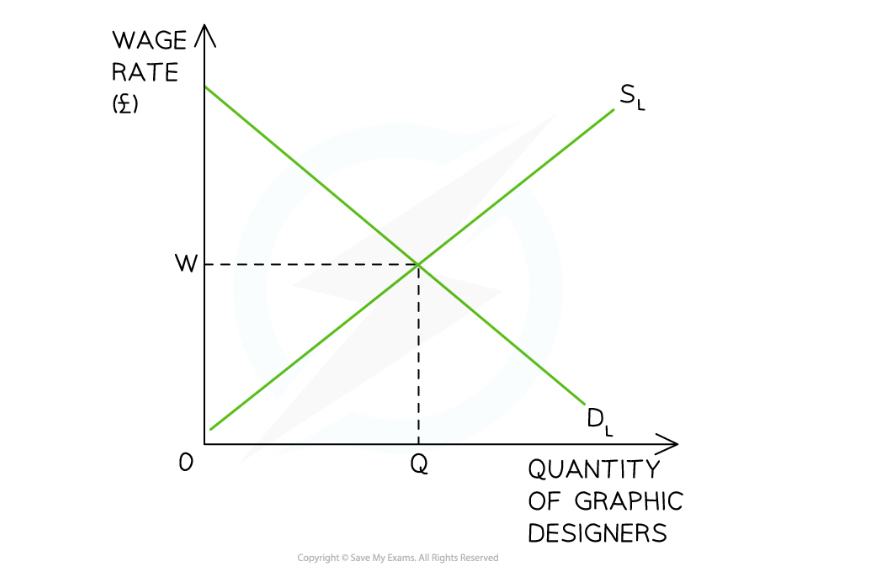
In the labour market for graphic designers, the equilibrium wage rate is W and the equilibrium quantity is Q. At this point the DL = SL - Diagram Analysis
The market for graphic designers is in equilibrium where DL = SL
The equilibrium wage is W and the quantity of labour is Q
There is no excess supply of labour
There is no excess demand for labour
Why is the labour market important and why can changes to the condition in the labour market be traumatic ?
The labour market is extremely important as jobs provide income to households, which directly impacts the standard of living in an economy
Changes to conditions in the labour market can be traumatic as they may result in changes to wage rates, working conditions and/or the benefits associated with a particular job
These changes can possibly decrease the standard of livingfor many people
Current Labour Market Issues in the UK
Current Labour Market Issues in the UK
Skills shortages | Youth unemployment | Changes to retirement ages |
|---|---|---|
|
|
|
School leaving age | Zero-hour contracts | Temporary/flexible working |
|
|
|
Why do the UK government intervene in the labour market ?
The UK Government usually intervenes in the labour market in order to improve equity and avoid the exploitation of workers
A maximum wage is a government imposed price ceiling below the market price and is rarely used
There has been some discussion recently to set maximum wages for CEOs as their wages in early 2022 were 86x the average wage of full-time employees
If CEOs were paid less then the average pay per workermay increase
A minimum wage is a legally imposed wage level that employers must pay their workers
It is set above the market rate
The minimum wage/hour varies based on age
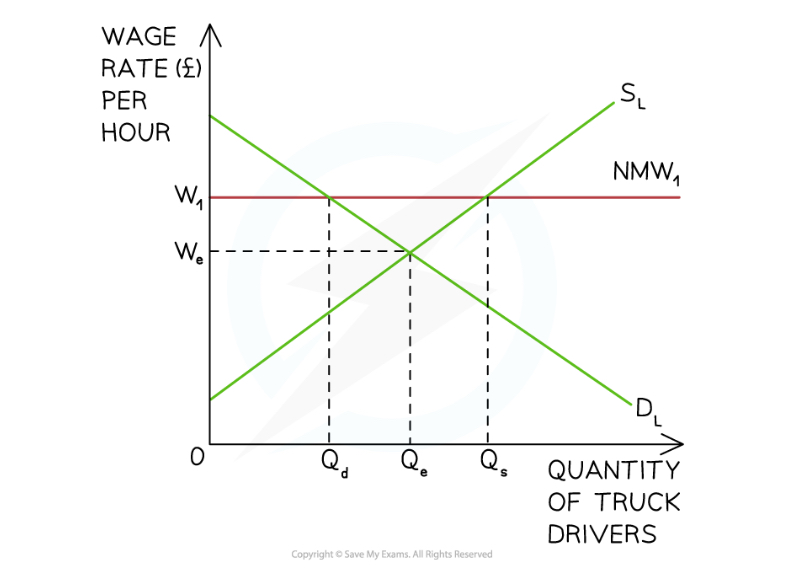
A national minimum wage (NMW1) is imposed above the market wage rate (We) at W1 - Diagram Analysis
The market equilibrium wage and quantity for truck drivers in the UK is seen at WeQe
The UK government imposes a national minimum wage (NMW) at W1
Incentivised by higher wages, the supply of labour increases from Qe to Qs
Facing higher production costs, the demand for labour by firms decreases from Qe to Qd
This means that at a wage rate of W1 there is excess supply of labour and the potential for real wage unemployment (Occurs when wages are set above the equilibrium level creating imperfections (excess supply) in the labour market) `equal to QdQs
The Uk government is what ?
The UK government is the largest employer in the nation
In April 2022 there were 5.74 million public sector workers out of a total of 29.6 million employed workers (19.39%)
What is the UK government in many industries ?
In many industries, the UK Government is the dominant employerand so is able to exercise monopsony power in setting the wage rates
There are several implications of this public sector wage setting
If the government increases the NMW, they are significantly increasing their own wage bill
The private sector often uses public sector wages as a benchmark for their own wage calculations
If public sector wages increase and private sector ones do not, it can create tension between workers in the different sectors
Increases to public sector pay often have to be paid for by increases in tax rates for the entire working population
What happened in June 2022?
In June 2022, public sector workers were striking due to issues with the pay increases offered by the Government
Worker's wages were frozen from 2010 to 2015 after the 2008 global financial crisis
This was followed by rampant inflation (A sustained increase in the average price level of goods/services in an economy) and wage increases well below the level of inflation
Policies to tackle labour market immobility
There are many individual policies that the UK Government employs in order to reduce labour market immobility and together they help reduce the labour market failures
Examples Of Policies Used To Tackle Labour Market Immobility
Policy | Explanation |
|---|---|
Improved education/training | Education improves skills and a wider skill base allows workers to move more easily between jobs which are not 100% identical |
Targeting skills shortages | Identifying markets with specific skills shortages and training workers in those skills provides some opportunity for workers to switch between occupations |
Subsidising employers | A per hire subsidy from the government provides an incentive for employers to take on workers without the necessary skills (and train them) - or workers from a specific demographic (e.g. disabled workers) and this improves occupational mobility |
Relocation subsidies | Providing relocation subsidies to workers reduces both geographical and occupational immobility |
Reducing information asymmetry | Setting up job centres and improving the flow of information between employers and the unemployed helps workers to quickly identify new opportunities |
Reducing discrimination | Reducing discrimination in hiring practices will help some workers improve occupational mobility |
The elasticity of demand for labour
This refers to how responsive a firms demand for labour is to a change in the price of labour (wage rate)
If the demand for labour is elastic, then an increase in the wage rate will result in a more than proportional decrease in the quantity of labour demanded by firms
If the demand for labour is inelastic, then an increase in the wage rate will result in a less than proportional decrease in the quantity demanded of labour demanded by firms
If demand is elastic firms will be very responsive to changes in wage rates, rapidly hiring workers when wages fall and firing workers when wages rise
If demand is inelastic firms will have a much smaller response to rising or falling wages
Factors that influence PED of labour
Factors That Influence PED of Labour
The proportion of labour costs to total costs The higher these are then the more elastic the demand for labour will be; the lower these are then the more inelastic the demand for labour will be | Ease and cost of factor substitution If substituting capital for labour is easy and the cost is comparable to the increase in wages, the demand for labour will be more elastic - and vice versa |
PED of the final product If the product being produced is price inelastic in demand, then the demand for labour is likely to be more inelastic i.e if wages rise, firms will pass on the increased costs of production to the final consumers | Time period In the short-run, demand for labour is likely to be more price inelastic i.e an increase in wages will have a less than proportional decrease in the quantity demanded. However, in the medium to long-term firms can research alternative methods of production and the demand for labour becomes more price elastic |
The elasticity of supply of labour
This refers to how responsive the supply of labour is to a change in the price of labour (wage rate)
If the supply of labour is elastic, then an increase in the wage rate will result in a more than proportional increase in the quantity of labour supplied
If the supply of labour is inelastic, then an increase in the wage rate will result in a less than proportional increase in the quantity of labour supplied
In low skilled occupations the quantity of labour supplied is very responsive to a change in wage rates i.e. supply of labour is elastic
Occupations which require a longer and higher level of training tend to have an inelastic supply of labour i.e even if wage rates increased significantly, there would be a less than proportional increase in the supply of labour in the short run