APES Chapter 3 Review
 Call Kai
 Learn
Learn Practice Test
 Spaced Repetition
 Match
Match Flashcards
 Knowt Play
1/24

There's no tags or description
Looks like no tags are added yet.
Name | Mastery | Learn | Test | Matching | Spaced | Call with Kai |
|---|
No analytics yet
Send a link to your students to track their progress
25 Terms
Which of the following is NOT an example of an abiotic component of an ecosystem?
Water, Minerals, Sunlight, Fungi, or Air
Fungi
Which of the following is NOT characteristic of most ecosystems?
biotic or abiotic components, recycling of matter, distinct boundaries, a wide range of sizes
distinct boundaries
the waste product in photosynthesis is
oxygen
what could be a cause of decreased evapotranspiration
increased percolation
At which trophic level are eagles that consume fish that eat algae?
secondary consumers
at which trophic level do organisms use a process that produces oxygen as a waste product?
producers
at which trophic level are dragonflies that consume mosquitoes that feed on herbivorous mammals?
tertiary
beginning at the lowest trophic level, arrange the following food chain found on the Serengeti Plain of Africa in the correct sequece
decomposers, cheetas, shrubs, and gazelles
shrubs, gazells, cheetas, decomposers
Which macronutrient is required by humans in the largest amounts?
nitrogen
roughly what percentage of incoming solar energy is converted into chemical energy by producers
1%
the net primary productivity of an ecosystem is 1 kg c/m2/year, and the energy needed by the producers for their own respiration is 1.5 kg C/m2/year. The gross primary productivity of such an ecosystem would be
2.5 kgC/m2/year
An ecosystem has an ecological efficiency of 10%. If the product level contains 10,000 kilocalories of energy, how much energy does the tertiary consumer level contain?
10 kcal
Which biogeochemical cycle(s) does NOT have a gaseous component?
potassium, sulfur, phosphorous
Phosphorous
a true statement about the carbon cycle
carbon transfer from photosynthesis is in steady state with respiration and death
*this is my best educated guess
human interaction with the nitrogen cycle is primarily due to
the leaching of nitrates into terrestrial ecosystems
research at Hubbard Brook showed that stream nitrate concentrations in two watersheds were 1. _________ before clear cutting, and that after one watershed was clear-cut, its stream nitrate concentration was 2. __________
similar, decreased, increased, the same
similar; increased
small inputs of this substance, commonly a limiting factor in aquatic ecosystems, can result in algal blooms and dead zones
phosphorous
after a severe drought, the productivity in an ecosystem took many years to return to pre-drought conditions. This observation indicates that the ecosystem has
low resilience
nitrogen is crucial for sustaining life in terrestrial and aquatic ecosystems...draw a full diagram of nitrogen cycle
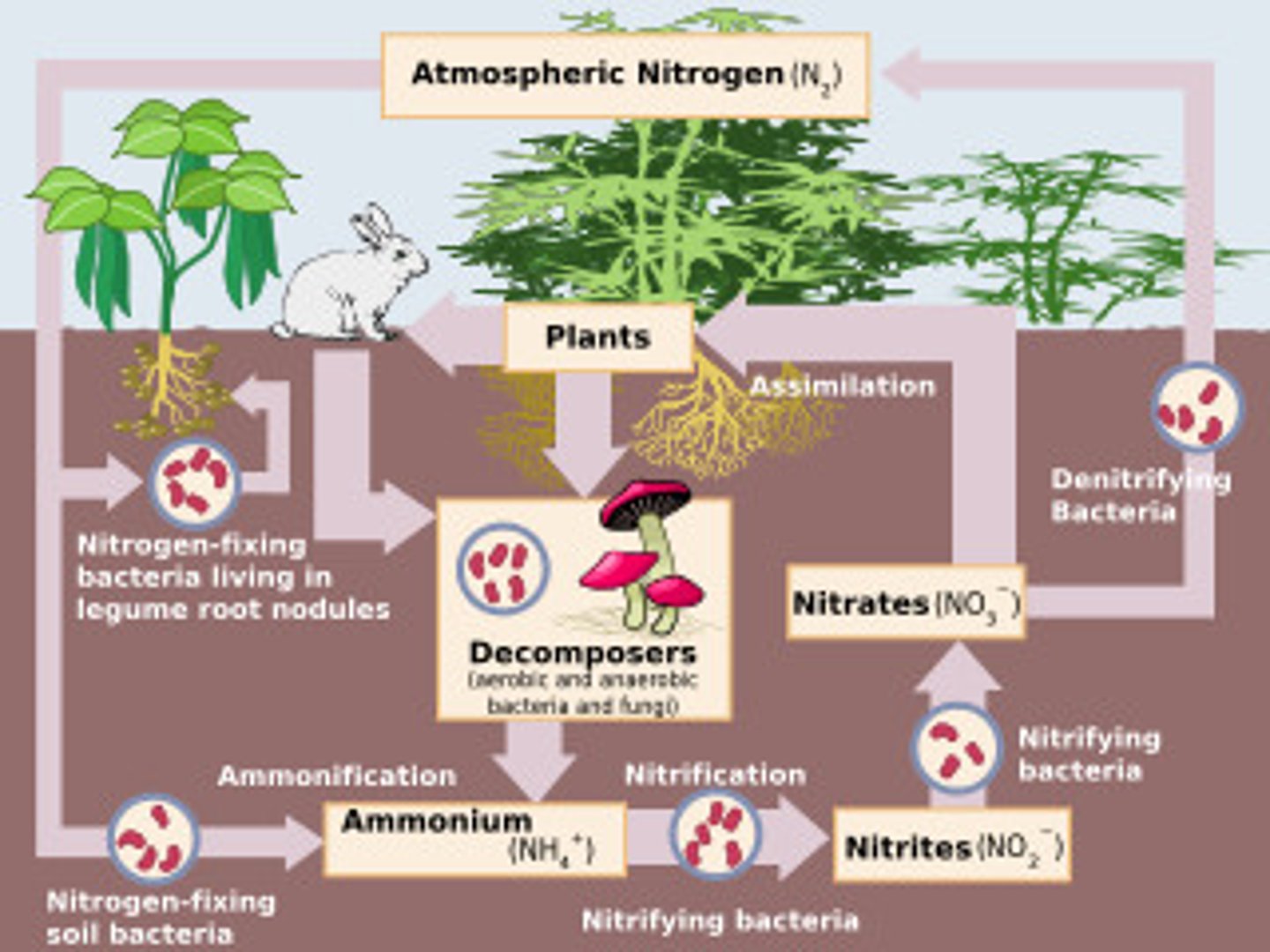
describe: Nitrogen fixation
The conversion of nitrogen gas (N2) to ammonia (NH3) that can be used by many producers. Can occur in processes of lightning and combustion.
describe: ammonification
When an organism dies, decomposers that use nitrogen containing materials for food, convert organic matter to ammonium ion
describe: nitrification
conversion of ammonium ion into nitrite (NO2-) then into nitrate (NO3), which can then be absorbed by producers
describe: denitrification
natural conversion of nitrate to nitrous oxide, a gas released into the atmosphere, where it can be converted to nitrogen gas
describe why nitrogen is crucial for sustaining life
Is found in amino acids, building blocks of proteins, in all plant and animal species
or
specific amounts of nitrogen are required by plants for healthy growth
or
required in high concentration for living organisms and is considered a limiting factor
describe one way that the nitrogen cycle can be disrupted by human activities
burning of fossil fuels
or
humans produce huge amounts of nitrogen containing plant fertilizers and this can overload the area of application (problem with leaching)