Economic Activity and Energy
 Call Kai
 Learn
Learn Practice Test
 Spaced Repetition
 Match
Match Flashcards
 Knowt Play
1/26

There's no tags or description
Looks like no tags are added yet.
Name | Mastery | Learn | Test | Matching | Spaced | Call with Kai |
|---|
No analytics yet
Send a link to your students to track their progress
27 Terms
Economic Activity
the production, manufacturing or provision of goods and services
Things economic activities do:
-create jobs
-generates income
-produces something for sale/consumption
Economic sectors:
Primary- extraction of raw materials
Secondary- processing of raw materials into goods
Tertiary- provision of those goods/ services
Quaternary- the creation of new products through R and D
The Clarke Fisher Model- describe
The pre-industrial phase– the primary sector leads the economy and may employ more than two-thirds of the working population. Agriculture is the most important activity.
The industrial phase– the secondary and tertiary sectors increase in importance. The primary sector declines, as industrialization (machinery in farms grows)
The post-industrial phase– As the tertiary sector becomes the most important sector, the secondary sector declines and the primary sector employs a small percentage of the active population.
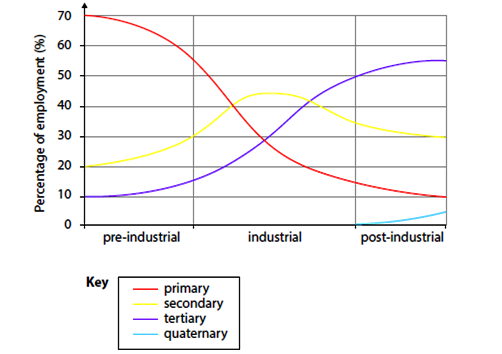
The Clark Fisher Model- explain
Decline of Primary sector + Rise in Secondary Sector- due to mechanization + secondary sector is higher paying- in low income countries, there is less mechanization, so farmers have to rely on subsistence farming (harvesting only enough food for their family)
Rise in Tertiary sector- as more rural- urban migration occurs (rise in secondary sector) more factories move to cities due to extra labour available. More people have stable salaries- rise in disposable income creates demand for luxury services
Fall in Secondary sector- service sector grows due to higher pay and safety (compared to secondary sector)
Rise in quaternary- more people start getting educated + greater demand for newer products and tech
Global Shift
movement of manufacturing from developed countries to developing/emerging countries in search for cheaper labour
Factors affecting primary sector location
Availability of workers
Availability of raw materials
climate/ soil conditions
proximity to transport links
factors affecting secondary sector location
cheap/ available labour
transport links
large land
urban area
amenities
factors affecting location of tertiary sector
urban area
consumer availability
land price
factors affecting location of quaternary sector
amenities
educated workforce
urban area
large and open space
Informal employment/ sector
it is the unofficial sector that is unregulated and doesn’t fall under government control
Causes of informal employment
rural to urban migration- occurs in less developed countries as the people moving have less qualifications so cant access official jobs
due to a lot of people living in cities- there aren’t many jobs, so people have to join unregulated jobs to survive
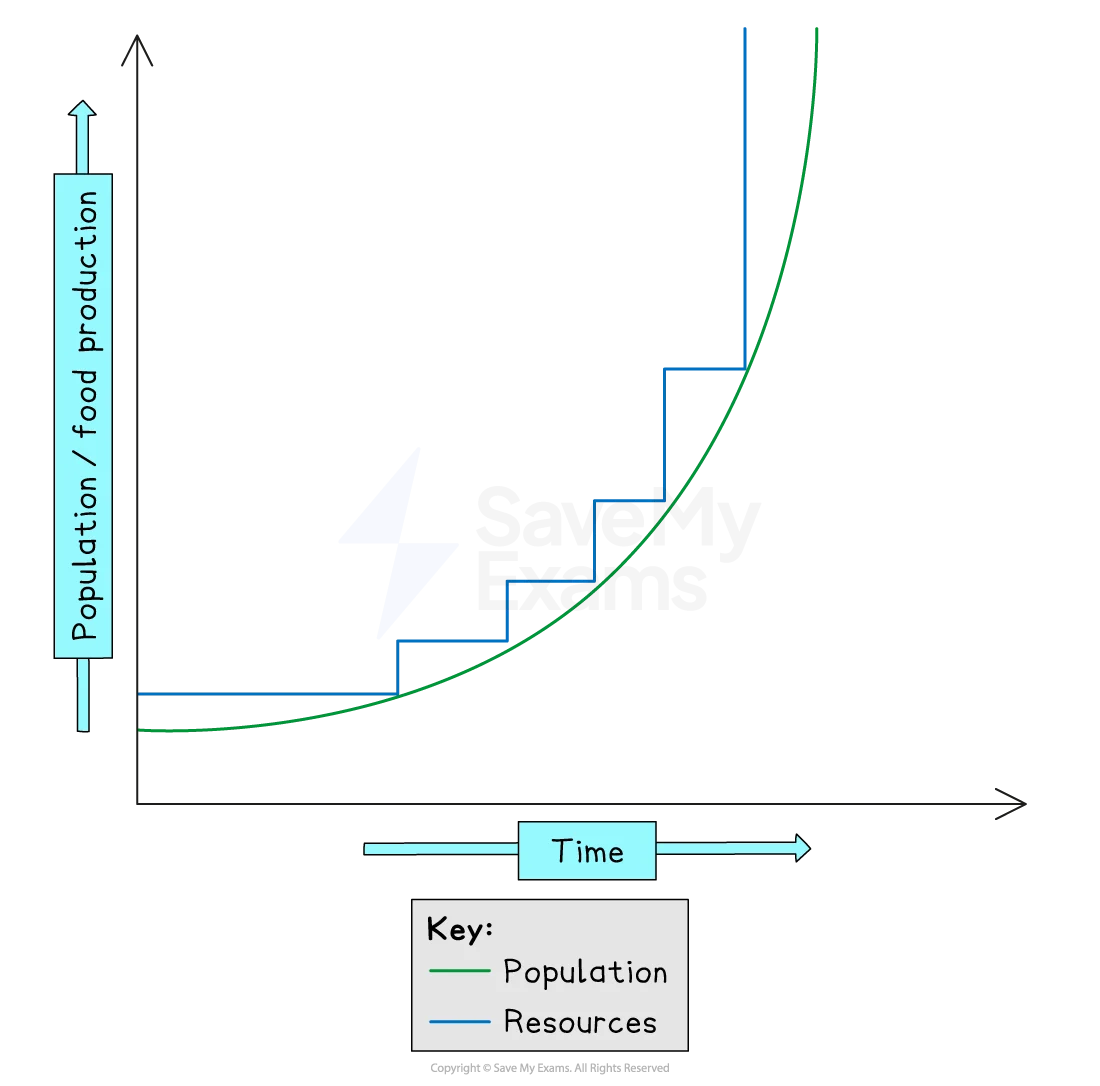
Boserup’s Population Theory
believed population growth stimulates agricultural production
believed food supply will increase with population growth- humanity would invent new farming methods to keep up with rising demand
necessity drives technological advancement
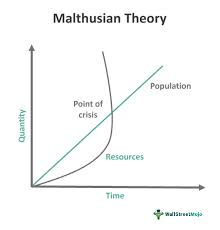
Malthus’s Population Theory
believed unchecked population growth led to famine and disease since resources limit population size
idea that positive checks include war, famine and epidemics + preventative checks include moral restraint + delayed marriage
population grows faster than food supply
Employment structure in LIC—>MIC
more people working in primary sector due to lack of mechanization- as country begins to develop, factories move to cities, which leads more people to working in secondary sector from rural to urban migration
Employment structure in MIC—>HIC
people move from secondary sector jobs to tertiary sector jobs because these jobs pay more and are safer. Then they have higher disposable income, which leads to higher education rates, leading to a more educated workforce. Then as the demand for better products arises, people start working in quaternary sector
Energy demand
increased wealth- when countries have more wealth they want to make citizen’s lives better by introducing tech advances- need for energy (demand) increases
Increased population- the demand increases as more people need tech and energy
Increased amount of energy- as tech increases, demand also increases because tech needs energy to function
Energy supply
delivery of fuels to a point of consumption
Energy security
uninterrupted availability of energy sources at an affordable price
Energy consumption
energy used by a population
Energy surplus
when more energy is available than what is required
Energy deficit
when less energy is there than what is required
Renewable
a material that can be made without damaging the source product
Non- renewable
a material that once used can’t be used again
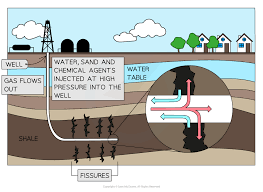
Fracking
process that uses san, chemicals and water to extract natural gases from the earth
Fracking process
well is drilled into the ground- vertically and then horizontally, into layers of shale rock that contain natural gases
steel pipes (casings), are inserted into te well and sealed with cement to stop gas or excess liquid from leaking into the surrounding soil/water
a mix of sand, chemicals and water are pumped into the stale rock, creating small fractures
sand in fractures open, allowing the trapped natural gases trapped in rock to flow into the pipes/ well
gas travels upwards to surface where it is seperated, processed and sent for use
Energy efficiency + conservation
energy efficiency- use a resource that provides the same output that uses less energy while doing so
energy conservation- the practice of reducing energy consumption by using less energy-intensive services, cutting down on waste, and improving efficiency