Macro Econ - Mid 2
 Call Kai
 Learn
Learn Practice Test
 Spaced Repetition
 Match
Match Flashcards
 Knowt Play
1/103

There's no tags or description
Looks like no tags are added yet.
Name | Mastery | Learn | Test | Matching | Spaced | Call with Kai |
|---|
No analytics yet
Send a link to your students to track their progress
104 Terms
what is fundamental analysis? what is the fundamental value? What are the steps of assessing a businesses fundamental value?
a framework for assessing an asset’s fundamental value
the present value of the future profits that a company will earn
1 - Forecast future profits - a spreadsheet that models the business;s revenues and costs in each pf the ext 5-10 years
2 - discount these profits - convert each year’s profits into their present values using the discounting formula
3 - add up the sum of those discounted future profits - the sum of the present value of the future profits is your estimate of the fundamental value of
4 - divide the company’s fundamental value by the total number of shares - that’s the final comanys’s fundamental value
when does the fundamental value investment strategy work? when should you buy stock?
only when your estimate of the company’s fundamental value is more accurate than the stock price.
then the stock price is lower than the fundamental value
what is relative valuation? what Is a price to book ratio? what is a price-to-earniings ratio?
an assessment of the value of an asset by comparing it to similar assets
measures a firms stock price relative to the book value per share - the businesses net value per share (price-to-book ratio = price per share/book value per share)
measures a firms stock price, relative to last years profits - earnings per share (price-to-earnings ratio = price per share/earnings per share)
what is the efficient market hypothesis? what is a random walk?
the theory that at any point in time, stock prices reflect all publicly available information
when a price follows an unpredictable path
what is a mutual fund? what are the two types?
a fund that buys a portfolio of stocks (and sometimes bondS) on your behalf
actively managed mutual funds - you pay expert stock pickers who invest your money in the stocks that they think are likely to do well (high fees)
Index funds - program a computer to automatically buy every stock that is in some broad market index (low fees)
what is a speculative bubble? what is the greater fool theory?
when the price of an asset rises above what appears to be its fundamental value - prices will keep inflating until the bubble bursts
the idea that people buy an investment because they expect other people to buy it from them at a higher price
why do speculative bubbles persist?t
it can be hard to spot a speculative bubble
even if you spot a speculative bubble, it can be hard to bet against it
you don’t know when the bubble will pop
what are six lessons for personal finance?
harness the power of compound interest - a small amount of money can grow over time, so start saving early and save your gains
don’t pick individual stocks - even if the efficient markets hypothesis is not perfect right, it is mostly right
diversify your portfolio to reduce risk - easiest way to diversify your stock holdings is to buy index funds
past performance is no guarantee of future performance
minimize fees
follow al five rules with low-cost index
what is an export? what is an import? what are the net exports? what are negative and positive exports called? what is international trade?
goods and services produced domestically and purchased by foreign buyers
goods and services produced in a foreign country and purchased by domestic buyers
(spending on exports - spending on imports) also referred to as the trade balance
trade deficits and trade surplus
when people buy or sell goods and services across national borders
what is globalization? what has it lead to?
the increasing global integration of economies, cultures, political institutions, and ideas
reductions in the cost of international transports and communications, and a growth in trade
what are financial inflows?what are financial outflows?
foreigners investing in Canada - funds flow to Canada from the outside
Canadians investing their money in other countries - funds flow out of Canada
what are the three main forms of financial flows?
foreign direct investment - a company that hires Canadian worker, but the profits go to another country - its when foreigners invest in physical assets
portfolio investment - when foreigners buy Canadian stocks or bonds - foreign investors receive future payments in return
deposits and loans - when foreigners lend money to Canadians - including loans made directly to Canadians and foreign deposits in Canada banks which fund domestic loans
what is financial globalization? capital controls? institutional investors? financial innovation?
when financial flows between countries increase
rules designed to limit the fakir if money across borders
pension funds and mutual funds
innovations to the financial market that allow ex, investors to take advantage of new opportunities to diversify their risks in foreign markets
why have financial flows risen across the world?
1- removal of capital controls
2- large institutional investors have become more important over time (seeking to diversify their portfolios
3- tech has made investors more comfortable sending their money overseas
4- financial innovation - new ways for investors to diversify and hedge their risks on foreign markets
what is the nominal exchange rate? whats the equation?
the price of a countries currency (in terms of another countries currency)
nominal exchange rate (price of a dollar in yen) = # of yen/ # of dollars
what is an appreciation of the dollar? depreciation? what happens when the dollar appreciates(3)? what happens when the dollar depreciates?
when the price of a currency rises
when the price of a currency falls
imports become cheaper, exports become more expensive, higher exchange rate
imports become more expensive, lower exchange rate, and exports become cheaper
what is the foreign exchange market? who is the demand and supply?
the market in which currencies are bought and sold
demand = foreigners needing dollars to buy Canadian goods(exports) and invest in Canada (Canadian inflows) ex = Japanese grocery store looking to buy Canadian dollars to purchase Canadian pork
suppliers = Canadians needing foreign dollars to buy there goods(imports) and invest in them(can outflows) ex = people looking to sell their Canadian dollars in return for Japanese yen
what are trade flows in the context of international transactions? financial flows?
exports of one good and imports of another
an investment of one country to another (Toyota invests in building a new factory in Canada)
how do we keep exchange rates straight? (3)
clarify which market you’re analyzing (market for Canadian dollars)
specify what prices you’re evaluating (how much yen is needed to get this many dollars)
state the origin and destination (exports from A to B)
what are shifts in the demand in the foreign exchange market ? (5) & (4)
increase in demand for Canadian dollars shifts curve right - decrease in demand for Canadian dollars shifts curve left
-exports increase = demand for can dollar increase
strength of global economy - increase in GDP of our major trading partners will cause an increase in Canadian exports and shift demand to the right
barriers to trade in foreign markets - fewer barriers = more exports = shift right
domestic innovation and marketing - good innovation and marketing will increase exports = shift demand right
foreign prices - increase in foreign prices = Canadian dollar demand to the right
domestic prices - lower domestic prices = CAN$ demand to the right
-financial inflows increase = demand for can dollars increase
interest rate differentials - higher interest rate differential = demand curve to right
business profitability - more opportunities for profitable investments = demand curve right
political risk - low political risk in can and high political risk in other countries = demand right
expected exchange rate movements - expected rise in can dollars = demand shift right
what are shifts in the supply in the foreign exchange market ? (5) & (4)
increase in supply moves the supply curve right, a decrease in supply of Canadian dollars moves the curve to the left
-imports to Canada increase = increase in supply of Can dollars
strength of the domestic economy - increase in Canada GDP = more ppl getting more money = supply of CAN dollars to the right (increase)
trade barriers protecting domestic producers - reduced barriers = supply to the right
foreign innovation and marketing - good innovation and marketing of foreign products = increase in Canadian demand for imports = supply of dollars to the right
domestic prices - domestic producers raise their prices = Canadians will import = supply to the right
foreign prices - foreign prices decrease = supply will increase
-increased financial outflows = increase in supply of CAN dollars
interest rate differentials - lower interest rate differential = more financial outflows cause Canadians seek better investment opportunities outside of Canada = supply goes to the right
business profitability - fewer profitable businesses to invest into in Canada = supply to the right
political risk - foreign political risk decreases = Canadians invest = supply to the right
expected exchange rate movements - news that the dollar might fall = ppl sell more = supply to the right
what factor never shifts demand or supply curves?
exchange rate
what is a floating exchange rate ? what is a fixed exchange rate? what is a managed exchange rate?
when the exchange rate is determined purely by the forces of supply and demand
exchange rate is set by the government
the government buys/sells currency ti reduce volatility and/or keep the currency cheap
how to calculate the real exchange rate?
real exchange rate = domestic price in dollars/foreign price converted to dollars
real exchange rate = domestic price in dollars/(foreign price in foreign currency/nominal exchange rate)
what does real exchange rate depreciation lead to (2)? what is the real exchange rate? what does the real exchange rate determine?
a decrease in imports & an increase in exports
the rate at which you can exchange domestic goods for foreign goods
net exports- an economy-wide real depreciation willl lead total exports to increase and total imports to decrease
real exchange rate vs nominal exchange rate?
real exchange rate = the rate at which you can exchange one countries output for another country’s output
nominal exchange rate = rate at which you can exchange one countries currency for another
what does a high real exchange rate mean? what abt a low one?
internationally uncompetitive - Canadian prices are high relative to foreign prices - Canadians import a lot of foreign goods - foreigns buy few Canadian exports
internationally competitive - Canadian prices are low relative to foreign prices - Canadians import few foreign goods - foreigners buy a lot of Canadian exports
what is the current account ? whats the current account balance?
how much income crosses national borders each year (tracks all income flows)
the difference between the income that Canadians receive from abroad and the income Canadians pay to people abroad
what is the financial account? whats the financial account balance?
tracks and tallies up changes in the ownership of assets, loans, and investments
the difference between the financial inflows and financial outflows
to Canada what is an inflow of dollars? what is an outflow? what must inflows equal?
payments from the rest of the world (financial inflows + income from abroad)
payments to the rest of the world (financial outflows + income paid abroad)
the outflow of dollars
how do we calculate the current account deficit ? what does it occur?
current account deficit = I - (Y - C - T) - (T - G) = I - S
current account deficit = private saving - government saving = national saving
when investment exceeds total national savings
what can a current account deficit reflect? (2)
people living beyond their means (people pending more than they earn)
valuable investments in the future (reducing current account deficit means preventing businesses from making valuable investments that could be the foundation of future economic growth
what is the business cycle? what does it do?
short-term fluctuations in economic activity
knocks the economy off course form its longer-run trend
note - it is not regular
what is potential output?
the level of output that occurs when all resources are fully employed (how skilled the workers are, how many we have, how much capital to work with, and how many ideas we have to combine inputs) - is reflected by long-run economic growth
what is the output gap and how Is it calculated? when is output below its potential, what does it mean? when is actual output above its potential, what does it mean?
the difference between the actual and potential output
output gap = ((actual output - potential output)/potential output) x 100
the output gap is negative (workers can’t find jobs, equipment lies unused, storefronts are shuttered)
output gap is positive (economy is using its resources with an unsustainable intensity (ppl work extra shifts, factories put off repairs, prices start to rise) - short periods
in the business cycle, what is a peak? a trough? a recession, how long do they last? an expansion, how long do they last?
a high point in economic activity - followed by a fall in output
a low point in economic activity
economy shrinks/contracts - period of declining economic activity - short and sharp
a period of increasing economic activity - killed by an adverse tock, not due to time - long and gradual
what is a level versus a change? (the business cycle)
levels - GDP measures the level of output - the output gap tells you how well the economy us doing relative to its potential - describes business cycle peaks and troughs
change - GDP growth rates are abt changes - describing the rate at which the size of the economy is expanding or contracting (recession(negative change) and expansion(positive change))
what is co-movement? what is a leading indicator? what is a lagging indicator?
variables that move up and down together - if one part of the economy is doing weak, the other parts of the economy are also doing well
variables that tend to predict the future path of the economy (business and consumer confidence, and the stick market)
variables that tend to follow business cycle movements with a bit of delay (unemployment trends)
what is Okun’s rule of thumb?
for every percentage point that actual output falls below potential output, the unemployment rate is around one-third a percentage point higher
when output is below potential, unemployment tends to be higher, and when output is above potential, unemployment tends to be low
the unemployment rate falls as the output gap rises
what is an annualized rate? what is seasonally adjusted data?what are data revisions? what is real data? what is nominal data?
data converted to the rate that would occur if the same growth had occurred throughout the year
data stripped of predictable seasonal patterns
updates to earlier estimates
data adjusted for inflation
data not adjusted for inflation
what are the top ten economic indicators?
Real GDP - broadest measure of economic activity
Export data - provides indications about production in Canada’s big export sectors
Unemployment rate - indicator f excess capacity
Payrolls - tells you if the labour market is improving/how many jobs are created each month
Building Permits - tell you abt construction - better economy = more construction
Capacity utilization - indicator of industrial slack
retail sales - indicator of consumer confidence and spending
Inflation rates - indicates how much economy-wide prices are growing
Labour cost index - indicates how fast wages and benefits are rising
stack market - indicates future expected profits of businesses
what aggregate expenditure? whats the equation? what do you want to focus on when trying to assess economy-wide demand?
the total amount of goods and services that people want to buy across the whole economy (planned investment)
= consumption +planned investment + Government purchases + net exports
how much people/businesses buy, not the unsold inventories that companies accumulate
what is the macroeconomic equilibrium? equation? what does output adjust to?
when the quantity of output buyers collectively want to purchase is equal to the quantity of output that suppliers collectively produce
when output = aggregate expenditure
output adjusts to meet aggregate expenditure
int he short run, what do changes in demand drive? what happens when people purchase less than businesses produce? what happens if aggregate expenditure is greater than production ofr a short while?
changes in demand drive changes in the output
extra output is stored as inventories and businesses cut back on production
businesses delay delivery or sell existing inventories and businesses increase production
what drives the short run? what drives the long run? why would actual output fail to meet potential in the short run? how would actual output exceed potential output in the short run?
demand - explains year-to-year fluctuations in actual output
supply - explained economy potential output (level at which all resources are fully employed)
weak aggregate expenditure - businesses don’t want to produce output that ppl wont buy - output is less than potential
strong aggregate expenditure - suppliers run extra overnight shifts, defer maintenance, etc - output exceeds potential
what does the output gap focus on? how do we calculate it? what does the real interest rate determine?
the balance between short-run demand for output and long-run supply of output
output gap = (actual output - potential output)/(potential output) x 100
the real interest rate is the price that determines this years aggregate expenditure
what is equilibrium GDP vs potential GDP?
equilibrium GDP - the lvl of GdP at the point of macroeconomic equilibrium - the point at which the economy will come to rest
potential GDP - economy highest sustainable level of production - determined by available inputs
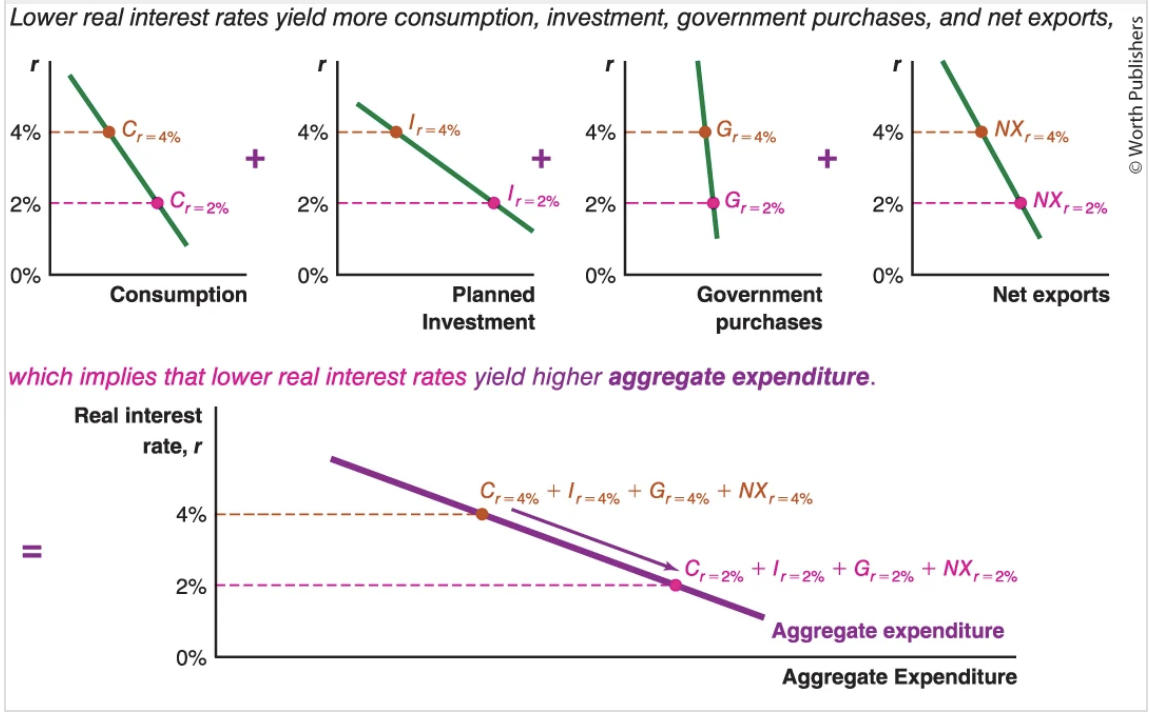
what do low interest rates do (5)? what does the IS curve describe?what does it illustrate?
boost consumption
boost investment
boost gov. purchases
boost net exports - make Canadian dollar cheaper
boost aggregate expenditure - C + I + G + NX - increased GDP as well
the link btw the real interest rate and the output gap
it illustrates the link btw interest rates, GDP, and the output gap
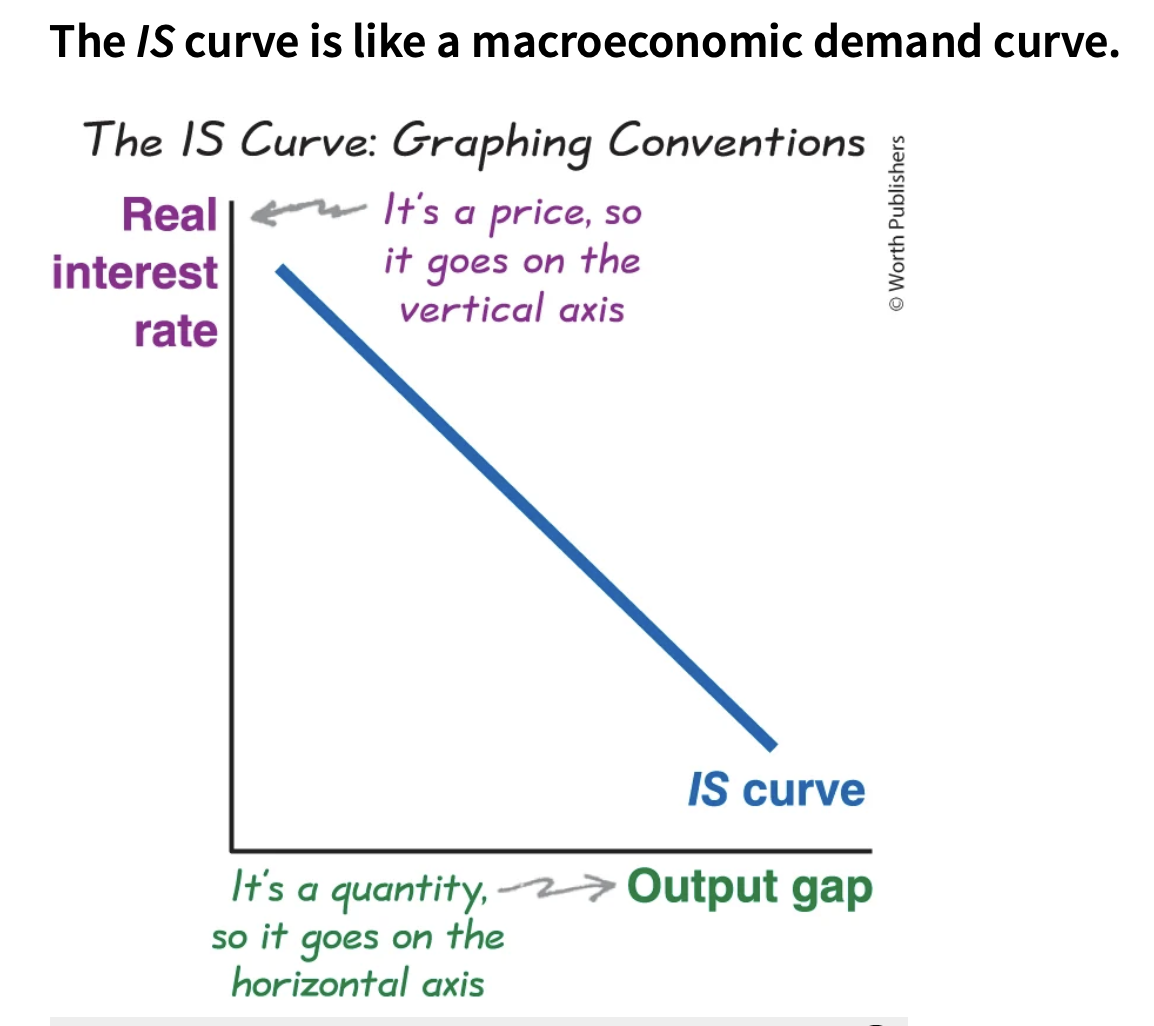
what is the x - axis of the IS curve? what is the y-axis of the IS curve? what is the IS curve?
the output gap (real GDP, relative to potential GDP)
the real interest rate
the macroeconomic demand for output (all types of output)
what causes a movement along the IS curve? what causes a shift ti the IS curve?
a change in the real interest rate
changes in other factors that change aggregate expenditure at a given interest rate
what is the monetary policy ? what is the risk-free interest rate? what is the risk premium? how do we calculate real interest rate?
the prices of setting interest rates in an effort to influence economic conditions
the interest rate on a loan that involves no risk - the interest rate in a set of overnight loans that are almost certain to be repaid the next day
the extra interest that lenders charge to account for the risk of loaning money
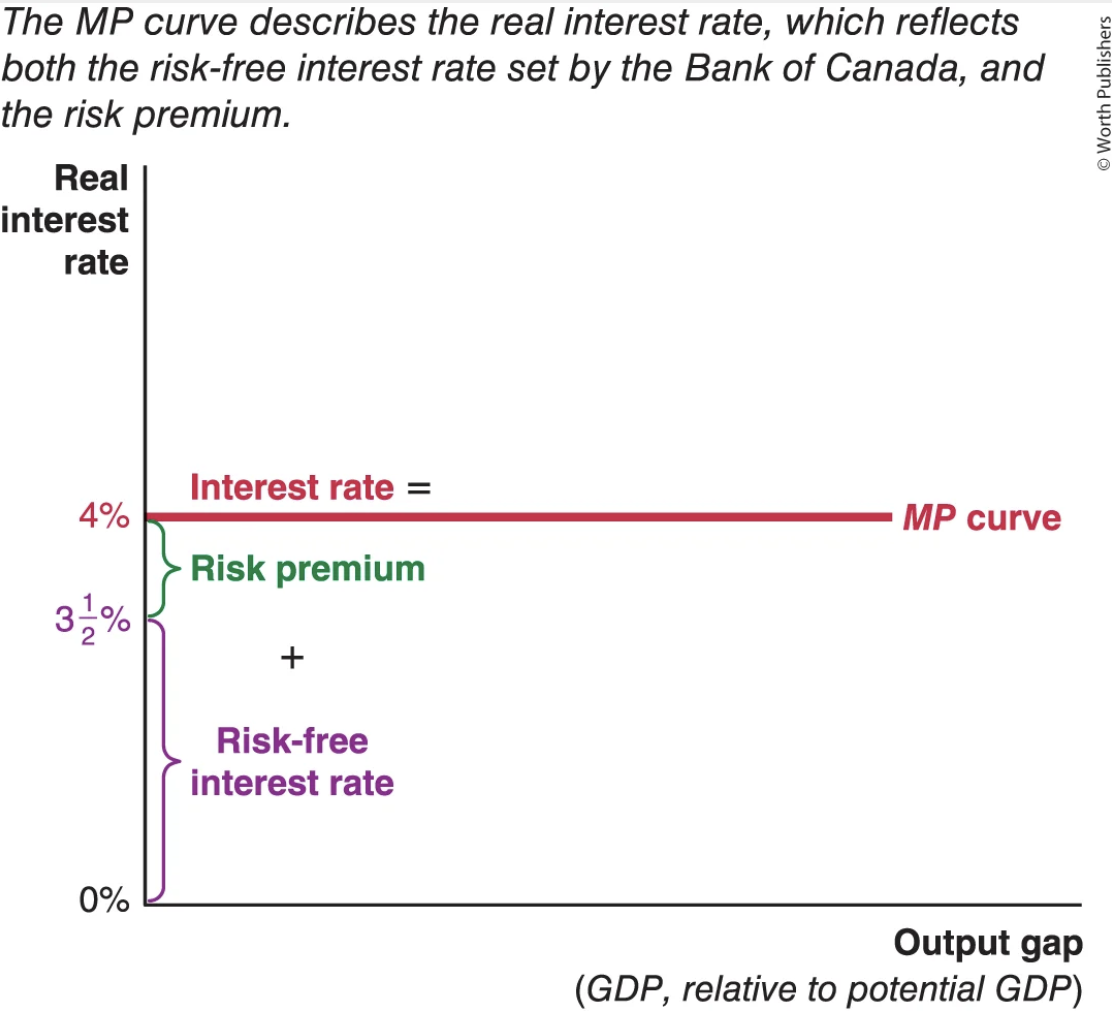
real interest rate = risk-free real interest rate + risk premium
What is the MP curve ? why does the MP curve shift? what is an interest rate spread?
it illustrates the current real interest rate, which is shaped by monetary policy and the risk premium (Monetary Policy)
the bank changed its monetary policy or/and changes in financial markets shifted the risk premium
the difference between the interest rate at which you can borrow and the risk free interest rate
why do you pay different interest rates in different loans?
the riskier the loan the higher the interest rate
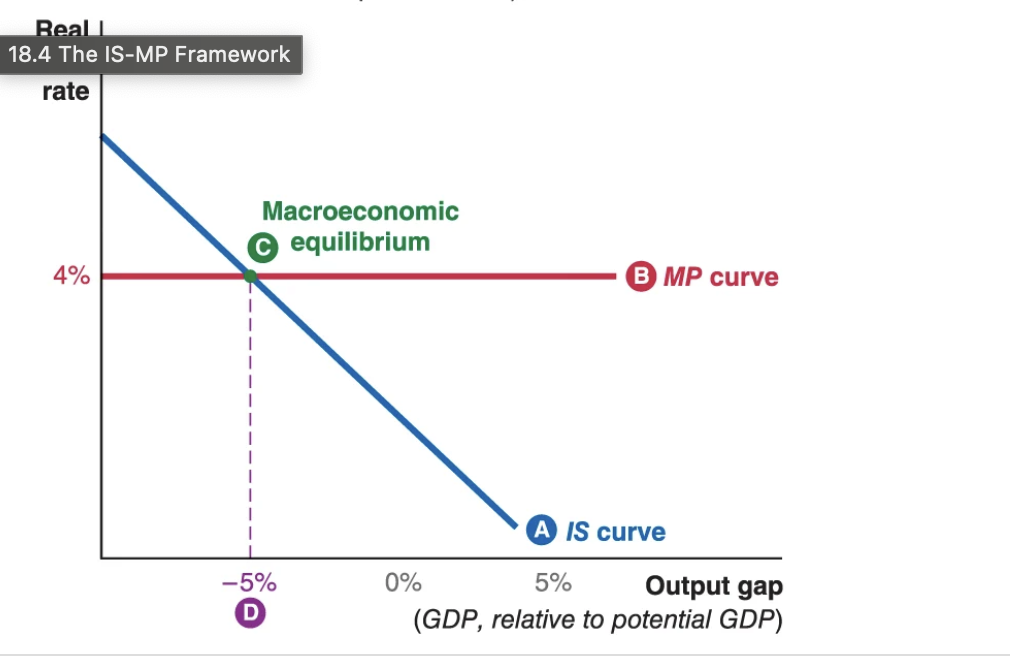
what si the IS-MP framework ?
Is curve - describes the output gap associated with each real interest rate
Mp curve - describes the real interest rate set by monetary policy and financial markets
Macroeconomic equilibrium - where two curves intersect
what are booms and busts of the business cycle? What does strong and weak aggregate expenditure do for booms and busts? what creates economic fluctuations ?
boom - output is at its potential
bust - decrease In output
string - booming economy and full employment
weak - economic slump (bust) and unemployment
changes in aggregate expenditures
what is John Maynard Keynes persistence of economic slumps ?
its a cycle of people spending less then businesses cutting back production to people spending less
we need to kickstart the economy by persuading people to spend again
what shifts the MP curve?
monetary policy - in a recession GDP is less than potential GDP so the bank will cut the real interest rate and MP curve shifts down, then we get a higher output and a reduced negative output gap
what is fiscal policy? how does it change the IS-MP equilibrium?
the governments use of spending and tax policies to attempt to stabilize the economy
it shifts the IS curve - increased government spending causes the IS curve to shift right - higher gap and unchanged interest rate
what is a multiplier? what is a direct effect? what is a ripple effect?
a measure of how much GDP changes as a result of both the direct and indirect effects following from each extra dollar of spending
the literal expenses of material
how the money gets passed on after the exchange (income - daycare - subway - etc)
what does the multiplier do? how to calculate GDP with it? what does the multiplier determine?
summarizes the effect f an initial burst of spending on output
gap = spending x multiplier
how much the IS curve shifts
what does the IS curve reflect? When does it shift left/right?
it reflects aggregate expenditure at each real interest rate
increase in spending = IS curve shifts right
decreased in spending = IS curve shifts left
consumption increase, shift right - planned investment increase, shift tot the right - government purchases - net exports
What are IS curve shifters? (4) (18.5) what are they also called?
consumption increase, shift right
planned investment increase (wealth, consumer confidence, gov.assistance/taxes, shift to the right
government purchases increase (expanding economy, business confidence, corporate taxes, lending standards), shift to the right
net exports increase (global economy growth, exchange rate, fewer trade barriers), shift t the right
spending shocks
what are MP curve shifters? what are they also called? (18.5)
Changes in monetary policy - increased interest rates by increasing risk-free rates and expected future interest rates
financial market - a higher risk premium will rase interest rates due to…
- increased default risk
- increased liquidity risk
- increased interest rate risk
- increased risk aversion
Financial shocks - any change in borrowing conditions that change the real interest rate at which people can borrow
what are the three causes of inflation?
inflation expectations - the rate at which average prices are anticipated to rise next year (if I except inflation to rise 2%, I will increase my workers wages by 2% so inflation expectations create inflation
demand-pull inflation - inflation resulting from excess demand - when demand outstrips a business’s productive capacity, it raises prices - widespread price increases create demand-pull inflation
ex: when income increases, Canadians spend more
-long run: managers will consider opening new stores
-short run: managers can’t increase supply so they raise prices instead
scaling up = when demand exceeds the economy productive capacity, prices rise
supply shocks and Cost-push Inflation - inflation that results from an unexpected rise in production costs ( with the original catalyst being a supply shock)
what determines people inflation expectations? (4)
adaptive expectations - people expect recent levels of inflation to continue
anchored expectations - people who believe the bank of Canada will deliver on its promise to ensure inflation stays around 2%
rational expectations - people who use all available data to come up with the most accurate forecast possible
sticky expectations - people who revisit their views on inflation only irregularly, so they stick with their previous view
what do the three inflationary forces do individually?
increased expectations increase inflation
increased output gap increases inflation
increased production costs increase inflation
what are two key factors for setting prices ? final point?
1 - your marginal costs - as a manager, if your suppliers raise their prices, then you’ll have to charge higher prices to make up for the higher marginal costs you expect to pay
2 - your competitors prices - your competitors are also facing rising input costs, so they’ll likely raise prices as well. Thus, you can raise your prices alongside them and remain competitive
summary - you should raise your prices for next year because you expect other businesses to(suppliers and competitors) to raise their prices
what do inflation expectations create (other than inflation)? what does monetary policy do?
a self-fulfilling prophecy - high inflation creates high inflation expectations which creates higher inflation - low inflation creates low inflation expectations which creates low inflation expectations
shape inflation expectations - convince people that future inflation is going to be low even when businesses are experiencing a temporary rise in inflation
what are three ways or tracking inflation expectations ?
surveys - a representative group of people about their inflation expectations
economists forecasts - ongoing survey of professional economists regarding their inflation forecasts
financial markets - deduce the expected inflation rate by comparing the interest yields of real-return and regular return bonds
what is demand-pull inflation? what is excess demand? what is insufficient demand?
when excess demand leads inflation to rise above inflation expectations
when a customer demands exceeds what producers can supply
when the quantity demanded at the prevailing price is below whats supplied
what is demand-pull inflation driven by? what does it lead to? how to calculate unexpected inflation?
driven by the output gap
leads inflation to diverge from inflation expectations
unexpected inflation = inflation - inflation expectations
what is the Phillips curve? what are the axises of the Phillips curve? what slope does the Phillips curve have?
a curve illustrating the link between the output gap and unexpected inflation - when there’s excess demand (output is higher relative to potential), there is increased unexpected inflation
x-axis : output gap - y-axis : unexpected inflation
upward sloping
what is potential output? what if it increases? (phillips curve). what does negative unexpected inflation mean?
the most amount of output that can still be sustained
unexpected inflation increases
actual inflation will be less than expected inflation
how do you use the phillips curve to forecast future inflation
assess inflation expectations
forecast unexpected inflation
what is the labour market phillips curve? what’s it also called? what happens when unemployment rate is lower then equilibrium?
a curve illustrating the link between the output gap and unemployment rate - excess demand corresponds with a high level of GDP relative to potential output, but low unemployment rate
okun’s rule of thumb
inflation starts to creep up
whats a supply shock (shifts phillips curve)? what is a wage-price spiral? what shifts the supply curve?
supply shocks - a change in production costs that leads suppliers to change the prices they charge at any given level of output.
Input prices
wage-price spiral - a cycle where higher prices lead to higher nominal wages, which leads to higher prices
rising input prices lead to rising prices, and beacasue this boosts inflation at any given level of the output gap, it shifts the phillips curve up
high input prices = phillips curve shift up
productivity
high productivity = phillips curve up
Exchange rates
cost-pull inflation
depreciation of canadian dollar = left shift/upward shift (indirect effect)
when the canadian dollar depreciated, foreign goods are more expensive (direct effecT)
What creates movement along the pjillips curve, and what shifts it?
demand pull inflation -
increase in output gap (increased GDP) = movement upwards and right
cost push inflation
increased input cost, decreased prodoctivity growth, depreciation of canadian dollar due to inflation = shift up
how to calculate rising inflation (how does inflation rise) ? falling inflation? how to calcualte inflation?
rising expected inflation + no change in unexpected inflation = rising inflation
falling expected inflation + no change in unexpected inflation = falling inflation
expected inflation + demand-pull inflation + cost-push inflation = inflation
what does the full model combine?
the IS curve, MP curve, and Phillips curve
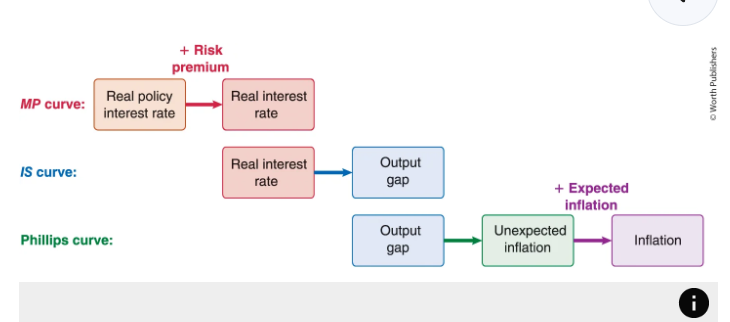
how to forecast economic outcomes? wen does the Phillips curve shift ?
1) find the output gap
2) assess inflation (unexpected inflation + expected inflation)
in response to changes in production costs - i.e. in response to:
input prices - when the price of inputs rises, so will production costs, shifting Phillips curve up
productivity - faster productivity growth leads to more rapid declines in production costs, shifting the Phillips curve down
exchange rates - the value of the CAN dollar determines the price of imports - a depreciating CAN dollar leads imported inputs to become more expensice, which makes domestic prices rise, shifting the Phillips curve up (left)
what are the three types of macroeconomic shocks?
1) financial shocks - any change in borrowing conditions that changes the real interest rate at which people can borrow- (shift the MP curve) (interest rates)
2) spending shocks - any change in aggregate expenditure at a given real interest rate and level of income - shift IS curve (total spending)
3) supply shocks - any change in production costs that leads suppliers to change the prices they charge at any given level of output - shift phillips curve (costs)
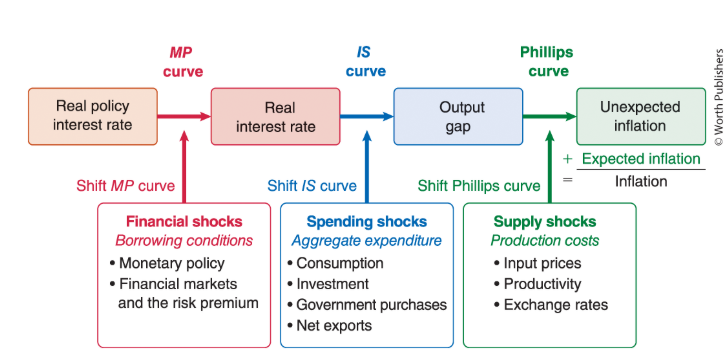
how to analyze macroeconomic shocks
identify the shock so you can shift a curve (supply, financial, spending)
find the output gap
assess inflation - trace the output gap from the IS-MP graph to the (potentially shifted) Phillips curve to find the inflationary implications of this output gap
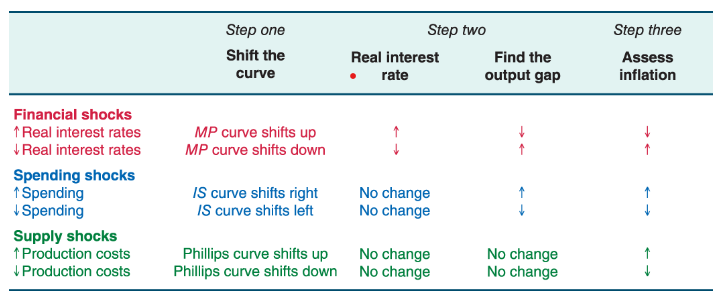
when does the MP curve shift? when does the IS curve shift?
in response to mnetary policy and Financial Market risks
monetary policy - when the Bank of Canada raises or lowers the risk-free real interest rate, the rate borrowers pay also changes, shifting the MP curve
Financial makret risks - any change that makes banks more reluctant to lend money ata given interest rate will raise the risk premium, raising the interest rate that borrowers pay, shifting the MP curve
in response to changes in aggregate expenditure by the (change in spending x multiplyer)
change in consumption - driven by changes in wealth, consumer confidence
changes in Planned investments - driven by business confidence, corporate taxes
C.I. Gov. spending - reflects gov. fiscal policy
c.i. Net exports - driven by economic growth among trading partners, exchange rates
what’s monetary policy? who sets it?
monetary policy - the process of setting interest rates in an effort to influence economic conditions
a countries central bank
what are the 5 steps of monetary policy?
Economic projections - Model made of Canadian GDP used to project the path for important economic outcomes
Major breifing - economists gather and talk about their collected data
Policy recommendations - economists re-gather to discuss policy recommendations
making the decision
communication - Bank announces its decision to the world
what is a banks inflation target? what does hittin the inflation target do?
inflation target - a publicly stated goal for the inflation rate (trying to make expectations and influence inflation rate)
promotes maximum sustainable employment
why dont banks aim for zero inflation?
inflation greses the wheels of the labour market
easier to cut nominal wages (if its 0, it will lead to unemployment
the bank can lower real intrest rates by more when inflation is above zero
zero lower bound - the constraint that nominal interest rates cannot be effectively set below zero
easier to set inflation to 0% than -2%
a 0% inflation rate target runs the risk of deflation
deflation - a generalized decrease in the overall level of prices
measured inflation may be overstated
some economists think that an inflation of 0% actually means an inflation of -1%
what are the four factors that shape the banks policy choices ?
the bank starts with the neutral real interest rate
neutral real interest rate - the interest rate that operates when the economy is in neutral - producing neither above nor below its potential
setting the real interest rate higher than the neutral real interest rate will push actual output below potential output and vice versa
the bank targets the nominal interest rate when trying to influence the real interest rate
overnight interest rate - the interest rate that the bank targets as its policy interst rate - the overnight rate is the nominal interest rate that banks pay to borrow from each other overnight
the bank compares inflation with its inflation target
if the inflation is higher than the banks inflation target, it signals to the bank that it should set real interest rates higher than the neutral real itnerest rate in order to encourage consumers and investors to spend less
the bank looks at the output gap
the bank responds to the output gap, if positive, they set the real interest rate above the neutral real interest rate in an attempt to reduce inflationary pressure
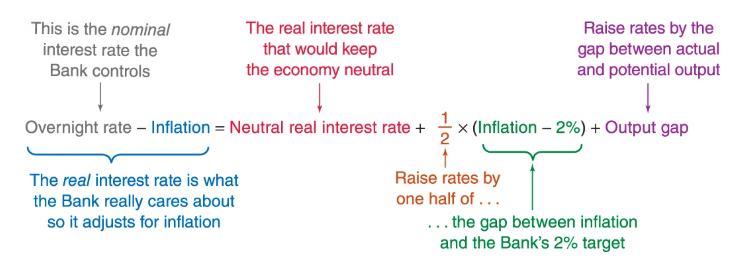
what is the policy rule of thumb (also known as the taylor rule)? are monetary policy choices systematic or automatic?
the recepie that describes how the bank sets the real interest rate:
overnight rate - inflation = neutral real interest rate + ½ x (inflation - 2%) + Output gap
systematic - the bank responds in a reliable fashion to the state of the economy - they arent simply an application of a single rule over time
what is the overnight market for interbank loans
when banks need to borrow from each other overnight - you give the banks money and they give it out, if they loan out too much money and dont have enough to transfer checks or for deposits, they need to borrow from other banks
reserves - the cash banks need to keep on hand to me payments
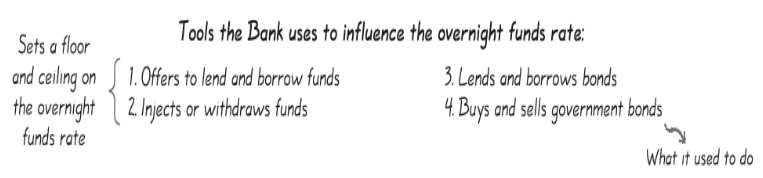
what are some tools the Bank uses to hit interest rate targets for the overnight rate
the bank offers to lend and borrow overnight funds
if financial institutions have excess funds anf they dont like the going interest rate in the overnight market, they can lend the excess to the Bank of Canada overnight by depositing it at a special deposit rate (the interest rate the bank pays on funds deposited overnight)
if the financial institutions are short on funds, they can take up the Bank of Canadas standing offer to borrow at a special borrowing rate called the bank rate (interest rate the bank charges on funds borrowed overnight)
operating band - the range for the overnight rate between the deposit rate and the bank rate
the bank injects or withdraws overnight funds
the primary tool for pushing overnight rates up or down inside the operating band is injecting or withdrawing funds
if the bank needs to nudge the overnight rate up a bit, then it puts a bit less of the federal government’s funds in the overnight market
The bank lends and borrows
overnight repurchase agreements - when the bank buys a government bond from a financial institution, with an agreement to sell it back the next day at a higher price (increasing the funds in the overnight market)
reverse repo - the bank sells a bond from its holdings with an agreement to buy it back the next day
the bank buys and sells government bonds
permanent sale
by selling bonds, the bank increases demand for overnight loans and decreases supply - the banks bonds sales push the overnight rate up
open market operations - the Bank of Canadas buying and selling of government bonds to influence the overnight rate
what are the demand and supply for funds?
demand - sometimes banks dont have enough ready cash to make payments on a given day
supply - other banks may have more cash on hand than they need
what is the impact of changing the policy interest rate on the rest of the economy?
once the bank has succeeded in moving the overnight rate, the effects ripple throughout the economy
a lower real interest rate leads to more consumption and investment, an exchange rate depreciates, and higher net exports - rise in aggregate expenditure = expanded production, which requires them to hire more workers, etc
a change in the overnight rate percolates through to other interest rates
interest rates change the value of consuming today versus consuming tomorrow - interest rates change how much the government pays to borrow, affecting how much the government has available to spend on other things
what are Monetary policy choices when nominal interest rates are zero ?
Forward guidance
providing information about the future course of monetary policy in order to influence market expectations of future interest rates
bank pushes down longer-term interest rates because the bank is promising that people can count on low interest rates for longer
crucial that people believe that the bank is committed to keeping rates low for a while
Quantitative easing
purchasing large quantities of longer-term government bonds and other securities in an effort to lower long-term interest rates
the increase in supply pushes down interest rates on other long-term loans, allowing businesses to borrow at lower rates
Lender of last resort
the banks role as their lender that financial institutions turn to when they’re having trouble getting loan
prevent bank runs and financial panics - someone who gives you a loan when no one else will through the special Emergency Lending Assistance program (high interest rate)
what is social insurance ? how much of government spending is it?
social insurance - Gov.-provided insutance against bad outcomes such as unemployment, illness, disability, or outliving your savings
almost half
what is included in the government sector? what do provinces provide? ← (gov. saving) → local government?
government spending
government saving
hidden gov. saving (tax expenditures)
regulation
education and healthcare
gov. services you see in your everyday life (garbage, transport, public safety)
what makes up federal gov. revenue?
income taxes - taxes collected on all income, regardless of its source - income = all the money that you receive in a year
income taxes are progressive = a tax where those with more income tend to pay a hogher share of their income in tax
payroll taxes - taxes on earned income - earned income = wages from an employer, or net earnings from self-employment
the tax rate you pay if you earn another dollar = marginal tax rate
taxable income = total income receives - deductions
what makes up provincial gov. revenue?
sales tax - a tax on purchases that’s typically a percentage of the purchase price of goods and services
excise tax - a tax on a specific product (based on quantity you buy, not the price you pay
they also receive transfer payments frm the federal gov.
what makes up local gov. revenue?
property tax - a tax on the value of property, usually real estate
a tax where those with less income tend to pay a higher share of their income on the tax
what makes up hidden government spending?
tax expenditures - special deductions, exemption, or credits that lower your tax obligations, to encourage you to engage in certain kinds of activities
they have a lower political cost & encourage spending on certain goods and services
encourage you to purchase employer-provided supplemental health insurance, save for retirement, etc
government regulation