polymers
 Call Kai
 Learn
Learn Practice Test
 Spaced Repetition
 Match
Match Flashcards
 Knowt Play
1/13

There's no tags or description
Looks like no tags are added yet.
Name | Mastery | Learn | Test | Matching | Spaced | Call with Kai |
|---|
No analytics yet
Send a link to your students to track their progress
14 Terms
How to make a polyester/ condensation polymers
2 monomers - diol and dicarbxylic acid releasing water or diacylchloride and diol
what is condensation polymers?
2 products - a polymer and small molecule
Terylene
How is it made? Draw the repeating unit. Uses
pg 2
from the monomers Ethan 1-2diol and benzene 1,4 dicarboxylic acid
carpets clothing plastic bottles
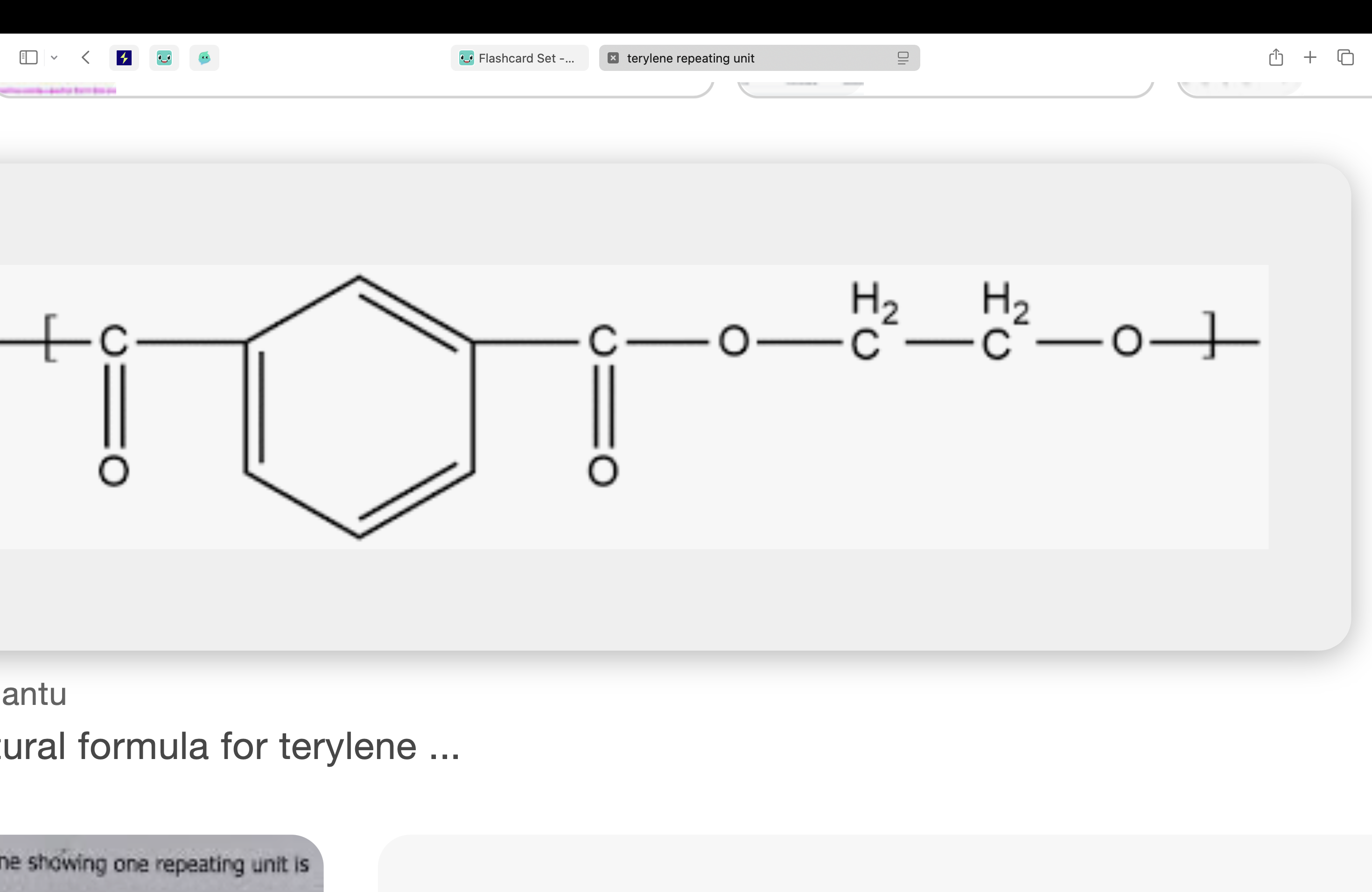
forces present between polyester polymer chains
permanent dipole dipole
making polyamides
diamine and dicarboxylic acid
Nylon 6,6
how it is made, repeating unit, Uses
1,6diaminohexane and hexane1,4dioic acid
clothing carpets rope parachutes
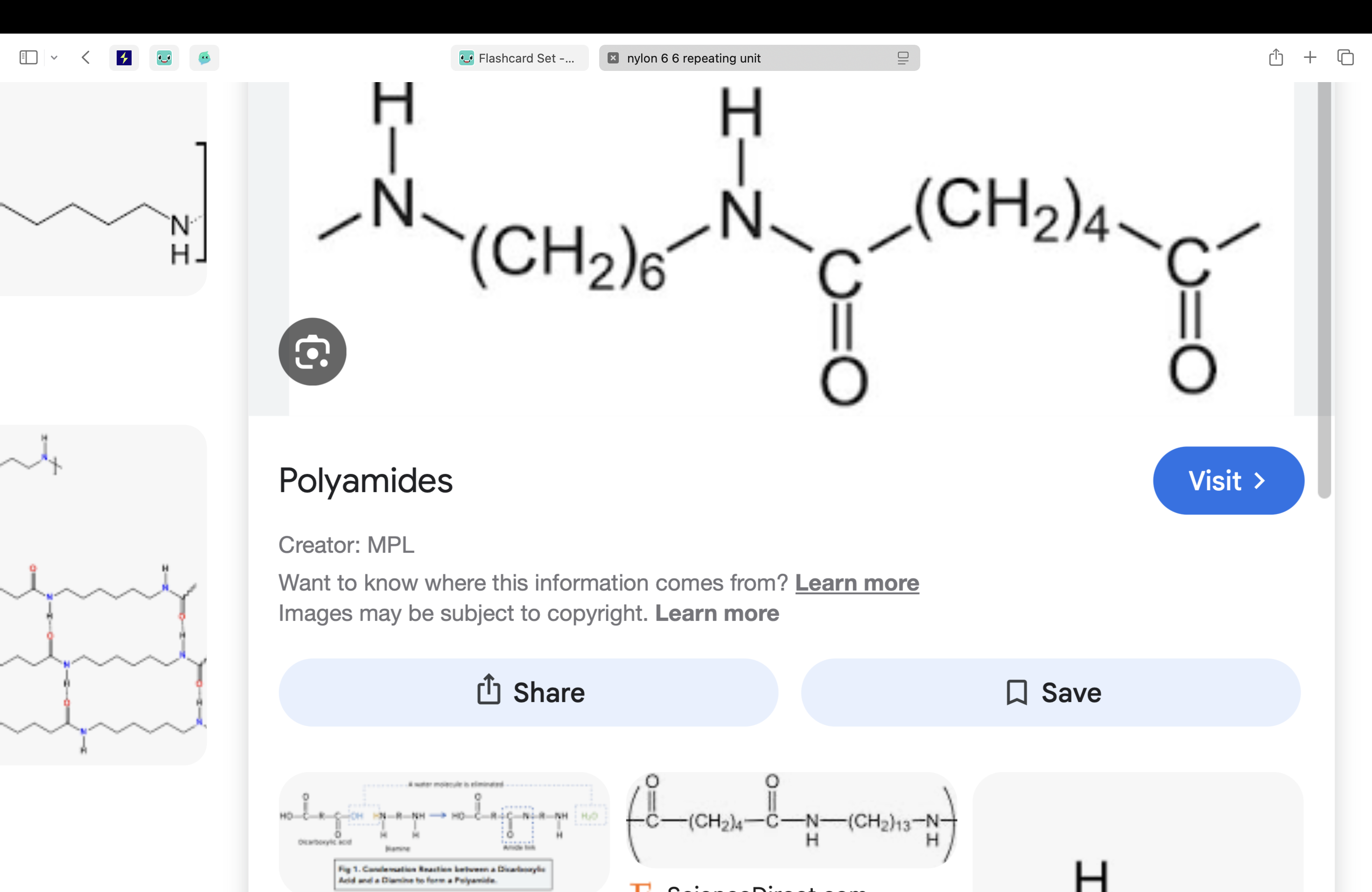
Why does nylon have a higher melting point than terylene
Hydrogen bonds between molecules of nylon are stronger than permanent dipole dipole forces between terylene
Kevlar
how it is made, repeating unit, Uses
benzene14dicarbosylic acid and benzene14diamine
bulletproof vests crash helmets and fire resistant material
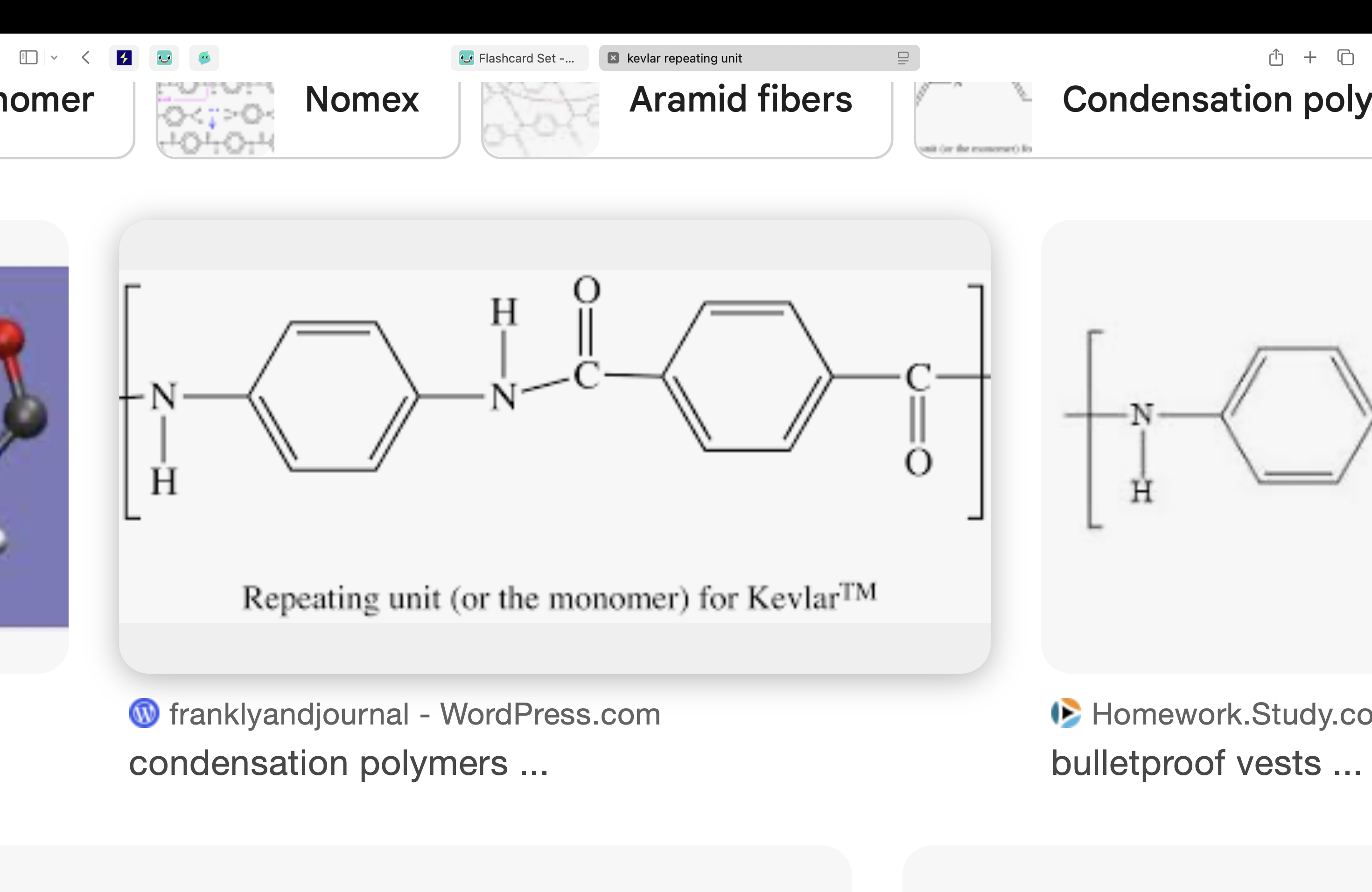
Why are the melting points of polyamides higher than the melting point of polyesters
hydrogen bonds between polyamide polymers are stronger than permanent dipole dipole forces between polyester chains
Addition polymers
Use, 4 characteristics, forces
induced dipole dipole forces between polymer chains and strong C-C bonds within the polymer chains
makes the bonds not very susceptible to attack from nucleophiles
unreactive and biodegradable
used as insulators
high melting and boiling point
Polyester- COOH/OH
Polyamide - COOH/NH2
hydrolysis of polyesters - base and acid
Base:
NaOH reflux
diol and dicarboxylic acid with COO- and Na+ + 2 water
(botton pg14)
Acid:
HCl reflux
diol and dicarboxylic acid
hydrolysis of polyamides - base and acid
Base:
diamine and diCOO- Na+ and two waters
Acid:
dicarboxylic acid
di+NH3 Cl-
bottom pg 15
what non biodegradable is?
non polar C-C bonds
cannot be attacked by nucleophiles/acids/cannot be hydrolysed.