Motor Control and Learning - Test 3
 Call Kai
 Learn
Learn Practice Test
 Spaced Repetition
 Match
Match Flashcards
 Knowt Play
1/100

There's no tags or description
Looks like no tags are added yet.
Name | Mastery | Learn | Test | Matching | Spaced | Call with Kai |
|---|
No analytics yet
Send a link to your students to track their progress
101 Terms
what changes (adapts) in a person to produce increased strength when they weight train?
mainly neural changes with some hypertrophy
- the increase in strength that occurs in long term strength program does not parallel increases in muscle mass
untrained limb
an increase in strength occurs in the untrained limb in a unilateral strength training program
commonly observed neural adaptations to resistance training
1. increased maximum EMG level seen due to increased motor unit firing frequency, produces higher maximum force from muscle
2. reduction in the antagonist coactivation allows prime mover torque to not be counteracted by antagonists
3. multijoint/multimuscle coordination for posture and stabilization
4. increased rate of rise of EMG at the start of force development
increased maximum EMG level seen due to increased motor unit firing frequency
after resistance training, the motor units can fire more frequently, allowing for greater force to be produced in a MVC
- increase in maximal effort motor unit firing frequency has been found to be much higher in elderly and moderately higher in young adults
85% MVC before resistance training
100% recruitment but low firing rate in the largest motor units
maximum force effort before resistance training
low firing rate in largest motor units
maximum force effort after resistance training
higher firing frequency in largest motor units, allows for higher level of force to be produced
discharge rate and amplitudes of MUAPs in athletes vs. non-athletes
discharge rates and amplitudes of MUAPs from athletes were significantly higher than those from nonathletes
reduction in the antagonist coactivation
allows the prime mover torque to not be counteracted by antagonists
- coactivation of agonist and antagonist will work against each other and reduce the net torque (force) output from an agonist prime mover
multijoint/multimuscle coordination for posture and stabilization
hip, knee, ankle, trunk, contralateral leg, & arm muscle activation coordination for leg extension during kick prime movers, & all around there joints for stabilization
increased rate of rise of EMG at start of force development
- increased doublets in motor unit firing at start of contraction
- lower recruitment threshold for motor units as they are recruited earlier as force in increasing
- produces increased maximum rate of force development
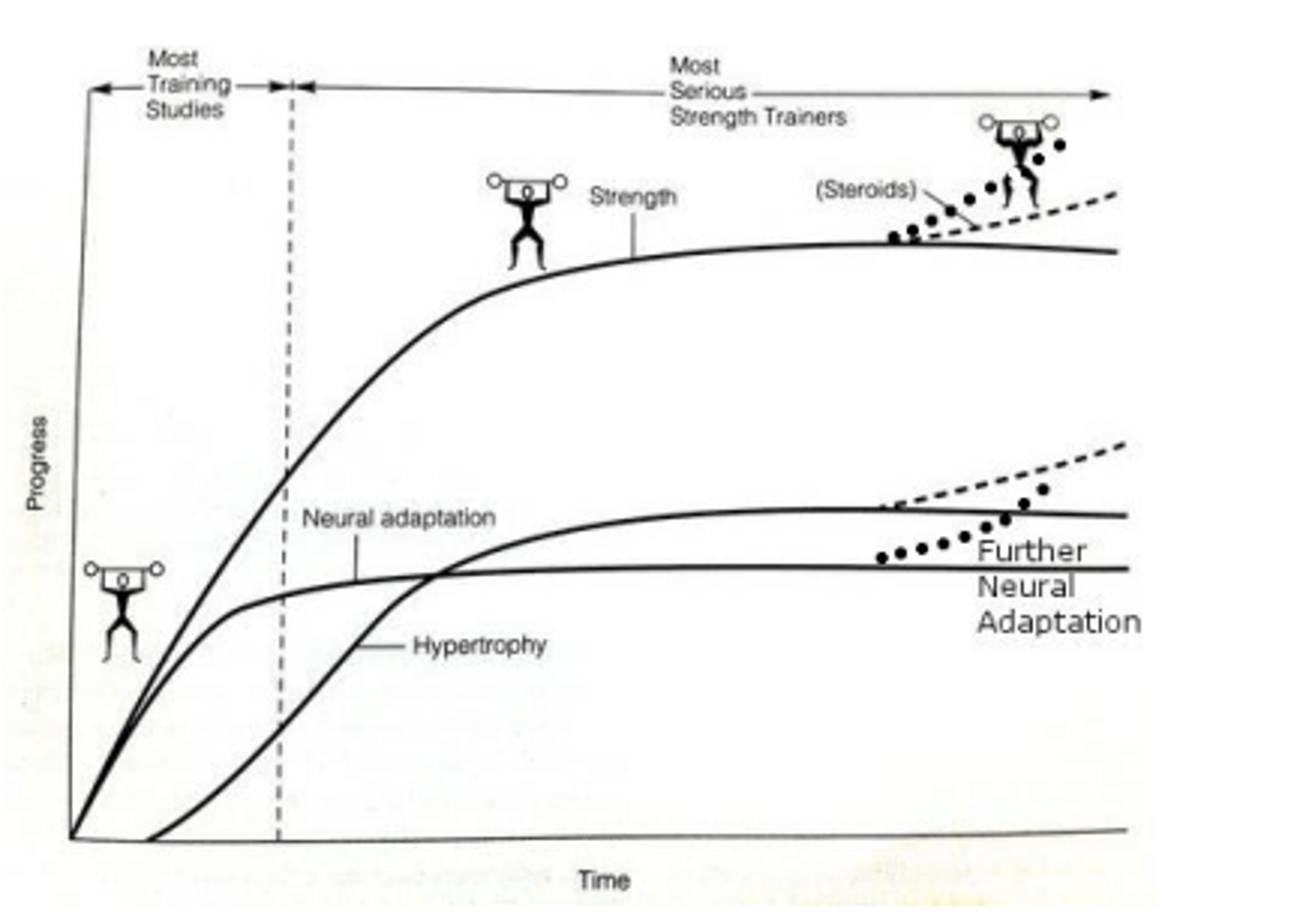
strength adaptations in young men
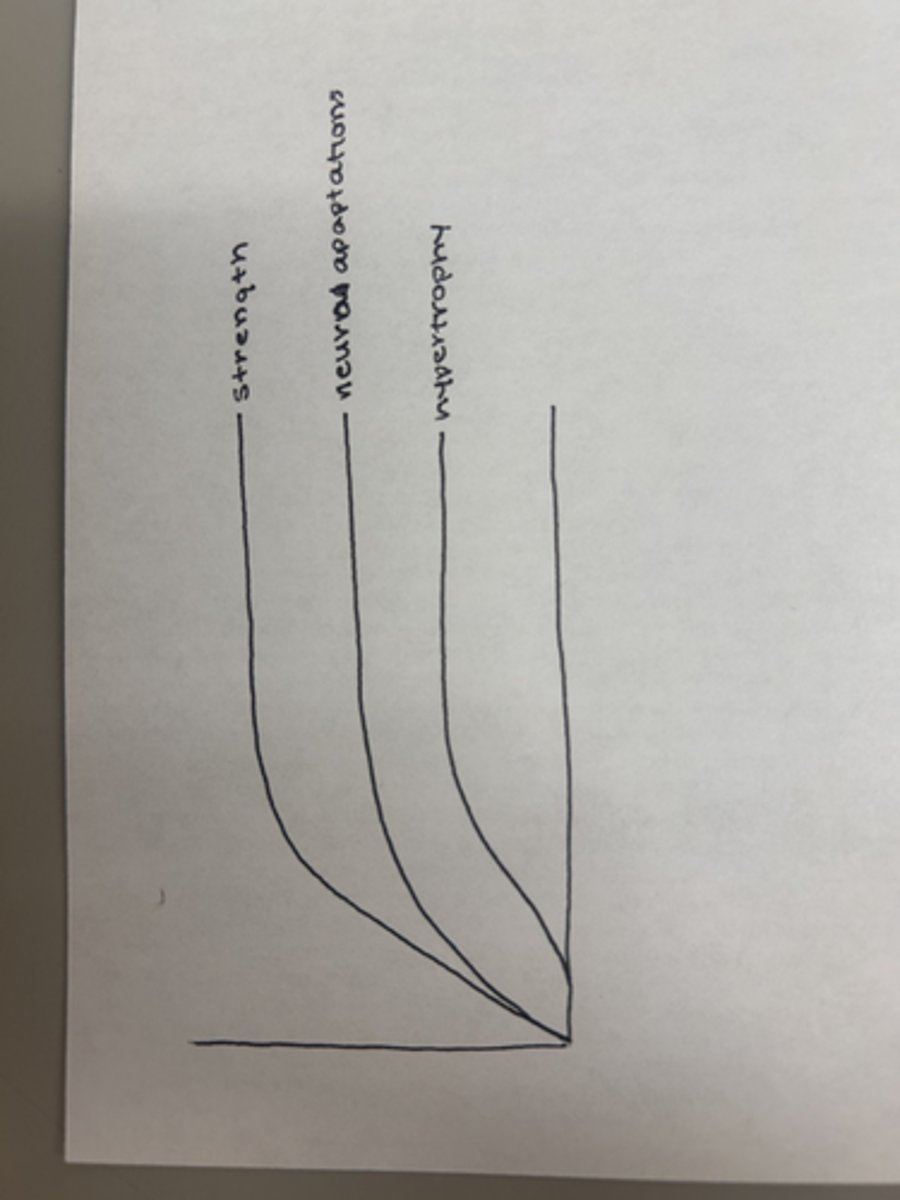
strength adaptations in young women
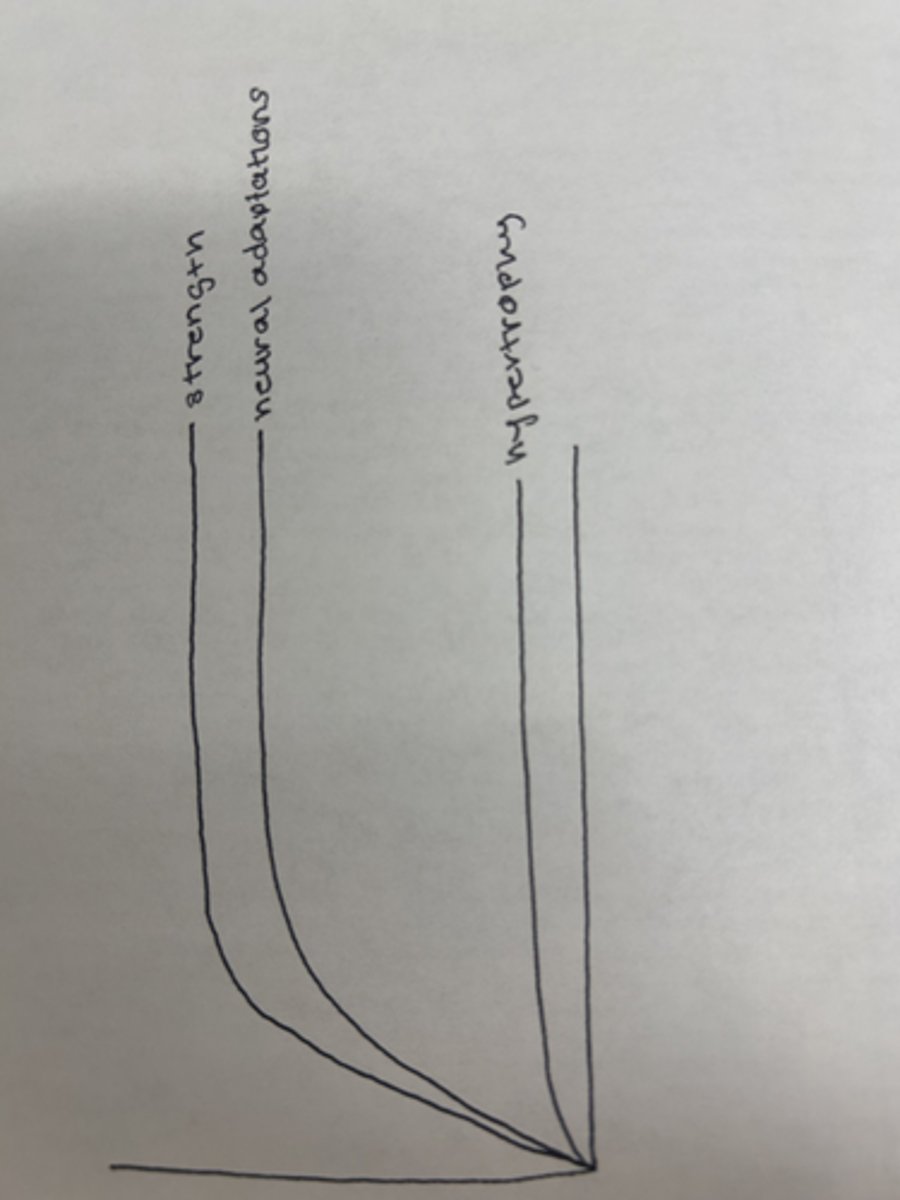
strength adaptations in older men and women
for people who trained with a free squat, why is there less of an increase in knee extensor force?
because it is a different movement pattern, the neural adaptations do not apply
how can we increase progress after maxing out natural hypertrophy?
- steroids
- neural adaptations
neural adaptations in elite weightlifters
in the last four month period, with only a slightly higher average training intensity, there was a significant increase in maximum EMG
bilateral transfer
coordination of the central nervous system, allows the contralateral limb to gain strength in unilateral training
correlation between isolated single muscle groups and functional performance
very low
- the coordination pattern and neural adaptations gained from strength training isolated single muscle groups (machines) are not applicable to the functional movements.
5 ways we can increase strength
- hypertrophy
- higher frequency of AP
- reduction of antagonist co-activation
- multijoint/multiuse coordination
- increased rate of EMG force production at start of the movement
can hypertrophy be developed with machines?
yes
can higher frequency of AP be developed with machines?
yes
can reduction in antagonist co-activation be developed with machines?
no (abnormally developed)
can multijoint/multiuse coordination be developed with machines?
no
can increased rate of EMG force production at the start of the movement be developed with machines?
no
why do people resistance train?
changes in performance in the gym transfers to changes in performance in desired task
- performance/daily living
similar movement pattern
choosing an exercise with a similar movement pattern is necessary for success
- don't over-emphasize this prinicple (functional training)
strength vs. speeds
an increased in strength does not transfer to all speeds at which the trained muscle moves
slow training
large increase in power at slow speeds
- much smaller improvement at intermediate and fast
fast training
large increase in power at fast speeds
- much smaller at intermediate speeds
- almost no improvement at slow speeds
intermediate speed training
intermediate increases in power at fast, slow, and intermediate speeds
explosive training
plateaus faster because their muscles activate faster
- increase in rate of EMG force production at start of the movement
- faster acceleration
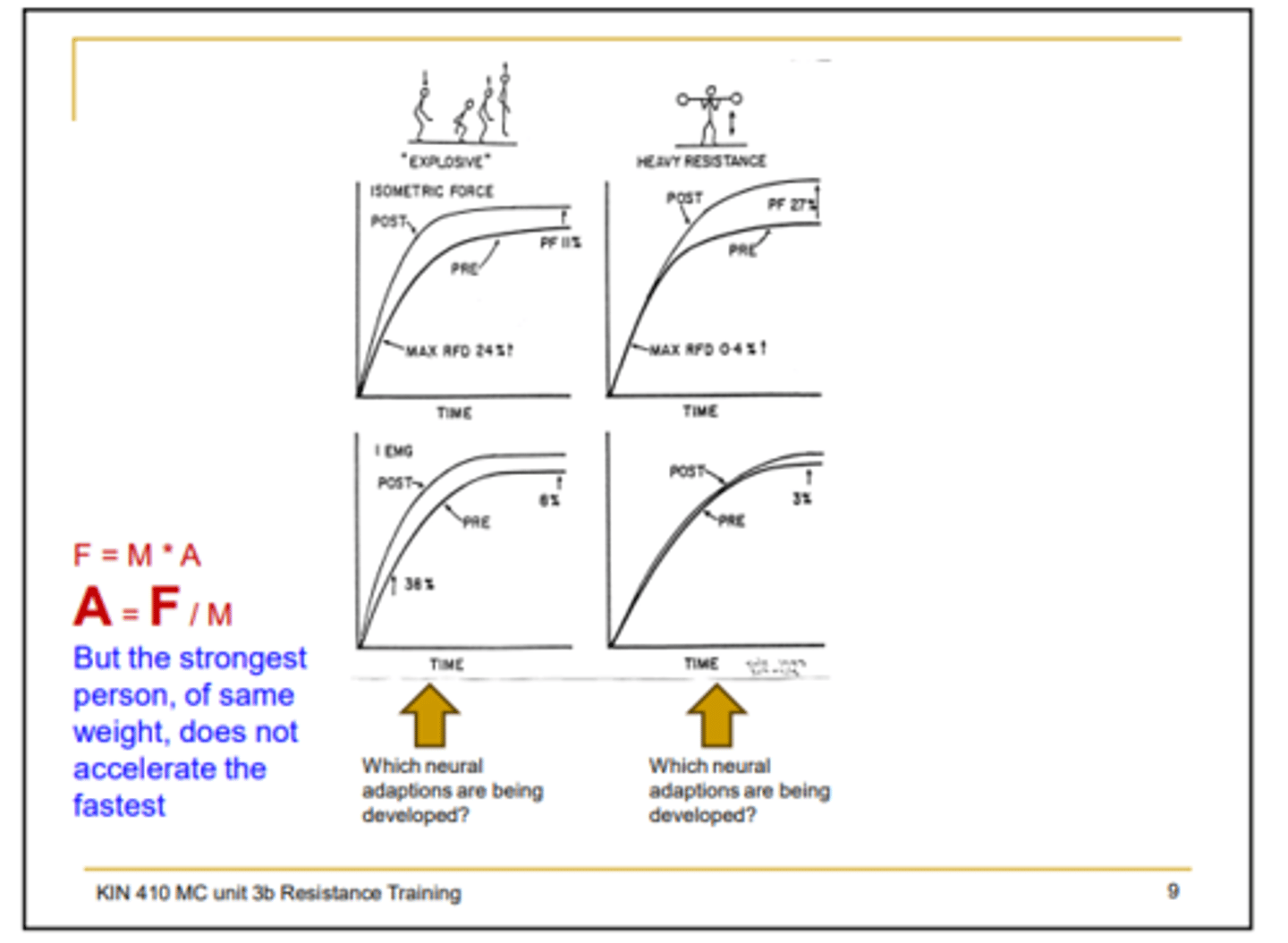
training at a fast speed
develops the ability to rapidly produce force and maximize strength gains at fast speeds
slow and fast weight training in kayaking
slow weight training is likely to be more effective than explosive training for improving the acceleration phase of sprinting, when force is high throughout the length of the stroke. Explosive weight training may be more effective in speed maintenance, when forces are developed rapidly over a short period at the start of the stroke.
at what speed should we train
train at slow, intermediate, and fast speeds
- but velocity specificity of training may apply mainly to people who are trained, and not for untrained people
power
necessary in sports and in daily living
power in aging
aging leads to declines in maximal strength but even greater declines in power
power training in older adults
power training was more effective than strength training for improving physical function in community-dwelling older adults
peak power
~30% 1RM
power training and loads
power can and should be trained across a continuum. This continuum ranges from lighter loads moving at high velocities to heavier loads moving at slower velocities
why is it difficult to train power with light weight?
multijoint power exercises are difficult to execute properly with typical resistance training equipment because the athlete can not sufficiently overload the muscles and still control the bar's deacceleration at the end of the exercise ROM
turning on the brakes
the antagonist comes on at the end of the movement to slow the movement
- the faster the velocity, the increased duration of the deceleration phase
so how can we train power?
"ballistic" resistance training
ballistic resistance training
athlete throws or jumps with the weight
- being able to release the mass at the end of the range of motion is vital to promoting power and acceleration
easy to implement ballistic training
- medicine balls, plyometrics
- weighted squats/pushups (leave the ground)
- chains
chains/elastics
increases the load as you go through the range of motion so have to apply more force
- chains turn on the brakes
- you can push prime movers right to end range of motion
olympic lifts
allow high velocity w/o slamming into end range of motion
life fitness machine
bilateral defecit
In untrained individuals, the force produced when both limbs contract together is lower than the sum of the forces they produce when contracting unilaterally.
why is there a bilateral deficit?
we are designed to inhibit one limb when pushing hard with the other limb
- they inhibit each other
why do we unilaterally train?
we work not just the prime movers, but also the stabilizers and neutralizers
- bilateral training neglects the stabilizers
unstable surface training (UST)
effectively ignores the principle of specificity of training. most sports occur on stable surfaces with instability applied further up the kinetic chain
unstable training and antagonist activation
unstable training increases activation of antagonist musculature to increase joint stability
what neural adaptation does UST inhibit?
reduction in antagonist activation
as instability increases ....
Net force decreases
stabilizer activation increases
as stability increases ....
net force increases
stabilizer activation decreases
very stable leg extension
leg extension machine
very unstable leg extension
unilateral squat
unilateral lower-extremity exercises
by nature, are unstable training because of the smaller base of support
positioning of weight
positioning the weight higher up at the shoulder increases the amount of instability
- uneven loading also increases the instability because it moves the COM to the edge of the BOS
why is it important to include stable and unstable exercsies?
- stable exercises allows you to live the highest loads and therefore gain the most muscle mass and strength (allows higher velocities in lower body as well)
-
what is too stable?
machine exercises
what is too unstable?
unstavle surfaces
coordination of joints for movement
coordination of fingers to toes is necessary for daily movements
how should most of your exercises be done?
standing up
~ 90%
what planes should we perform exercise in?
all planes
who should be doing bench presses?
powerlifters, football players, hockey players
what would be better instead of bench press? why?
cable push, TRX pushup, unilateral row/press with strap
- it is more relatable to the real world scenarios; allows you to develop stability correlated with the real world
women and machines
machines are designed for men so it will be hard to get the right fit
- predisposition to injury
machine safety and body position
creates an artificial environment that does not effectively transfer to unsupported movements
isolated joint exercises
not as effective as larger body movements
- push, pull, squat are better and target larger and more functional muscle groups.
when are single joint exercises good?
for movements near the spine
- people often forget about joints near the spine
- helps activate muscles and helps them move around those joints
what does good training look like?
- similarity of movement pattern
- varying speeds and loads
- power training
- stable surfaces
- stable and unstable exercises
- bilateral and unilateral
- multijoint (hand to foot)
- 90% standing up
Steps of performing a movement
1. strategies for the uncoming movement must be devised
2. tactics for the upcoming movement must be decided upon
3. execution of the movement
function of the high level brain
goal and strategy of movement (what to do)
structure of the high level brain
pre-frontal and posterior parietal cortex
function of the middle level brain
tactics of movement sequence of muscle contraction to produce movement (how to do it)
structure of middle level brain
motor cortex and cerebellum
function of low level brain
execution of movement activation of specific muscles (do it)
structure of low level brain
spinal cord and brain stem
primary motor cortex
the section of the frontal lobe responsible for voluntary movement
primary somatosensory cortex
the region of the anterior parietal lobe whose primary input is from the somatosensory system
frontal lobe
A region of the cerebral cortex that has specialized areas for movement, abstract thinking, planning, memory, and judgement
parietal lobe
cerebellum
spinal cord
supplemental motor area
premotor cortex
prefrontal cortex
high level thoughts about abstract ideas, and cause and effect
step 1 in performing a movement
posterior parietal cortex and prefrontal cortex
- prefrontal: comes up with an idea and communicates with posterior parietal cortex
where is the HIGHEST level of decision making?
the prefrontal cortex and posterior parietal cortex
step 2 in performing a movement
the decision is sent to the SMA and premotor cortex
- they start planning how to do the movement decided
- activates neurons associated with movement
- activated neurons HOLD the instruction
start of step 3 in performing a movement
basal ganglia sends "go" signal and the movement tactics are released from the SMA and pre-motor cortex to activate neurons in primary motor cortex
continuation of step 3 in performing a movement
the primary motor cortex activates spinal cord motor neuron pools, to activate muscles
- activation of interneurons in the spinal cord
pre-frontal lobotomy
cuts the connections between the pre-frontal cortex and the rest of the brain
- can't strategize or come up with ideas
role of primary motor cortex cells
role can change
- if a stroke kills the primary motor cortex cells which control the hand muscles, the other neighboring cells can slowly take over control of the hand
- practice can enlarge area of primary motor cortex of part practiced
the cerebellum
critical for determining the detailed sequence of muscle contraction before and during the movement
cerebellum and planning
receives movement idea from posterior parietal and prefrontal cortex, as well as tactics from primary motor cortex
- sends contribution of muscle coordination to primary motor cortex
cerebellum and help during the movement
compares desired planed movement to actual sensory feedback
- if desired and actual movement don't match, then correction is made
cerebellum and motor learning
cerebellum is an important site where motor learning occurs